
When requesting waste bin liners Hong Kong, include the measured width, length or circumference, depth, bin capacity and how the liner is retained. Ask the supplier to confirm fit, material and thickness or gauge where applicable, pack count and any use limitations before ordering.
Measure the bin before requesting waste bin liners Hong Kong
Start by measuring the bin itself, not a catalogue litre figure. Remove any lid or retainer ring and record the internal opening across the narrowest point. For rectangular or slim profiles, note both internal width and length; for round bins, record the internal diameter; for oval rims, capture the major and minor axes. Measure the usable internal depth from the base to the point where the liner will be held (under a rim, clamp ring or lid). Photograph the rim shape and any retention features. When comparing waste bin liners Hong Kong, buyers should keep these measurements together with the bin brand and model if known.
Use the circumference where that is easier to obtain: wrap a tape around the outside at the top rim and deduct a small allowance for wall thickness. As an example only, some buyers start by sizing bag width at half the bin circumference, and bag length at the internal depth plus an allowance for overhang and tying; confirm the chosen formula in writing with the supplier. Record how much overhang is acceptable given clearance under lids and within cabinetry. Highlight constraints such as a swing lid aperture, foot pedal mechanism, or the narrow openings common on slim waste bins that Hong Kong offices use, as these details influence liner drape, tear points and how the bag is secured during service.
State pack quantities and change frequency for waste bin liners Hong Kong
State how you intend to consume and store liners so quotes are directly comparable. Specify the preferred packing unit (for example, coreless rolls in cartons) and the per-roll and per-carton counts. If the cleaning plan changes liners on each service, provide an example calculation of daily usage per area and the number of active bins; ensure the supplier confirms the calculation in the written quotation. Identify whether attendants will pull from wall-mounted dispensers or issue full cartons to floors, as this affects roll size and core type.
Describe peak periods when changes rise (such as lunch in catering, events or weekend trading). Note housekeeping schedules, building operating hours and any restrictions on deliveries, including loading-bay booking and goods-lift dimensions. Humid stores can make cardboard cartons soften; ask for moisture-resistant packaging if needed. Where sites require bilingual information, request English/Chinese product labels and data sheets. If lids are being replaced concurrently, mention any separate request for waste bin replacement lids Hong Kong so the retainer method is coordinated. Provide storage constraints (maximum carton height for shelves, no-pallet rules) and ask suppliers to declare carton weight and barcodes for inventory control.
What should buyers compare for waste bin liners Hong Kong?
| Criterion | Straightforward requirement | More complex requirement | Evidence to provide |
|---|---|---|---|
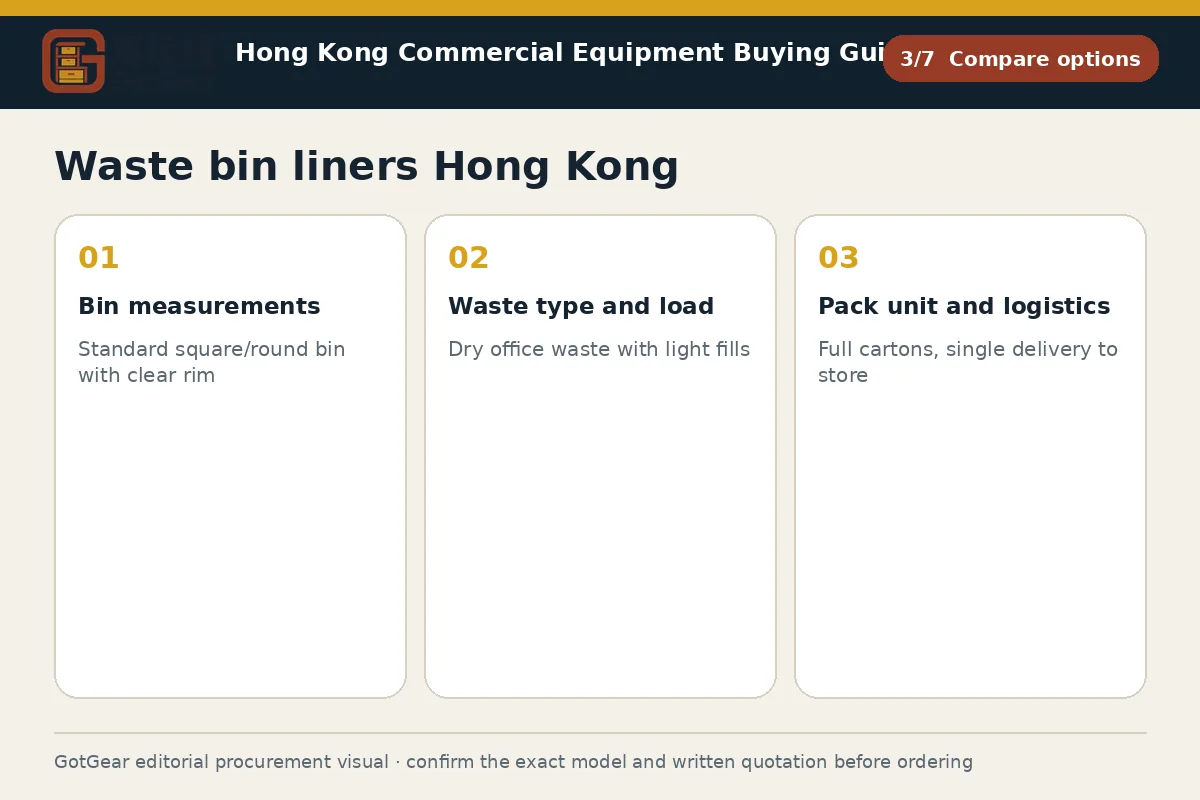
| Bin measurements | Standard square/round bin with clear rim | Irregular/oval bin, tight cabinetry or retainer ring | Internal width/length/diameter, depth, rim photos, clearance notes |
| Waste type and load | Dry office waste with light fills | Wet food waste, bathroom waste or sharp-edged packaging | Waste description, expected liquids, example max fill weight to be confirmed |
| Pack unit and logistics | Full cartons, single delivery to store | Split-floor drops, booked loading windows, small goods-lift | Per-roll/carton counts, delivery plan, lift and doorway sizes |
| Material and thickness | HDPE/LDPE at standard strength | Heavier gauge, star-seal, recycled content requirement | Stated micron/gauge with basis, seal type, recycled-content declaration |
| Documentation and fit | Supplier spec sheet only | Samples, site trial, bilingual labels and statements if applicable | Sample approval record, photos of fit, any food-area or use-limitation note |
This framework helps buyers create comparable written enquiries. Final model specifications, availability, delivery and commercial terms must be confirmed in a formal quotation.
Define waste type and gauge needs for waste bin liners Hong Kong
Link the liner to the waste stream and expected load. Describe the contents (dry paper, mixed office waste, food scraps, bathroom waste, back-of-house catering prep, or sharp-edged packaging) and whether liquids are likely. State whether the bag must be transparent for inspection or colour-coded to match your recycling station Hong Kong, such as the site policy. Identify the closure method (tie-tape, drawstring, or twist) and the base seal preference (star-seal for better leak resistance, or flat-seal for stacking). Humid conditions and warm kitchens increase condensation and odour risk, so leak resistance matters for wet loads.
Define material and strength in a way suppliers can match. Quote the plastic family (HDPE for stiffness and puncture resistance; LDPE for stretch), then request thickness in micron or gauge and the test basis where offered. Example starting points only: a light office stream might suit a thinner HDPE, while food-service back-of-house may require thicker LDPE with a star-seal; confirm values against the proposed model specification and written quotation. If bags contact food zones, ask for a manufacturer statement of suitability as required by your venue or insurer. If recycled content is important, request a recycled-content declaration and any supporting evidence without assuming a universal standard.
Ask suppliers to confirm fit for waste bin liners Hong Kong
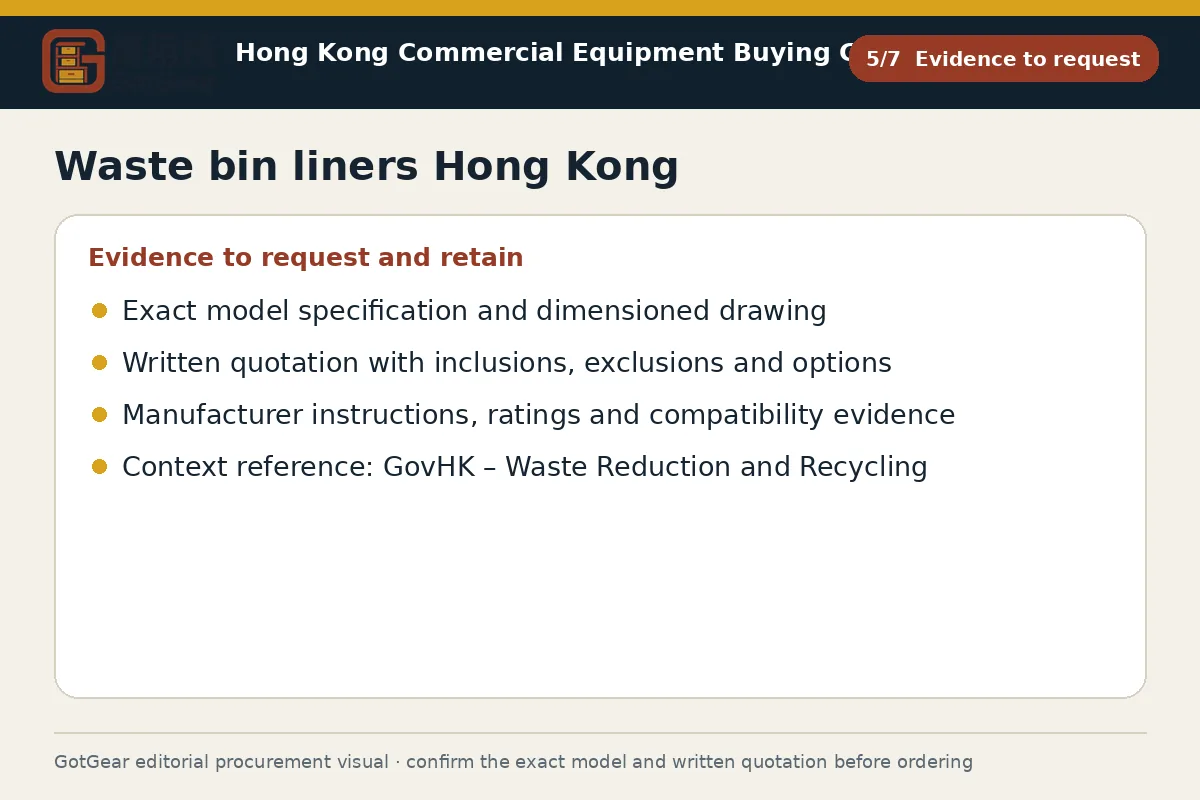
Ask suppliers to confirm, in writing, that their proposed liner will fit the named bin model or your measured opening and depth, and indicate how it will be retained under any ring or lid. Where feasible, request samples for a short on-site trial: the acceptance check is that a typical full bag lifts cleanly without tearing, drapes sufficiently to conceal contents if required, and allows lids or foot pedals to operate normally. Record which bins passed and include photos of the fit to speed internal approval.
Compare quotations line-by-line: liner dimensions, material and thickness/gauge with basis, seal type, colour/opacity, pack unit and carton count, carton weight and size, and any limitations (e.g., not for wet loads). Ask for confirmation of delivery conditions (split shipments, loading-window booking, driver ID requirements in management offices, industrial-building access). On receipt, verify carton labelling (bilingual if required), batch/lot traceability, and that rolls match the quoted counts. For claims such as recycled content or food-area suitability, request manufacturer documentation. If a substitution is proposed, insist on new samples and a revised written quotation before approval. Sites using bulk waste containers Hong Kong back-of-house should also note any separate liner or sack requirement.
Waste bin liners Hong Kong decision checklist
Compile a written brief with measured internal opening, depth, rim or retainer details and photos. State each waste stream, expected load and any liquid content, plus the required opacity or colour. Specify material family, thickness or gauge with test basis, base seal, closure and desired overhang. Set out pack units, per-roll and per-carton counts, daily change assumptions, storage constraints and any bilingual labelling needs. Provide delivery windows, lift dimensions and access notes. Compare quotes on the same fields and request samples for fit checks. Before approval, obtain any manufacturer statements for food-area suitability or recycled content. On receipt, verify labelling, lot codes and roll counts against the model specification and the formal written quotation, which shall prevail.
- Operating use, quantity and expected frequency
- Dimensions, capacity, material and accessory requirements
- Delivery address, floor, goods lift and loading window
- Required documents, acceptance checks and after-sales arrangements
Key points for waste bin liners Hong Kong
In Hong Kong, building management often requires advance booking for loading bays and goods-lift use, and drivers may need registration at the management office. Note these constraints in your enquiry so deliveries align with permitted windows and lift sizes. Humidity, warm kitchens and long carry routes can stress liners and raise leakage risk, so specify seal type and strength relative to your waste stream. Where bilingual handling is needed, request English/Chinese labels and documents. This guidance helps operational planning but is not legal advice; always follow your venue, insurer and building rules.
Questions about waste bin liners Hong Kong
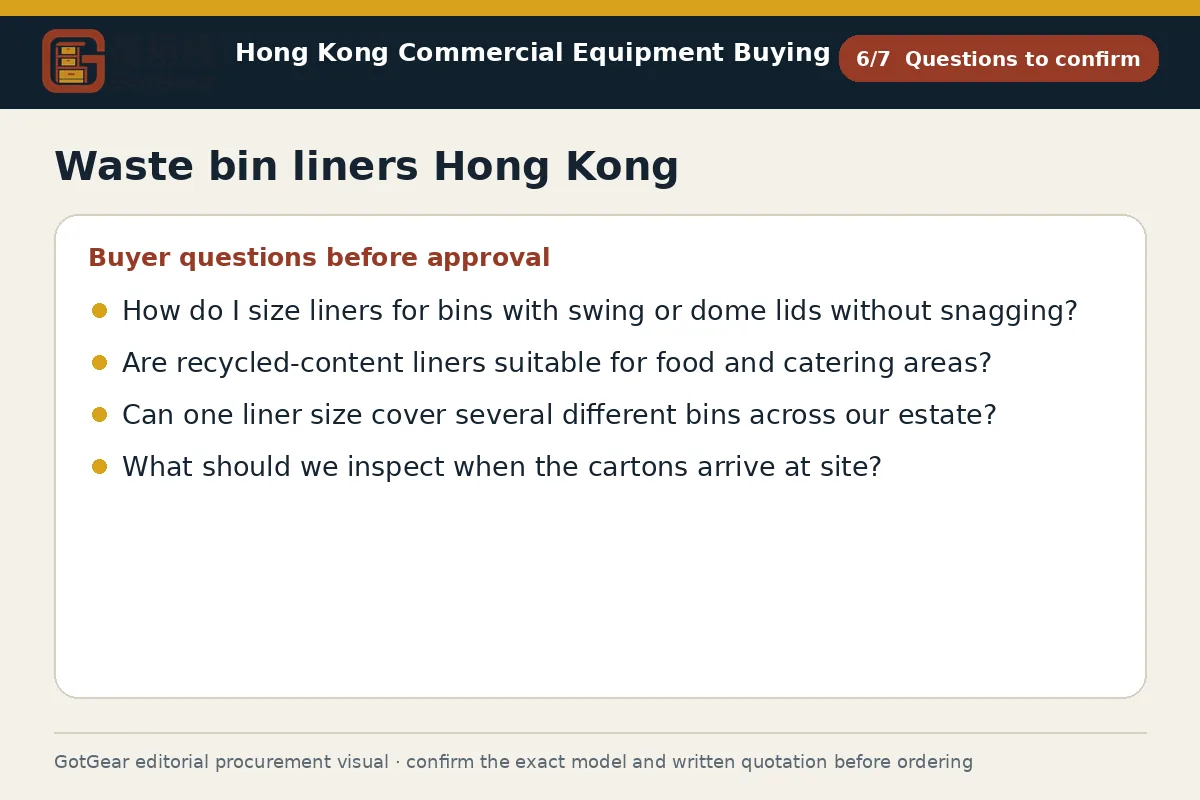
How do I size liners for bins with swing or dome lids without snagging?
Measure the internal opening, depth to the retention point, and the lid clearance when closed. Request a liner long enough to drape over the rim yet thin enough at the neck to avoid bunching under the lid. Ask suppliers for a sample to trial with the actual lid and confirm pass/fail in writing, as lid tolerances vary by model and venue.
Are recycled-content liners suitable for food and catering areas?
They can be, provided the manufacturer confirms suitability for the intended use and the site’s hygiene rules. Request a written statement of use limitations and any relevant product data. Some venues or insurers may set additional conditions for food-prep zones, so align selections with your internal policy and obtain approval before switching specifications.
Can one liner size cover several different bins across our estate?
Sometimes, if the bins share similar internal openings and depths, and retention methods are consistent. Ask suppliers to map your measured dimensions to a shortlist of liners and provide samples for the most challenging bins first. Consolidation reduces SKUs, but only approve a common size after site trials confirm fit and performance at your heaviest expected loads.
What should we inspect when the cartons arrive at site?
Check outer cartons for damage and moisture, then confirm carton labels match the quoted product code, colour, thickness or gauge, seal type and pack count. Open a carton to verify roll counts and liner measurements against the quotation. Record batch or lot numbers for traceability. If anything differs, quarantine the affected cartons and seek a written resolution before use.
Continue with closely related procurement topics
These pages share equipment, operating or decision-stage signals with this guide.
Bin dollies Hong Kong
Use this checklist to assess bin dollies Hong Kong for bin-base fit, expected load, wheel behaviour, threshold clearance and turning space. It also helps plan routes and restraint methods and includes information from GotGear.
Read the guide
Waste bin replacement lids Hong Kong
For waste bin replacement lids Hong Kong, photograph the bin, record its make and model, measure the rim and fixings, and check the hinge, opening and colour coding to confirm the fit. Guidance is from GotGear.
Read the guide
Waste stream labels Hong Kong
When specifying waste stream labels Hong Kong, confirm accepted materials, wording, colours, visibility and bin location. Pair recycling bin stickers Hong Kong with larger recycling bin signage Hong Kong for guidance from GotGear.
Read the guide
Recycling bin enclosures Hong Kong
Use this site checklist to assess recycling bin enclosures Hong Kong and bulk waste containers Hong Kong. With GotGear, record measurements for gates, turning space, clearances, capacity and drainage to verify fit and access.
Read the guideRelated topic indexOpen more English procurement pages2 topics
Browse additional equipment families, applications and procurement questions relevant to a wider buying brief.