
To assess bin dollies Hong Kong, first confirm the dolly’s stated compatibility with the existing bin and expected load. Walk the full route and verify wheel behaviour, restraint method and operating instructions against actual site conditions.
Match bin dollies Hong Kong to the existing container base
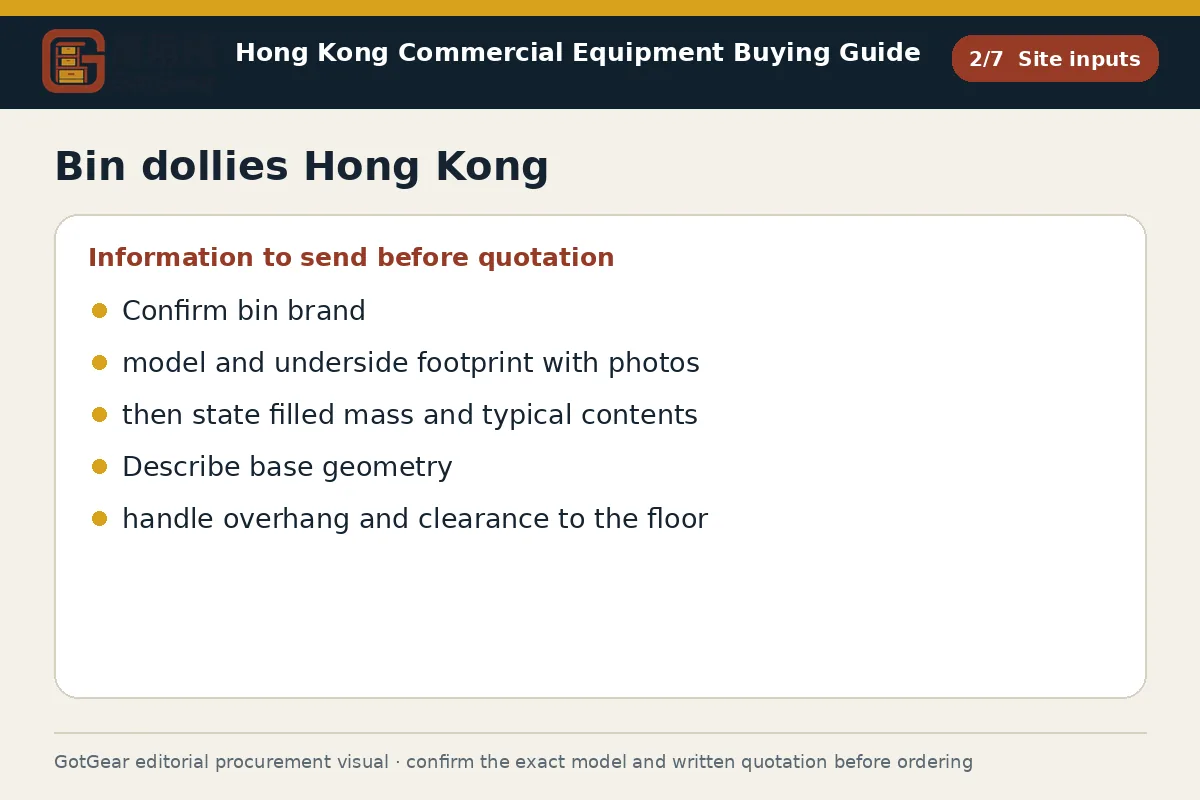
Start by identifying the exact bin make and model from the moulded mark or label, then capture the underside footprint in a sketch with dimensions and rib layout. Note corner radii, any central boss, and whether the base is round, square or tapered. Photograph the underside and the handle area so the supplier can confirm how the bin will sit on a platform, ring or star-frame. This is the point to reference bin dollies Hong Kong in your enquiry so the responder understands local access constraints and expects bilingual documentation.
Measure outer width/diameter and depth of the base; record the distance from floor to any lower ribs to confirm clearance above the dolly deck. State the filled mass you intend to move, plus typical contents (dry recyclables, wet organics, kitchen waste). Ask for the dolly’s attachment method (twist-lock, strap, clamp, ring), compatibility list by bin brand/size, deck material, and fastener material. In humid plant rooms, specify stainless-steel or corrosion-resistant fixings. If you operate back of house recycling bins Hong Kong, keep the bin family consistent to simplify future replacements. Where lids are heavy or self-closing, note their swing and overhang, and whether waste bin replacement lids Hong Kong are planned, as lid weight and geometry can affect stability on a raised base.
Check wheel control and parking positions for bin dollies Hong Kong
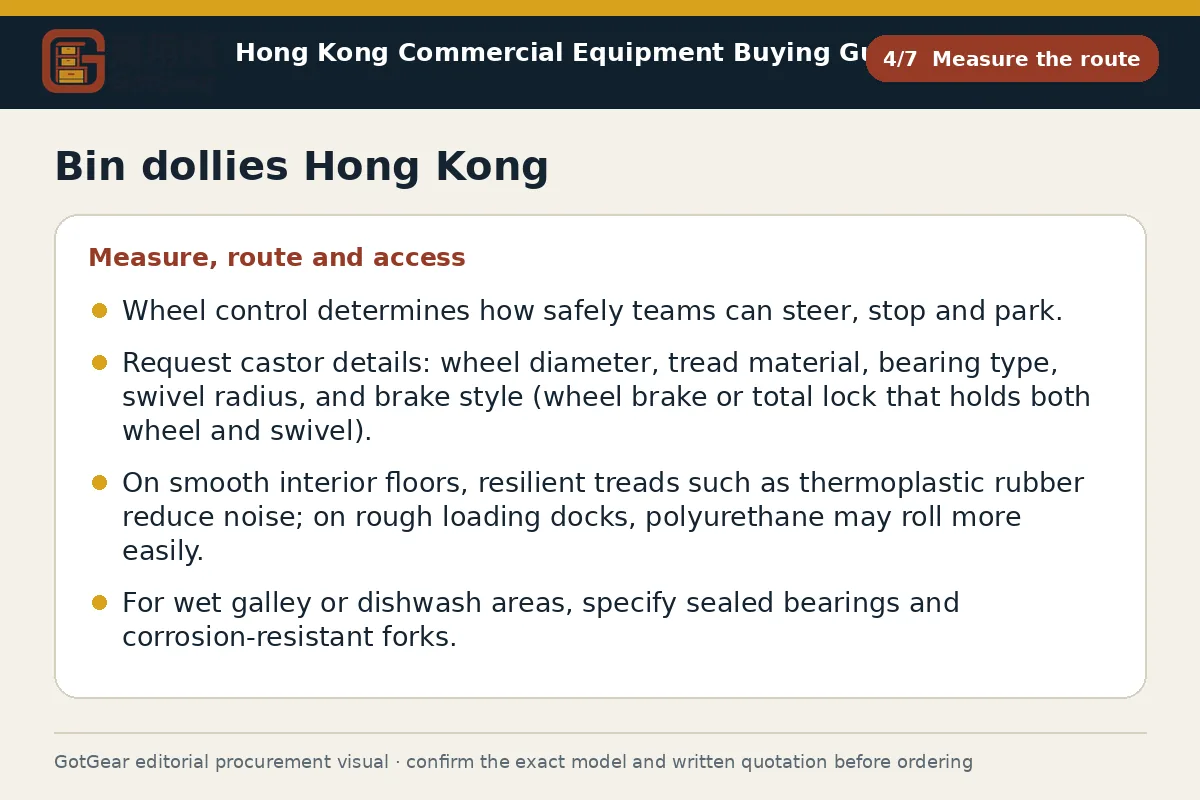
Wheel control determines how safely teams can steer, stop and park. Request castor details: wheel diameter, tread material, bearing type, swivel radius, and brake style (wheel brake or total lock that holds both wheel and swivel). On smooth interior floors, resilient treads such as thermoplastic rubber reduce noise; on rough loading docks, polyurethane may roll more easily. For wet galley or dishwash areas, specify sealed bearings and corrosion-resistant forks. Ask for the stated rolling resistance and any gradient guidance from the manufacturer.
Walk the route and mark proposed parking bays. Confirm that brakes can be operated without trapping toes and that the brake lever is reachable with gloves. If staff must maintain straight tracking over distance, ask whether a directional lock is available. Where dollies queue near lifts or on slight slopes, provision a chock, dock or wall strap, and designate a painted box for each position. As an example starting point only, test-handle a comparable dolly on your steepest ramp section before purchase; confirm findings in writing with the supplier and your building manager. Ensure operating instructions and safety labels can be supplied bilingually for training and audits.
What should buyers compare for bin dollies Hong Kong?
| Criterion | Straightforward requirement | More complex requirement | Evidence to provide |
|---|---|---|---|
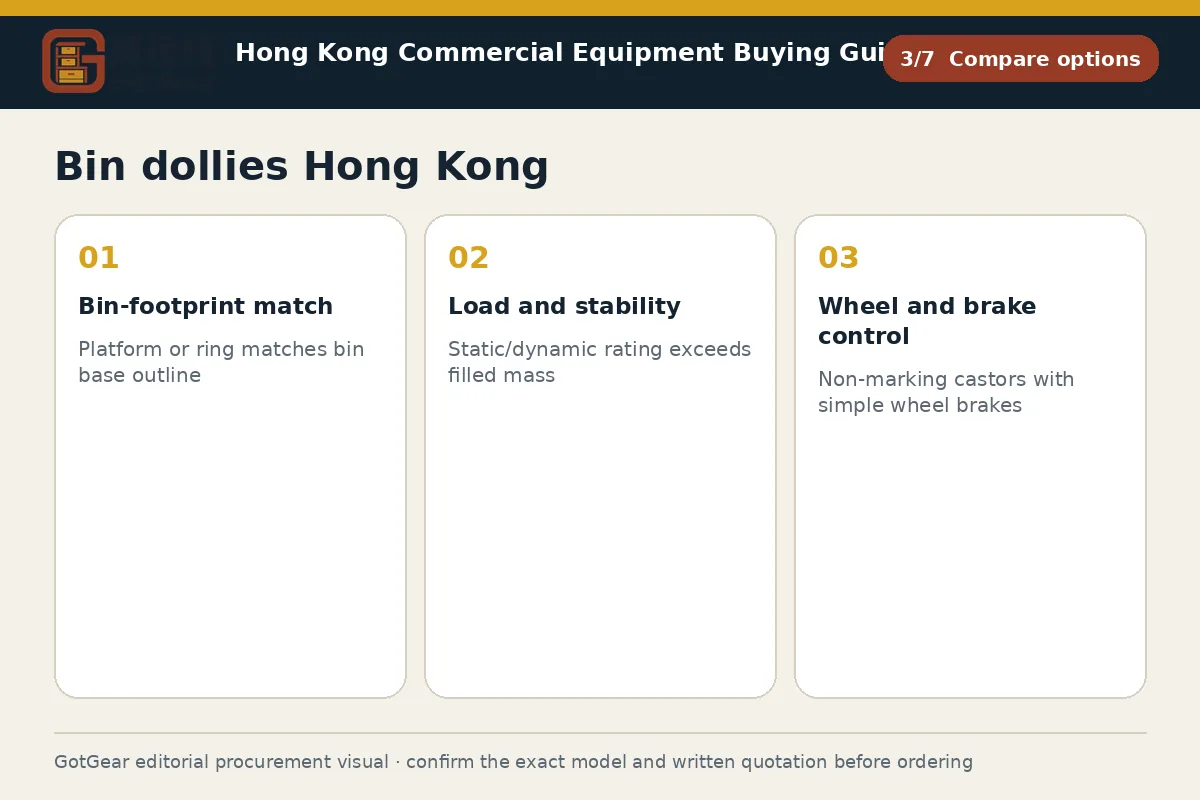
| Bin-footprint match | Platform or ring matches bin base outline | Keyed or twist-lock interface for named bin model | Photos, base dimensions, bin make/model, underside rib sketch |
| Load and stability | Static/dynamic rating exceeds filled mass | Per-castor ratings, safety factor and tipping line agreed | Filled mass estimate, contents description, centre-of-gravity notes |
| Wheel and brake control | Non-marking castors with simple wheel brakes | Total-lock and directional lock with sealed bearings | Floor types, gradients, noise expectations, brake access photos |
| Route and thresholds | Fits narrowest door and lift opening with clearance | Negotiates ramps, grates and plates with tested effort | Measured widths/heights, threshold heights, route photos, timings |
| Materials and documentation | Galvanised hardware and basic instructions | Corrosion-resistant build and bilingual instructions set | Humidity notes, cleaning chemicals, language needs, manager requirements |
This framework helps buyers create comparable written enquiries. Final model specifications, availability, delivery and commercial terms must be confirmed in a formal quotation.
Map thresholds and turning space for bin dollies Hong Kong
Before ordering, map the full movement path with measurements and photos, from bin-store to compactor, loading bay or back-of-house sorting area. Record the tightest doorway clear width, height, and any door-closer protrusions. Measure lift car depth, width and threshold step; verify lift door opening size and turning space to enter and exit. In older industrial buildings, note corridor pinch points and drain grates that could trap small wheels. If you also run bulk waste containers Hong Kong, align routes so full bins travel the shortest distance to bulk points.
Measure thresholds, ramps and floor breaks. State approximate gradient and the presence of metal plates or expansion joints. As an example starting point only, aim to accommodate a turning circle around 1.3–1.6 metres for a person and bin together; confirm your site’s actual requirement. Check lift bookings, loading windows and porter coverage to avoid peak public traffic. Identify ventilation grills that blow across floors, as these can affect handling on lightweight bins. Capture lighting levels in back corridors where alignment is critical. For public-event venues, confirm a quiet-rolling tread is acceptable to the venue management office. Include photos of hand clearance at railings and door pulls so the supplier can advise on castor offset and deck diameter.
Inspect load and attachment details before ordering bin dollies Hong Kong
Capacity and restraint need written confirmation. Request the dolly’s maximum static and dynamic load ratings, the number and rating of each castor, and any safety factor the manufacturer applies. State your heaviest expected fill and content variability; liquids in liners can shift unexpectedly, so consider a margin. If you use waste bin liners Hong Kong, describe liner gauge and whether liquid is routinely captured, as this affects mass and centre-of-gravity.
Specify the attachment method in detail. Twist-locks require a matching undercut on the bin; ring or platform styles rely on friction and restraint straps; corner-socket types suit square containers. Ask for installation and use instructions, including how straps are tensioned and inspected. Confirm fastener material, deck perforations for drainage, toe clearance, and any anti-tip features around the deck edge. Where insurers or building managers require it, request manufacturer declarations about compatibility with your named bin models and wheel brake holding capability on a stated gradient. As an example starting point only, you may trial-fit one unit under supervision to confirm fit and operator acceptance; formal model specifications and the supplier’s written quotation prevail.
Bin dollies Hong Kong decision checklist
Confirm bin brand, model and underside footprint with photos, then state filled mass and typical contents. Describe base geometry, handle overhang and clearance to the floor. Measure tightest doors, turning points, lift openings and thresholds, and show any ramps, drain grates or plates. Request dolly drawings with deck size, attachment method, castor diameter, tread, swivel radius and brake type, plus static/dynamic load ratings. Ask for corrosion details for humid areas and bilingual instructions. Compare quotations line-by-line against your route notes and measurements. Before committing, validate brake reach and hold in your intended parking bay. On receipt, check deck alignment, fixings, castor fasteners, free rotation and brake action, then record serials and file the supplier’s compatibility and maintenance documents.
- Operating use, quantity and expected frequency
- Dimensions, capacity, material and accessory requirements
- Delivery address, floor, goods lift and loading window
- Required documents, acceptance checks and after-sales arrangements
Key points for bin dollies Hong Kong
Hong Kong handling routes are often constrained by compact goods lifts, narrow service doors and shared back corridors. Map the actual lift door clear opening, car depth and threshold step, and confirm booking windows with the management office. Humid plant rooms and coastal sites accelerate corrosion, so fasteners and bearings should be specified accordingly. Sloping ramps into refuse rooms, drain channels at thresholds, and crowded loading bays all influence wheel choice and brake control. This summary highlights typical local conditions only and is not legal advice; always follow your building manager’s requirements and the manufacturer’s written guidance.
Questions about bin dollies Hong Kong
Can one dolly work across several bin sizes?
Sometimes, if the deck is a universal ring or platform with a strap, but secure fit must be confirmed on each bin model. Twist-lock or keyed systems are usually brand- and size-specific. Ask for the manufacturer’s compatibility list and, if mixing sizes, request guidance on maximum overhang and strap configuration for your named bins.
What wheel material performs best on wet kitchen floors?
Soft, non-marking treads such as thermoplastic rubber often give grip and quiet rolling on smooth, wet interiors. On rougher routes or drains, polyurethane may roll with less effort. Always match the tread to your actual surface and cleaning chemicals, and request the supplier’s advice with sample data for your stated floor types and gradients.
Do we need brakes if our floors are level?
Yes, brakes or a directional lock are still useful for parking, loading, and lift queuing. Even level floors can have airflow, minor slopes or vibration. Choose total locks where precise positioning is needed, and verify that the lever is accessible with gloved footwear. Confirm suitability in writing for your gradient and parking plan with the supplier.
Should we choose three-, four- or five-wheel dollies?
Four castors are common for stability; three can manoeuvre well on uneven floors but may reduce stability with tall loads; five can spread load and improve tracking. The best choice depends on your bin height, contents and route. Request a drawing showing castor positions, deck diameter and tipping line, and confirm load per castor for your stated mass.
Continue with closely related procurement topics
These pages share equipment, operating or decision-stage signals with this guide.
Decorative refuse bins Hong Kong
Compare decorative refuse bins Hong Kong with lobby litter bins Hong Kong to assess capacity, opening style, finish, liner concealment and cleanability, and to confirm required floor area with GotGear, Hong Kong.
Read the guide
Slim waste bins Hong Kong
Select slim waste bins Hong Kong by considering footprint, lid movement and easy liner removal. Compare swing top waste bins Hong Kong with push top waste bins Hong Kong for clearance and staff access with GotGear.
Read the guide
Hooded waste bins Hong Kong
GotGear compares hooded waste bins Hong Kong and wall mounted waste bins Hong Kong by aperture, floor clearance, fixings and cleaning access to help foodservice buyers assess suitability.
Read the guide
Waste bins with ashtray Hong Kong
Compare waste bins with ashtray Hong Kong and cigarette butt bins Hong Kong for placement, waste separation, emptying and hot-ash risk at local sites. Find guidance and options from GotGear.
Read the guideRelated topic indexOpen more English procurement pages2 topics
Browse additional equipment families, applications and procurement questions relevant to a wider buying brief.