
For Mobile working platform height-to-base ratio Hong Kong, use only the limits and configuration defined for the exact model by its manufacturer. Verify whether outriggers are specified, how they are deployed, the supporting ground, site controls and applicable Hong Kong requirements; outriggers alone do not establish stability.
Use stated limits for Mobile working platform height-to-base ratio Hong Kong
Use the stated, model-specific limits published by the manufacturer; do not rely on a rule of thumb. When assessing procurement decisions, refer to Mobile working platform height-to-base ratio Hong Kong and request the official stability statement for the exact model code, including any configuration variants. Confirm how platform height, attachments, tyres or tracks, wind allowances and any levelling systems alter the permissible relationship between the working height and the deployed base width or footprint. Ask for the latest manual revision and stability drawings and check they match the serial-number range you will purchase.
In your written enquiry, specify the maximum platform height you intend to use, whether indoors or outdoors, and whether any accessories will be fitted. Require the supplier to state if outriggers are mandatory, optional or prohibited for that height, and to provide deployed footprint dimensions and ground pressure data. Compare quotations only when they reference the same model code, configuration and revision, and include identical assumptions for wind, slope and surface. For Hong Kong sites, also confirm bilingual manuals and decals, and whether the footprint will fit through your goods lift and corridors during positioning. On delivery, inspect that the nameplate, stability notices and control labels match the quoted configuration, and retain the signed documentation set that will govern site use. The written quotation and the manufacturer’s documents prevail if details differ.
Deployed footprint and ground for Mobile working platform height-to-base ratio Hong Kong
A correct ratio check depends on the deployed footprint and the supporting ground. Obtain the manufacturer’s drawing showing centre-to-centre outrigger spread, outrigger pad size and overall footprint. On site, mark the intended deployment using a tape and chalk line, verify width and length against the drawing, and measure diagonals to confirm squareness. Check clearance from walls, kerbs and handrails, and verify you can manoeuvre from the goods lift or doorway to the work zone without rotating into obstructions. Where gradients are present, record them for reference with Mobile working platform on slopes Hong Kong.
Ground conditions matter as much as geometry. Ask the building manager for written confirmation of slab bearing capacity and any areas with voids, tiles or services; if unavailable, engage a competent adviser. Request the equipment’s maximum point load and ground pressure under each outrigger to plan spreader mats. As an example starting point, you might trial calculations assuming 5 kN/m² floor capacity, but only use values confirmed in writing by the responsible party. Consider wet, polished or dusty surfaces common in Hong Kong’s humid months and plan anti-slip underlay where permitted. For public-event or retail floors, add protection boards and crowd control to avoid dynamic loads near the footprint. Record these constraints in your method statement and purchasing file.
What should buyers compare for Mobile working platform height-to-base ratio Hong Kong?
| Criterion | Straightforward requirement | More complex requirement | Evidence to provide |
|---|---|---|---|
| Model-specific stability data | Manufacturer’s declared stability limits for the exact model | Configuration-specific limits covering height, wind, slope and attachments | Manual pages and stability chart matching model code and serial range |
| Outrigger configuration | Full-spread only, with confirmation of required footprint | Variable-geometry modes, de-rate logic, pad dimensions and auto-levelling | Outrigger diagram, interlock description, pad specification and tolerances |
| Deployed footprint and access | Overall deployed width and length at work zone | Complete route plan from delivery point via goods lift and corridors | Scaled sketch with measured clearances and turning spaces |
| Ground bearing and level | Written confirmation of level, dry slab at work area | Bearing capacity statement and spreader-mat plan (example values to be confirmed) | Building manager letter or competent adviser note plus mat sizing rationale |
| Documentation and markings | Bilingual manuals and safety decals provided with machine | Site-specific method statement, permits and training records if required | Copies of manuals, decals, induction or training certificates and approvals |
This framework helps buyers create comparable written enquiries. Final model specifications, availability, delivery and commercial terms must be confirmed in a formal quotation.
How Mobile working platform outriggers Hong Kong affect Mobile working platform height-to-base ratio Hong Kong checks
When procuring mobile working platforms with outriggers in Hong Kong, purchasers should recognise that outriggers alter the effective base, the permissible platform height and the interlock logic. Some models require a fixed, full spread; others allow variable geometry with sensors that de-rate available height unless a wider spread is confirmed. Establish whether outriggers are provided solely for levelling or are integral to the stability envelope, and whether wind allowances differ when they are used. Outriggers form part of, and are not a substitute for, a complete stability assessment that includes load position and ground bearing.
In your enquiry, state the anticipated deployment pattern (indoors/outdoors), the required maximum height and whether reduced-spread modes are expected in tight corridors in Hong Kong. Ask for the minimum and maximum outrigger spread dimensions, any permitted intermediate positions, pad area, and whether auto-levelling is fitted. Require a description of interlocks that prevent elevation unless the correct spread and level are confirmed, and request the manufacturer’s diagram showing pad placement and levelling tolerances. For slabs with unknown bearing, request the maximum point load at each outrigger and the recommended spreader-mat specification. When receiving the machine, witness a functional test that demonstrates the outrigger interlocks and any height de-rate with partial spread, and retain the signed commissioning records aligned to the quoted configuration.
Configuration instructions for Mobile working platform height-to-base ratio Hong Kong
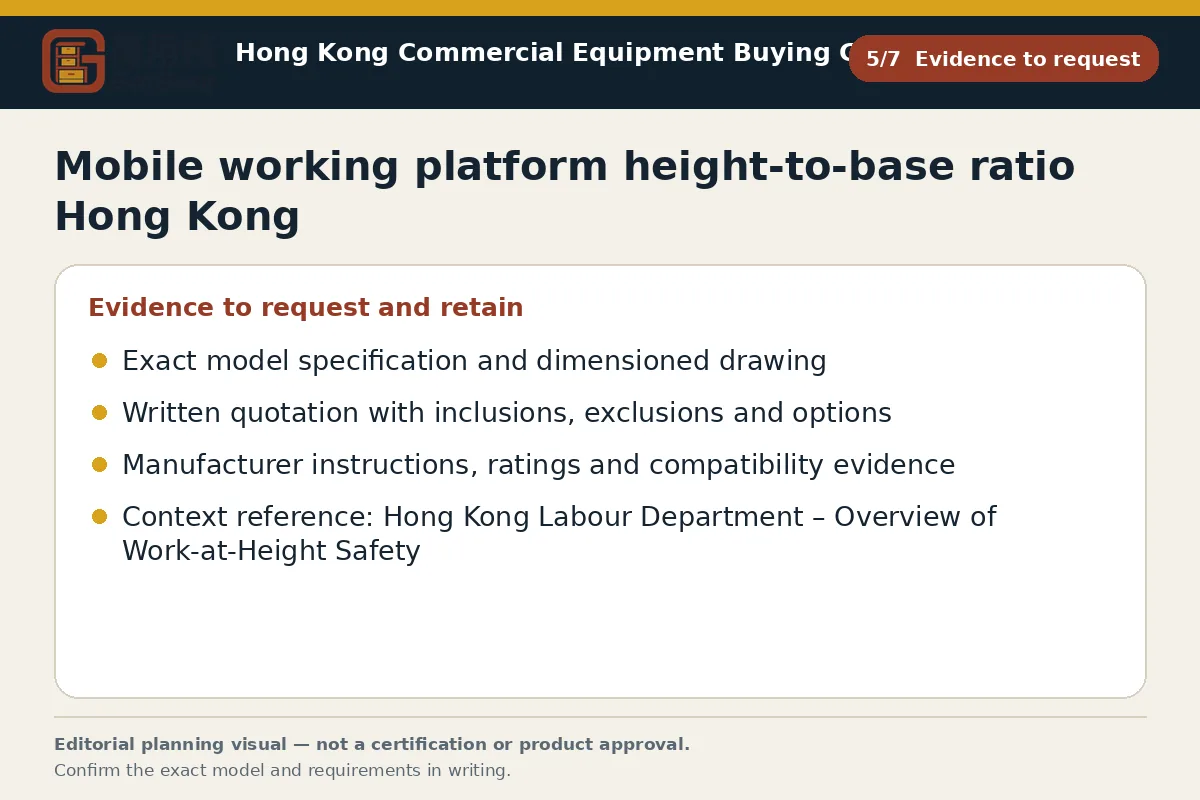
Turn the manufacturer’s information into site-ready configuration instructions before work begins. Assemble the latest manual, stability chart, deployed-footprint drawing, ground-pressure data and any wind or slope notes into a concise pack. Verify that the model code, serial-number range and optional equipment listed all match your quotation. Note the maximum platform height allowed for each configuration and whether any special accessories alter the limits. Cross-reference your pack with your Working platform risk assessment Hong Kong and Work platform procurement specification Hong Kong.
At the work area, measure and mark the deployment rectangle, place spreader mats if required, and use a calibrated level to confirm the ground is within the levelling tolerance stated by the manufacturer. Check tyres or tracks for condition, confirm the Mobile working platform safe working load Hong Kong at the intended outreach, and review wind exposure for the shift, especially near waterfronts or open atria. Prove interlocks and alarms with the platform at low height, then raise only within the documented limits. Establish a bilingual exclusion zone with signage where the public may pass, and record serial number, outrigger spread and height used in the permit to work if applicable. If any reading, dimension or control response differs from the documentation, stop and request written guidance from the manufacturer or the responsible venue or building manager.
Mobile working platform height-to-base ratio Hong Kong decision checklist
Before shortlisting, obtain the manufacturer’s stability statement for the exact model and configuration, plus deployed-footprint and ground-pressure drawings. Measure the intended work zone, route and clearance, noting slopes and surfaces, and request written slab-bearing confirmation. State in the enquiry the maximum platform height, whether indoors or outdoors, and if reduced outrigger spread is anticipated. Compare quotations only on matching model codes, options, wind and slope assumptions, and bilingual documentation. On receipt, verify nameplate, decals and manuals, and witness an outrigger interlock test. Document the configuration, spreader mats, exclusion zone and any venue approvals in your method statement; if anything conflicts, pause and obtain written guidance from the responsible parties.
- Operating use, quantity and expected frequency
- Dimensions, capacity, material and accessory requirements
- Delivery address, floor, goods lift and loading window
- Required documents, acceptance checks and after-sales arrangements
Key points for Mobile working platform height-to-base ratio Hong Kong, Mobile working platform outriggers Hong Kong
Hong Kong sites often involve narrow goods lifts, tight doorways and restricted manoeuvring space, so check the deployed footprint against the route to the work zone. Many buildings require management-office approval for floor protection, slab loading and out-of-hours positioning; secure this in writing. Waterfront winds, open podiums and typhoon signals can increase exposure even for indoor atria. Bilingual manuals, decals and signage are commonly expected for institutional approval. This page is practical guidance only; confirm requirements with the manufacturer, venue, building manager, competent adviser or insurer.
Questions about Mobile working platform height-to-base ratio Hong Kong
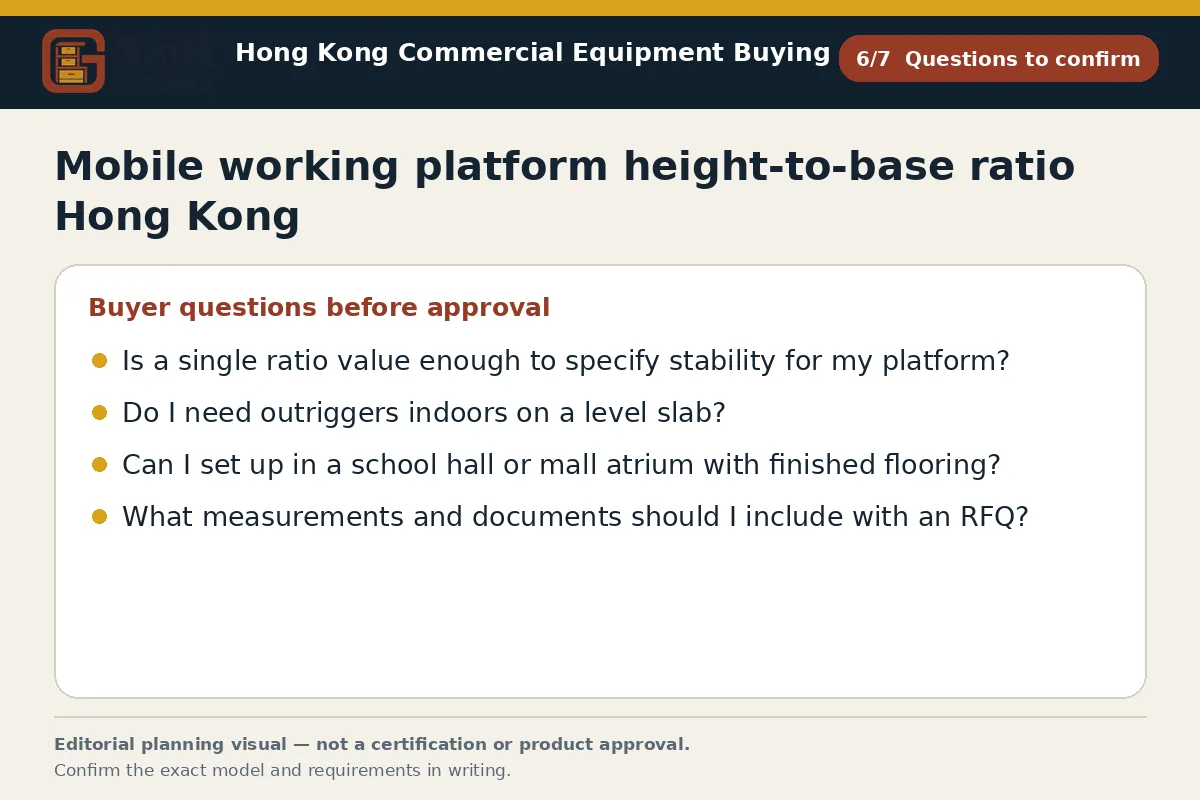
Is a single ratio value enough to specify stability for my platform?
No. Stability is model- and configuration-specific, and depends on deployed footprint, surface, wind and load position. Use the manufacturer’s limits for the exact model and configuration and confirm them in writing. If documents conflict, the formal quotation and latest manual prevail. When in doubt, obtain advice from the manufacturer or a competent adviser before proceeding.
Do I need outriggers indoors on a level slab?
Only if the model’s documentation requires them for the intended platform height or outreach. Some units allow full operation without outriggers at lower heights, but de-rate unless they are deployed. Confirm in writing whether mats are needed for slab protection or bearing, as building managers in Hong Kong may stipulate additional controls for finished floors.
Can I set up in a school hall or mall atrium with finished flooring?
Often possible with spreader mats and approvals, but only if slab bearing, floor protection and exclusion zones are confirmed in writing. Request ground-pressure data for the outriggers, choose mats accordingly, and coordinate with the venue on cleaning and crowd control. Add a method statement covering access, set-down area and out-of-hours movement if required.
What measurements and documents should I include with an RFQ?
Provide intended maximum platform height, available deployment space, access-path dimensions, slope readings, ground description and any wind exposure notes. Attach building-manager rules on slab loading and floor protection if available. Request the manufacturer’s stability statement, deployed-footprint drawing, ground-pressure data and bilingual manuals. Quote the exact model code and any options that could affect stability.
Continue with closely related procurement topics
These pages share equipment, operating or decision-stage signals with this guide.
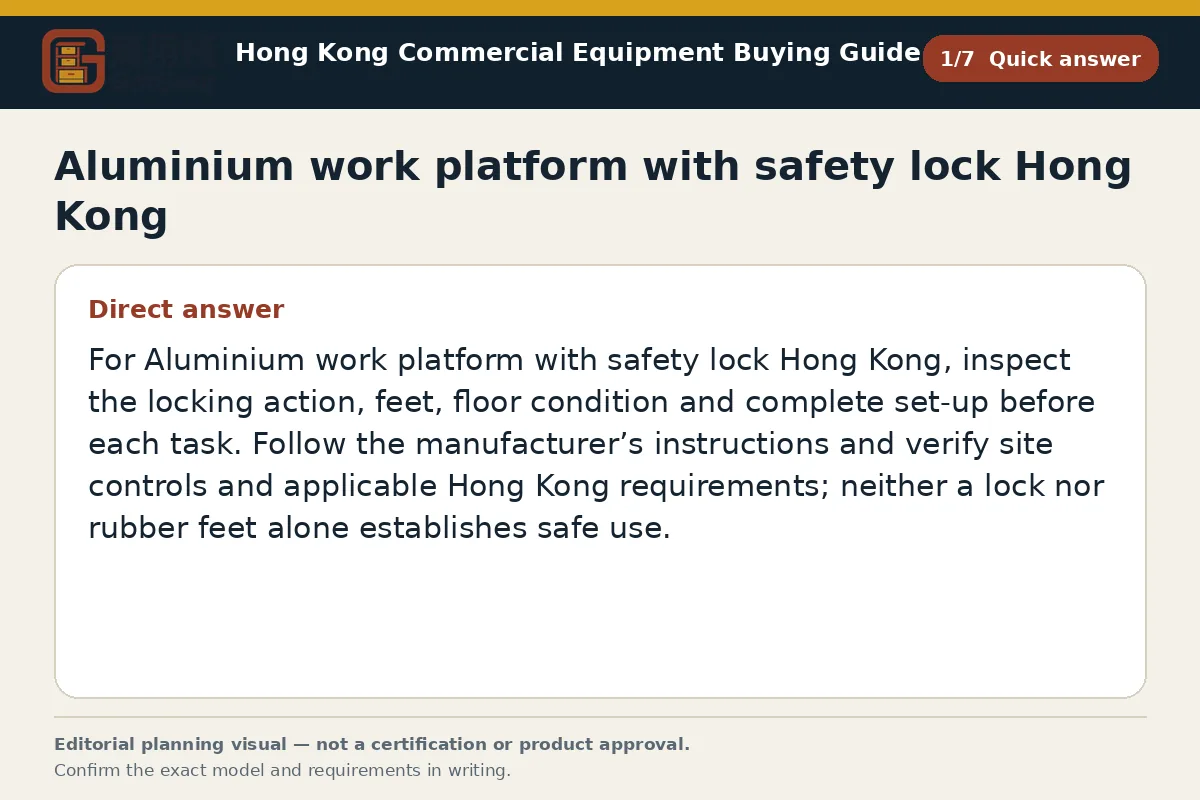
Aluminium work platform with safety lock Hong Kong
GotGear, Hong Kong advises checking the locking action, feet condition, flooring and setup of Aluminium work platform with safety lock Hong Kong. Compare with Aluminium work platform with non-slip rubber feet Hong Kong.
Read the guide
Aluminium step platform with platform lock Hong Kong
Aluminium step platform with platform lock Hong Kong and Aluminium step platform with wide non-slip steps Hong Kong should be inspected for lock operation, tread dimensions, surface grip and floor footing, according to GotGear.
Read the guide
Aluminium work platform with adjustable legs Hong Kong
Before selecting or using an Aluminium work platform with adjustable legs Hong Kong, check the ground surface, adjustment range and footprint. Compare Work platform with adjustable stabilisers Hong Kong at GotGear.
Read the guide
Folding aluminium work platform Hong Kong
Folding aluminium work platform Hong Kong: GotGear compares folded and deployed dimensions, routes and storage. Foldable guardrail work platform Hong Kong: Confirm how the unit locks open and is secured.
Read the guideRelated topic indexOpen more English procurement pages2 topics
Browse additional equipment families, applications and procurement questions relevant to a wider buying brief.