
Specify the contents, unit weight, stacking method and handling touchpoints first. Add lids, partitions and labels only where they support access, protection or picking.
Euro containers Hong Kong — Check Dimensions and Handling Interfaces
Begin with measurements. Euro containers intended for use in Hong Kong should be selected only after you map the full pathway from loading point to shelf. Record goods-lift car width and depth, doorway clear openings, stair and corridor pinch points, and vehicle dock height. As example starting points only, many buyers compare 600×400 mm or 400×300 mm footprints, with heights in the 120–420 mm range; confirm all figures in the supplier’s written quotation. Note both external and internal dimensions, since wall thickness and ribbing determine usable volume and whether inserts or bags will fit.
Handling interfaces determine day-to-day safety and speed. Specify how the box will be moved: hand carry, dolly, pallet truck, conveyor or ASRS. Ask for base style (closed or ribbed), corner design, and whether the container has hand grips, drop handles or fork-entry trays. If you barcode or apply RFID, request locations and sizes of label areas and card holders, preferably with bilingual insert windows. For conveyor use, ask for base flatness tolerances and sensor-read marker panels. For humid stores or chiller rooms, ask the manufacturer to state the material (e.g., PP/HDPE) and the operational temperature range. If your insurer or process requires ESD control or food contact, request the relevant manufacturer declarations and keep them with the project file, subject to site and authority requirements.
Euro containers Hong Kong: Compare Access and Protection Options for Euro Containers
Before adding a lid, define the access pattern. If picks are frequent and items are low‑risk, an open top with label holders may be faster. If the route crosses outdoor docks or damp back‑of‑house corridors during Hong Kong showers, lids reduce contamination and short splashes. State if stacking must interlock with lids fitted, and whether containers should nest or cross‑stack when empty. Ask suppliers to describe hinge and latch types and to confirm compatibility with your dollies and racking.
Protection is not just weather. Lids slow dust ingress on long mezzanine walks, deter casual interference in public‑facing venues, and keep contents together when trolleys brake in goods lifts. Specify if you need living‑hinge, clip‑on, or drop‑on covers, and whether tamper‑evident seals are required by venue, client or audit. In Hong Kong, Euro containers with lids are often compared with open‑front storage bins when the same shelf must support both picking and back‑stock. For airflow or rapid drying after washdown, you may shortlist perforated Euro containers in Hong Kong; confirm that any opening size and smoothness meet your quality and safety expectations in writing.
What should buyers compare for Euro containers Hong Kong?
| Criterion | Straightforward requirement | More complex requirement | Evidence to provide |
|---|---|---|---|
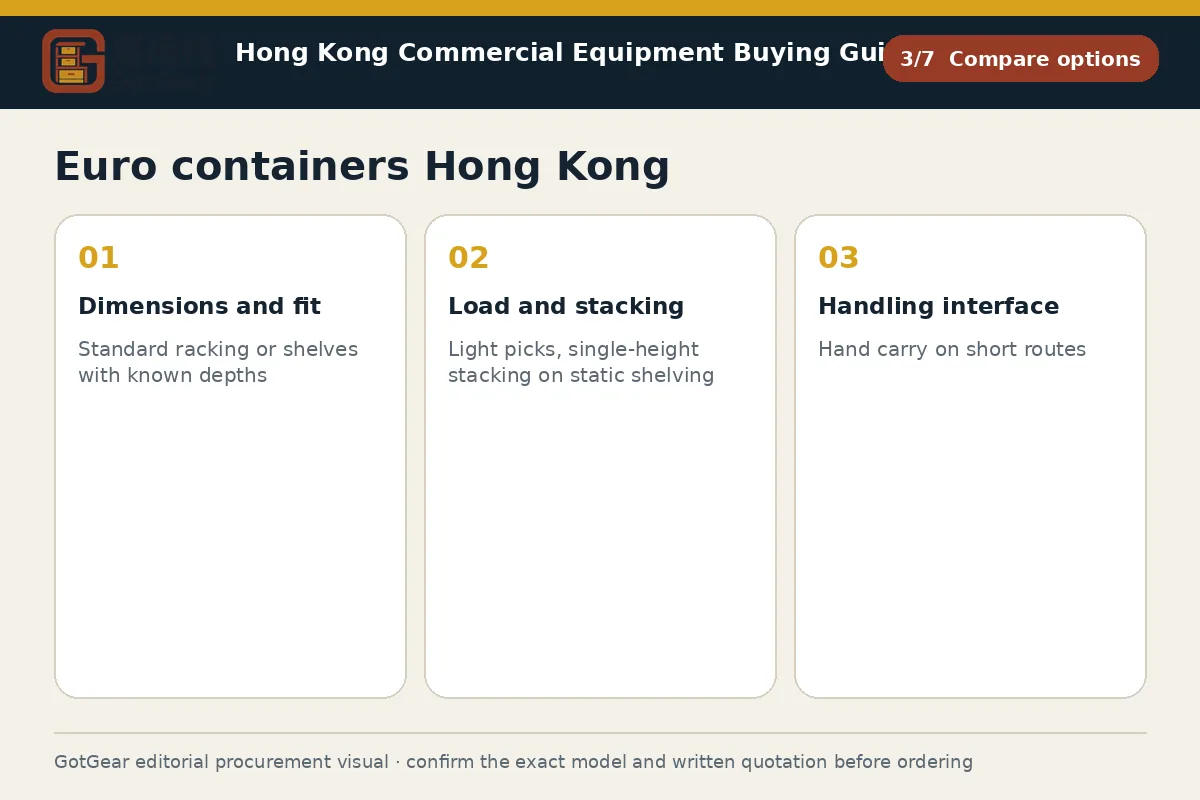
| Dimensions and fit | Standard racking or shelves with known depths | Tight goods‑lift and corridor turns between dock and store | Provide measured lift car size, door clear width/height, shelf depth and photos of pinch points |
| Load and stacking | Light picks, single‑height stacking on static shelving | Interlocked stacking, lid‑on stacking, or conveyor transfer loads | State unit weight per container, desired stack height, and request test method cited in quotation |
| Handling interface | Hand carry on short routes | Dollies, pallet trucks, conveyors or ASRS integration | Describe route, equipment used, base style required and any sensor/label window positions |
| Access and identification | Simple open top with label area | Lids, tamper‑evidence, partitions and bilingual card holders | Specify pick frequency, security needs, label size/placement and seal type if required |
| Environment and hygiene | Dry store at ambient conditions | Humid docks, chillers, washdown or food/ESD requirements | State temperature range, cleaning method, request material grade and any manufacturer declarations |
This framework helps buyers create comparable written enquiries. Final model specifications, availability, delivery and commercial terms must be confirmed in a formal quotation.
Euro containers Hong Kong — Decide When Contents Need Protection or Separation
Decide early whether contents need separation, cushioning, or traceable identification. Mixed components moving between district offices, schools or labs benefit from fixed slots to prevent cross‑mix. Ask for partition material (plastic board, solid PP, foam) and whether dividers are fixed, adjustable or removable. Request drawings that show internal clearances after partitions are fitted; usable space can shrink quickly. For small parts, require card‑holder or barcode windows visible from the picker’s side, and state your bilingual label format so window size and placement are confirmed in the quotation.
Protection is more than impact. If food, pharmaceuticals or teaching aids might be stored, ask whether the resin grade, colourant and mould release agents are suitable for your process and request the manufacturer’s statement where your organisation or insurer demands it. In humid backrooms and basements, specify smooth inner walls to ease cleaning and reduce moisture retention. If trolleys are parked under sprinklers or in covered loading bays, request information on lid overhang and water‑shedding features. Where office management controls back‑of‑house access windows tightly, plan seals, numbering and sign‑off so returns and handovers are auditable without slowing shifts.
Euro containers Hong Kong: Plan Mixed-SKU Storage with Divided Euro Containers
Mixed‑SKU storage needs careful slotting. Start by auditing SKU dimensions, fragility and pick frequency; as a practical starting point, group items into small/medium/large bins and confirm weights with calibrated scales. In Hong Kong, Euro containers with partitions are useful because they allow teams to pack multiple lines per box while maintaining count integrity during lift rides and cross‑dock moves. Specify the minimum and maximum cell sizes you need, and ask whether dividers lock into a grid to prevent creep during vibration on trolleys.
For high‑velocity picks, choose partition layouts that present the opening to the picker with clear sight lines; if you need even faster access on shelving, compare against plastic storage bins with dividers in Hong Kong, and confirm shelf compatibility. Where cartons feed conveyors or shuttles, consider warehouse totes in Hong Kong with reinforced bases, and ask for test evidence of sensor readability and transfer performance. When comparing offers, request samples to test label adhesion, partition stability and ergonomic grip with gloved hands. On receipt, inspect for warping, sharp edges, poor hinge alignment and fit of dividers. Photograph any defects before acceptance. If public‑event controls or institutional approvals apply, ask whether tamper‑evident options or number‑matched lids can be formally documented for your case.
Euro containers Hong Kong decision checklist
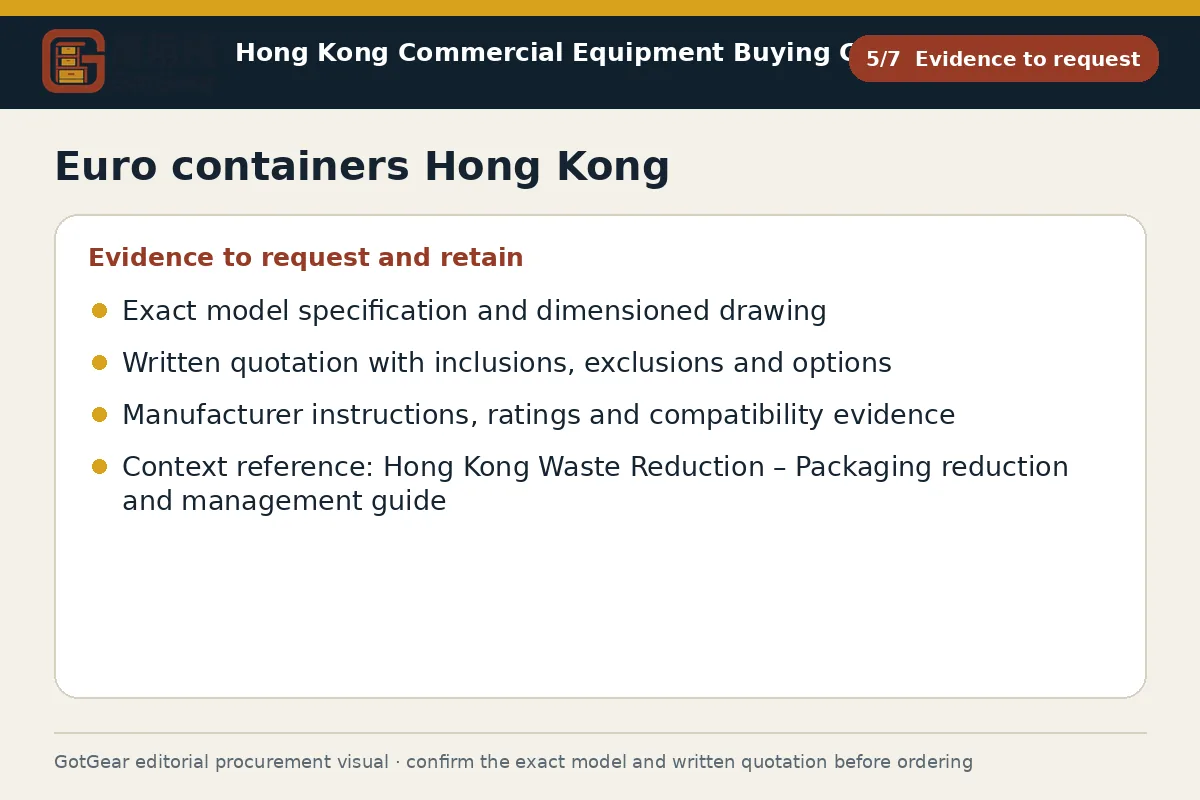
Confirm the contents, unit weights and pick paths; measure shelf depths, lift car and doorway clearances, and record photos of tight turns. State external and internal dimensions, usable volume, base style, handle type and label‑holder positions in your enquiry. Decide whether lids, partitions or open fronts support the access pattern, and request drawings and samples. Compare quotations line‑by‑line for stacking load claims, test methods, material grades and temperature ranges. Schedule delivery within the building’s loading window and advise the management office as required. On receipt, check dimensional tolerance, lid fit, hinge action, rigidity and surface finish, and verify that bilingual label pockets and partitions match the quotation. File any manufacturer statements your process or insurer requires.
- Operating use, quantity and expected frequency
- Dimensions, capacity, material and accessory requirements
- Delivery address, floor, goods lift and loading window
- Required documents, acceptance checks and after-sales arrangements
Key points for Euro containers Hong Kong, Euro containers with lids Hong Kong, Euro containers with partitions Hong Kong
Hong Kong facilities face tight goods‑lift cars, narrow corridors and short loading windows controlled by building management offices. Map these constraints before selecting any container footprint or lid style. Humid back‑of‑house routes and sudden rain between dock and lift often justify covers or drainage‑friendly bases, while bilingual label pockets ease inter‑team handovers. Where venues or insurers impose controls on food contact, ESD or tamper evidence, request manufacturer statements to suit the exact model and use. This is an operational guide, not legal advice; final specifications and written quotations prevail.
Questions about Euro containers Hong Kong
Do I need lids if the containers are used only indoors?
Choose lids when you need dust control, tamper deterrence or safer stacking during trolley and lift movement. If picks are frequent on open shelving, open tops or open fronts may be faster. Confirm with your venue or insurer if tamper‑evident closures are required, and ask the manufacturer to state compatibility with your racking, dollies and label format.
How should I select the right footprint and height?
Match the external footprint to shelves, dollies and lift paths; then check internal dimensions for the products and any inserts. As an example starting point, assess 600×400 or 400×300 footprints and confirm height limits against shelf spacing. Always request written confirmation of internal clearances, stack height with lids and any conveyor base tolerances.
When are partitions better than multiple small bins?
Use partitions when mixed SKUs must travel together with clear counts and minimal handling. Partitions reduce cross‑mixing and save shelf space, but they do reduce internal clearance. If ultra‑fast picking is needed, compare against small open bins and test ergonomics. Ask for drawings that show post‑partition dimensions and request samples to verify divider stability.
What should I inspect on delivery?
Check that external and internal dimensions match the quotation, lids seat without rocking, hinges latch smoothly and bases are flat for conveyors. Inspect for warping, sharp edges and flashing, and test label‑holder fit with your bilingual cards. If food contact, ESD or tamper‑evident claims influenced approval, file the manufacturer’s statements before putting containers into service.
Continue with closely related procurement topics
These pages share equipment, operating or decision-stage signals with this guide.
Plastic storage bins with dividers Hong Kong
GotGear provides practical guidance to help teams choose plastic storage bins with dividers Hong Kong, including how compartment sizes and refill triggers support line-side movement for material flow bins Hong Kong.
Read the guide
Drawer containers Hong Kong
GotGear compares drawer containers Hong Kong by depth and labelling to help you choose the right parts drawer cabinet Hong Kong or transparent drawer storage cabinet Hong Kong.
Read the guide
Warehouse totes Hong Kong
GotGear provides a checklist for dimensions, packed weight, closure type and empty-return routing for warehouse totes Hong Kong. GotGear also reviews retail distribution totes Hong Kong and e-commerce fulfilment totes Hong Kong.
Read the guide
Collapsible pallet containers Hong Kong
GotGear offers a Hong Kong guide to collapsible pallet containers Hong Kong, comparing load capacities, handling interfaces, access and empty returns with lockable pallet containers Hong Kong and plastic bulk containers Hong Kong.
Read the guideRelated topic indexOpen more English procurement pages3 topics
Browse additional equipment families, applications and procurement questions relevant to a wider buying brief.