
Choose an open design only when its aperture pattern suits the product and process. Confirm temperature range, cleaning method and material suitability from the manufacturer.
Perforated Euro containers Hong Kong — Define Airflow and Drainage Needs
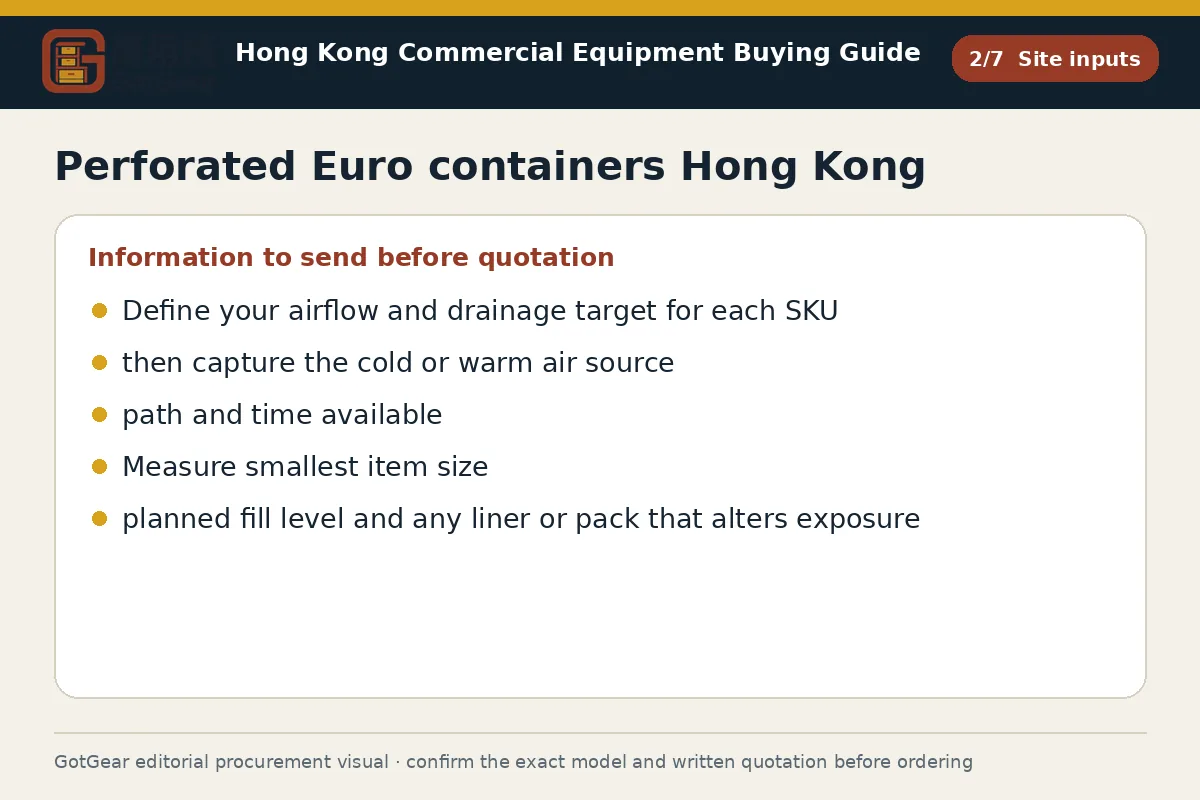
Start by mapping how air, moisture and condensate will move through the load, the crate and the room. Identify the cold or warm air source, any obstructions (liners, film, tray dividers), and the direction of airflow across racking or pallets. Note where meltwater or wash water will collect and how quickly you need it to drain. Record the smallest product items, the most delicate surfaces, and any label or sensor that must remain visible. If airflow is externally forced (blast chill, fan-assisted display), capture fan location and speed settings from the site brief.
For enquiry and quotation, request the manufacturer’s stated side and base open-area percentage, aperture geometry (slot or hole), typical aperture width and length in millimetres, vent orientation, base drainage path and rim height. Ask for the material grade (e.g., PP or HDPE), process temperature limits and the cleaning method it supports. Example starting point only: some chilled produce processes use 20–40% side open area with a partially perforated base; confirm needs with your process owner and supplier. If seafood or ice-heavy loads are in scope, flag cross-reference requirements with seafood crates Hong Kong to align drainage expectations. Record site constraints: goods-lift openings, turning spaces, wash-bay availability, loading windows, and any requirement for bilingual documentation for institutional approval. Written model specifications and the supplier’s formal quotation should prevail over planning notes.
Perforated Euro containers Hong Kong: Compare Ventilated Container Designs
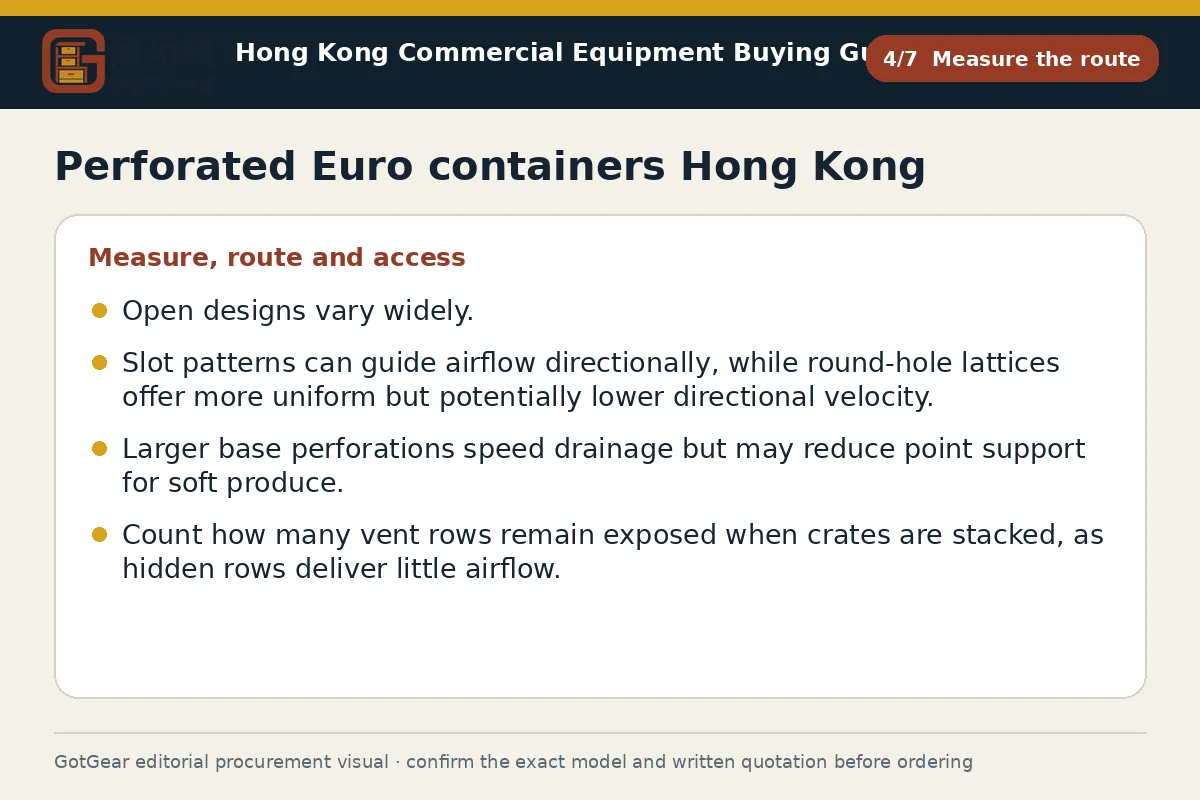
Open designs vary widely. Slot patterns can guide airflow directionally, while round-hole lattices offer more uniform airflow but potentially lower directional velocity. Larger base perforations speed drainage but may reduce point support for soft produce. Count how many vent rows remain exposed when Euro containers are stacked in Hong Kong, as hidden rows deliver little airflow. Where empty-return space is tight, compare stack-only versus stack-and-nest designs and measure the nested height. For narrow corridors and small lifts, verify external dimensions against the tightest doorway the container must pass through.
When operations in Hong Kong compare perforated Euro containers, they often also look at vented plastic crates in Hong Kong when SKUs mix between leafy produce, bakery and chilled protein. To compare designs side by side, request a dimensional drawing with aperture size and open-area percentage, rib layout, label plate locations, and stacking interlock details. Ask for sample photos of the actual cavity edges—look for smooth radii and no flashing, which eases washing. Example starting point only: trial a single production unit through your chill, wash and picking steps, then record dry-down time, label adhesion and any product snag points. Capture all findings in your enquiry so suppliers quote to the same criteria.
What should buyers compare for perforated Euro containers Hong Kong?
| Criterion | Straightforward requirement | More complex requirement | Evidence to provide |
|---|---|---|---|
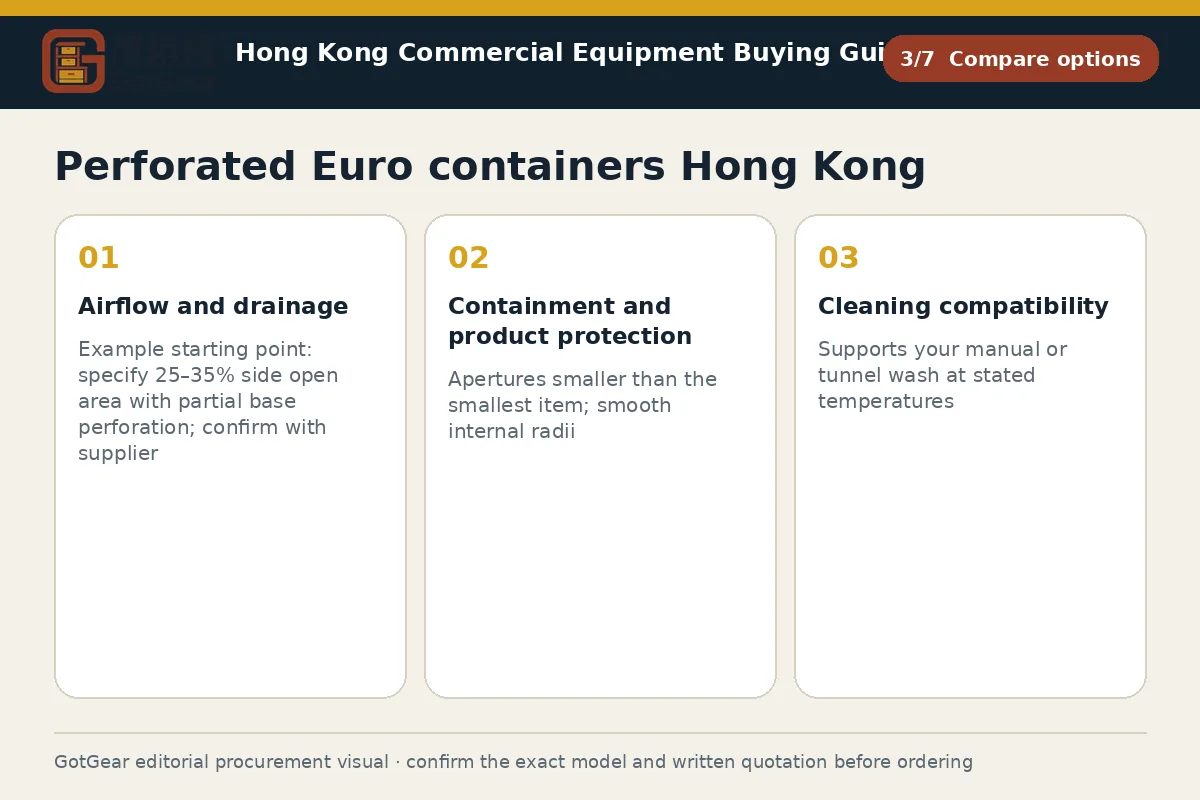
| Airflow and drainage | Example starting point: specify 25–35% side open area with partial base perforation; confirm with supplier | Directional slots aligned to fan flow; base channels for rapid meltwater exit | Provide airflow source/location, target pull-down time, and any liner details |
| Containment and product protection | Apertures smaller than the smallest item; smooth internal radii | Insert/liner for fines; tamper-evident lid for public handling | State smallest item size, bruise sensitivity, and any seal requirement |
| Cleaning compatibility | Supports your manual or tunnel wash at stated temperatures | Validated jet access to cavities; detergent compatibility statement | Share washer type, temperature/chemistry, and desired dry-down time |
| Handling and stacking | Interlocking stack with labelled external dimensions | Stack-and-nest design with defined nested height and pallet fit | Provide lift/door sizes, pallet pattern, and max stack height on site |
| Documentation and evidence | Manufacturer data sheet and drawing with aperture metrics | Food-contact declaration (if applicable) and cleaning guidance | Request bilingual documents where needed; the formal quotation prevails |
This framework helps buyers create comparable written enquiries. Final model specifications, availability, delivery and commercial terms must be confirmed in a formal quotation.
Perforated Euro containers Hong Kong — Check Containment and Product Protection
Ventilation helps temperature control but can expose the load. Check the smallest item dimension against the largest aperture in sides and base; many buyers use an internal “no-pass” rule where the smallest item is larger than the aperture by a safety margin set by the process owner. If fines or leaves are present, consider a liner or a tray insert, but confirm it will not block critical airflow. Review whether rims, handles and base ribs could bruise soft fruit or pierce bags; request inside-corner radius data and photos of the mould finish.
Assess stability: does the crate interlock when stacked, with or without a lid? If pallets are used, confirm footprint and pallet pattern with your warehouse so wrap, banding or lids can be specified. Example starting point only: some buyers trial stability at a modest tilt angle on the target pallet to check for slide. For public events or school distribution, ask whether tamper-evident lids or seals are required by the venue. When comparing written quotations, line up: stated load limits (static/stacking), aperture specifications with tolerances, lid compatibility, label plate options and any offered food-contact declaration. The model specification and signed quotation should control the purchase.
Perforated Euro containers Hong Kong — Review Cleaning and Handling Interfaces
Cleaning performance depends on surface design, chemistry and temperature. Ask the manufacturer to state the maximum wash temperature, recommended detergents and whether pressure-jet cleaning is acceptable. Look for smooth internal walls and fully open ribs so soil cannot trap behind webs. Confirm that drainage features allow wash water to exit quickly; check that large base perforations won’t snag brushes. If you operate tunnel washers, request the crate’s orientation guidance and any cleaning validation the maker can share for similar models.
Handling interfaces should suit your flow: hand grips that clear gloves, label plates sized for barcodes, and optional RFID tags that sit flush. Verify fit on common dollies and on hygiene plastic pallets Hong Kong to avoid rocking. For compact lifts, evaluate stack heights of full and empty crates and the manoeuvrability on landings. Before sign-off, run a cleaning trial on one unit and inspect for deformation, whitening or residue; note the exact settings used so the supplier can confirm suitability. If your SOPs require bilingual work instructions, align them with plastic crate cleaning and sanitising Hong Kong to keep maintenance consistent across teams. Always let the supplier’s documented limits and your site risk assessment determine the final method.
Perforated Euro containers Hong Kong decision checklist
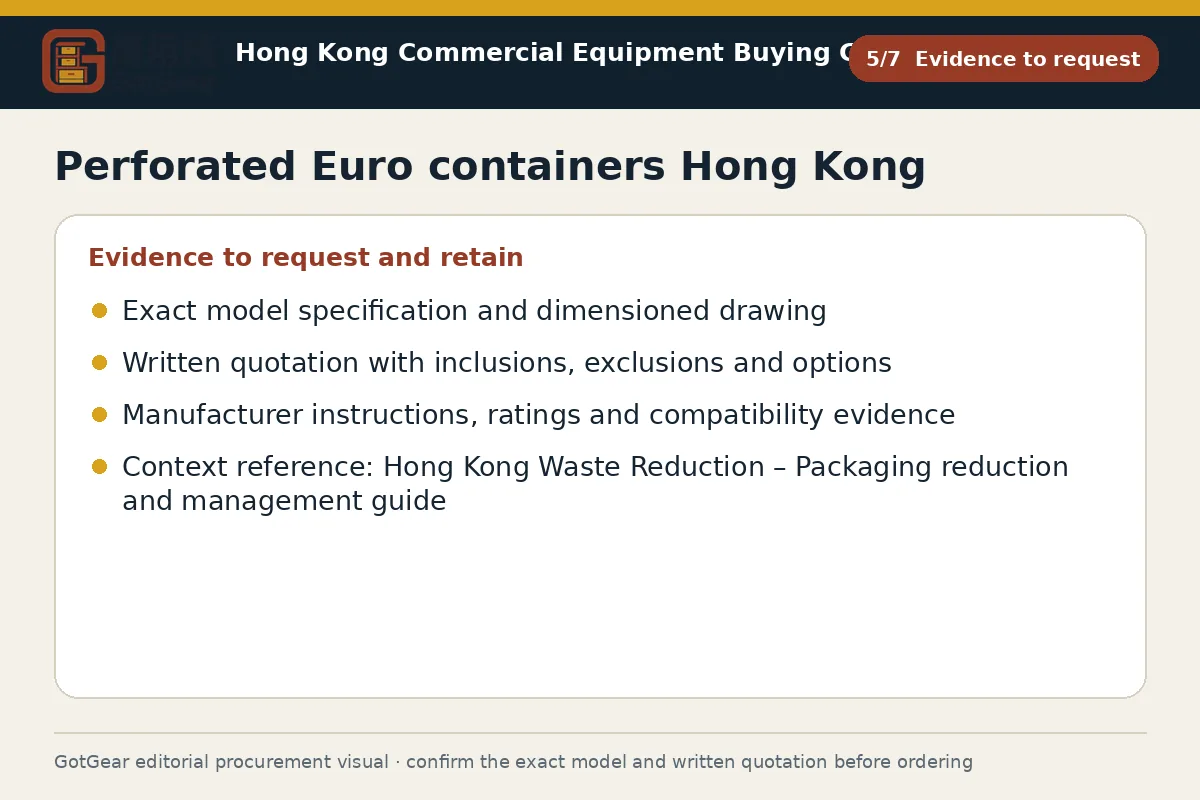
Define your airflow and drainage target for each SKU, then capture the cold or warm air source, path and time available. Measure smallest item size, planned fill level and any liner or pack that alters exposure. Record site limits: door and lift clearances, wash-bay capacity, and pallet patterns. Issue a written enquiry requesting material grade, temperature limits, side and base open-area percentage, aperture dimensions, stacking method, lid options and label plates. Ask for drawings, photos of edges, and cleaning guidance. Trial one unit through your chill, wash and pick steps, documenting temperature pull-down, drip control and handling. Compare quotations line-by-line against the same fields, noting tolerances and any declarations offered. On receipt, inspect for flashing, blocked vents, warping and interlock fit. The chosen model specification and the supplier’s formal quotation should govern the order.
- Operating use, quantity and expected frequency
- Dimensions, capacity, material and accessory requirements
- Delivery address, floor, goods lift and loading window
- Required documents, acceptance checks and after-sales arrangements
Key points for perforated Euro containers Hong Kong, vented plastic crates Hong Kong
Hong Kong sites often face tight goods-lifts, narrow doorways and timed loading windows; measure these before choosing ventilated crates. Humid, coastal conditions and frequent washdowns mean drainage and quick dry-down are practical priorities, not just airflow. Many industrial buildings require coordination with the management office for wash-bay access and waste-water handling; obtain approval where needed. If public-event or campus distribution is involved, bilingual labelling and simple, tamper-evident closures can speed checks. The notes here address typical operating constraints and are not legal advice; confirm specific requirements with your venue, insurer and supplier.
Questions about perforated Euro containers Hong Kong
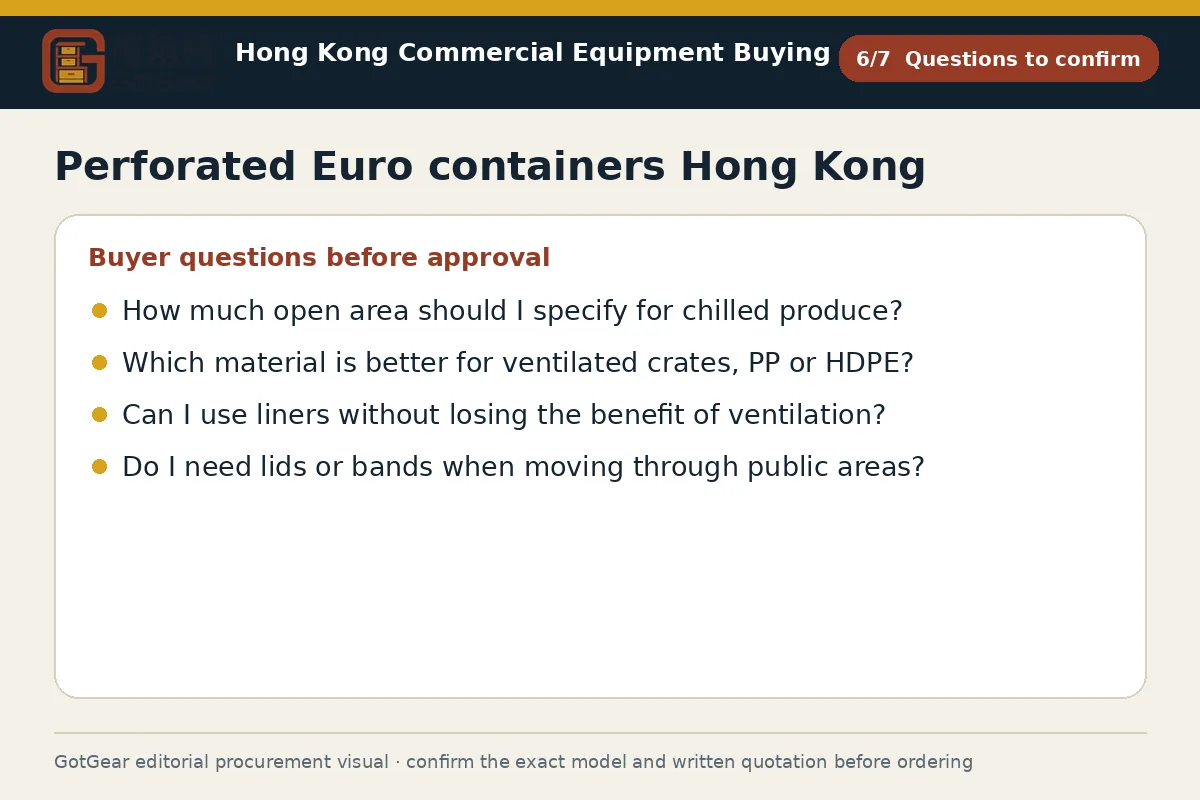
How much open area should I specify for chilled produce?
Set open area to match your airflow, product and time allowance; both sides and base may contribute. As an example starting point only, some buyers explore 25–40% on sides with selective base perforation, then trial to confirm pull-down and containment. Your process owner and the manufacturer should agree the final percentage, pattern and tolerances in writing.
Which material is better for ventilated crates, PP or HDPE?
Pick the material to suit temperature, stiffness and washing. HDPE often tolerates colder storage; PP can feel stiffer under load. The right choice depends on your chill or freeze range, washer temperatures and chemicals used. Request the maker’s temperature and detergent limits for the exact model, then verify against your SOP and risk assessment.
Can I use liners without losing the benefit of ventilation?
Yes, if the liner design preserves the intended airflow and drainage. Choose perforated or partially open liners where cooling or drying is critical, and confirm how they are secured so they do not block vents. Trial one load to check temperature pull-down and drip control, then document the method in your enquiry and quotation.
Do I need lids or bands when moving through public areas?
Often a lid or banding reduces spill risk and speeds checks in venues with public access. Requirements differ by building manager and event; some also want tamper evidence. Confirm expectations with the venue or institution, then specify lid compatibility and sealing method in the enquiry so the supplier quotes the correct components.
Continue with closely related procurement topics
These pages share equipment, operating or decision-stage signals with this guide.
Plastic pallet for airport cargo Hong Kong
GotGear provides a checklist for plastic pallet for airport cargo Hong Kong so air-cargo handlers can record cargo profile, handling equipment, transfer points, restraint, inspection, operating limits and compatibility.
Read the guide
Reusable plastic crates Hong Kong
GotGear explains how reusable plastic crates Hong Kong are issued, sorted and inspected. It also outlines loss management, plastic crate colour coding Hong Kong and plastic crate cleaning and sanitising Hong Kong.
Read the guide
Recycled plastic pallets Hong Kong
Use this procurement checklist to inspect recycled plastic pallets Hong Kong by verifying material evidence, load and handling practices, cleaning and reuse protocols, damage control and end-of-use routes. Contact GotGear.
Read the guide
Plastic pallets for cold storage Hong Kong
Plastic pallets for cold storage Hong Kong: GotGear provides a checklist to compare temperature range, unit load capacity, handling, cleaning and condensation risks to help select suitable pallets for cold chain operation.
Read the guideRelated topic indexOpen more English procurement pages3 topics
Browse additional equipment families, applications and procurement questions relevant to a wider buying brief.