
For a warehouse racking specification Hong Kong, list pallet types, load dimensions and weights, quantities by SKU, truck models and operating patterns. Include rack plans and elevations, floor and building data, accessories, obstructions, site drawings and a response schedule for assumptions and exclusions.
Define pallets and loads in a warehouse racking specification Hong Kong
Start by locking down the unit load. For a warehouse racking specification Hong Kong responders can quote consistently, describe each pallet type (timber, plastic or metal) with clear photos, footprint and entry orientation. Record the overall load dimensions on the pallet, weight per pallet, wrapping or strapping method, centre of gravity concerns and whether loads are rigid or crushable. Note permissible pallet overhang at front, rear and sides, plus any restrictions where product must sit flush with beams or decks. Where pallets vary by SKU, provide a list that groups SKUs by identical handling and storage requirements.
Quantify volumes by SKU or family: pallets in, out and peak on-hand, and any seasonal skew. If you use half-pallets, display pallets or non-standard skids, state how they will be handled and stored. Indicate rotation rules (FIFO, FILO, batch/lot, quarantine) that affect bay depth or flow. If you expect growth, include an example starting point for future volumes and required beam levels, then instruct suppliers to confirm in their written quotation. In Hong Kong’s humid conditions, flag moisture-sensitive products and whether drip trays, mesh decks or solid shelving are preferred. State any prohibition on wood pallets for hygiene or client requirements so alternates are not assumed.
Add truck, floor and building data to a warehouse racking specification Hong Kong
Handling equipment sets the safe aisle widths and beam elevations. List the truck make and model, mast type, lift height required at the top beam, collapsed mast height for doors and goods lifts, and the rated capacity at working height. State the operating aisle method used (for example, starting point only), and then require suppliers to validate with their truck data. Include turning and staging space at row ends and docks. If night deliveries or narrow access are typical, document loading windows and whether a banking person is needed due to building management rules in industrial estates.
The floor and building brief should include slab drawings, known joints and repairs, and any floor flatness data available from the landlord or contractor. Note the clear height to the lowest obstruction, column grids, sprinkler mains, and any policy on racking fire flue space that Hong Kong facility managers may require; ask bidders to state their assumption and confirm with the competent party. Record service lift door width, car depth and payload, plus delivery routes, ceiling soffit constraints and staging zones. Provide measured, dimensioned plans and elevations in PDF and, if possible, CAD, and request that suppliers highlight any conflicts they foresee before anything is finalised.
What should buyers compare for warehouse racking specification Hong Kong?
| Criterion | Straightforward requirement | More complex requirement | Evidence to provide |
|---|---|---|---|
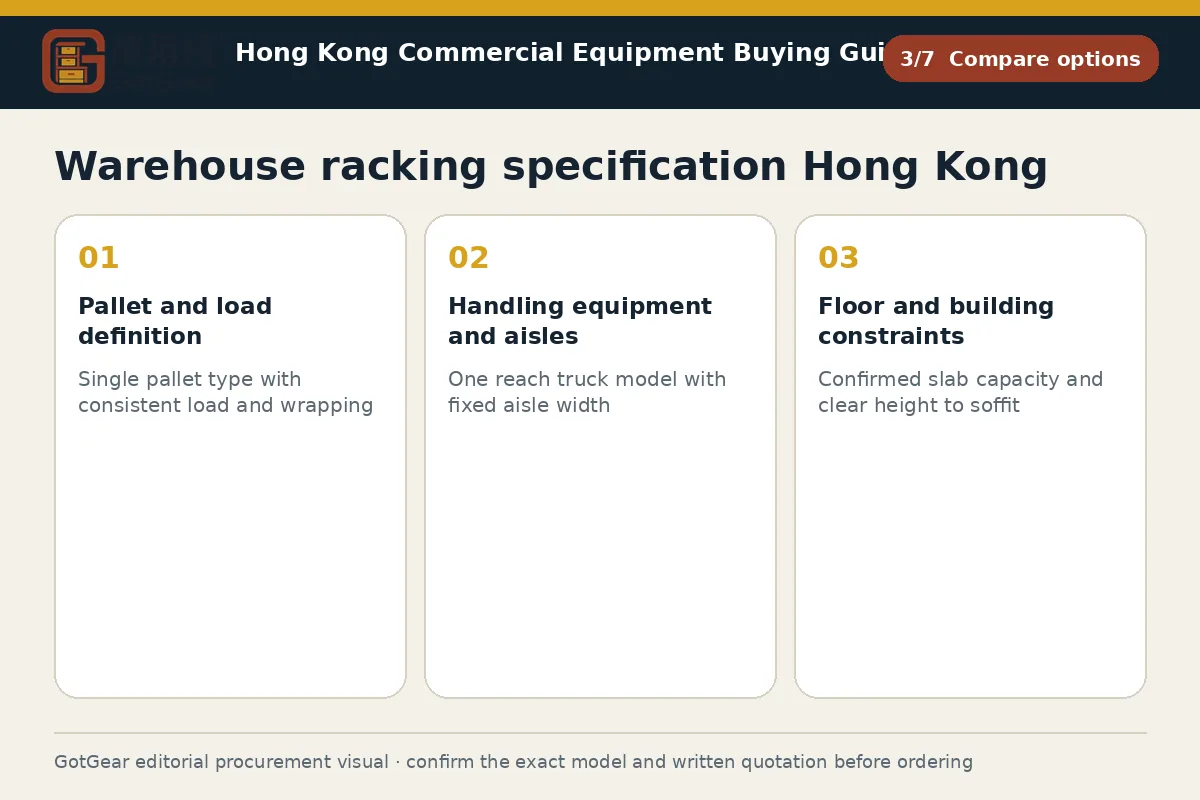
| Pallet and load definition | Single pallet type with consistent load and wrapping | Mixed pallet types, variable overhang and fragile goods | Photos, footprints, load sizes/weights by SKU, stability/overhang notes |
| Handling equipment and aisles | One reach truck model with fixed aisle width | Multiple truck types and end-of-aisle staging needs | Truck datasheets, aisle method, turning clearances on plan |
| Floor and building constraints | Confirmed slab capacity and clear height to soffit | Joints, slopes, goods-lift limits and booking windows | Structural letter/drawings, lift dimensions, access rules |
| Rack performance and accessories | UDL per level, beam levels and standard mesh decks | Point loads, flue management, guards and galvanised finishes | Model references, load data sheets, finish specs and accessory list |
| Programme and documentation | Single-mobilisation delivery and install | Phased nights/weekends per management-office rules | Method statement, programme, permits, insurance, bilingual labels |
This framework helps buyers create comparable written enquiries. Final model specifications, availability, delivery and commercial terms must be confirmed in a formal quotation.
Develop a pallet rack specification Hong Kong within a warehouse racking specification Hong Kong
Convert load and site data into performance fields that bidders can complete consistently. A pallet racking specification for Hong Kong that buyers can evaluate should state frame depth, bay width, nominal beam pitch, number of beam levels per bay, and the required uniformly distributed load per level. If you need point-load capacities (by pallet position), say so explicitly. Specify whether decks are required and of what type, and include row spacers, frame protectors, end barriers and run lengths. In Hong Kong’s humid coastal climate, ask vendors to state finishes (powder-coated, pre-galvanised and hot-dip options) and their suitability for your environment, and confirm this in the model specification and the formal quotation.
Fix operational clearances in your brief so alternatives are comparable. Define pallet overhang allowances, minimum upright-to-pallet gaps and rear flues; for further guidance, direct reviewers to the pallet racking clearances used internally in Hong Kong. If loading patterns vary, ask bidders to show how local Hong Kong practices for pallet racking load distribution affect beam selection and connector class. Provide example starting points for beam elevations and bay counts, then require the manufacturer to verify component compatibility and publish load notices that reflect the finally approved design.
Structuring a racking procurement specification: Warehouse racking specification Hong Kong
Turn the technical brief into a structured enquiry pack with a consistent response schedule. Prepare a racking procurement specification for Hong Kong. Such a specification, when issued by local teams, should bundle a cover note, drawings, the load and site data, acceptance criteria, delivery constraints, and a priced bill of quantities by bay type and accessory. Include a schedule where bidders must list assumptions, exclusions, alternates, lead times (as examples only, to be confirmed), programme, and installation method. If your operations sit within a managed industrial building, request method statements, permits and evidence of insurance aligned with management-office requirements.
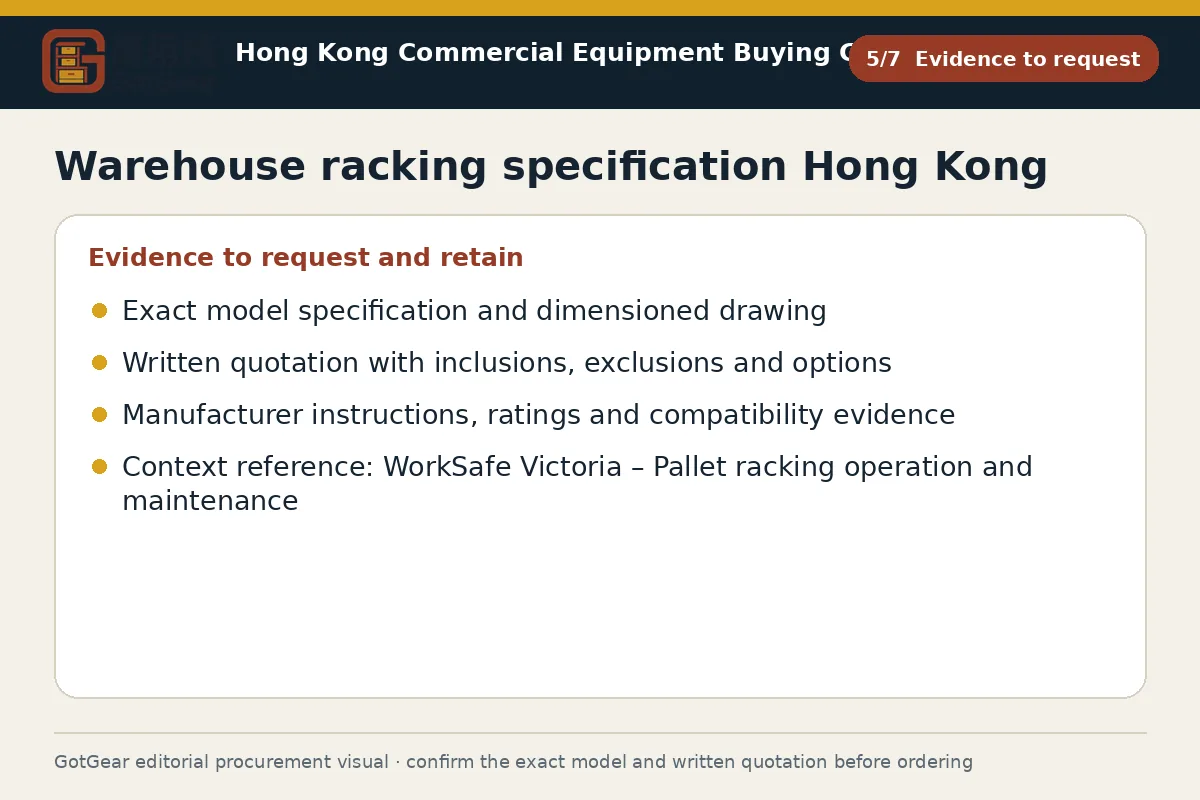
For evaluation, require suppliers to return marked-up plans and elevations with beam levels and references that match their quotation. Ask for product data sheets, sample load notice wording, and—where available from the manufacturer—test reports or declarations suitable for the proposed model and site. State that bilingual safety labels and drawings are required. Plan receipt checks: count bays and accessories against the bill, inspect finishes and packaging, verify component IDs against the quotation, and request as-built drawings and torque records where proposed. Refer buyers to create a warehouse racking tender specification that Hong Kong stakeholders can approve without rework. Use this guide to compare specifications and prepare a written enquiry.
Warehouse racking specification Hong Kong decision checklist
Confirm pallet types, load dimensions and weights per SKU, overhang limits and any hygiene or moisture sensitivities. List truck models, mast heights and aisle assumptions, then provide floor and building drawings with lift and access limits. Fix beam levels and operational clearances as example starting points and ask manufacturers to verify. Issue a response schedule for assumptions, exclusions, alternates and programme. Compare quotations bay-by-bay with accessories itemised and finishes stated. Before approval, align installation with management-office rules and booking windows. On receipt, check quantities, component IDs, finishes, labels and as-built drawings, and request product data sheets and load notices consistent with the finally approved model specification and written quotation.
- Operating use, quantity and expected frequency
- Dimensions, capacity, material and accessory requirements
- Delivery address, floor, goods lift and loading window
- Required documents, acceptance checks and after-sales arrangements
Key points for warehouse racking specification Hong Kong, pallet rack specification Hong Kong, racking procurement specification Hong Kong
Hong Kong projects often face tight goods-lift cars, narrow doorways and limited loading windows controlled by management offices. Build these constraints into the enquiry so suppliers plan suitable component lengths, delivery vehicles and labour. Many industrial buildings require permits, method statements and advance booking for works, including off-peak deliveries. Humidity and saline air can influence finish choices; ask vendors to explain their proposal’s suitability. Where sprinklers or aisles impose flue or access needs, confirm the requirement with the building manager, insurer or competent adviser before final approval. Bilingual drawings, load notices and handover documents help speed institutional sign-off.
Questions about warehouse racking specification Hong Kong
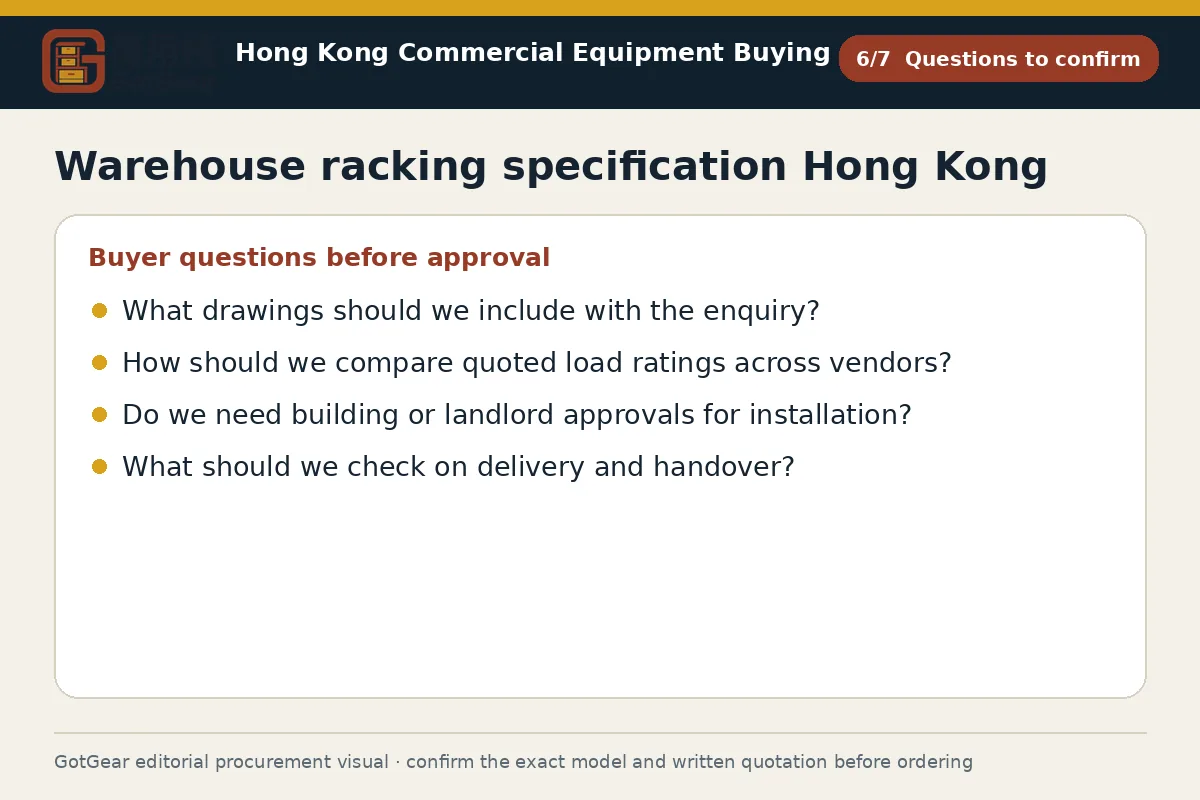
What drawings should we include with the enquiry?
Provide dimensioned plans and elevations showing columns, obstructions, beam levels and operating aisles. CAD files help suppliers check conflicts quickly, but a carefully measured PDF with key dimensions can work if confirmed on site. Ask bidders to return marked-up drawings with their quotation so you can compare beam references, bay counts and proposed clearances reliably.
How should we compare quoted load ratings across vendors?
Compare like-for-like on level uniformly distributed load and, if relevant, point loads per pallet position. Require beam and frame model references with data sheets, and ask the manufacturer to confirm ratings for your final beam elevations as an example starting point. If alternates are offered, insist on a clear comparison table that preserves bay type, levels and clearances.
Do we need building or landlord approvals for installation?
Many managed buildings in Hong Kong require permits, method statements and insurance before works begin. Confirm with the management office what is needed for deliveries, lifts and hot works, if any. If sprinklers, flues or egress are affected, consult the building manager, your insurer or a competent adviser so the final layout and documentation satisfy site-specific requirements.
What should we check on delivery and handover?
Match component counts and bay types to the bill, inspect finishes for transit damage, and verify component IDs against the quotation. Request bilingual load notices, product data sheets and as-built drawings. If offered for the chosen model and site, obtain torque records and any test or declaration documents. Record deviations and have the supplier confirm corrective actions in writing.
Continue with closely related procurement topics
These pages share equipment, operating or decision-stage signals with this guide.
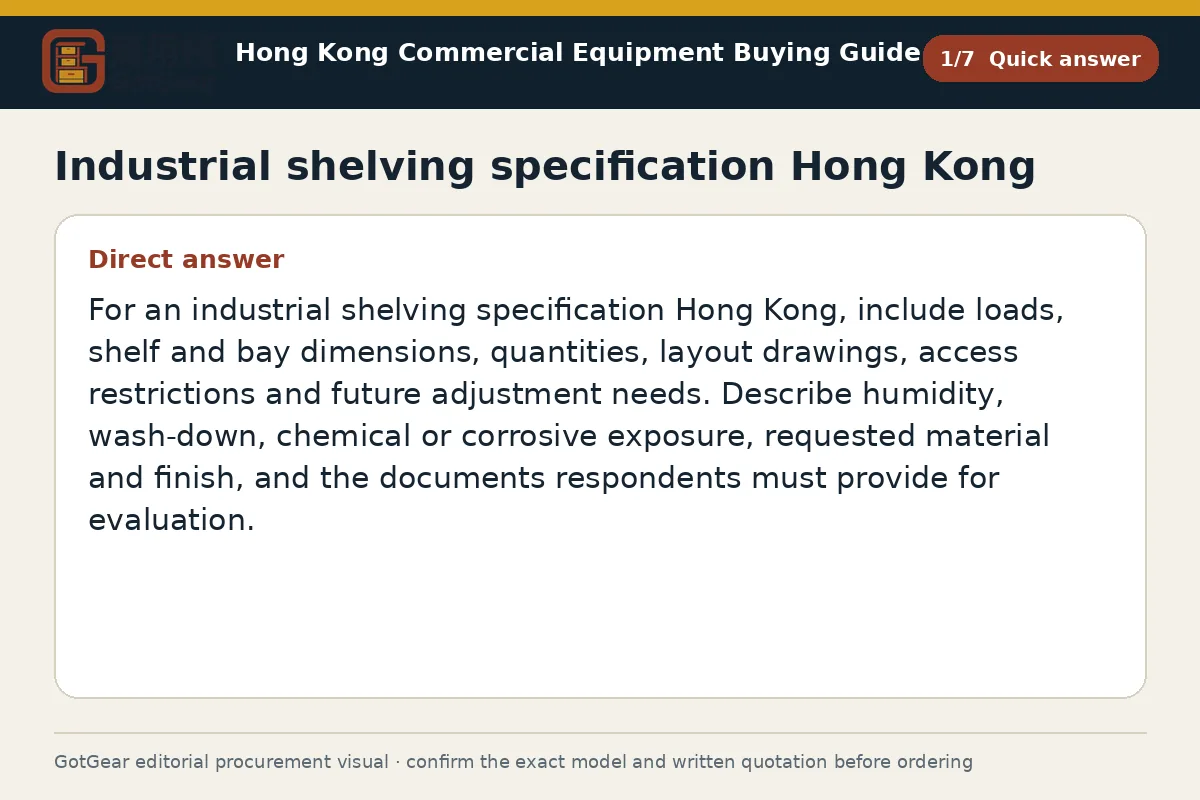
Industrial shelving specification Hong Kong
GotGear explains industrial shelving specification Hong Kong. It covers shelving material specification Hong Kong, plus criteria for industrial shelving corrosion resistance Hong Kong.
Read the guide
Warehouse rack guardrails Hong Kong
GotGear provides a checklist for warehouse rack guardrails Hong Kong and maps vehicle routes. It reviews racking aisle barriers Hong Kong and racking pedestrian barriers Hong Kong to assess risks in racking areas.
Read the guide
Warehouse racking tender specification Hong Kong
GotGear's warehouse racking tender specification Hong Kong is a guide to setting scope, site data, unit loads, handling equipment and layout. It includes a response schedule for comparing bids.
Read the guide
Rack end protection Hong Kong
Use the GotGear checklist to map forklift routes, measure rack end dimensions and assess impact exposure for rack end protection Hong Kong. Compare the results with racking collision protection Hong Kong to identify any gaps.
Read the guideRelated topic indexOpen more English procurement pages4 topics
Browse additional equipment families, applications and procurement questions relevant to a wider buying brief.