
For pallet racking clearances Hong Kong, record pallet and load dimensions including overhang, maximum load heights, rack configuration, beam levels and lift-truck model. Have the dimensioned arrangement reviewed by the appropriate system and project professionals against manufacturer instructions, site conditions and applicable Hong Kong requirements.
Record pallets and unit loads for pallet racking clearances Hong Kong
To establish pallet racking clearances Hong Kong, start by measuring the actual pallets and unit loads that will be stored and handled. Record the overall pallet length, width and height; base style (block or stringer); runner orientation; bottom‑deck gaps; fork‑entry sides; and any winged or chamfered edges. Note the load footprint and any deliberate overhang on all four sides, the packaging type, unit‑load stability, and the maximum gross mass. As an example starting point only, many Hong Kong warehouses use 1,200 x 1,000 mm pallets with stretch‑wrapped cartons; confirm the exact dimensions, mass and quality in writing for each SKU with the responsible supplier before design decisions are finalised.
Capture variability: wet or humid conditions can swell timber decks, change friction and alter fit on beams. Photograph representative loads, weigh samples, and mark centre‑of‑gravity where practical. Identify special units (bulky, fragile, unwrapped, irregular, return logistics). Create a bilingual data sheet for each SKU that references the intended storage level, orientation and handling sequence. Include a warehouse racking specification Hong Kong as part of the brief; it should list acceptable pallet types, maximum load height per level, and any prohibition on damaged bases. Include site constraints that affect unit loads, such as narrow doorways and goods‑lift car sizes on the access route, so the chosen bay width, frame depth and beam spans reflect real pallets, not nominal catalogue figures.
Add lift-truck data to pallet racking clearances Hong Kong checks
Lift-truck characteristics define workable aisle, bay and elevation clearances. Capture the make and model, rated capacity at the relevant load-centre for your unit loads, mast type (two/three stage, with or without freelift), attachment details (side-shift, fork positioner, clamps), and reach/pantograph data. Record the manufacturer-declared right-angle stack (RAS) or minimum aisle width for the specified load dimensions, plus turning radius, fork length, carriage width and heel radius. Note overall lowered and raised mast heights to check against doors, mezzanines and sprinklers; tight Hong Kong goods-lift headroom and corridor turns are frequent limiting factors.
Ask the lift-truck supplier for a swept-path diagram or template for your load footprint at the tallest handling height. Include floor flatness and joint details if they restrict reach truck performance, and indicate any ramps or thresholds. State the maximum retrieval elevation and the heaviest load at that level. Request that written quotations for the racking reference the exact lift-truck model and the aisle width they have assumed, so later substitutions cannot reduce safe clearance. Where appropriate, seek the manufacturer’s handling guidance for the chosen attachments and confirm that the proposed beam levels and pallet supports accommodate forks and mast sway during approach and set-down.
What should buyers compare for pallet racking clearances Hong Kong?
| Criterion | Straightforward requirement | More complex requirement | Evidence to provide |
|---|---|---|---|
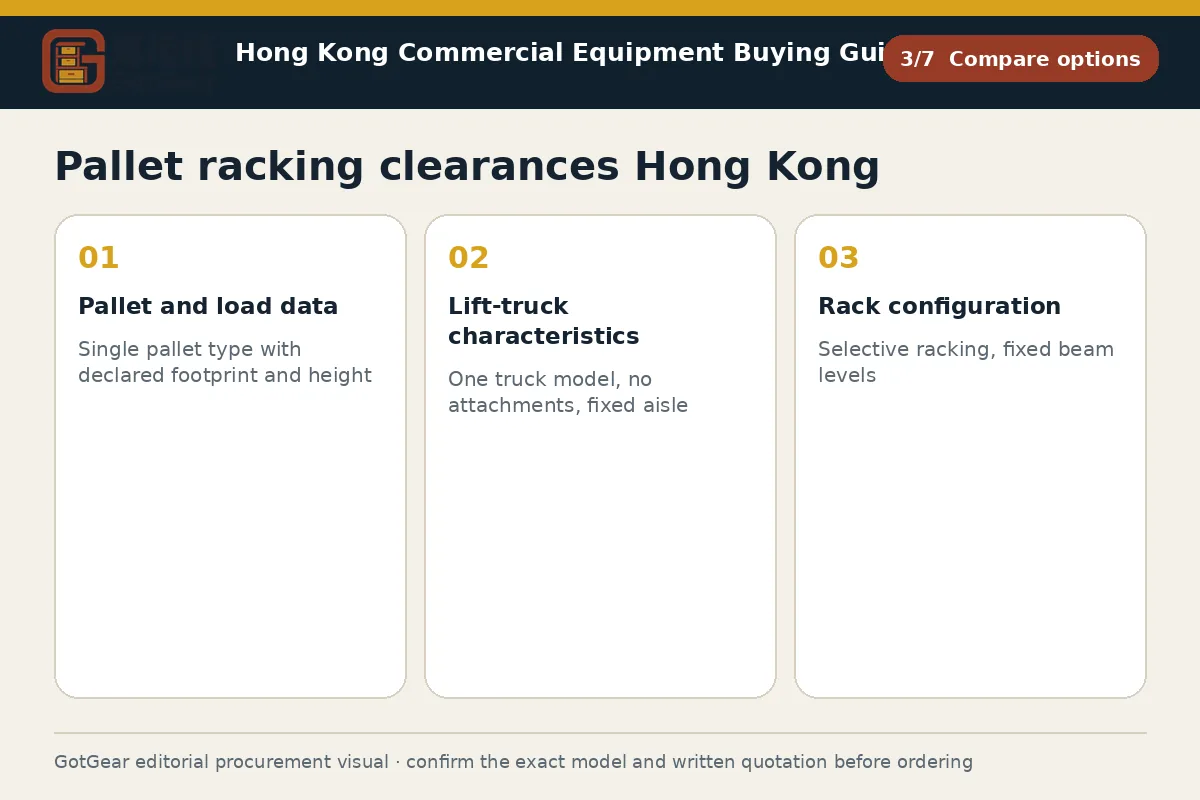
| Pallet and load data | Single pallet type with declared footprint and height | Multiple SKUs with variable overhang and packaging | Bilingual data sheets, photos, mass, overhang per side, centre-of-gravity notes |
| Lift-truck characteristics | One truck model, no attachments, fixed aisle | Different trucks/attachments, reach and counterbalance mix | Model numbers, capacity at load-centre, RAS/aisle width, swept-path for tallest load |
| Rack configuration | Selective racking, fixed beam levels | Backstops, double-deep, decking, specified flue spaces | GA drawings with beam elevations, back-to-back spacing, overhang assumptions |
| Site constraints | Clear, open access and headroom | Tight lifts/doors, low services, managed loading windows | Measured route drawings, headroom checks, management-office rules and permits |
| Verification and acceptance | Paper review of drawings | Mock bay, aisle marking, receipt inspection and labels | Signed layout, test records, delivery inspection log, bilingual safety labels |
This framework helps buyers create comparable written enquiries. Final model specifications, availability, delivery and commercial terms must be confirmed in a formal quotation.
Relate pallet racking clearances Hong Kong to pallet load overhang racking Hong Kong
Clearances must account for real load geometry, including overhang, to avoid contact with uprights, beam steps and adjacent loads. For pallet load overhang for racking in Hong Kong, specify acceptable overhang at the front, rear and sides for each SKU. State whether loads sit on beams, on decked levels, or on supports such as timber bearers. Side overhang influences flue space and the usable clear bay width; rear overhang defines the need for backstops or deeper frames. Align any building- or insurer-requested flue spaces with the actual tote or carton sizes so that overhang does not unintentionally close critical gaps.
In your warehouse racking specification in Hong Kong, request that bidders declare the overhang and clearances they have assumed: side clearances per pallet, back-to-back spacing, upright-to-wall offsets, and beam deflection allowances at working load. Compare quotations on those written assumptions, not on nominal bay lengths alone. Where the insurer or venue requires, coordinate racking fire flue space in Hong Kong with your sprinkler consultant and the racking manufacturer’s instructions. Refer to pallet racking load distribution in Hong Kong in your enquiry and ask suppliers to confirm load-sharing on beams, tolerances, and permissible pallet entry directions in writing for the proposed components.
Verify the proposed layout for pallet racking clearances Hong Kong
Verification is a drawing-and-measure exercise, not a rule-of-thumb. Request dimensioned general arrangement plans and elevations showing pallets, overhang, beams, frames and lift-truck envelopes at working height. Ask for a tolerance stack-up note that includes beam deflection under example loads, pallet variability and expected mast sway, then check the worst case against columns, sprinklers, lighting, pipes, doors and emergency routes. In Hong Kong buildings, also validate delivery and build sequencing with the management office—loading windows, lift bookings and method statements can affect the achievable bay count.
Before placing an order, agree the flue and backstop strategy, confirm the clear aisle at all end-of-aisle turns, and run a tape-measured mock bay with a representative pallet, forks and driver. For tendering, require bidders to state installation tolerances, anchor specification, finish (e.g., galvanised or painted) and labelling; include these fields in your warehouse racking tender specification Hong Kong documents. On receipt, inspect frames and beams for damage, coating condition in humid weather, correct beam lengths and hole pitch, anchor kits and bilingual labels. Where required by the venue, insurer, building manager or the chosen model, ask for manufacturer drawings, capacities and competent sign-off to be provided with the as-built set.
Pallet racking clearances Hong Kong decision checklist
Confirm pallet and unit-load dimensions, mass and overhang per SKU with photos and bilingual data sheets. Fix the exact lift-truck model, attachment set and aisle width, and obtain a swept-path for your tallest, widest load. Ask racking bidders to state assumed clearances, beam deflection, back-to-back spacing, flue strategy and pallet support method. Verify layout drawings against measured columns, sprinklers, doors and escape routes, and run a mock bay and aisle test. Co-ordinate management-office loading slots, goods-lift bookings and site access. Before purchase, compare written quotations on identical assumptions; after delivery, inspect frames, beams, anchors, finish and labels. Where required by the site, model or authority, request manufacturer drawings, capacities and any competent sign-off to accompany the as-built set.
- Operating use, quantity and expected frequency
- Dimensions, capacity, material and accessory requirements
- Delivery address, floor, goods lift and loading window
- Required documents, acceptance checks and after-sales arrangements
Key points for pallet racking clearances Hong Kong, pallet load overhang racking Hong Kong
Hong Kong sites often face tight access, limited goods-lift sizes and short loading windows controlled by a management office. These constraints can fix maximum bay lengths, frame heights and assembly sequence long before installation. Confirm lift car dimensions, turning spaces and headroom on the full route from loading dock to the racking area, and obtain any necessary permits and method statements. Humid conditions can affect timber pallets and coatings, so factor condition checks into receipt and commissioning. Always align storage layout decisions with the building’s rules, insurer expectations and manufacturer instructions; this is operational guidance, not legal advice.
Questions about pallet racking clearances Hong Kong
How much vertical space should I allow above the top of the load?
Provide only the clearance proven by drawings and trials for your load, rack and truck. As an example starting point, some users test 75–150 mm above the tallest load to accommodate pallet variation and mast movement. Confirm the final figure with the racking manufacturer, your lift-truck data and any site constraints; written quotations and model specifications prevail.
Can I mix different pallet sizes in the same bay or level?
Yes, if the rack, beams and supports are specified for the worst-case pallet, overhang and forklift approach. Adjustable beams and decking can help, but declare which SKUs go where, their orientation and overhang. Ask suppliers to give load tables and clearance assumptions in writing; mixed configurations should be verified by drawings and, where practical, a test fit.
Do I need decking if my pallets sit on beams?
Decking is advisable for irregular bases, small cartons or where overhang risks contact with beams. It can improve unit-load support and reduce snag points. However, it changes weight, fire behaviour and flue spaces, so coordinate with the racking manufacturer and, where required, your insurer or venue rules. Confirm deck capacity, material and fixings in the written quotation.
What proof should I request that the proposed layout will work on my site?
Ask for dimensioned plans and elevations with pallets shown at working height, a tolerance/deflection note, and a lift-truck swept path. Run a mock bay and tape-measured aisle on site before commitment. Where required by the building manager or insurer, obtain manufacturer drawings, capacities and competent sign-off. The final installed configuration should match the approved, dated drawings.
Continue with closely related procurement topics
These pages share equipment, operating or decision-stage signals with this guide.
Warehouse rack guardrails Hong Kong
GotGear provides a checklist for warehouse rack guardrails Hong Kong and maps vehicle routes. It reviews racking aisle barriers Hong Kong and racking pedestrian barriers Hong Kong to assess risks in racking areas.
Read the guide
Rack end protection Hong Kong
Use the GotGear checklist to map forklift routes, measure rack end dimensions and assess impact exposure for rack end protection Hong Kong. Compare the results with racking collision protection Hong Kong to identify any gaps.
Read the guide
Pallet racking load distribution Hong Kong
GotGear provides a checklist to review pallet racking load distribution Hong Kong, with drawings and beam levels. It includes pallet racking floor loading Hong Kong and racking beam elevation Hong Kong data.
Read the guide
Racking fire flue space Hong Kong
GotGear provides a checklist for racking fire flue space Hong Kong, describing layouts, storage heights and fire protection considerations. It also gives guidance for warehouse racking sprinkler clearance Hong Kong.
Read the guideRelated topic indexOpen more English procurement pages5 topics
Browse additional equipment families, applications and procurement questions relevant to a wider buying brief.