
Compare VNA racking Hong Kong using pallet and unit-load data, required selectivity, stock rotation, pick rates, truck type and clear building dimensions. Have each option reviewed for the actual floor, layout and operating conditions before making a system decision.
Assess aisle and handling needs for VNA racking Hong Kong
When planning VNA racking in Hong Kong, start by determining the handling method, then design the aisle. Confirm whether the operation will use man-up turret trucks, man-down VNA trucks, or articulated trucks, and whether guidance will be by floor wire, cameras or steel guide-rails. Measure clear internal height to the underside of services, the flattest workable floor strip, and every transition on the access route, including goods-lifts, doorways and turning spaces on multi‑storey levels. Note any office adjacency where noise or exhaust may be an issue for charging or battery changes.
Request in the written brief: proposed aisle width at floor level and at 1 m height, turning and overhang envelopes from the truck supplier, minimum required floor flatness and the test method, guide-rail specification and anchors, and allowable pallet and unit-load overhang. Ask for general arrangement drawings with beam elevations, protected cross-aisles and emergency access shown. State loading and unloading windows and the number of concurrent trucks planned. Record slab build-up and any post-tensioned zones for the racking installer to confirm anchor details. Require handrail and rack protection proposals where pedestrian routes cross. Prepare a warehouse racking specification for Hong Kong that captures these inputs so quotations can be compared consistently against model specifications and the formal written quotation from each supplier.
Review selectivity and stock rotation for VNA racking Hong Kong
Selectivity is the main strength of VNA in single‑deep layouts: every pallet is addressable, making it well suited to wide‑SKU, variable‑demand stores and e‑commerce replenishment. Define the SKU-to-pallet ratio, minimum days of safety stock and the proportion of full-pallet dispatch versus case pick from lower beam levels. State any first‑expiry‑first‑out rules and ageing thresholds so the designer can position fast movers near cross‑aisles and receiving doors.
Throughput depends on travel cycles, lift speeds and intersection discipline. Provide a time‑banded profile of pallets in/out per hour, plus any cross‑dock peaks tied to carrier cut‑offs. Request a data‑driven slotting proposal and a travel‑time estimate for typical pick waves. Specify bay labelling, bilingual location signs and scan heights that work for man‑up operations. Confirm pallet racking clearances Hong Kong at beam level, including top‑of‑load to sprinkler or services, and state the worst‑case pallet condition the system must accept. If throughput or 24/7 availability targets are beyond manual truck capacity, ask the supplier to benchmark against AS/RS racking Hong Kong so you can see the trade‑offs in labour, uptime and investment under your actual floor, layout and operating rules.
What should buyers compare for VNA racking Hong Kong?
| Criterion | Straightforward requirement | More complex requirement | Evidence to provide |
|---|---|---|---|
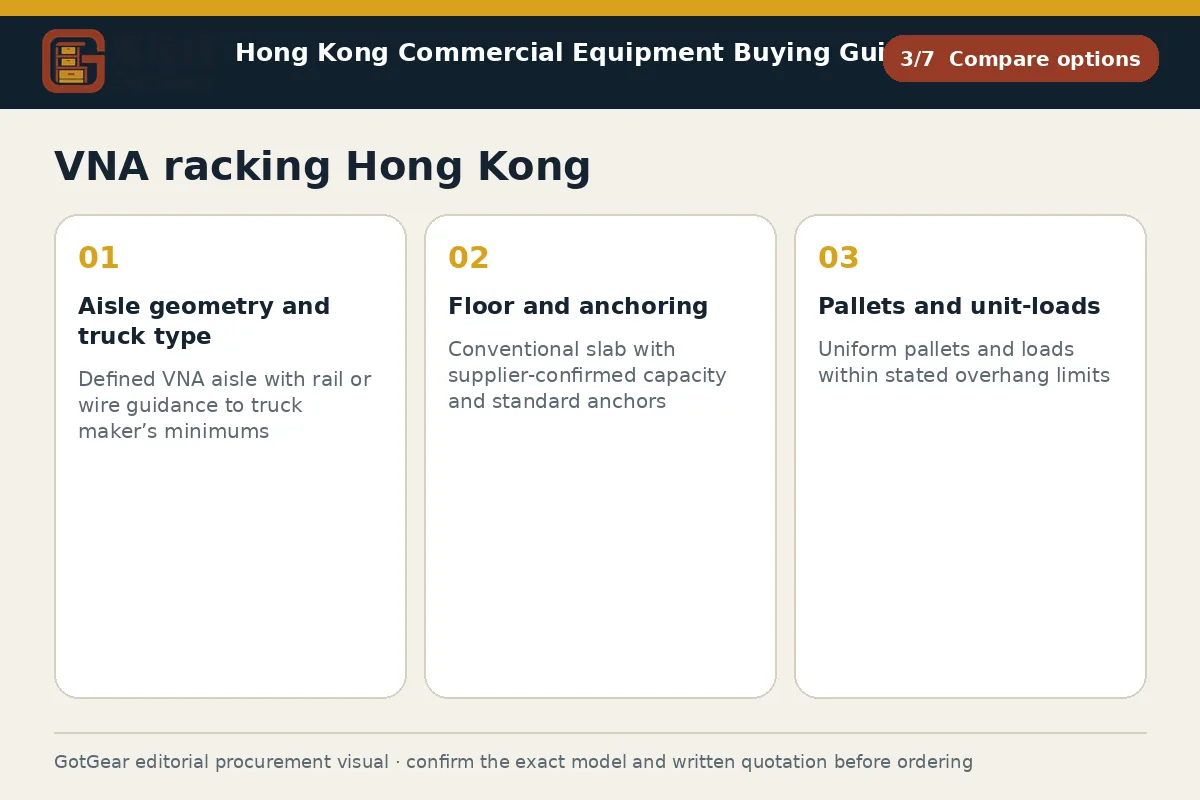
| Aisle geometry and truck type | Defined VNA aisle with rail or wire guidance to truck maker’s minimums | Mixed zones with articulated/VNA trucks and shared transfer areas | Measured aisle widths at floor and 1 m, truck datasheets, turning/overhang envelopes |
| Floor and anchoring | Conventional slab with supplier‑confirmed capacity and standard anchors | Post‑tensioned or mezzanine slab needing engineered anchors and landlord approval | Recent floor report, slab drawings, anchor layout and installer’s method statement |
| Pallets and unit‑loads | Uniform pallets and loads within stated overhang limits | Mixed sizes/conditions requiring guards, decking or adapters | L×W×H, weight, baseboard type, overhang; photos and worst‑case sample (example to confirm) |
| Selectivity and rotation | Single‑deep FIFO with direct pallet access | Blend of LIFO/FIFO using deep lanes and allocation rules | SKU‑to‑pallet ratio, ageing policy, lane‑depth rules and examples of demand profiles |
| Throughput and windows | Steady day‑shift flow with low congestion | Peaks, short loading windows and multi‑floor lift constraints | Hourly in/out by time band, carrier cut‑offs, lift capacity and queuing notes |
This framework helps buyers create comparable written enquiries. Final model specifications, availability, delivery and commercial terms must be confirmed in a formal quotation.
VNA racking Hong Kong: Double-deep racking comparison
Comparing VNA with double deep racking Hong Kong means trading aisle width and selectivity against depth and truck complexity. VNA single‑deep gives the highest selectivity per slot, ideal for many SKUs and disciplined FIFO. Double‑deep raises storage density by storing a second pallet behind the first, but reduces selectivity and typically runs LIFO per lane. Double‑deep requires deep‑reach trucks and more consistent pallet quality to reach the rear position without damage.
For a fair comparison, ask both options to quote on the same measured drawing and pallet file. Request capacity by bay and by level, selectivity per SKU family, expected travel cycles, and the reach‑truck or turret‑truck model assumed. Require the installer to confirm floor suitability, impact protection, and pick‑face guard details. If pure LIFO is acceptable for parts of the range, include drive-through racking Hong Kong as a reference case to pressure‑test the lane‑depth choice. Compare written quotations on like‑for‑like deliverables: GA drawings, load application data, anchor layout, beam and upright specifications, corrosion protection for humid areas, training scope, and commissioning tests. Note that whichever option you choose, the model specification and the supplier’s formal written quotation prevail.
VNA racking Hong Kong compared with push back racking Hong Kong
When you test push back racking Hong Kong against a VNA brief, focus on lane depth, turnover and pallet consistency. Push‑back uses nested carts or rollers on a slight incline and works best where several pallets of the same SKU move steadily, accepting LIFO within each lane. It offers higher face density than single‑deep but less selectivity; poor‑quality pallets or inconsistent baseboards can jam carts and slow picks.
Ask suppliers to state the approved pallet types, required runner stiffness and minimum fork clearance. Request lane depth and cart ratings, stop devices, anti‑rollback features, and maintenance access arrangements. Where offices sit beside the warehouse, request the expected noise level at the pick face, and propose guarding for public‑facing corridors if applicable. For Hong Kong’s humid summers, seek evidence of coatings, bearings and labels suitable for condensation‑prone areas. Require a witnessed acceptance test using your worst‑case pallets and shrink‑wrap, and a method statement for safe de‑jamming and cart retrieval. Compare this against the VNA layout’s throughput model, battery‑change plan and pedestrian management, then choose the system that meets your rotation discipline and documented building constraints.
VNA racking Hong Kong decision checklist
Start by measuring the building: clear height to the lowest service, usable floor bay sizes, lift car and doorway dimensions, and the access path to each floor. Capture pallet L×W×H, weight, overhang, baseboard style and worst‑case condition. Define throughput by hour, shift and carrier cut‑off, and list stock‑rotation rules. Issue the same drawing and pallet file to all bidders and request GA drawings, beam elevations, load application data, anchor plan and protection details. Ask for stated floor flatness needs and the test method. On receipt, inspect uprights, beams, locks and fixings for damage and grade marks, and confirm quantities against packing lists. Before handover, request training content, maintenance schedules, and manufacturer documentation for rated loads and components. The model specification and each supplier’s written quotation should govern the final decision.
- Operating use, quantity and expected frequency
- Dimensions, capacity, material and accessory requirements
- Delivery address, floor, goods lift and loading window
- Required documents, acceptance checks and after-sales arrangements
Key points for VNA racking Hong Kong, double deep racking Hong Kong, push back racking Hong Kong
Hong Kong warehouses often operate on upper floors with tight goods‑lift cars, narrow vehicle ramps and short loading windows set by building management. These constraints favour designs that minimise transfer moves and queueing at lifts. Confirm power availability and ventilation for battery charging, and check slab capacity against concentrated loads at guide‑rails and end‑of‑aisle protection. Landlord approval may be required for drilling anchors or installing guide‑rails; verify this before award. Humid coastal conditions and salt air near container berths can justify corrosion‑resistant finishes and sealed electronics. Agree bilingual labelling and handover documents with operations and the management office to speed approvals and training.
Questions about VNA racking Hong Kong
Can VNA be run without wire guidance?
Yes, VNA can use mechanical guide‑rails or camera/vision guidance instead of floor wire, depending on the truck model. Performance, aisle width and speed will vary by system, so ask the truck maker to state minimum aisle, stopping distances and any reflectors or rails required, then have the installer integrate those details into drawings and commissioning tests.
Is double‑deep suitable when I need some FIFO capability?
Double‑deep is inherently LIFO per lane, but you can achieve near‑FIFO by SKU assignment and disciplined lane management. That requires predictable replenishment, uniform pallets and clear procedures, and may still leave aged stock risk. Model SKU families and peaks, then compare a mixed design—single‑deep for FIFO SKUs and deep lanes for steady movers—on one drawing.
What if my pallets vary in size or condition across suppliers?
Varying pallets increase risk in deep‑reach and push‑back lanes; jamming and damage are more likely. Single‑deep VNA usually tolerates more variation, but only within stated clearances. Provide dimensions, weights, overhang and photos of typical and worst‑case pallets. Ask bidders to state acceptance limits and propose guards, decking or adapters where variation cannot be eliminated.
What information do suppliers need to scope work accurately in Hong Kong?
Provide measured drawings, clear heights, slab details, goods‑lift and doorway sizes, pallet and unit‑load data, hourly throughput by time band, and loading‑window rules from the management office. Add photos of access routes, notes on humidity or coastal exposure, and any landlord approval process. Request GA drawings, load data, and anchoring proposals in the formal quotation.
Continue with closely related procurement topics
These pages share equipment, operating or decision-stage signals with this guide.
Modular shelving Hong Kong
Compare usable height, picker travel, access and expansion when choosing between modular shelving Hong Kong and multi-tier shelving Hong Kong. Read practical layout guidance from GotGear.
Read the guide
Spare parts shelving Hong Kong
Use this maintenance, repair and operations checklist to compare sizes, weights, counts, pick rates and store layout for spare parts shelving Hong Kong and shelving for machinery parts Hong Kong. This checklist is from GotGear.
Read the guide
Drive-through racking Hong Kong
GotGear presents a practical checklist for drive-through racking Hong Kong. It guides consideration of two-sided access, stock flow patterns, pallet dimensions, lane depth, truck specifications and building layout.
Read the guide
AS/RS racking Hong Kong
GotGear in Hong Kong assesses the feasibility of AS/RS racking Hong Kong and mini-load storage system Hong Kong for distribution centres, examining loads, dimensions, throughput and control interfaces.
Read the guide