
Specify the bakery load, stacking arrangement, vehicle and trolley interfaces, delivery cycle and return process. Verify food-contact and cleaning suitability from manufacturer information.
Bread crates Hong Kong — Protect Loaves and Trays in Transit
Start by defining what must be protected: bagged loaves, bare loaves on trays, or full pans. Record the packed weight, the softest contact points, and where abrasion typically occurs. For bakeries searching for bread crates Hong Kong, note whether the priority is crust integrity, pan stability or bag protection. Ask suppliers to state wall stiffness, base deflection under load, and the radius of internal corners to reduce snagging. Surface finish matters; smooth interiors and rounded ribs reduce scuffing on bags and pastry. If condensation control is important, specify vent pattern and open-area percentage alongside any requirement for partial shielding from drafts during ferry or van runs.
Transit handling in Hong Kong often includes tight turns through goods lifts and kerbside transfers within narrow loading windows. To avoid crush damage, request interlocking details, stack stability data, and whether optional lids, straps or roll-cage interfaces are supported. If crates will ride on aluminium bakery trolleys, confirm base compatibility and how shock is transmitted across stacks on uneven pavements. Where routes combine warm bread with cooler ambient legs, ask manufacturers for guidance on moisture management and drying time between trips. Treat any example figures as starting points only and ensure the model specification and formal written quotation set the performance you will hold the supplier to.
Bread crates Hong Kong — Match Internal Geometry to the Bakery Load
Map the bakery load precisely before shortlisting models. Measure length, width and height of loaves, bags and trays with the intended orientation, and record overhangs such as clip-seals. Mark how many units per layer and the number of layers per crate you expect, then verify that the internal geometry avoids compressing corners or crust. For pans or mesh trays, check whether the base requires a smooth platform, cross ribs, or rails, and ask whether the crate supports pan lips without rocking. Provide photos and a dimensioned sketch with your enquiry.
Confirm how crates nest and stack: some nest when empty only if rotated; some require a lid to interlock when full. State the trolley, conveyor and van-shelf interfaces so suppliers can confirm base rib pitch and skid compatibility. Teams accustomed to milk crates Hong Kong will recognise the value of tight tolerances; apply the same discipline here to ensure stable stacks in goods lifts and on roll cages. If mixed SKUs share a route, request divider or tote-in-tote options and ask the manufacturer for a sample test to validate your layer plan on-site before committing.
What should buyers compare for bread crates Hong Kong?
| Criterion | Straightforward requirement | More complex requirement | Evidence to provide |
|---|---|---|---|
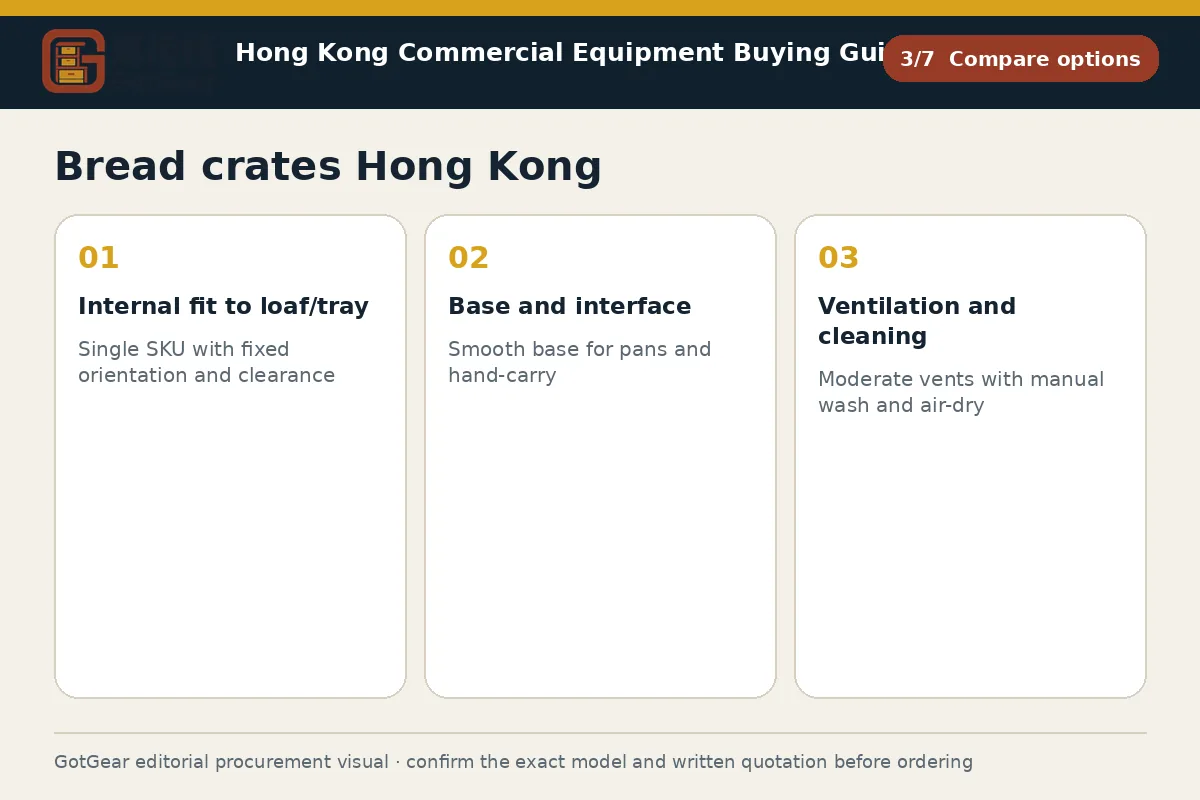
| Internal fit to loaf/tray | Single SKU with fixed orientation and clearance | Mixed SKUs with dividers or tote-in-tote approach | Provide L×W×H of loaves/bags/trays, orientation per layer, photos and a sketch |
| Base and interface | Smooth base for pans and hand-carry | Reinforced ribs for roll cages, conveyors and van shelves | State pan type, trolley rail spacing, vehicle floor interface and handling aids |
| Ventilation and cleaning | Moderate vents with manual wash and air-dry | High open area and drainage for tunnel wash and fast turnaround | Share wash temperature range, chemicals used, drying space and hygiene team needs |
| Stacking and transport | Fixed interlock, manual stacks in lift and van | Palletisation or roll-cage travel with tie-downs and lids | Declare stack height limit, lift dimensions, ramp angles and route handling steps |
| Identification and returns | Printed logo and barcode label plate | Embedded RFID, route coding and bilingual fields | Specify symbology, data fields, colour coding, return SOP and pooling rules |
This framework helps buyers create comparable written enquiries. Final model specifications, availability, delivery and commercial terms must be confirmed in a formal quotation.
Bread crates Hong Kong — Define Cleaning and Return Controls
Define washing and inspection as part of the specification, not an afterthought. Document the wash process you actually run: temperature range, contact time, approved detergents or sanitisers, rinsing pressure, and drying space available. Ask the manufacturer to confirm material compatibility, drainage features, and whether the vent geometry supports rapid drying. Obtain written food-contact suitability statements and cleaning guidance, ideally with a drawing showing radii, ribbing and open area so your hygiene team can risk-assess soil traps. If using tunnel washers, ask for maximum recommended conveyor speeds and any restrictions on stacking through wash.
Plan returns with the same care. State depot locations, backhaul options, and where empty stacks must pass through goods-lift doors or turn tight corners in older industrial buildings. Specify how many empty crates should nest per stack and the target stack height for safe manual movement; the supplier should confirm stability for that height. Build a simple quarantine and inspection step for damaged crates, and record the trigger for repair or retirement in a route SOP. Operations already managing plastic crate cleaning and sanitising Hong Kong will have procedures you can adapt; ensure the final, written procedure aligns with the selected model and that the quotation reflects any accessories needed for washing or returns.
Bread crates Hong Kong — Check Stacking, Identification and Route Handling
Stacking strength, identification and route handling determine whether crates behave reliably beyond the store room. Request the stack load rating and the interlock type, and ask how the design resists mis-stacking when drivers are moving quickly during short Hong Kong loading windows. If crates travel on roll cages, specify cage shelf spacing and the maximum height allowed by goods-lift doors and tenant corridors. For van and light-truck use, confirm tie-down options and whether lids or cross-straps are recommended for mixed loads and ferries.
Plan identification from day one. Choose a permanent marking set (moulded logo, hot-stamp, or label plate) and define readable barcode or QR positions that stay scannable when stacked. If you expect route pooling across institutions, ask about RFID tags and tamper-evident seals. Require bilingual label fields so branch teams and building-management offices can recognise ownership and return instructions. Coordinate with distribution on pre-departure counts, stack height limits and handling aids to protect staff. Organisations standardising returnable transport packaging in Hong Kong can align crate IDs, colour coding and SOPs across products; where seafood crates already circulate in Hong Kong, ensure colour and coding avoid cross-use. Final handling rules must be documented and confirmed in the written quotation.
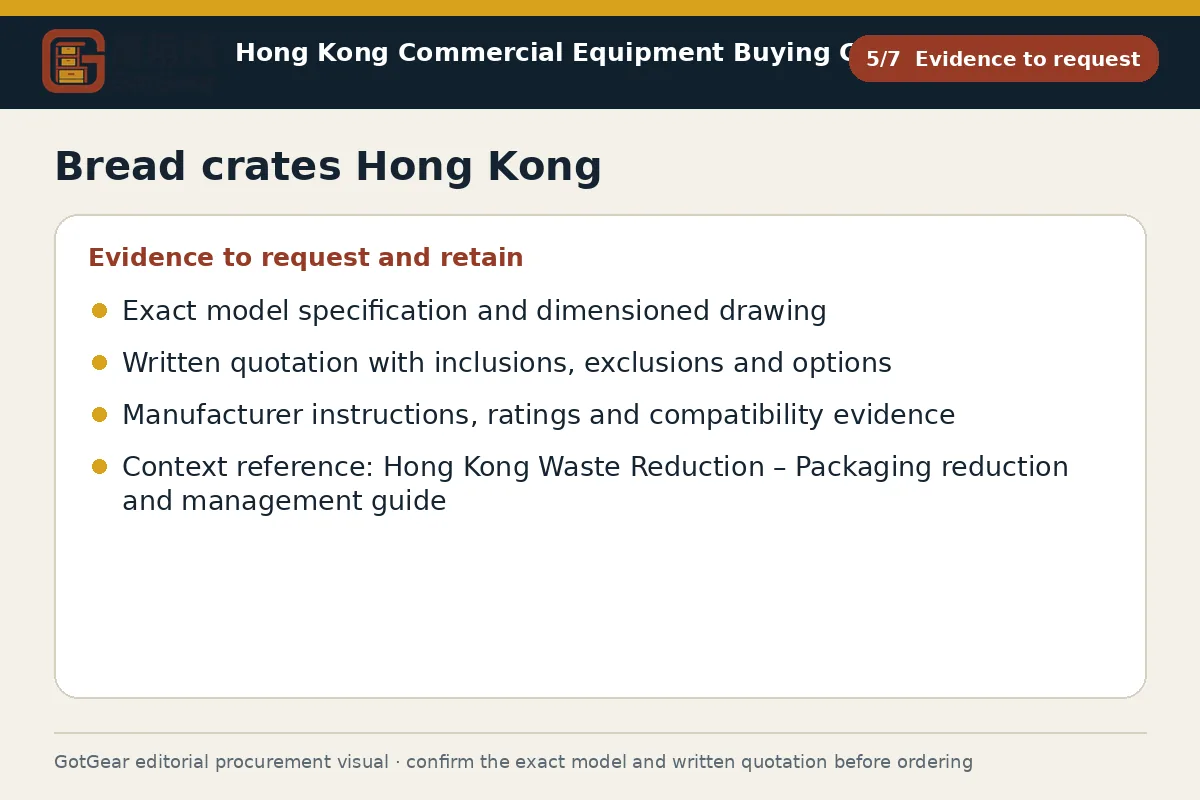
Bread crates Hong Kong decision checklist
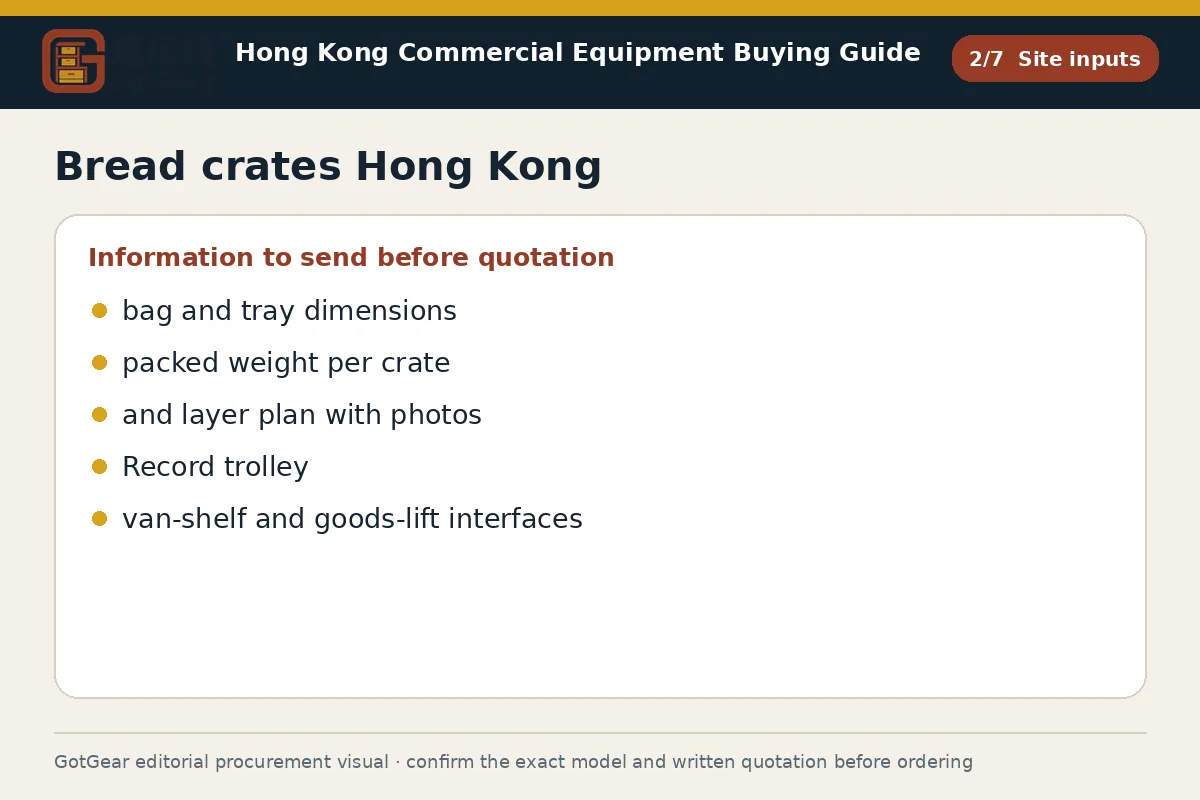
Capture loaf, bag and tray dimensions, packed weight per crate, and layer plan with photos. Record trolley, roll-cage, van-shelf and goods-lift interfaces, plus the tallest safe stack at each site. State venting and surface finish needs to protect crusts and bags. Document your wash process, chemicals and drying space, then ask the manufacturer to confirm compatibility, food-contact suitability and drainage. Define identification: logo method, barcode or RFID, and bilingual fields. Set returns and quarantine steps, including nesting height and damage triggers. Request drawings with internal geometry and interlock details, plus load and stack ratings. Compare written quotations line-by-line for material, base type, vents, accessories and delivery terms. The final model specification and the supplier’s formal quotation must prevail over any examples noted in this planning checklist.
- Operating use, quantity and expected frequency
- Dimensions, capacity, material and accessory requirements
- Delivery address, floor, goods lift and loading window
- Required documents, acceptance checks and after-sales arrangements
Key points for bread crates Hong Kong
Hong Kong bakery distribution faces tight goods-lift sizes, narrow service corridors and short kerbside loading windows. When specifying crates, confirm stack height against actual lift doors and route clearances, and plan for sudden weather shifts and high humidity that challenge drying. Some routes include ferries or steep ramps into industrial buildings, so interlocks and tie-downs matter. Bilingual markings help building-management officers and drivers route empties back correctly. Treat any example figures as starting points only; model specifications, building constraints and formal written quotations should prevail, and specific approvals may be required by individual venues or insurers.
Questions about bread crates Hong Kong
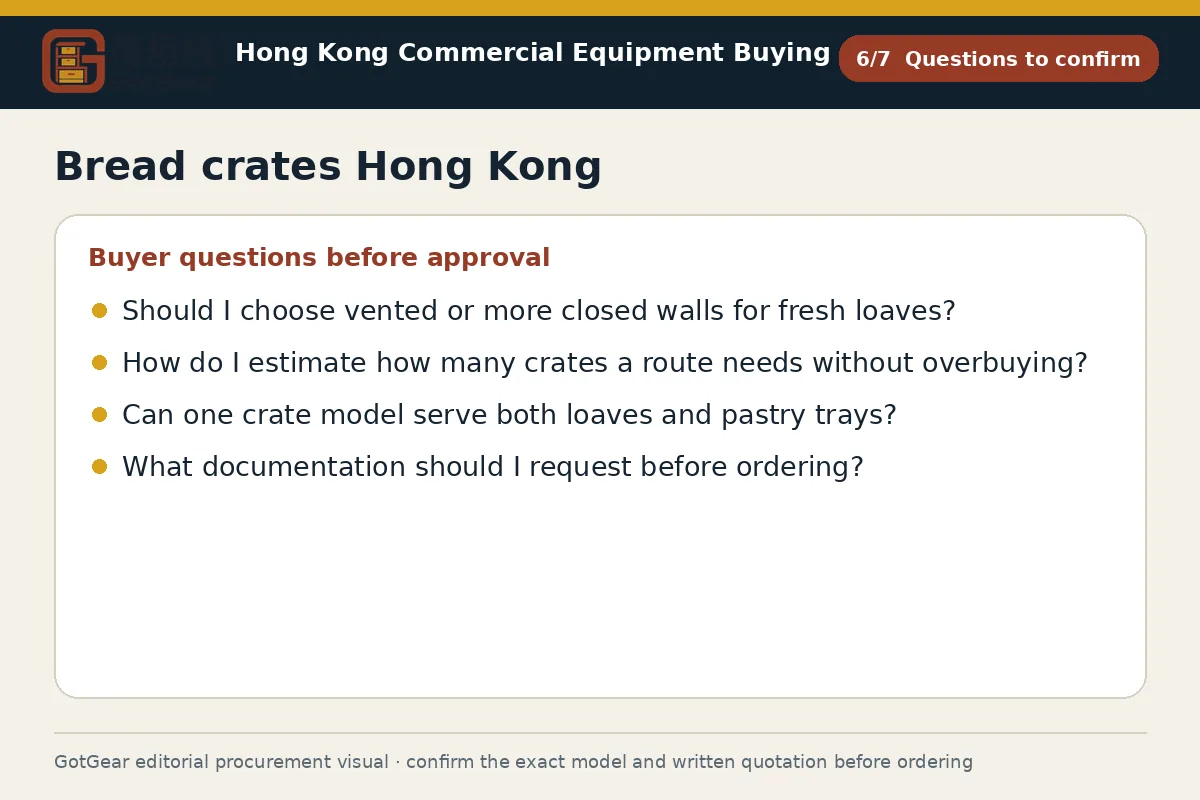
Should I choose vented or more closed walls for fresh loaves?
Use vented walls and bases when you need airflow to cool and manage condensation, especially on warm routes. Choose more closed patterns if drafts risk drying crusts or scuffing bag surfaces. The right balance depends on your route temperature swings and wash-drying capacity; ask the manufacturer to confirm open-area percentage, drying guidance and material compatibility with your in-house cleaning process.
How do I estimate how many crates a route needs without overbuying?
Start with the layer plan per SKU and expected turns per shift, then add a buffer for washing and returns. Map each route’s stack height limit, lift constraints and backhaul timing to size the fleet. Treat any fleet-size figure as a starting estimate and confirm it in your written brief; the supplier’s model specification and formal quotation should finalise counts and accessories.
Can one crate model serve both loaves and pastry trays?
It can, if the base supports trays without rocking and the internal geometry protects bagged loaves. Ask for drawings showing rib pitch and corner radii, and test-fit with your pans. Confirm cleaning guidance for flour and fat residues and check that identification fields can separate allergen routes. Final suitability should be verified by an on-site trial and confirmed in the supplier’s quotation.
What documentation should I request before ordering?
Ask for a dimensioned drawing, stated material grade, food-contact suitability, load and stack ratings, cleaning compatibility, and interlock details. If using scanning, request barcode/label plate specifications and any RFID options. Bilingual marking samples help with building management. Ensure the written quotation reflects all agreed specifications and accessories; any example figures discussed should be validated in your own brief and site tests.
Continue with closely related procurement topics
These pages share equipment, operating or decision-stage signals with this guide.
Plastic pallet for airport cargo Hong Kong
GotGear provides a checklist for plastic pallet for airport cargo Hong Kong so air-cargo handlers can record cargo profile, handling equipment, transfer points, restraint, inspection, operating limits and compatibility.
Read the guide
Milk crates Hong Kong
GotGear provides a practical checklist for milk crates Hong Kong, covering bottle and carton dimensions, typical filled weight, internal support and stacking pattern. It also outlines the cleaning and empty return process.
Read the guide
Seafood crates Hong Kong
GotGear provides a checklist for seafood crates Hong Kong that compares drainage, containment, pack weight, temperature control, cleaning, stacking and cold-chain transfers for wet loads.
Read the guide
Perforated Euro containers Hong Kong
GotGear provides a checklist to compare perforated Euro containers Hong Kong and vented plastic crates Hong Kong for food handling and cold chain, covering airflow, drainage, containment and cleaning considerations.
Read the guideRelated topic indexOpen more English procurement pages2 topics
Browse additional equipment families, applications and procurement questions relevant to a wider buying brief.