
Define local colour rules and validate washing and sanitising methods against the previous contents, manufacturer instructions, site conditions and relevant requirements.
Reusable plastic crates Hong Kong: Identify and Sort Returnable Crate Assets
Procurement teams evaluating reusable plastic crates in Hong Kong should first map how assets will be identified the moment they re-enter your site. Build a simple visual hierarchy: colour first, then a large human‑readable code, then barcode/2D and, where justified, RFID. Set plastic-crate colour-coding rules that are consistent across Hong Kong locations, and issue a brief stating colour purpose, bilingual label text, minimum character height, barcode symbology and placement. Request from suppliers: moulded colour options, pigment UV stability, texture that accepts labels, recessed label plates, embossing zones and recommended cleaning‑resistant adhesives. Ask for sample panels to test scanner readability at your actual dock lighting and typical scan distance (for example, 40–60 cm, to be confirmed in your site trial).
Plan the sort area before buying. Measure inbound chute height, table space and the distance between return point and wash staging so colour cues remain visible in stacked nests. Specify crate external length/width/height, nesting ratio, and safe stack height when full and when empty (example: 8 high on a level pallet, to be confirmed in the manufacturer’s data). Confirm that codes remain readable when crates are nested. Where food flows mix, agree a colour that avoids confusion with adjacent loops such as food distribution crates Hong Kong or seafood crates Hong Kong, and record the rules in your bilingual SOPs.
Reusable plastic crates Hong Kong — Assign Ownership and Acceptance Criteria
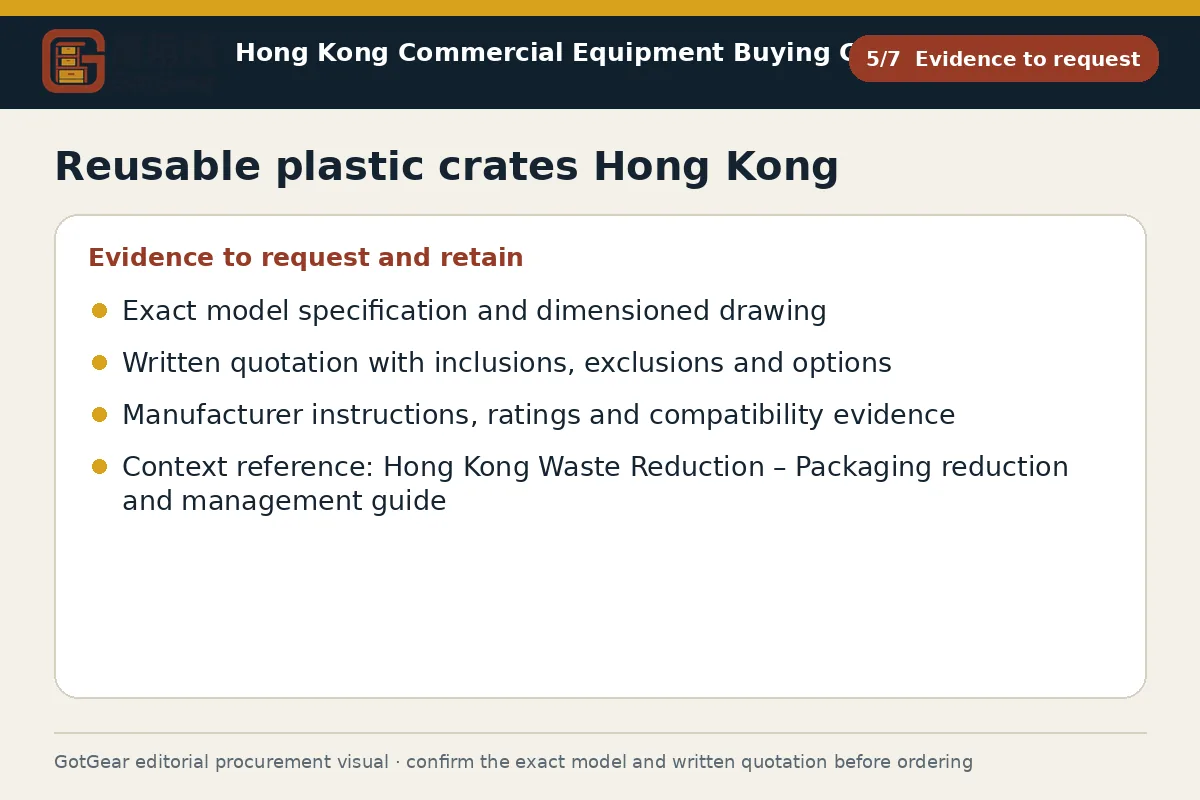
Assign ownership for every leg of the loop and write acceptance criteria that the receiving party can check without tools. Define the handover record: date/time, location, counted quantities, crate IDs (range or scan file), and named signatories. Acceptance checks might include: exterior soil level, odour, evidence of chemical residues, structural cracks, locking-tab integrity and label legibility. Set thresholds with examples (e.g., reject if any lip crack exposes sharp edges), but state that the model specification and the written quotation prevail. Provide bilingual pass/fail descriptors and photo references to keep rejections consistent across shifts.
Clarify who carries risk and cost for loss, late return or contamination. If a distributor returns mixed loops, require sealed liners or tags per batch and specify how exceptions are recorded. Request from suppliers: recommended maximum load per crate and per stack, acceptable wash temperatures and an ownership/marking method that survives cleaning. For reusable plastic crates, Hong Kong buyers should also confirm with building management how and where deliveries are receipted, who can sign for returns, and when contested handovers are escalated. Keep these rules published in your purchase orders and service instructions so there is one source of truth during audits.
What should buyers compare for reusable plastic crates Hong Kong?
| Criterion | Straightforward requirement | More complex requirement | Evidence to provide |
|---|---|---|---|
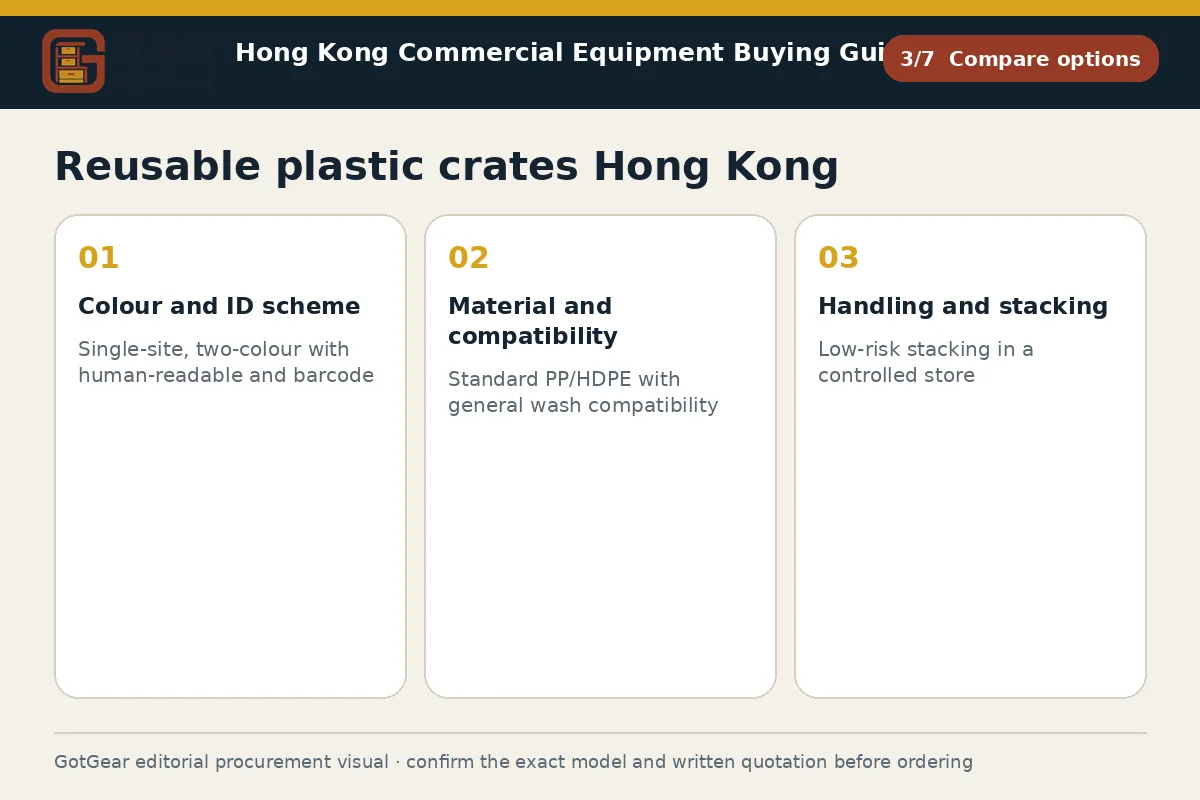
| Colour and ID scheme | Single‑site, two‑colour with human‑readable and barcode | Multi‑site palette with bilingual text, 2D and optional RFID | Provide colour rules, code placement drawings, and scanner distance in metres |
| Material and compatibility | Standard PP/HDPE with general wash compatibility | Documented compatibility with specific chemicals and example temperatures | Share prior contents, chemicals used, and request manufacturer cleaning notes |
| Handling and stacking | Low‑risk stacking in a controlled store | Mixed stacks, mobile handling and lift transport between floors | State max stack examples, lift dimensions and pallet policy; confirm supplier data |
| Label durability | Basic adhesive labels on smooth panels | Recessed label plates, embossed IDs and laminated labels | Provide test plan: cycles, wash settings, and acceptance photos for legibility |
| Tracking and records | Manual counts per batch | Scanned IDs with status codes and exception logging | Submit status list, file format for reconciliations, and bilingual exception reasons |
This framework helps buyers create comparable written enquiries. Final model specifications, availability, delivery and commercial terms must be confirmed in a formal quotation.
Reusable plastic crates Hong Kong: Define Cleaning and Release Steps for Returnable Crates
Define the path from “soiled return” to “released to issue” in timed, observable steps. Sort by prior contents before washing; the method for sticky seafood residues will differ from dry grocery dust, so route seafood crates Hong Kong separately from food distribution crates Hong Kong or retail distribution totes Hong Kong. Document plastic crate cleaning and sanitising Hong Kong methods suitable for each residue class and the crate material. Ask the manufacturer for cleaning compatibility guidance, including chemical types to avoid, example maximum temperatures and recommended drying approaches; validate these details on your site with your chosen chemicals and water quality. Confirm drainage, splash containment and ventilation at the wash area with your building manager.
Create hold points that prevent premature release: pre‑wash inspection, post‑wash visual check, dryness check and final sign‑off. In humid weather, air‑drying can be slow; plan forced airflow or dehumidified storage and verify that labels remain adhered after repeated wet cycles. Agree measurable release criteria such as dry‑to‑touch at representative points, readable codes and no residual odour, noting that any sampling frequency cited is an example starting point to be confirmed by your competent adviser. Keep batch records listing washer settings used, chemicals, operator initials and the crate ID range, and file the manufacturer’s washing guidance alongside your SOP.
Reusable plastic crates Hong Kong — Record Loss, Damage and Cycle Status
Decide how you will record loss, damage and cycle status before the first crate leaves your site. Standard statuses should include: in service, in transit, soiled, awaiting wash, quarantined for inspection, released, damaged–repairable and damaged–retire. Choose an ID technology that matches your operating speed and lighting, and specify in procurement the ID field location, 2D code window size, embossing depth and any RFID cavity. Ask suppliers for sample pieces to test scanner performance through shrink‑wrap and on moving belts. Define damage categories with photos (for example, corner crush, rim chip, base warp) and the associated action.
On receipt of new stock, count and inspect: colour match, surface finish, burrs, flatness of base, nesting fit and label‑plate dimensions. Photograph any variance and reference the model code from the written quotation; that document prevails in case of dispute. Record new crates in your asset register with opening quantities per site and assign them to loops in your system. Where returns are shared across partners using returnable transport packaging Hong Kong, agree a monthly reconciliation file format and bilingual exception notes. For replenishment, compare quotations on unit spec, marking method, spare lids or fittings, delivery windows feasible for your building, and evidence of after‑sales support for replacement parts or labels.
Reusable plastic crates Hong Kong decision checklist
Confirm your colour and ID hierarchy, then request supplier data on mould colours, UV stability, label‑plate dimensions and any RFID/2D options. Measure your sort and wash spaces, lift and door clearances, and the distance scanners must read. Ask the manufacturer for cleaning compatibility notes and example limits, and validate them under your water, chemicals and humidity. Define ownership at each handover with bilingual pass/fail criteria and photo examples. In written quotations, compare model codes, dimensions, nesting and stacking statements, marking services, delivery windows and after‑sales support. On receipt, count and inspect finish, base flatness and code areas, and file variance photos against the quotation. Publish release steps, quarantine reasons and loss/damage categories so every return follows the same path.
- Operating use, quantity and expected frequency
- Dimensions, capacity, material and accessory requirements
- Delivery address, floor, goods lift and loading window
- Required documents, acceptance checks and after-sales arrangements
Key points for reusable plastic crates Hong Kong, plastic crate colour coding Hong Kong, plastic crate cleaning and sanitising Hong Kong
Hong Kong operations must plan for narrow goods lifts, tight dock slots and humid conditions that slow drying. Measure lift car and doorway clearances and confirm pallet size policies with building management before ordering. Many industrial buildings restrict washing noise, water use and discharge; check your venue’s drainage and cleaning‑chemical rules in writing. Coordinate release and delivery with management‑office loading windows and security sign‑in requirements. Where public‑event sites are involved, align crate identification with venue accreditation and bilingual labelling policies. This page offers practical procurement points; always confirm model specifications, site approvals and any authority guidance relevant to your operation before implementation.
Questions about reusable plastic crates Hong Kong
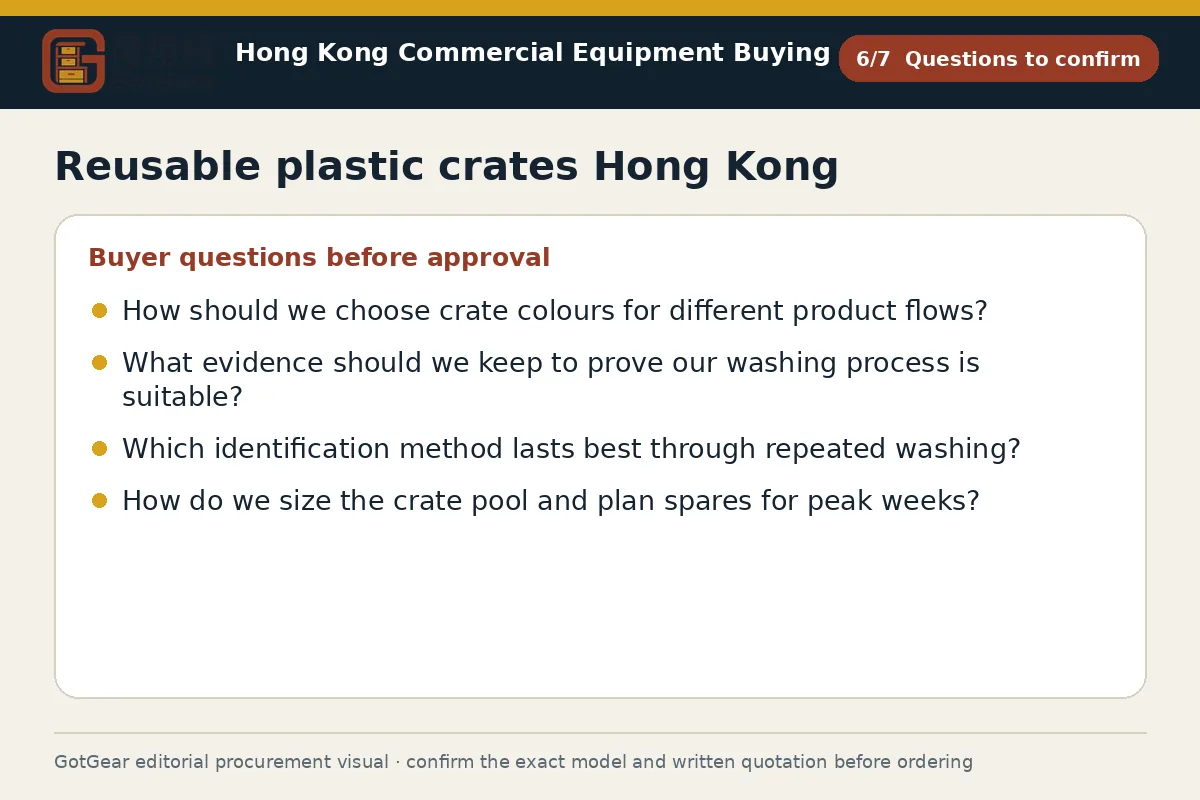
How should we choose crate colours for different product flows?
Pick a small, unambiguous palette tied to product risk and route, then keep it consistent across all locations. Test visibility in your actual lighting and confirm no clashes with adjacent loops. Treat any example mapping (e.g., chilled vs ambient) as a starting point only, and document bilingual rules and label placement that match the chosen crate model’s features.
What evidence should we keep to prove our washing process is suitable?
Keep the manufacturer’s cleaning compatibility guidance, your validated wash settings, chemical data, and batch records linking crate IDs to cycles. Where you use swab or odour checks, record results and corrective actions. Any temperature, time or sampling frequency you trial is an example starting point and must be confirmed by your competent adviser for your exact site and model.
Which identification method lasts best through repeated washing?
Moulded colour plus recessed plates with laminated labels or direct embossing typically endure better than surface stickers. Validate in your washer with your chemicals and drying conditions, and check scanner performance through nests and wrap. Ask the supplier for sample panels and written advice on adhesives and materials proven compatible with the proposed crate resin and finish.
How do we size the crate pool and plan spares for peak weeks?
Map the full cycle time from issue to clean release and add contingency for building loading windows and weather‑related drying delays. Use a conservative example buffer only as a starting point and refine it with measured return data. Confirm storage capacity, lift constraints and partner handover timetables before finalising quantities, and let the written quotation’s model specs govern.
Continue with closely related procurement topics
These pages share equipment, operating or decision-stage signals with this guide.
Plastic pallet stacking safety Hong Kong
GotGear explains plastic pallet stacking safety Hong Kong, plastic pallet load stability Hong Kong and plastic pallet anti-slip surface Hong Kong. It also recommends a unit-load checklist to check restraint, support and handling.
Read the guide
Perforated Euro containers Hong Kong
GotGear provides a checklist to compare perforated Euro containers Hong Kong and vented plastic crates Hong Kong for food handling and cold chain, covering airflow, drainage, containment and cleaning considerations.
Read the guide
Recycled plastic pallets Hong Kong
Use this procurement checklist to inspect recycled plastic pallets Hong Kong by verifying material evidence, load and handling practices, cleaning and reuse protocols, damage control and end-of-use routes. Contact GotGear.
Read the guide
Plastic pallets for cold storage Hong Kong
Plastic pallets for cold storage Hong Kong: GotGear provides a checklist to compare temperature range, unit load capacity, handling, cleaning and condensation risks to help select suitable pallets for cold chain operation.
Read the guideRelated topic indexOpen more English procurement pages3 topics
Browse additional equipment families, applications and procurement questions relevant to a wider buying brief.