
What should organisers test before doors open? Estimate arrival peaks, define each registration step, size holding space and plan lane changes; keep recycling points clear of queues and exits, then verify accessibility, fire precautions and venue rules.
Event recycling and queue management Hong Kong — Forecast peaks and service capacity
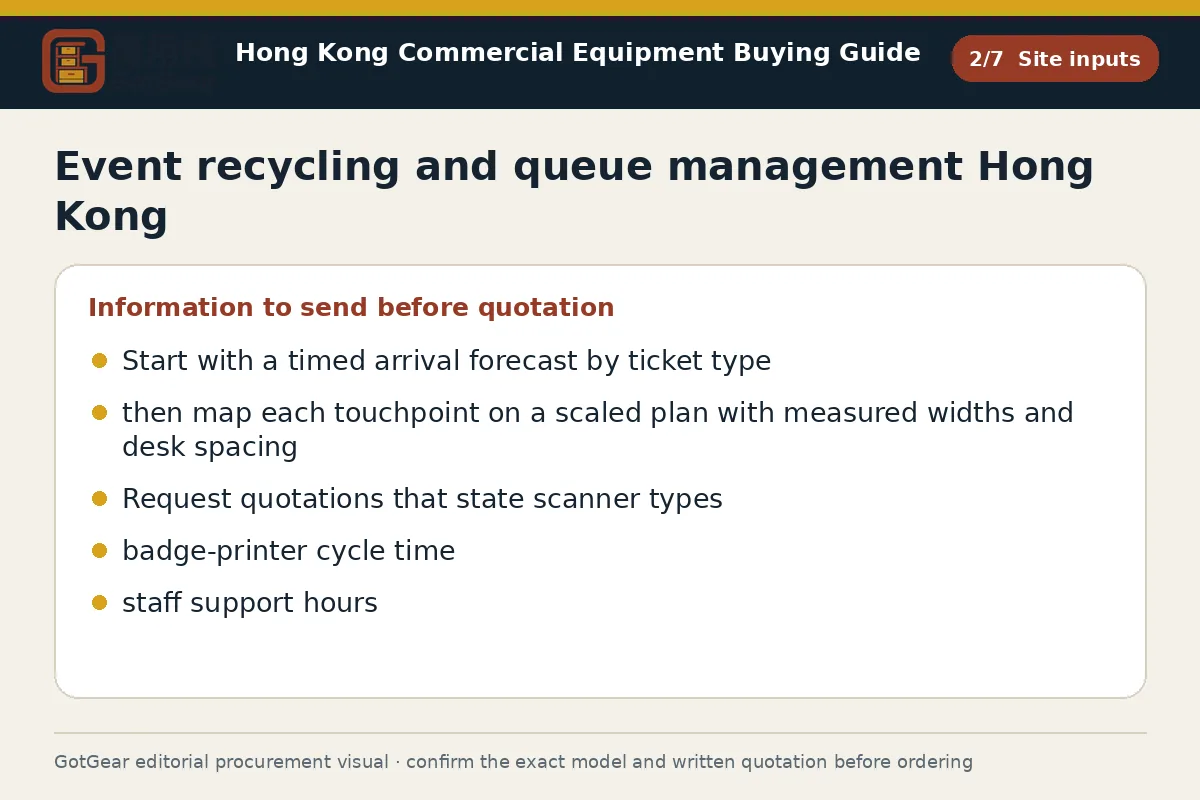
When planning event recycling and queue management in Hong Kong, organisers should forecast arrival peaks, processing capacity and holding space on one scaled plan. Segment arrivals by ticket type, time slot, transport mode, and exhibitor/visitor/staff groups. Map touchpoints in order (security check, bag search if used, badge scan/print, wristband, lanyard pick-up, payment if applicable) and measure the distance between them to avoid backflows. As an example starting point only, assume a single trained registrar with pre-registered QR scanning might process 5–8 people per minute; on‑site data entry and badge printing may reduce that. All figures must be confirmed in writing by the responsible supplier and venue.
Record field measurements: foyer width and pinch points; door-leaf clear width; column centres; ceiling obstructions; power outlets; fixed signage; and the maximum queue length before blocking lifts, escalators or retail frontages. Ask suppliers to state in quotations: assumed throughput, scanner types (1D/2D, optical range), badge-printer cycle time and consumables, desk depth and cable routing, and any staff training or on-site support included. Request separate lines for delivery and set‑up labour, confirm building-management loading windows, and state that the model specification and the formal written quotation prevail over verbal estimates.
Event recycling and queue management Hong Kong: Test Registration Steps at Event Scale
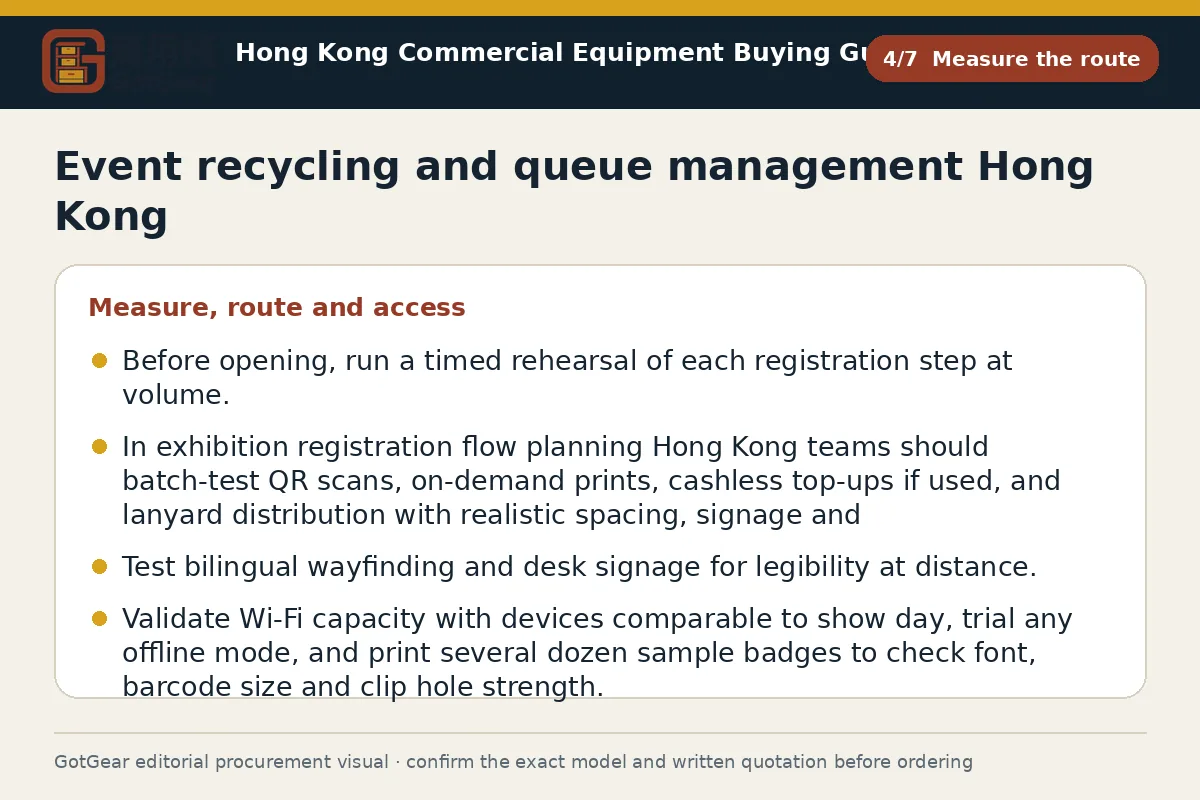
Before opening, run a timed rehearsal of each registration step at volume. This guidance applies to exhibition registration flow planning Hong Kong. Teams should batch-test QR scans, on‑demand prints, cashless top‑ups if used, and lanyard distribution with realistic spacing, signage and noise. Test bilingual wayfinding and desk signage for legibility at distance. Validate Wi‑Fi capacity using devices comparable to those on show day, trial any offline mode, and print several dozen sample badges to check font, barcode size and clip hole strength.
Procurement actions: request a test plan from each technology vendor, with firmware versions and reader settings noted; ask for sample consumables (lanyards, badge stock) and recommended printer duty cycles. Require the quotation to detail on‑site support hours, escalation contacts and replacement device availability during show time. Capture stopwatch timings for each step and update the scaled plan. Review the Hong Kong guidance on crowd‑management queue layout to confirm lane geometry supports the measured processing time. Where personal data is processed, confirm with the organiser and the venue what notices or approvals are required; any documentation should be venue- or organisation‑specific and confirmed by the responsible party.
What should buyers compare for event recycling and queue management Hong Kong?
| Criterion | Straightforward requirement | More complex requirement | Evidence to provide |
|---|---|---|---|
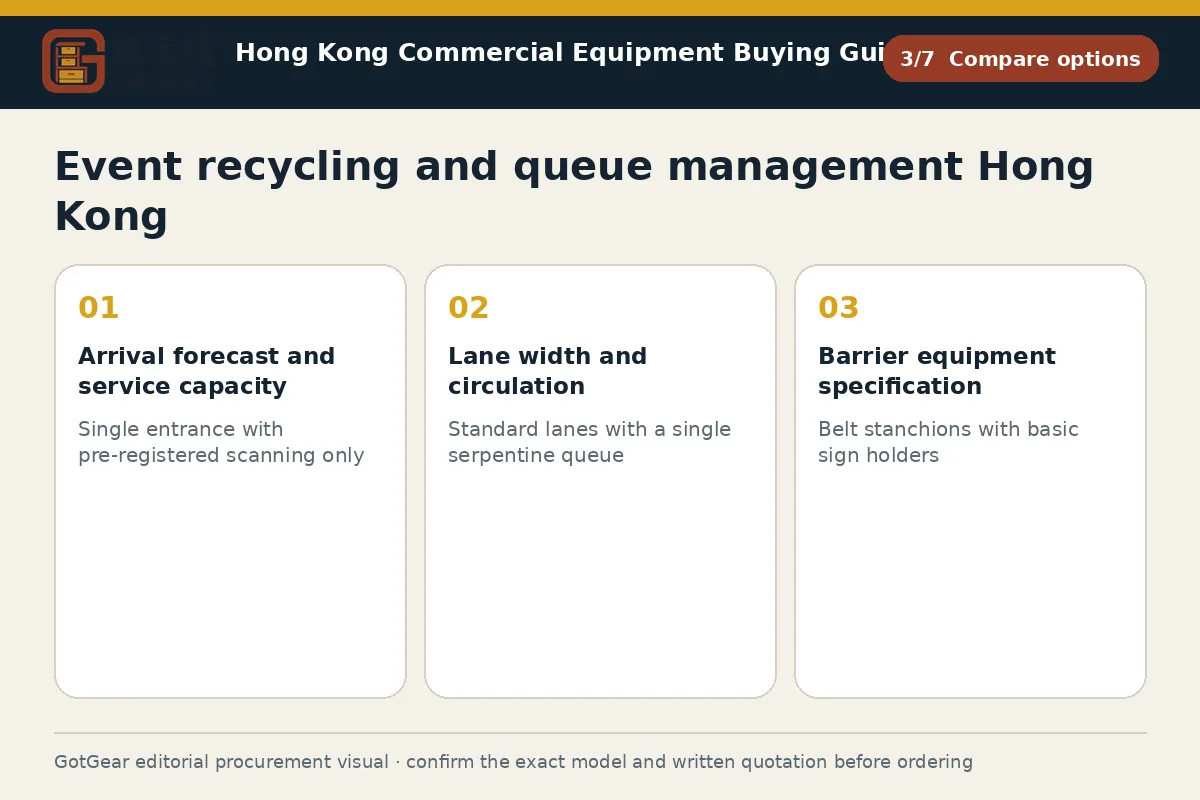
| Arrival forecast and service capacity | Single entrance with pre‑registered scanning only | Multiple entrances with mixed pre‑reg and on‑site data entry, badge print and payment | Provide timed forecast by cohort, assumed scan/print rates, and peak window rationale |
| Lane width and circulation | Standard lanes with a single serpentine queue | Accessible lane, turn‑bays, express/on‑site split and cross‑flow control | Scaled plan with measured widths, turn areas, door swing arcs and photos of pinch points |
| Barrier equipment specification | Belt stanchions with basic sign holders | Rigid panels, anti‑trip feet, non‑marking bases and lane‑change clips | Manufacturer data sheets: base weight/diameter, belt length/braking, materials; any fabric insert info |
| Registration technology and power/data | Handheld scanners at fixed desks | On‑demand badge printers, tablets, UPS and managed Wi‑Fi or wired drops | Vendor throughput figures, power layout, SSID/VLAN details, and support hours in quotation |
| Recycling and safety clearances | Standalone bins on bypass route | Multi‑stream station with decals, lids and attendant at peak | Station layout with distances from exits, capacities, sample signage artwork and venue approval email |
This framework helps buyers create comparable written enquiries. Final model specifications, availability, delivery and commercial terms must be confirmed in a formal quotation.
Event recycling and queue management Hong Kong: Place Queue Barriers Without Obstructing Circulation
Barriers should shape movement without blocking circulation, sightlines or fire routes. A practical queue barrier layout for Hong Kong registration events places turn bays away from exits, keeps crossover points short, and separates express and on-site registration to reduce lane switching. Maintain at least one accessible route with generous turning space at desks; confirm wheelchair turning radii and counter heights with the venue. Keep recycling points on bypass routes so a person disposing of material never intersects the live queue. Use the queue barrier emergency exit clearance for Hong Kong, and consult the guidance to check hold-lines against exit swing arcs and alarm panels.
Procurement actions: in your enquiry, specify barrier type (belt stanchion or rigid panel), base diameter and weight, belt length and braking, panel height and infill type, and whether non-marking bases or floor protection are needed on polished stone. Request data sheets and manufacturer guidance for indoor/outdoor use and cleaning in humid conditions. Ask suppliers to include sign holders, lane-change clips and storage trolleys if required, and to state any tools needed for rapid reconfiguration. Cross-check against the crowd control barrier safety checklist for Hong Kong before ordering. For signage and any fabric inserts, ask for the manufacturer’s material information; any fire-retardant claims or approvals should be confirmed as required by the venue, insurer or competent adviser.
Event recycling and queue management Hong Kong — Prepare contingencies and live monitoring
Even robust plans need live adjustment. Agree trigger points to open overflow lanes, split queues by ticket type, or divert to a secondary entrance. Assign a floor manager to monitor arrivals, desk utilisation and queue length, using handheld counters or a simple dashboard if your system offers one. Prepare spare scanners, printer ribbons and batteries; brief staff on rapid lane changes and on how to reseat belts or panels safely. In wet weather, deploy mats and drip trays so water does not track into scanning areas.
Procurement actions: request spare cassette belts and battery packs in the quotation, plus a named hotline during show hours. Ask the venue management office to confirm radio channels, any method statement requirements and permissible attachment points for overhead signage. Include a note on typhoon or black rain arrangements (e.g., protected queuing indoors) agreed with the venue. Position recycling on bypass routes with clear decals; the event recycling station setup Hong Kong (guidance) helps size streams and signage. All contingency quantities and timings are example starting points only and must be confirmed in writing with suppliers and the venue.
Event recycling and queue management Hong Kong decision checklist
Start with a timed arrival forecast by ticket type, then map each touchpoint on a scaled plan with measured widths and desk spacing. Request quotations that state scanner types, badge‑printer cycle time, staff support hours, barrier base weight and belt length, and storage. Compare vendors on throughput assumptions, power/data drops and reconfiguration hardware. Measure lobby pinch points, door swings, lift cabins and column centres; keep exits and alarm panels clear. Place recycling on bypass routes with bilingual signs. Inspect deliveries for correct quantities, undamaged belt cassettes, level bases and non‑marking feet; test a sample stanchion and printer before set‑up. Obtain manufacturer data sheets, and any venue‑requested method statement or materials information. Treat all example timings as starting points pending written confirmation in the final specification and quotation.
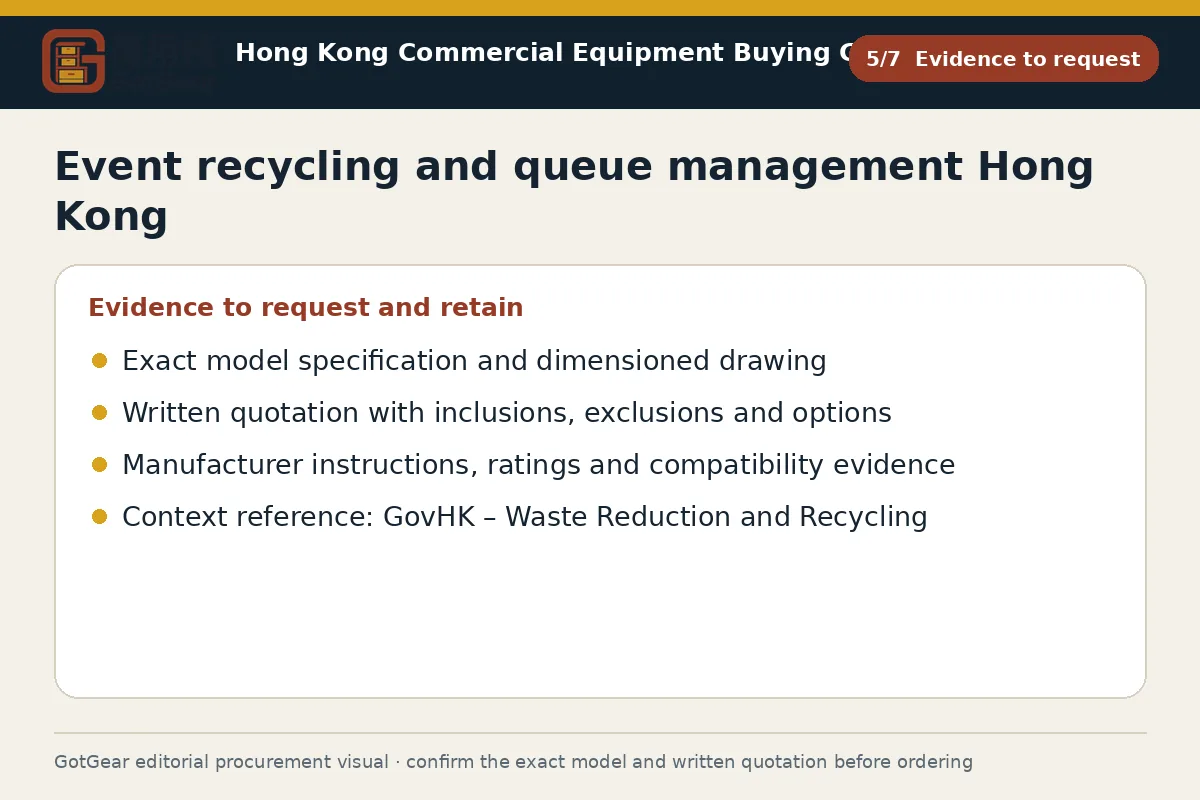
- Operating use, quantity and expected frequency
- Dimensions, capacity, material and accessory requirements
- Delivery address, floor, goods lift and loading window
- Required documents, acceptance checks and after-sales arrangements
Key points for event recycling and queue management Hong Kong, queue barrier layout for Hong Kong registration events, exhibition registration flow planning Hong Kong
Hong Kong venues often have tight lobbies, narrow service corridors and strictly scheduled loading windows managed by the building office. Confirm goods‑lift cabin size, turning space and any escort policy before ordering barriers, panels and trolleys. Many foyers are polished stone; request non‑marking bases and floor protection. Humidity and heavy rain can affect adhesive signage and paper badges, so specify materials accordingly. Public‑event controls vary by venue; clear fire‑exit sightlines, bilingual wayfinding and accessible counter heights should be validated against venue instructions. Treat any operational practice here as planning guidance, not legal advice, and follow the written rules set by the venue, organiser, insurer or competent adviser.
Questions about event recycling and queue management Hong Kong
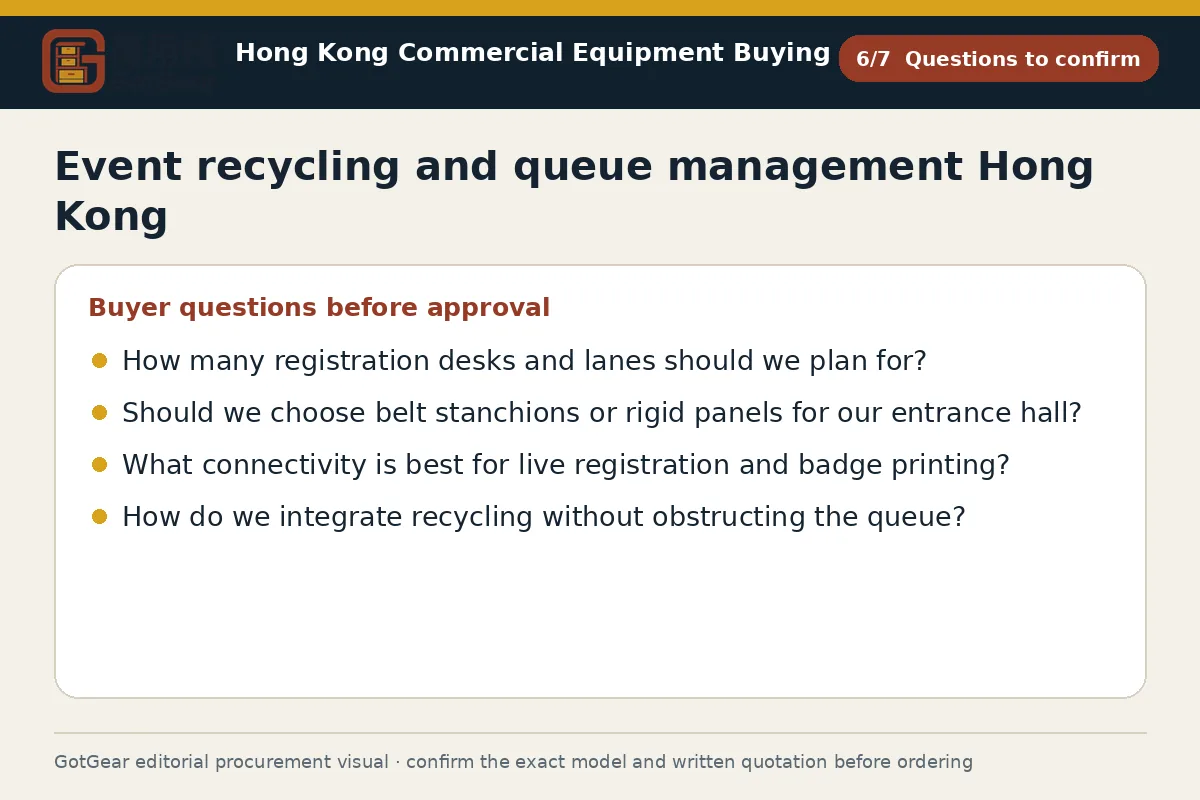
How many registration desks and lanes should we plan for?
Start from timed tests: measure scan and print cycles, then size desks and lanes to match your peak arrival window. As an example starting point only, one pre‑registered scan lane might process 5–8 people per minute; on‑site data entry will be slower. Final numbers must be confirmed with your technology vendor and venue in writing.
Should we choose belt stanchions or rigid panels for our entrance hall?
Belt stanchions reconfigure quickly and store compactly; rigid panels provide stronger visual segregation and wind resistance for semi‑open foyers. Outdoors or in draughty atria, request heavier bases, anti‑trip feet, and corrosion‑resistant finishes if specified by the manufacturer. Ask suppliers to document base weight, belt length, panel stability and any usage limits; venue rules prevail.
What connectivity is best for live registration and badge printing?
Wired links are typically more stable; enterprise Wi‑Fi works if channels, capacity and roaming are engineered for your device count. Ask vendors for a spectrum survey, dedicated SSID and offline workflows if connectivity drops. Confirm with the venue what power outlets and network hand‑off are available, and who provides on‑site support during opening hours.
How do we integrate recycling without obstructing the queue?
Place stations on bypass routes, not within the live lane, with clear bilingual signs and lids that match the waste contractor’s streams. As an example starting point only, size capacity for your first 60–90 minutes of peak arrivals, then confirm with the venue’s cleaning schedule and contractor instructions. Keep clear of exits, alarm panels and lift doors.
Continue with closely related procurement topics
These pages share equipment, operating or decision-stage signals with this guide.
Event recycling station setup Hong Kong
GotGear has a checklist for event recycling station setup Hong Kong covering disposal points, servicing and signage. It includes recycling station signage for Hong Kong events and visitor direction signage for Hong Kong events.
Read the guide
How to store food off the floor in a Hong Kong commercial kitchen
GotGear explains how to store food off the floor in a Hong Kong commercial kitchen with raised shelving. Use the commercial kitchen food storage checklist Hong Kong to plan your restaurant back-of-house storage layout Hong Kong.
Read the guide
Manual handling risk assessment for warehouse trolleys Hong Kong
When should a Hong Kong warehouse use a trolley instead of manual carrying? GotGear has manual handling risk assessment for warehouse trolleys Hong Kong and warehouse trolley route planning Hong Kong.
Read the guide
Warehouse shelving access aisle planning Hong Kong
Consult our practical guide to warehouse shelving access aisle planning Hong Kong to review inventory handling, aisle clearances and emergency access. View the warehouse shelving layout checklist Hong Kong at GotGear.
Read the guideRelated topic indexOpen more English procurement pages4 topics
Browse additional equipment families, applications and procurement questions relevant to a wider buying brief.