
For crowd control barrier safety checklist Hong Kong, record observations, required actions and the person responsible for approving the arrangement. Verify each barrier’s manufacturer instructions, current site conditions and applicable Hong Kong requirements, escalating any unresolved safety or legal question to the responsible competent party.
Map routes and pinch points with crowd control barrier safety checklist Hong Kong
Begin by walking the actual arrival, waiting, service and departure routes during the operating hours that correspond to expected peaks. Use the crowd control barrier safety checklist Hong Kong to mark pinch points such as lift lobbies, turnstiles, stair heads, payment counters and security gates. Measure clear widths at door leaves, escalator landings and goods‑lift cars; note the narrowest point and any floor transitions. Record floor type and slope, likely queue length ranges by time band, and locations where trolleys, wheelchairs or strollers must pass without diversion.
Sketch a simple route plan over a scaled floor drawing, or photograph key areas and annotate with tape‑measured dimensions and arrows. Identify cross‑flows from washrooms, exits or retail tenants, and set target holding areas that do not block fire equipment, plant rooms or management‑office access. List practical constraints: delivery windows, shared loading bays, noise limits for crowd announcements, and bilingual sign needs. If demand surges are likely from nearby public transport or school dismissals, plan temporary overflow channels and steward points. For complex flows, request a supplier proposal that references your measured widths, forecast headcounts and any existing posts, bases or wall receivers. Align your map with any crowd management queue layout Hong Kong, as issued by the venue or organiser.
Record stability and communication checks in crowd control barrier safety checklist Hong Kong
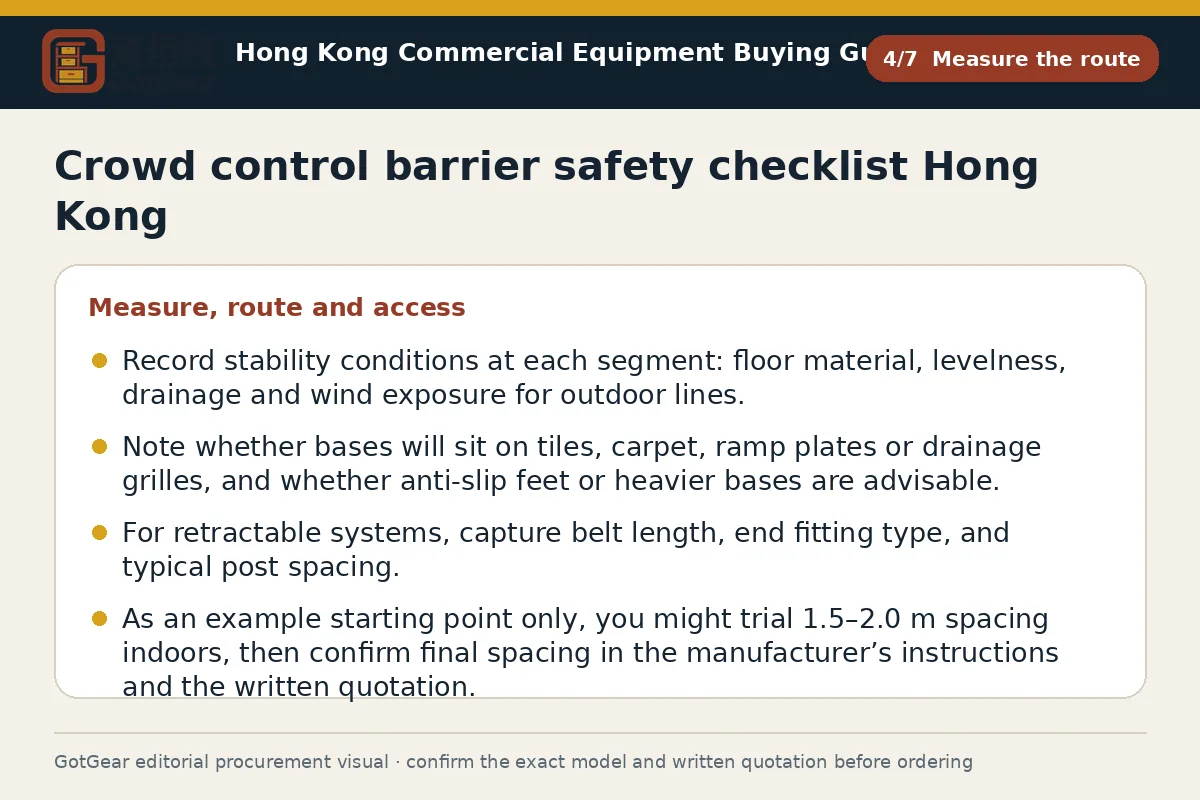
Record stability conditions at each segment: floor material, levelness, drainage and wind exposure for outdoor lines. Note whether bases will sit on tiles, carpet, ramp plates or drainage grilles, and whether anti‑slip feet or heavier bases are advisable. For retractable systems, capture belt length, end fitting type, and typical post spacing. As an example starting point only, you might trial 1.5–2.0 m spacing indoors, then confirm final spacing in the manufacturer’s instructions and the written quotation. Photograph obstacles where end receivers or low‑profile bases would reduce trip risk.
Document communication requirements alongside mechanical checks. Specify bilingual queue‑start, wait‑time and accessibility messages; identify who updates them and where signs mount without blocking sightlines. If you use PA or handheld radios for surge messaging, note coverage dead spots. Record model numbers, serials (if present) and the location of spares. Log inspection results for belt retraction, locking, post straightness, base fixings and visible corrosion risk, referring to any retractable belt barrier inspection checklist Hong Kong used by your team. Keep a space in your checklist for manufacturer care guidance, tightening torques and any conditional instructions for humid or marine‑air environments, so your site routine respects the supplier’s recommendations.
What should buyers compare for crowd control barrier safety checklist Hong Kong?
| Criterion | Straightforward requirement | More complex requirement | Evidence to provide |
|---|---|---|---|
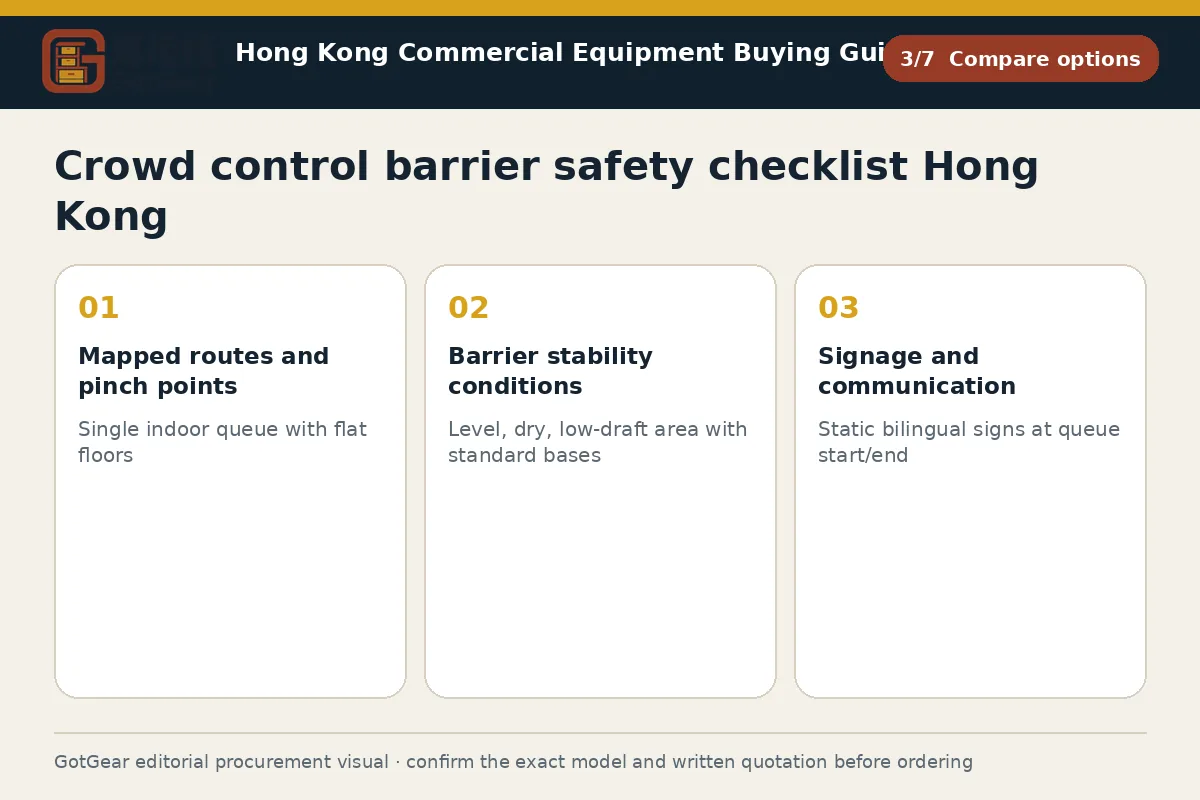
| Mapped routes and pinch points | Single indoor queue with flat floors | Multi‑stage flows across lifts, stairs and cross‑traffic | Scaled plan with measured widths, photos of pinch points, time‑band demand notes |
| Barrier stability conditions | Level, dry, low‑draft area with standard bases | Slopes, outdoor wind, drainage grilles or marine air | Manufacturer spacing guidance, base type/weight, floor notes, test‑build photos |
| Signage and communication | Static bilingual signs at queue start/end | Dynamic updates via PA/radio and steward positions | Artwork samples, mounting method, languages, update responsibility and locations |
| Emergency access and egress | Clear path past doors and equipment | Shared corridors and variable exit modes for events | Annotated clearance dimensions, venue management acceptance, escalation contact |
| Specification and compatibility | Standard retractable posts and belts | Mixed freestanding and wall‑receiver endpoints | Model codes, finish/material, belt length/width, end type, receiver compatibility list |
This framework helps buyers create comparable written enquiries. Final model specifications, availability, delivery and commercial terms must be confirmed in a formal quotation.
Review placement and signs in crowd control barrier safety checklist Hong Kong
Stand at each door, gate and counter and test the queue shape with posts or tape before committing to a full build. Mark where the first and last post sit, how the belt approaches door swings, and where sightlines to service points remain clear. Specify sign holders at eye level for wayfinding arrows and capacity notes. Where an exit must remain clear, reference your venue’s practice on queue barrier emergency exit clearance Hong Kong and capture measured distances on plan and photo. If wheelchair or stroller routes diverge from the main snake, show the bypass and its re‑entry point to the service counter.
Convert findings into procurement language. State required base types (low‑profile, rubber‑protected, weighted), belt length and width, finish (example: satin stainless or powder‑coated colour, subject to supplier codes), and anti‑tamper end fittings. For fixed points, indicate walls that can accept receivers and note any “retractable belt barrier wall receiver Hong Kong” compatibility. If combining freestanding and wall‑mounted lines, request drawings that show belt heights and end‑receiver positions. Ask suppliers to confirm corrosion resistance for humid plant‑room corridors, and to advise on outdoor storage covers for event sites. Compare written quotations like‑for‑like: model codes, material grade, base weight and footprint, belt print language(s), included sign frames, receiver hardware, and any assembly tools. Align placement with your crowd management queue layout Hong Kong and save annotated diagrams for approvals.
Assign decisions from crowd control barrier safety checklist Hong Kong
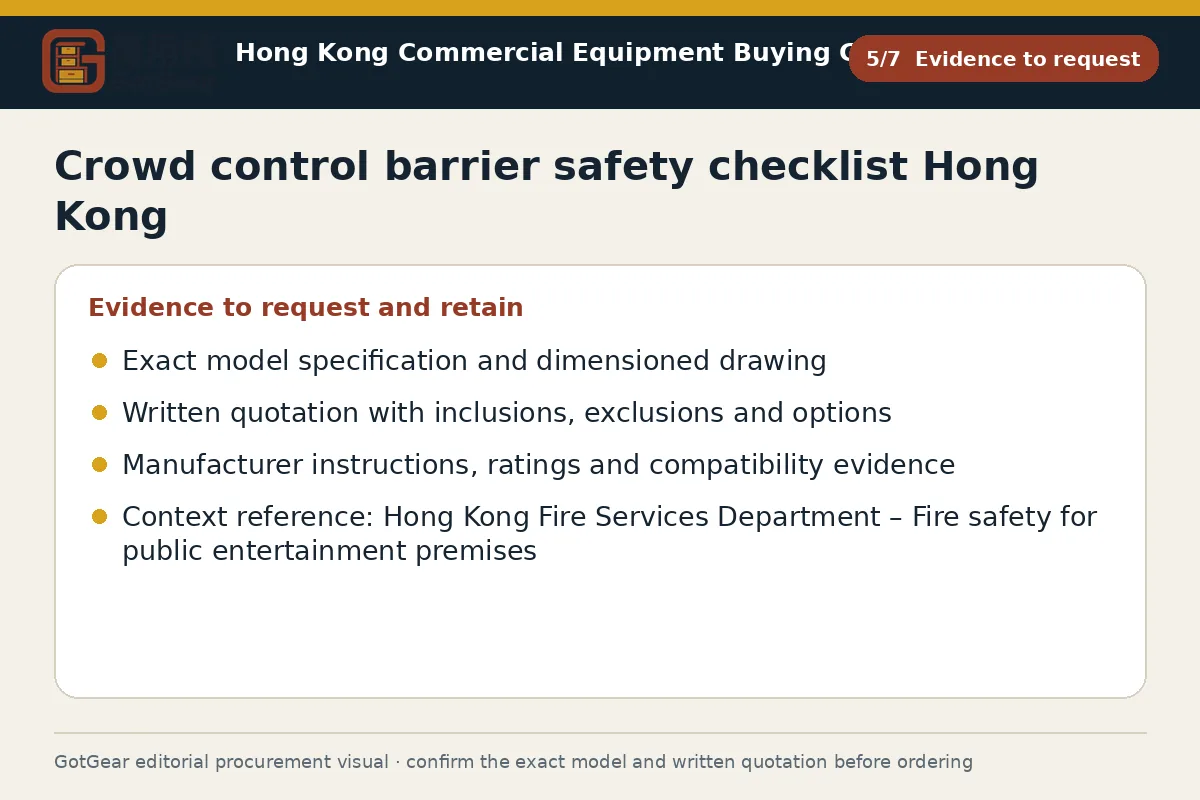
Assign named decision owners for each route: one to accept the measured layout, one to approve safety notes, and one to release the purchase order. In your record, tie every observation to a required action, an owner and a target date, with a field for the final sign‑off by the competent party responsible for safety at the venue. Capture version control on drawings and keep a list of unresolved queries awaiting a supplier, manufacturer, building manager or insurer response. Flag any legal or regulatory uncertainty for escalation via the venue’s established process.
Before ordering, state the evidence you expect: product data sheet, assembly and care instructions, confirmation of end‑receiver compatibility, and any statements the supplier offers on materials and stability under your described conditions. At delivery, inspect bases and posts for dents, loose fasteners, belt fray and slow retraction; test a sample build in the intended area, then log any corrective actions. Coordinate loading‑bay slots and goods‑lift dimensions with building management, and plan bilingual briefing notes for stewards. File all documents with the purchase record so future checks can trace what was bought, what was approved and who is responsible for any change.
Crowd control barrier safety checklist Hong Kong decision checklist
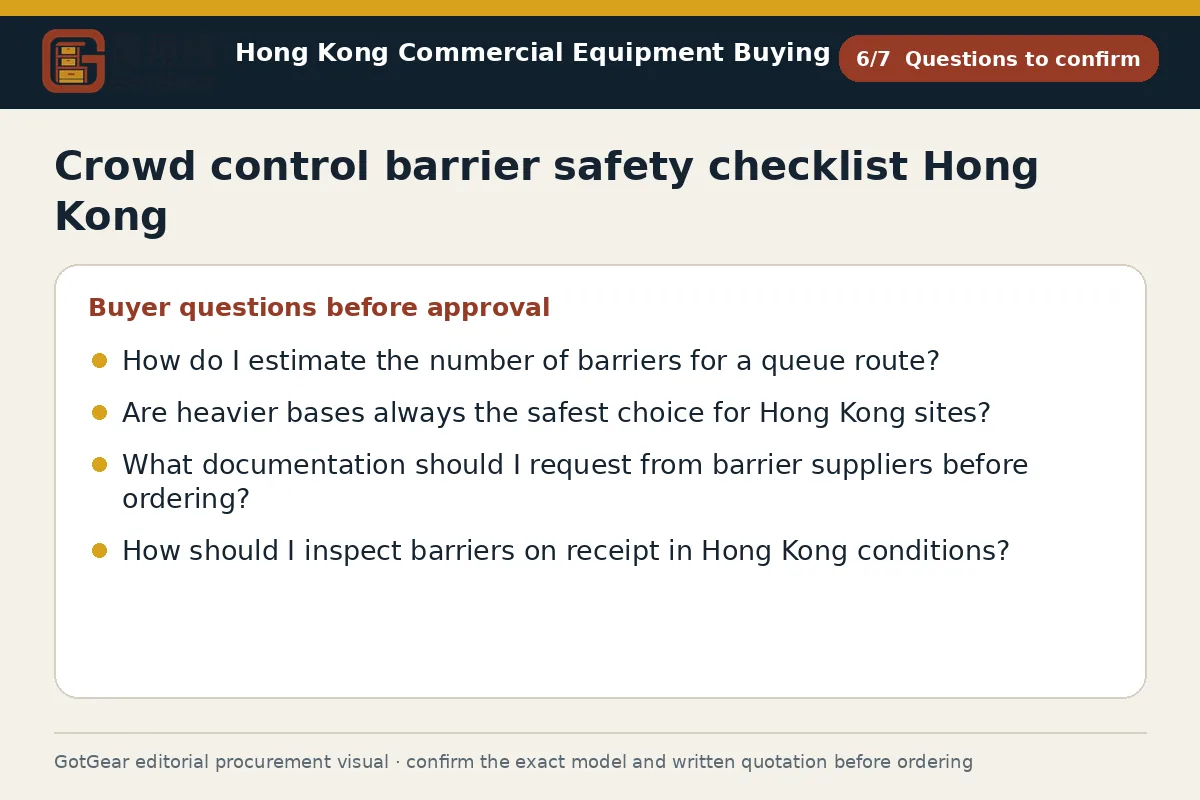
Start with a timed walk‑through of arrival, waiting, service and departure paths, measuring the narrowest points and floor changes. Sketch the queue shape on a scaled plan and photograph pinch points. Record surface, slope, wind exposure and any accessibility bypass. Define base type, belt length, finish and end‑receiver compatibility, then request product data sheets and care instructions in writing. Ask suppliers to confirm spacing guidance for your site conditions and to mark any limitations. Compare quotations line‑by‑line by model code, materials, base weight and included sign frames. Agree delivery routes, goods‑lift sizes and loading windows with building management. On receipt, inspect belts, posts and bases, assemble a test bay and log issues. Assign named approvers for safety, layout and procurement; escalate unresolved questions to the responsible party before final sign‑off.
- Operating use, quantity and expected frequency
- Dimensions, capacity, material and accessory requirements
- Delivery address, floor, goods lift and loading window
- Required documents, acceptance checks and after-sales arrangements
Key points for crowd control barrier safety checklist Hong Kong
Hong Kong venues must balance tight back‑of‑house routes, narrow goods‑lift cars and short loading windows with sudden footfall swings from MTR interchanges and weather‑driven surges. Humid, saline air accelerates corrosion, so finishes and care instructions should match site exposure. Many premises operate under management‑office procedures for deliveries, signage and emergency access; secure written acceptance before deployment. Keep bilingual messaging consistent with house style. This page supports practical planning only and does not replace advice from a competent person or applicable local requirements.
Questions about crowd control barrier safety checklist Hong Kong
How do I estimate the number of barriers for a queue route?
Measure the total route length and divide by your planned post spacing, then add corner and spare posts. As an example starting point only, trial 1.5–2.0 m spacing indoors and tighter at bends, then confirm with the manufacturer’s instructions and your venue’s approval. Final counts should be validated on a test build using actual floor conditions.
Are heavier bases always the safest choice for Hong Kong sites?
Heavier bases typically improve stability, especially outdoors or on sloped floors, but they increase handling strain, goods‑lift load and storage footprint. Choose weight, footprint and base protection to match your measured conditions and housekeeping regime. Ask the manufacturer to confirm stability guidance for your belt length and spacing, and consider low‑profile bases for narrow egress paths.
What documentation should I request from barrier suppliers before ordering?
Ask for a product data sheet, assembly and care instructions, finish/material specifications, and confirmation of end‑receiver compatibility. Where offered, request statements on corrosion resistance for humid sites and any tested stability guidance for your described spacing. Secure written quotations that list model codes, base weights, belt length/width and included accessories so you can compare like‑for‑like.
How should I inspect barriers on receipt in Hong Kong conditions?
Open cartons carefully, check bases and posts for dents, loose fixings and coating defects, and test belt retraction, locks and end fittings. Assemble a small run on the actual floor to confirm stability and spacing. Wipe off condensation, look for early signs of corrosion in humid areas, and photograph any issues to document discussions with the supplier or venue.
Continue with closely related procurement topics
These pages share equipment, operating or decision-stage signals with this guide.
Queue barrier emergency exit clearance Hong Kong
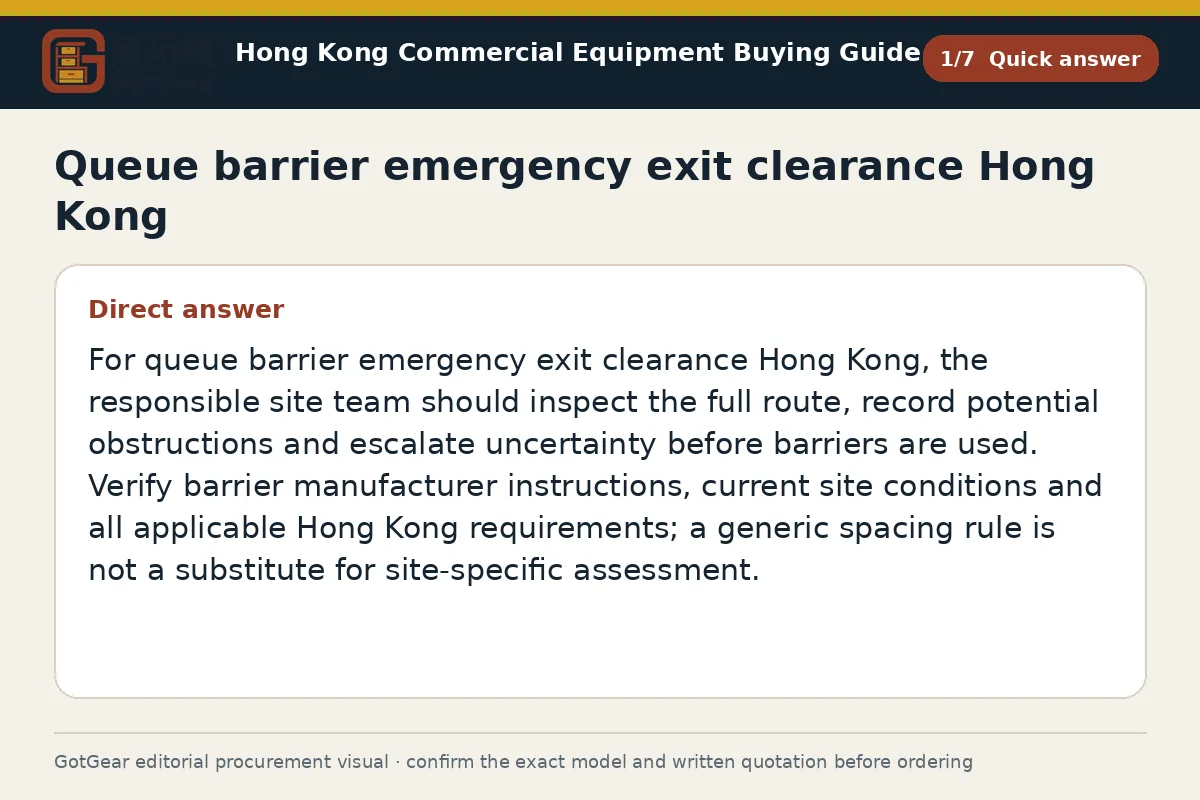
GotGear explains queue barrier emergency exit clearance Hong Kong by mapping routes and testing positions, noting obstructions and flagging issues. It also advises regular condition checks and following manufacturer guidance.
Read the guide
Retractable belt barrier inspection checklist Hong Kong
Use a retractable belt barrier inspection checklist Hong Kong to inspect posts, bases, belts and connections on site. Record dated findings and assign follow-up actions for routine maintenance and site records with GotGear.
Read the guide
Stanchion belt replacement cartridge Hong Kong
Stanchion belt replacement cartridge Hong Kong: GotGear explains how to identify the correct unit by post model, interface, belt length, connection end and fault.
Read the guide
Retractable belt barrier wall receiver Hong Kong
Before quoting a retractable belt barrier wall receiver Hong Kong, confirm belt end orientation, mounting surface, receiving point and the quantities required. Verify manufacturer guidance and site conditions with GotGear.
Read the guideRelated topic indexOpen more English procurement pages1 topics
Browse additional equipment families, applications and procurement questions relevant to a wider buying brief.