
For crowd management queue layout Hong Kong, test the proposed route under the site conditions in which it will operate and record the assumptions behind capacity and signage. Before use, verify barrier manufacturer instructions, emergency routes and all applicable Hong Kong requirements with the responsible site team.
Map arrivals and service points for crowd management queue layout Hong Kong
Start with a walk-through at opening, mid-peak and closing to see how customers arrive from pavements, car parks, MTR exits and goods-lift lobbies, and how they leave. Note the first decision points: ticket machines, reception, kiosks, counters and self-service. Sketch these on a scaled plan and mark staff intervention points for priority, wheelchair and pram access. When planning a crowd-management queue layout in Hong Kong, capture where groups tend to pause (menu boards, branch directories) and where line-of-sight is poor.
Measure door clear widths, vestibule depths, pillar offsets, lift car sizes and turning circles. Record floor gradients and drainage grates that could affect post stability. Mark fire doors and keep-out zones from the outset; document the queue-barrier emergency-exit clearance for Hong Kong on the plan for management-office review. For procurement, convert the sketch into a lane schedule: proposed lane width, estimated belt run per segment, number of turns, wall receivers required, and storage footprint when equipment is not in use. Photograph each constraint and label the images by location. Add coordination notes such as building access windows, trolley routes from storage to site, and any requirement for bilingual messaging at the arrival point so quotations can reflect real conditions rather than idealised drawings.
Record capacity assumptions for crowd management queue layout Hong Kong
Write down your capacity logic before ordering equipment so every later change is traceable. As an example starting point only, you might assume 0.6–0.8 m of linear space per waiting person and 1.2 m for wheelchairs or trolleys; confirm these working figures with your venue or adviser. Note assumed arrival peaks by time band, service times at each counter, typical group sizes and how many active positions you expect to open. Keep a log of external triggers that surge demand (paydays, school hours, ferry delays, show times) so you can justify contingency lanes.
Convert the assumptions into equipment requirements. On the enquiry, specify the target holding capacity in people and the total linear queue length needed to meet that capacity under your spacing assumption. State preferred lane width, minimum post spacing, whether wall receivers are acceptable, and if slow-retract belts and lockable ends are required. List finish (e.g., stainless or powder-coated), base type and weight category, belt colour/message, and compatible sign frames. Include a scaled plan with dimensions, annotated photos and the operating environment (indoor, semi-covered, outdoor). Ask suppliers to return written quotations referencing model numbers, belt lengths per post, accessories, delivery lead-time examples and any limits; state clearly that the final model specification and the written quotation prevail.
What should buyers compare for crowd management queue layout Hong Kong?
| Criterion | Straightforward requirement | More complex requirement | Evidence to provide |
|---|---|---|---|
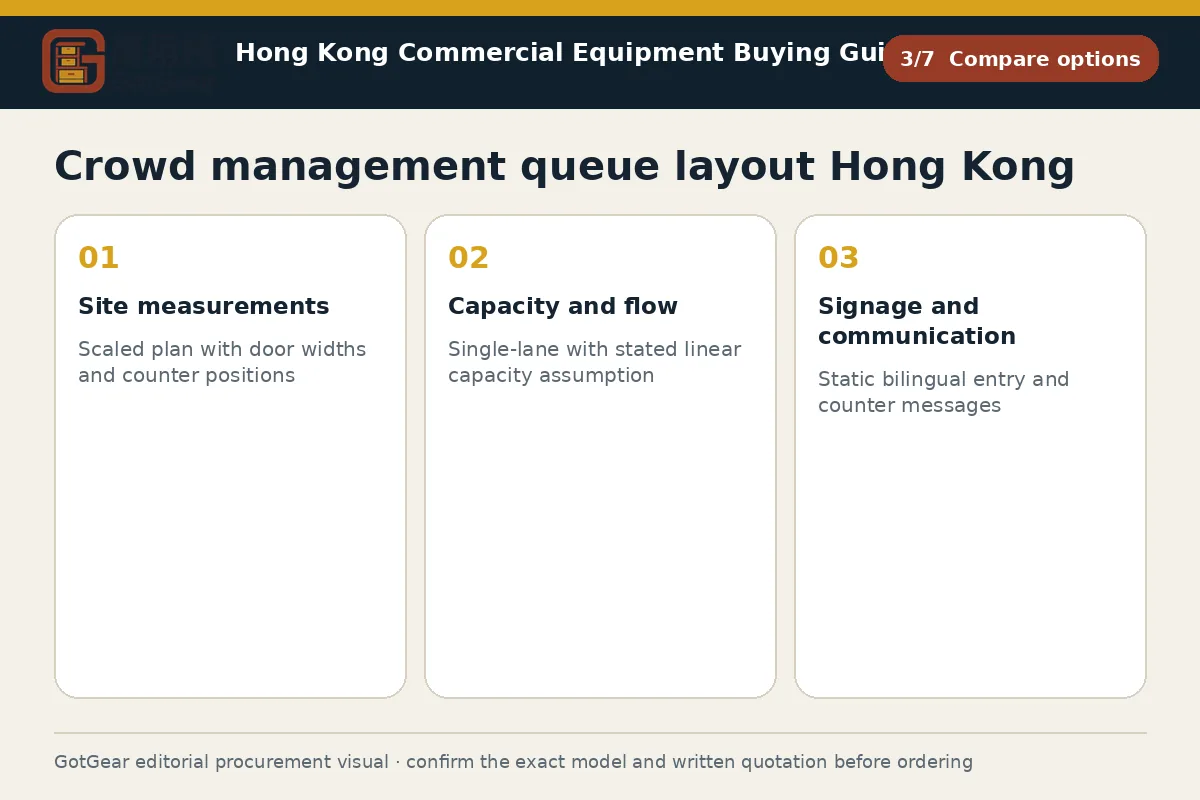
| Site measurements | Scaled plan with door widths and counter positions | Add turning circles, lift car sizes, floor gradients and storage paths | Annotated drawings plus labelled photos by location |
| Capacity and flow | Single-lane with stated linear capacity assumption | Serpentine with priority lane and timed peak triggers | Assumption log, time bands, example spacing figures to be confirmed |
| Signage and communication | Static bilingual entry and counter messages | Changeable messages by trigger with anti-glare frames and wayfinding | Artwork samples, frame size/orientation, placement distances |
| Safety and clearances | Marked keep-clear zones at exits and shutters | Documented exit clearances and alternate paths under surge conditions | Plan notes and approvals from responsible site team/building manager |
| Logistics and approvals | Supplier delivery and simple set-down | Booked loading bay, goods-lift slots and management-office conditions | Delivery schedule, access route, floor protection and supervision details |
This framework helps buyers create comparable written enquiries. Final model specifications, availability, delivery and commercial terms must be confirmed in a formal quotation.
Test waiting and departure flow in crowd management queue layout Hong Kong
Before committing, simulate the route at the venue during a representative period. Lay temporary tape on the floor, or set out a small number of posts, and have staff walk arrivals, waiting, service and departure. Time a few complete journeys as an example starting point only and record pinch-points, door swing arcs, lift dwell conflicts and sightline gaps around corners. Check that trolleys, wheelchairs and prams navigate turns without clipping bases. Verify that departure paths do not recirculate people into the arrival stream and that signage can be placed where heads naturally turn.
Document what changed versus the initial plan and why. If any post must sit near exits or shutters, confirm clearances with the site’s responsible person and keep a note of any building-manager instructions. Use a crowd control barrier safety checklist Hong Kong to structure pre-opening checks on stability, belt retraction and trip hazards. When your first shipment arrives, run a retractable belt barrier inspection checklist Hong Kong: count units against the delivery note, inspect finishes, test belt braking and locks, confirm sign-frame fit, and file the manufacturer’s instructions. For test days, book loading bays and goods lifts through the management office, and request base footprint templates or spacing guidance from the manufacturer where available so your mock-up reflects real equipment behaviour.
Review signs and changing conditions in crowd management queue layout Hong Kong
Queues live and breathe with changing conditions. Review the messaging you need at each decision point: entry, mid-queue, and at the counter or gate. Prepare bilingual Chinese/English artwork and ensure font sizes remain legible at the actual viewing distance. Confirm whether sign frames should be A4 or A3 (portrait or landscape), anti-glare, and tamper-resistant; request compatibility with the chosen posts in writing. For F&B and ticketed venues, position a menu stand Hong Kong or tariff board where browsing will not slow the main line.
Plan how messages will pivot with weather and events. On rainy days in Hong Kong, wet umbrellas and floors can slow movement; decide whether to add umbrella bags, mats or a short bypass lane. At transport-adjacent sites, define triggers to open overflow lanes when train or ferry arrivals spike. Specify if you need wall receivers, magnetic belt ends or swing gates to reconfigure paths quickly. Ask for indoor/semi-outdoor/outdoor suitability, corrosion resistance and cleaning guidance from the manufacturer. Keep a change log noting who approved message updates and under what conditions, and schedule periodic reviews so the route, wording and staff scripts remain aligned with actual customer behaviour.
Crowd management queue layout Hong Kong decision checklist
Walk the site and draw a scaled plan marking arrivals, counters, exits and staff posts. Measure widths, turning circles and storage paths, and photograph constraints. Write your capacity assumptions with example spacing and peak triggers, then translate them into lane width, linear length, post quantity, belt length and sign-frame needs. Issue an enquiry with annotated drawings, finish preferences and operating environment. Compare written quotations by model, belt length, base type, accessories and delivery conditions. Before opening, mock up the route, confirm exit clearances and signage placement, and book loading and lift slots. On receipt, inspect posts and belts against the delivery note and instructions, file documents, and update the plan so the final layout, assumptions and responsibilities are traceable.
- Operating use, quantity and expected frequency
- Dimensions, capacity, material and accessory requirements
- Delivery address, floor, goods lift and loading window
- Required documents, acceptance checks and after-sales arrangements
Key points for crowd management queue layout Hong Kong
Hong Kong venues face specific operating constraints: tight lift cars and doorways in industrial buildings, busy MTR-adjacent footfall, and management-office controls on deliveries, floor protection and works. High humidity and frequent rain make belt finish, base stability and cleaning practicalities important. Bilingual Chinese/English messaging is expected at public-facing points. Emergency-exit keeping-clear rules and event-day directions vary by site; always confirm clearance expectations, permissible fixings and any crowd guidance with the responsible venue team and the building manager. Treat manufacturer instructions and written approvals as controlling documents, and keep them attached to your annotated plan.
Questions about crowd management queue layout Hong Kong
How do we estimate how many posts and belts we need for our site plan?
Calculate the linear length your queue must hold, then divide by your assumed spacing per person to test different lane counts. As an example starting point only, sketch serpentine runs with post spacing from the manufacturer’s guidance. Provide a scaled plan to suppliers and request a take-off referencing model numbers and belt lengths; confirm quantities against the final written quotation.
Should we use wall receivers to reduce the number of freestanding posts?
Wall receivers can shorten runs and open up floor space, especially near counters and columns. Only use them where fixings are permitted and walls are sound; many buildings require prior approval. Ask the building manager for permissible fixings and the supplier for compatible belt ends. The chosen model specification and management-office instructions should prevail.
Can one layout work for both normal days and event peaks?
Use a modular design: a core route for routine days and clearly identified overflow lanes that open on triggers. Specify extra posts, wall receivers or swing gates and pre-approved sign messages. Test both states during representative periods, store spare equipment near the site, and train staff on changeovers. Confirm any event-day arrangements with the responsible venue team.
What should we check when the barriers arrive from the supplier?
Count items against the delivery note, verify finishes, bases and belt print, and test retraction speed and end locks. Fit sign frames to ensure compatibility. File the instructions and any maintenance guidance from the manufacturer. If anything differs from the quotation or drawings, stop and seek written clarification before the equipment is deployed on the customer route.
Continue with closely related procurement topics
These pages share equipment, operating or decision-stage signals with this guide.
Queue barrier emergency exit clearance Hong Kong
GotGear explains queue barrier emergency exit clearance Hong Kong by mapping routes and testing positions, noting obstructions and flagging issues. It also advises regular condition checks and following manufacturer guidance.
Read the guide
Slatwall display hooks Hong Kong
When selecting slatwall display hooks Hong Kong, check pack depth, hanging-hole format, facing count and panel fit for proper mounting. Compare slatwall display shelves Hong Kong for support and installation with GotGear.
Read the guide
Slatwall sign holders Hong Kong
Choose slatwall sign holders Hong Kong that match your insert size and intended viewing distance. Also select slatwall literature holders Hong Kong with appropriate pocket depth and reach height at GotGear in Hong Kong.
Read the guide
Slatwall wire baskets Hong Kong
GotGear guides you through comparing opening size, depth, containment, access, attachment and capacity to select slatwall wire baskets Hong Kong for loose or irregular goods.
Read the guideRelated topic indexOpen more English procurement pages1 topics
Browse additional equipment families, applications and procurement questions relevant to a wider buying brief.