
Use retractable belt barrier inspection checklist Hong Kong only within the inspection and maintenance process set by the responsible organisation. Verify manufacturer instructions, current placement and site conditions, and applicable Hong Kong requirements; isolate the barrier and escalate any uncertainty under the site procedure.
Inspect assembly condition with retractable belt barrier inspection checklist Hong Kong
Begin with a visual-and-touch inspection of each post and base before public use. Check the post is upright using a small level or plumb line; note any lean, wobble or loose fasteners. Inspect the base for cracks, missing floor-protection rings, corrosion patches or water ingress under the collar—common in humid plant rooms and seaside districts. Verify any fixing screws are present and tightened to the manufacturer’s method, and that the finish remains intact without sharp burrs. Confirm signage frames or leaflet holders, if fitted, are secure and not adding instability.
Capture the model identification, finish code, belt colour/print, and any serial or date code on the cassette. Measure and record belt height from floor and base footprint in millimetres, and note the belt width and declared maximum belt length as listed by the manufacturer. Use a retractable belt barrier inspection checklist Hong Kong to keep these steps predictable across schools, venues and retail concourses. Where barriers support a wider queuing plan, cross-reference your observations with the crowd control barrier safety checklist Hong Kong so that equipment condition and operating layout are reviewed together. Always compare against the manufacturer’s instructions and the formal written quotation for the installed model, which take precedence over general guidance.
Test belt travel and connections in retractable belt barrier inspection checklist Hong Kong
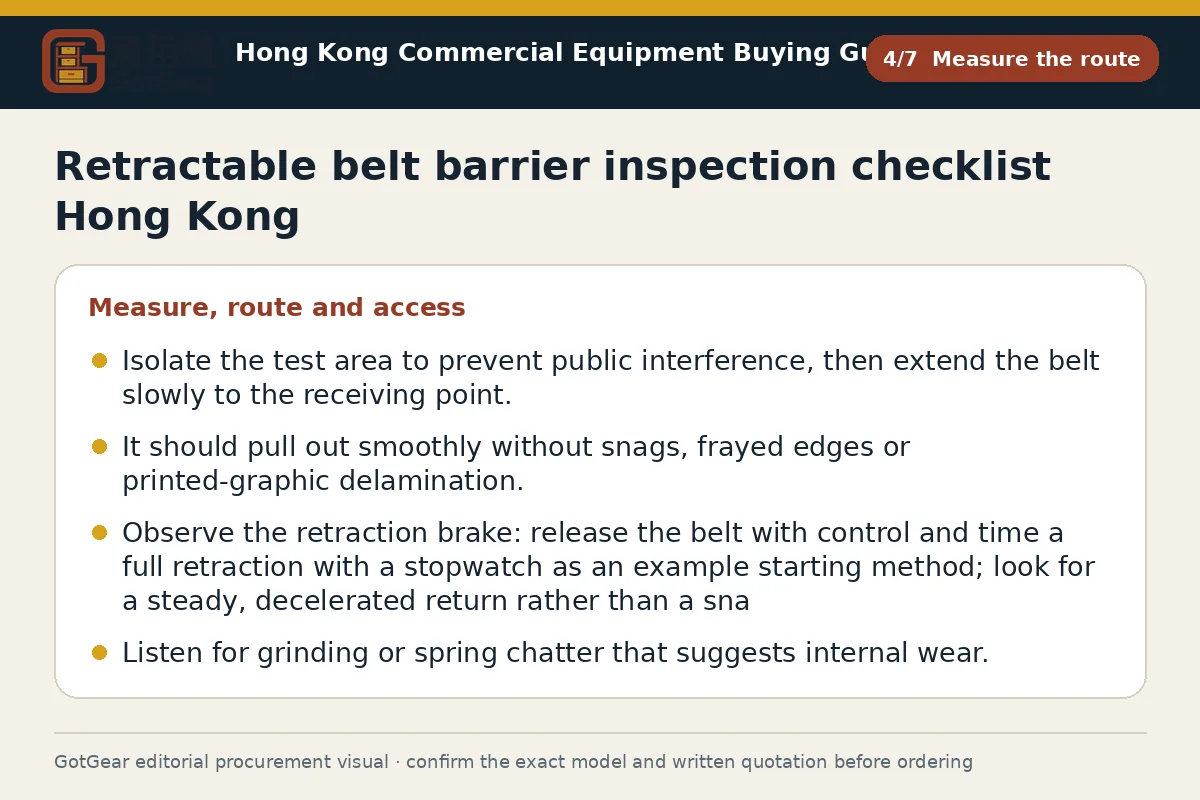
Isolate the test area to prevent public interference, then extend the belt slowly to the receiving point. It should pull out smoothly, without snags, frayed edges or printed-graphic delamination. Observe the retraction brake: release the belt with control and time a full retraction, for example using a stopwatch. Look for a steady, decelerated return rather than a snap-back. Listen for grinding or spring chatter that would indicate internal wear. Inspect the end-clip latch, rivets and any secondary safety tab for deformation or cracks, and check that the receiving head on the post is aligned and securely fixed.
Test cross-compatibility where relevant. If a post connects to a wall unit, verify the end clip mates properly with the retractable belt barrier wall receiver designated by your site in Hong Kong, and confirm that the latch fully closes without excessive force. Where belts retract unevenly or stick, consult the manufacturer’s service guidance to decide if a stanchion belt replacement cartridge for use in Hong Kong is appropriate; do not improvise lubrication or disassembly unless permitted. Document belt travel distance, retraction time and any hesitation points on your form. Integrate these results into your inspection notes rather than leaving them as informal observations, and escalate any uncertainties through your site’s process.
What should buyers compare for retractable belt barrier inspection checklist Hong Kong?
| Criterion | Straightforward requirement | More complex requirement | Evidence to provide |
|---|---|---|---|
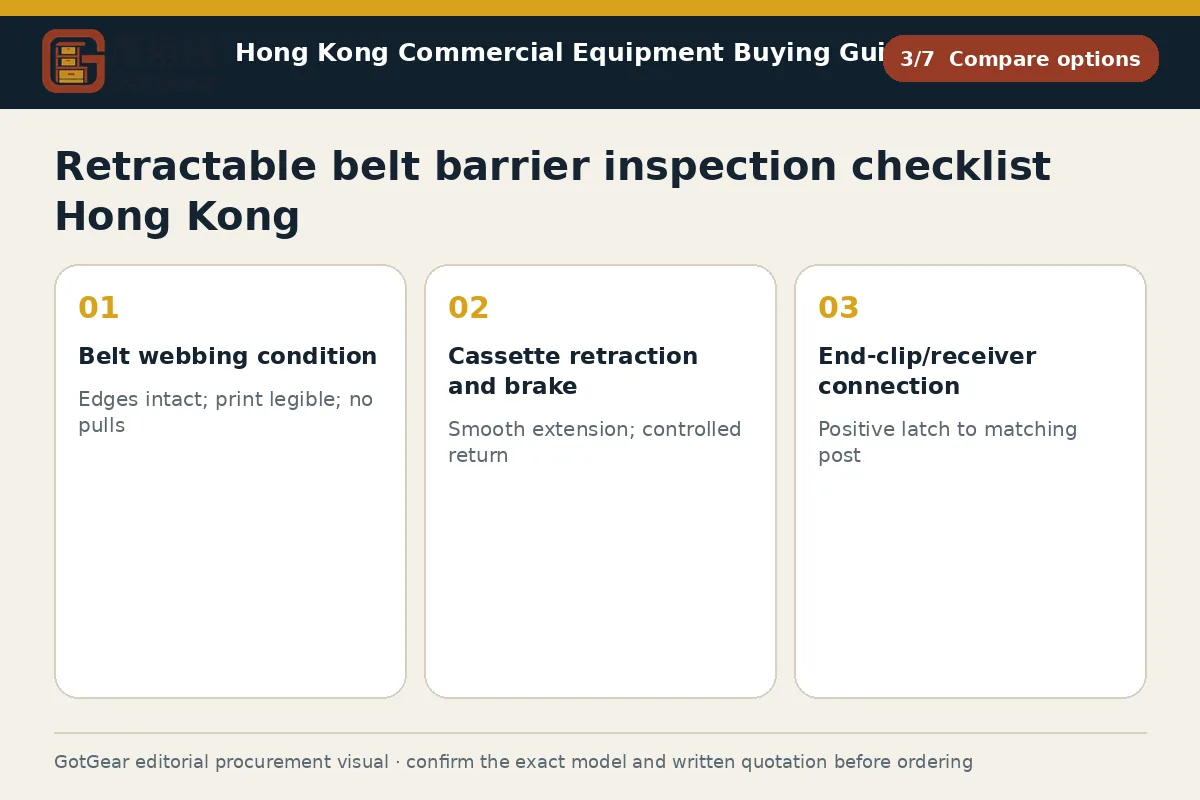
| Belt webbing condition | Edges intact; print legible; no pulls | Minor fray or faded print under assessment | Photos of edges/print; note location and length of damage |
| Cassette retraction and brake | Smooth extension; controlled return | Inconsistent return or hesitation under load | Stopwatch time; describe any sticking points and sounds |
| End-clip/receiver connection | Positive latch to matching post | Cross-brand fit validated by supplier | Photos of latch engaged; receiver make/model and statement of compatibility |
| Post verticality and base integrity | Post stands plumb; base undamaged | Minor lean or loose fastener pending fix | Level reading, wobble observation, fastener status and torque method |
| Placement and egress clearance | Queue respects marked pathways | Complex layout near exits/lifts under review | Measured clear width in mm; sketch with arrows; manager instruction reference |
This framework helps buyers create comparable written enquiries. Final model specifications, availability, delivery and commercial terms must be confirmed in a formal quotation.
Record findings from retractable belt barrier inspection checklist Hong Kong
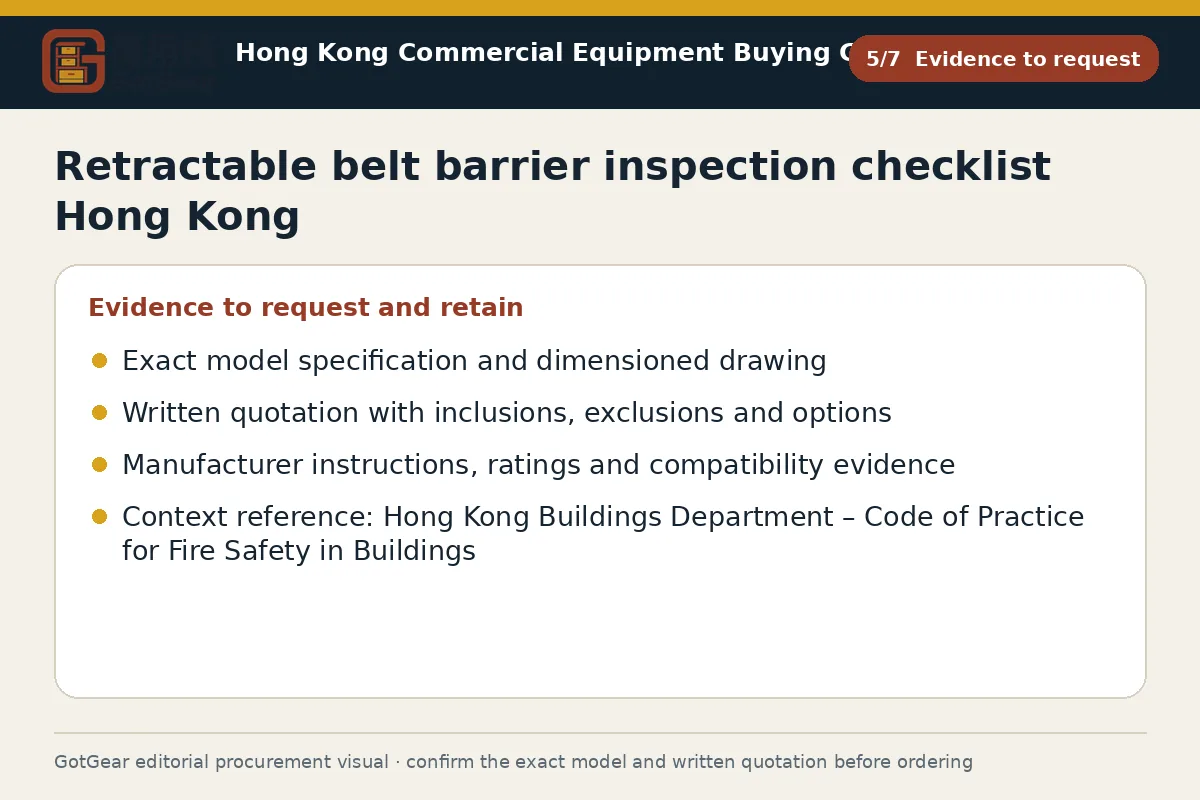
Record findings in a structured, bilingual form so maintenance and operations can action them quickly. Include location (floor/zone/nearby tenant), asset ID, model and finish, belt print, photos of defects, measured belt height and base footprint, and the test results for retraction. Date-stamp the record, name the inspector, and assign a clear next step—clean, tighten, replace cassette, quarantine or remove from service. Keep a link to the manufacturer’s instructions and any site-specific barrier plan, and attach a simple sketch showing current and intended positions for the management office file.
For future procurement or replenishment, prepare a written enquiry that requests: model number, base type and mass in kg, finish code, belt width and declared belt length in metres, end-clip type, compatibility with any existing wall receivers, and availability of replacement cassettes. Ask for cleaning/maintenance instructions, parts lists, and bilingual user guidance; request samples of belt print if brand colours matter. On receipt, inspect packaging integrity, verify finish and belt colour, confirm the declared belt length by a controlled pull-test, and check that end clips fit your specified receivers. When comparing written quotations, align like-for-like components, delivery arrangements into Hong Kong industrial buildings, and any documentation commitments. Model specifications and the formal quotation always prevail.
Escalate placement concerns from retractable belt barrier inspection checklist Hong Kong
Placement issues often present greater risk than component wear. If the line of posts reduces egress width, blocks tactile guide paths, fouls lift lobbies, or obscures statutory signage, pause deployment. Measure available clear widths in millimetres at the tightest points, note queue direction and turning radii, and reference any building‑manager instructions or applicable Hong Kong requirements on means of escape. Where doubt exists, quarantine the affected run, label it out of service, and raise an escalation ticket to the venue’s safety lead or property management office with photos and a simple plan sketch. For complex layouts, reference your queue barrier emergency exit clearance Hong Kong, and use the accompanying guidance to frame the discussion.
During public events or school assemblies, reassess whenever crowd density, tenant fit‑out or temporary displays change. Consider trip hazards from low bases on glossy tiles after cleaning, wind loading near open atriums, and sightline conflicts at corners. Propose corrective actions such as relocating posts, shortening belt runs, or using a wall receiver in place of a freestanding unit where permitted. Request written acceptance from the responsible manager before re‑opening the area. If an authority review is indicated by the venue, follow that route; requirements remain conditional on the model, the site and the insurer.
Retractable belt barrier inspection checklist Hong Kong decision checklist
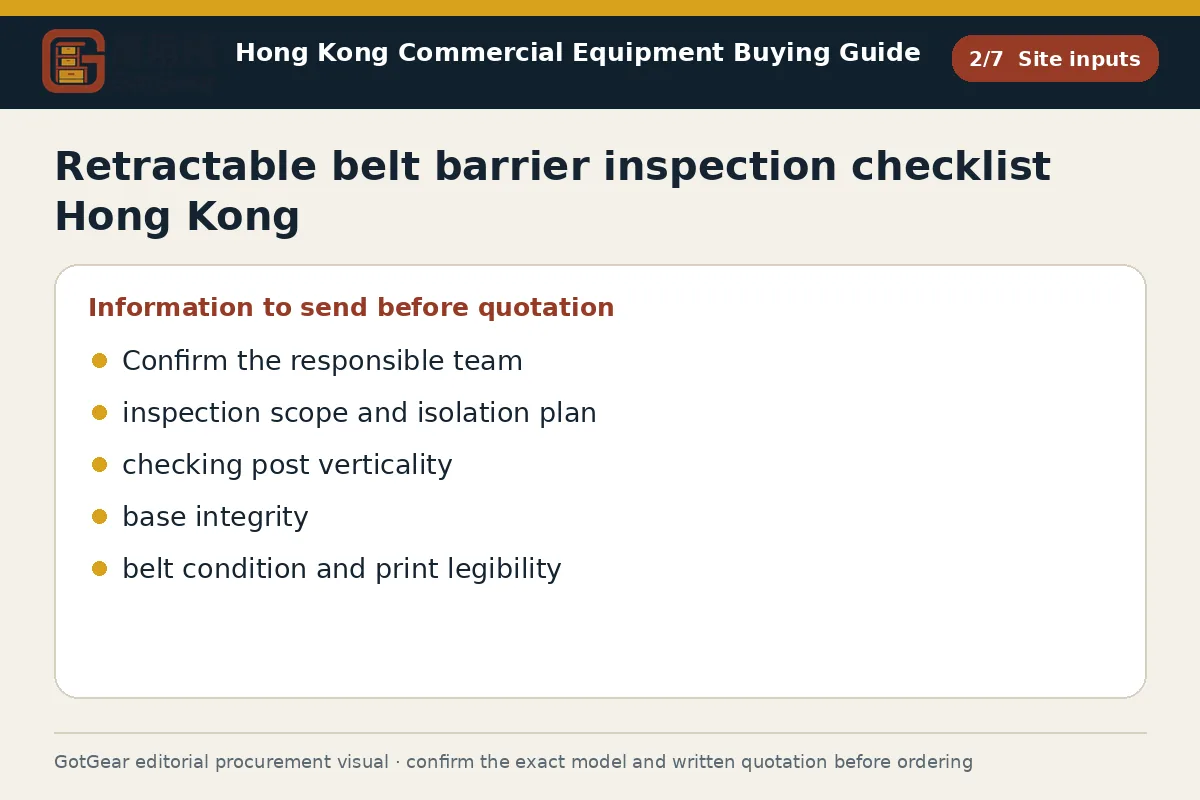
Confirm the responsible team, inspection scope and isolation plan. Walk the line, checking post verticality, base integrity, belt condition and print legibility, then test belt travel and return, recording retraction time and any hesitation. Note model, finish, serials and location, attach photos, and assign next actions with target dates. For replenishment, draft a written enquiry listing model, base mass, finish, belt width/length, end-clip type, compatibility with your receivers, delivery access constraints and documentation needs. Compare written quotations line by line. On receipt, verify finish, belt length and end-clip fit. Escalate any placement concerns—especially egress width—through the venue’s safety procedure. Model specifications and the formal quotation govern.
- Operating use, quantity and expected frequency
- Dimensions, capacity, material and accessory requirements
- Delivery address, floor, goods lift and loading window
- Required documents, acceptance checks and after-sales arrangements
Key points for retractable belt barrier inspection checklist Hong Kong
Hong Kong venues frequently operate under tight management-office controls, busy concourses and narrow service corridors. Before moving posts between floors, confirm goods-lift cabin size, door clear widths and any loading-window restrictions; note that some buildings require advance booking for dock access. Humid conditions and sea air can accelerate corrosion on unprotected finishes, so check bases and fasteners for early signs of rust. Bilingual documentation and on-site labels help mixed teams complete inspections consistently. This page offers practical checkpoints only and is not legal advice; defer to your building manager, manufacturer and any applicable Hong Kong requirements.
Questions about retractable belt barrier inspection checklist Hong Kong
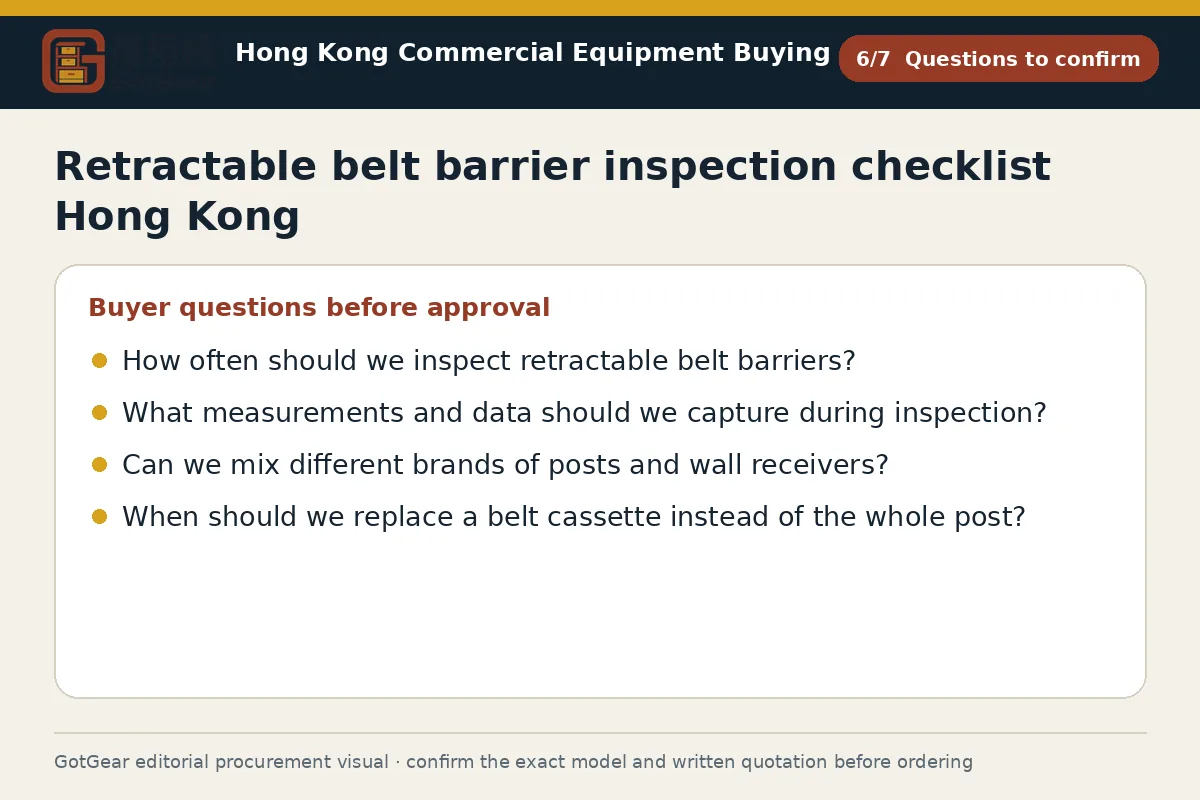
How often should we inspect retractable belt barriers?
Inspect before public use and at an interval set by your organisation and the manufacturer. In high-traffic concourses, an example starting point could be a short periodic check during opening rounds, but confirm this with your building manager or competent person. The correct frequency depends on the model, crowd profile, and any applicable Hong Kong or insurer requirement.
What measurements and data should we capture during inspection?
Record belt height from floor, belt width, declared belt length, base footprint, post verticality observations, and retraction time measured with a stopwatch. Note model/finish codes, serials or date codes, location, and photos of wear on edges, stitching and end clips. Capture clear-width measurements at pinch points. Maintain bilingual notes so maintenance, operations and procurement can act promptly.
Can we mix different brands of posts and wall receivers?
Only if the end clip and receiver are explicitly compatible. Test fit safely, or request a manufacturer’s compatibility statement and a sample where possible. If you already use a retractable-belt barrier wall receiver in Hong Kong, specify its make and model in your enquiry. Otherwise, plan to replace mismatched receivers to avoid insecure latching or accidental release.
When should we replace a belt cassette instead of the whole post?
Replace the cassette when retraction is uneven, the brake fails, or the belt webbing is damaged, provided the manufacturer supports cartridge replacement for your model. Ask for a stanchion belt replacement cartridge in Hong Kong with the correct finish and print. If the post tube, base or fixings are also compromised, a full post replacement may be more appropriate.
Continue with closely related procurement topics
These pages share equipment, operating or decision-stage signals with this guide.
Stanchion belt replacement cartridge Hong Kong
Stanchion belt replacement cartridge Hong Kong: GotGear explains how to identify the correct unit by post model, interface, belt length, connection end and fault.
Read the guide
Queue barrier emergency exit clearance Hong Kong
GotGear explains queue barrier emergency exit clearance Hong Kong by mapping routes and testing positions, noting obstructions and flagging issues. It also advises regular condition checks and following manufacturer guidance.
Read the guide
Slatwall display hooks Hong Kong
When selecting slatwall display hooks Hong Kong, check pack depth, hanging-hole format, facing count and panel fit for proper mounting. Compare slatwall display shelves Hong Kong for support and installation with GotGear.
Read the guide
Slatwall sign holders Hong Kong
Choose slatwall sign holders Hong Kong that match your insert size and intended viewing distance. Also select slatwall literature holders Hong Kong with appropriate pocket depth and reach height at GotGear in Hong Kong.
Read the guideRelated topic indexOpen more English procurement pages1 topics
Browse additional equipment families, applications and procurement questions relevant to a wider buying brief.