
Before selecting stanchion belt replacement cartridge Hong Kong, follow the existing barrier manufacturer’s identification and maintenance instructions and assess the actual site conditions. After any replacement, the responsible team should verify operation and placement against applicable Hong Kong requirements before returning the barrier to use.
Identify the existing post before sourcing stanchion belt replacement cartridge Hong Kong
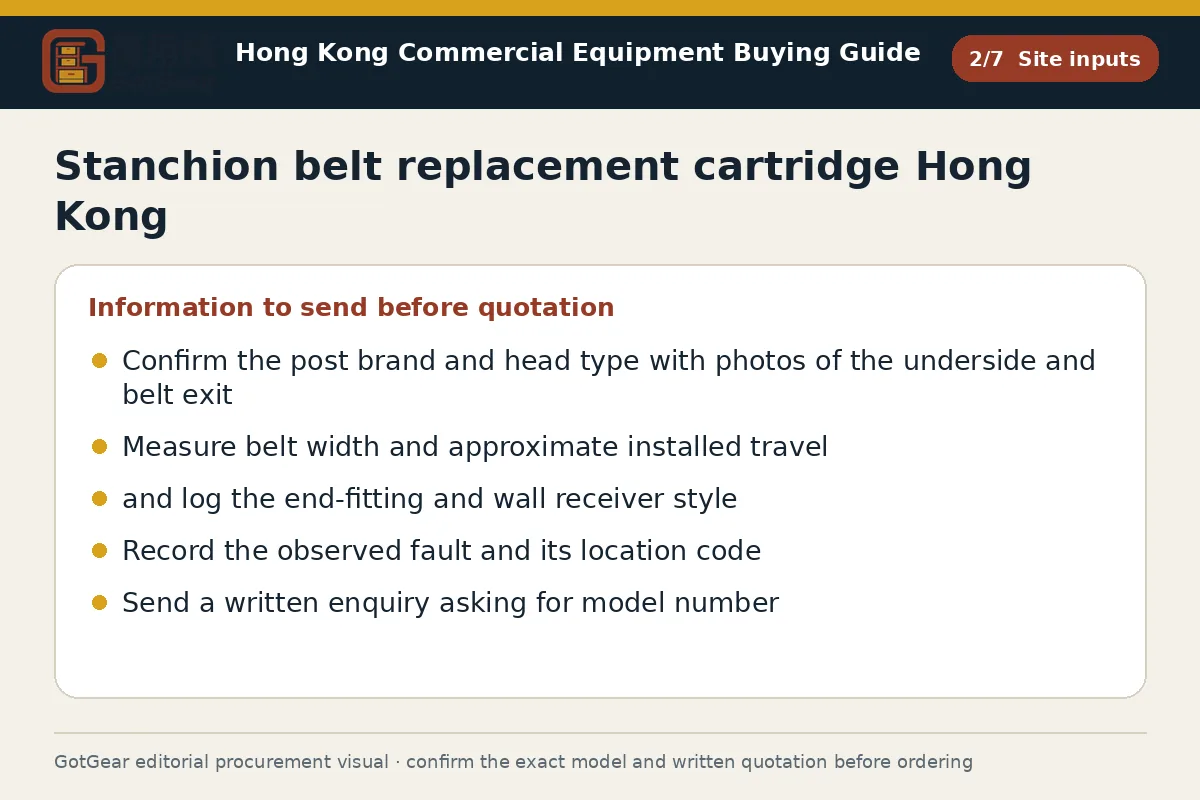
Start by identifying the post brand, model family and approximate purchase period. Photograph the top cap, belt exit slot and base, then remove the post head only if site rules permit and it is safe to do so. Record serial labels and any moulded markings, and measure the tube outside diameter and cap style. Note belt width and the fully extended belt length as installed; this can be estimated by aligning the post with its regular wall receiver or adjacent post and marking the travel. State clearly that these figures are an example starting point to be confirmed by the supplier.
Document the belt end fitting type (standard clip, locking tab, magnetic or specialty) and the receiver style it mates with. Capture the fixing method that retains the cartridge in the head (screws from above, side grub screws, bayonet twist). For Hong Kong sites, list access limits such as goods-lift size, loading bay windows and any management-office permit steps for contractor entry. Include bilingual notes where your maintenance logs are in both English and Chinese. Your enquiry should ask vendors to confirm drop‑in compatibility with the named post series, and to state what adapters or fasteners, if any, are included with the replacement cartridge.
Check cartridge interface and belt travel for stanchion belt replacement cartridge Hong Kong
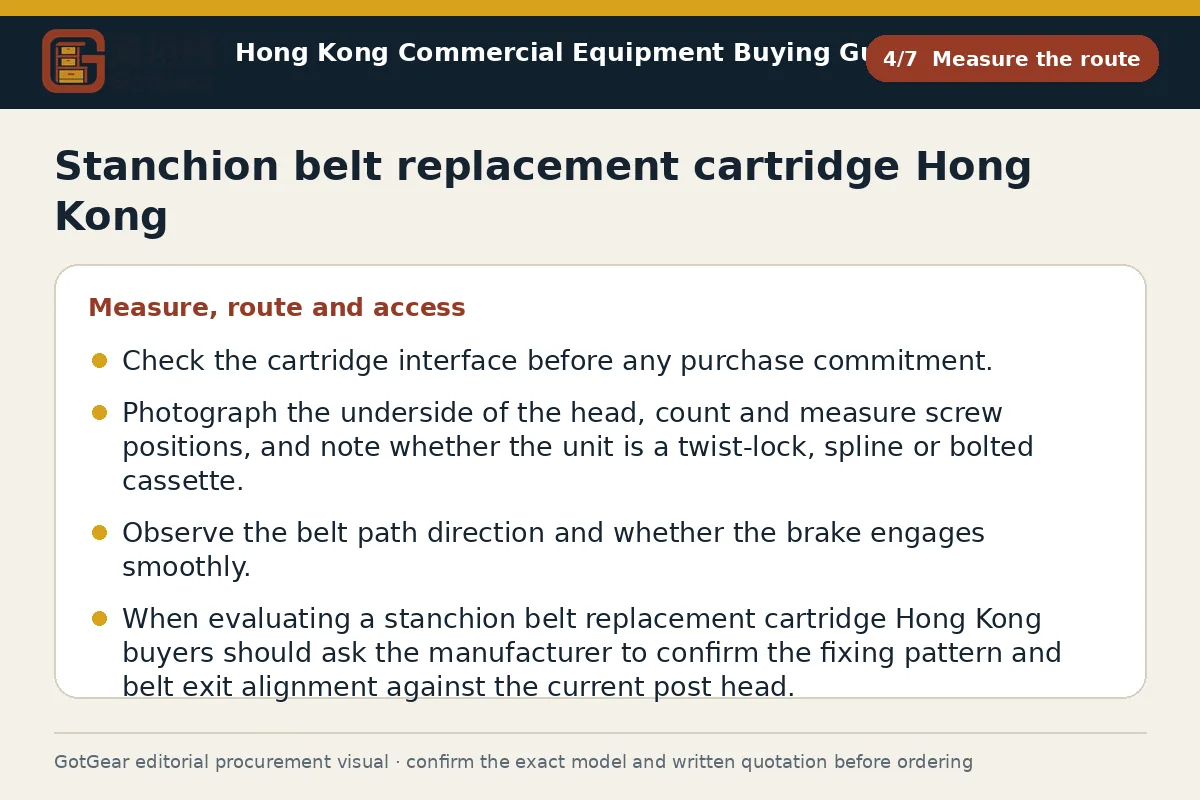
Check the cartridge interface before any purchase commitment. Photograph the underside of the head, count and measure screw positions, and note whether the unit is a twist‑lock, spline or bolted cassette. Observe the belt path direction and whether the brake engages smoothly. When evaluating a stanchion belt replacement cartridge Hong Kong, buyers should ask the manufacturer to confirm the fixing pattern and belt exit alignment against the current post head.
Verify belt travel and retraction behaviour with a controlled pull and slow release. Record whether the belt auto‑locks at extension, whether there is a damped return, and any scraping noises that could indicate misalignment. Inspect the end fitting against your receiver; if you use a wall point, refer to retractable belt barrier wall receiver Hong Kong to ensure the geometry matches. Humid conditions and frequent sanitiser use can accelerate wear; include a note about cleaning agents used on your site. Provide example starting measurements (e.g., belt width and approximate length) but make clear that the model specification in the written quotation prevails over field estimates.
What should buyers compare for stanchion belt replacement cartridge Hong Kong?
| Criterion | Straightforward requirement | More complex requirement | Evidence to provide |
|---|---|---|---|
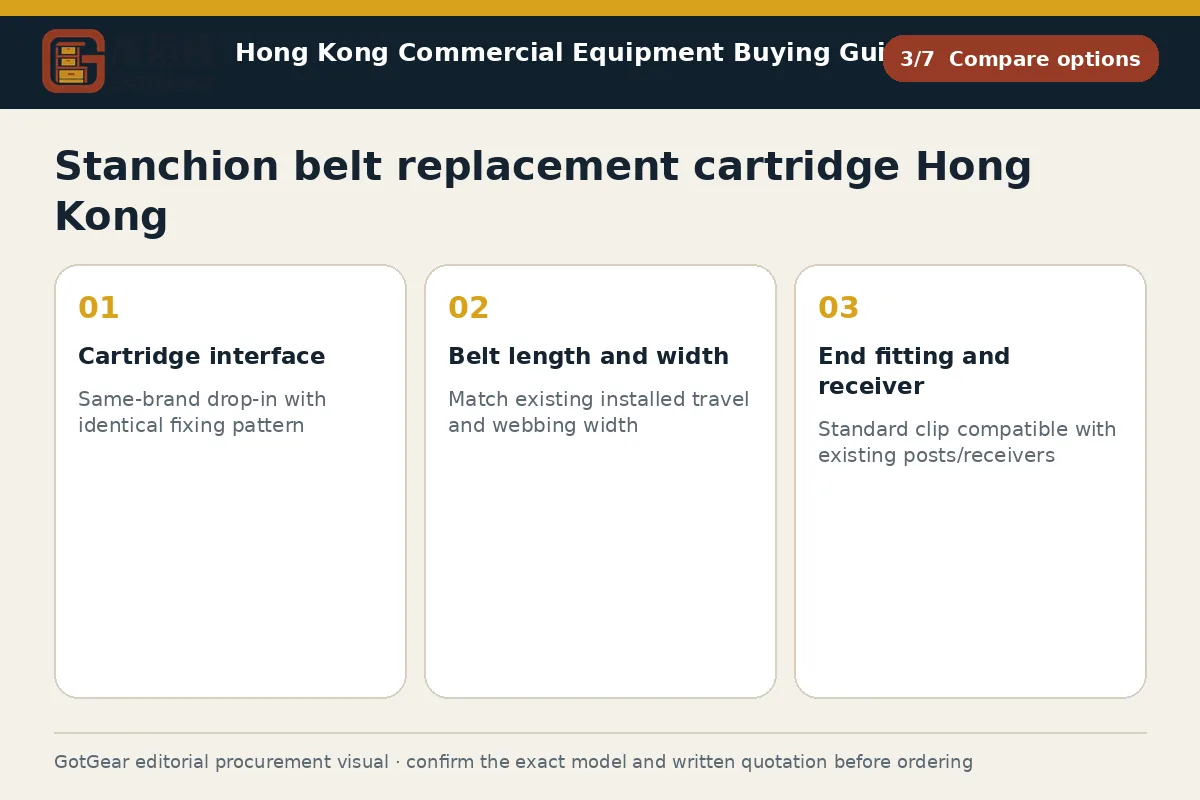
| Cartridge interface | Same-brand drop‑in with identical fixing pattern | Cross‑brand fit using confirmed adapter and matching belt exit | Photos of head underside, fixing centres, and confirmation email from manufacturer |
| Belt length and width | Match existing installed travel and webbing width | Revise length for new bay spacing or wall receivers per updated layout | Measured travel to receiver, example starting dimensions, marked plan of queue |
| End fitting and receiver | Standard clip compatible with existing posts/receivers | Locking, magnetic or specialty end confirmed for your receiver model | Close-up photos of end fitting and receiver; receiver model reference |
| Finish and environment | Indoor dry use with standard webbing and hardware | Humid/semi‑outdoor areas or frequent sanitiser exposure with upgraded materials | Notes on location, cleaning chemicals used, and corrosion observations |
| Documentation and approvals | Basic instructions included with the cartridge | Bilingual instructions, compatibility statement and site sign‑off record | Requested documents list and internal approval route contact details |
This framework helps buyers create comparable written enquiries. Final model specifications, availability, delivery and commercial terms must be confirmed in a formal quotation.
Record the belt fault for stanchion belt replacement cartridge Hong Kong
Write a concise fault report so that suppliers can recommend the correct cartridge and your approvers can justify replacement. State the symptom first: slow or uneven retraction, belt not locking at set length, frayed webbing or graphic wear, broken spring, damaged end fitting, cracked housing or excessive noise. Add when and where it was observed, the post ID/location code, and the queue or zone affected. If layouts are changing, flag the intended bay spacing and refer to crowd management queue layout Hong Kong so belt length can be reviewed.
Include context factors that matter in Hong Kong venues: expected crowd density for upcoming events, moisture exposure near entrances, and whether posts are routinely moved through tight doors and lifts. Attach photos of the interface, belt end, and the receiver it clips into. In your enquiry, request written confirmation of compatibility, belt material and finish, colour code, print orientation, and any supplied fixings. Ask for a sample risk note about snap‑back hazards where the venue requires it. Example cycle counts or retraction‑speed figures may be provided as starting points only and should be verified during on‑site testing after installation.
Document follow-up testing for stanchion belt replacement cartridge Hong Kong
After fitting the new cartridge, document structured checks before releasing the barrier back into public use. Perform controlled extensions and returns across multiple cycles (for example, ten cycles as a starting point), confirming the belt tracks centrally, the brake functions, and the end fitting seats positively in the receiver or adjacent post. If your venue mandates formal checks, align your record with retractable belt barrier inspection checklist Hong Kong and, where relevant to public areas, crowd control barrier safety checklist Hong Kong.
Confirm that the supplied cartridge, screws, adapters and instructions match the written quotation and are in bilingual form where your procedures require it. Record the installer’s name, time, nearby hazards and any residual issues such as mild rubbing that may settle after bedding‑in. Note queue geometry and, if spacing changed, update plans in line with crowd management queue layout Hong Kong. For industrial buildings, coordinate any follow‑up during allowed loading windows and record how removed cartridges are stored or disposed of. If any defect is detected, pause use and request the manufacturer’s maintenance guidance or a compatibility statement before proceeding.
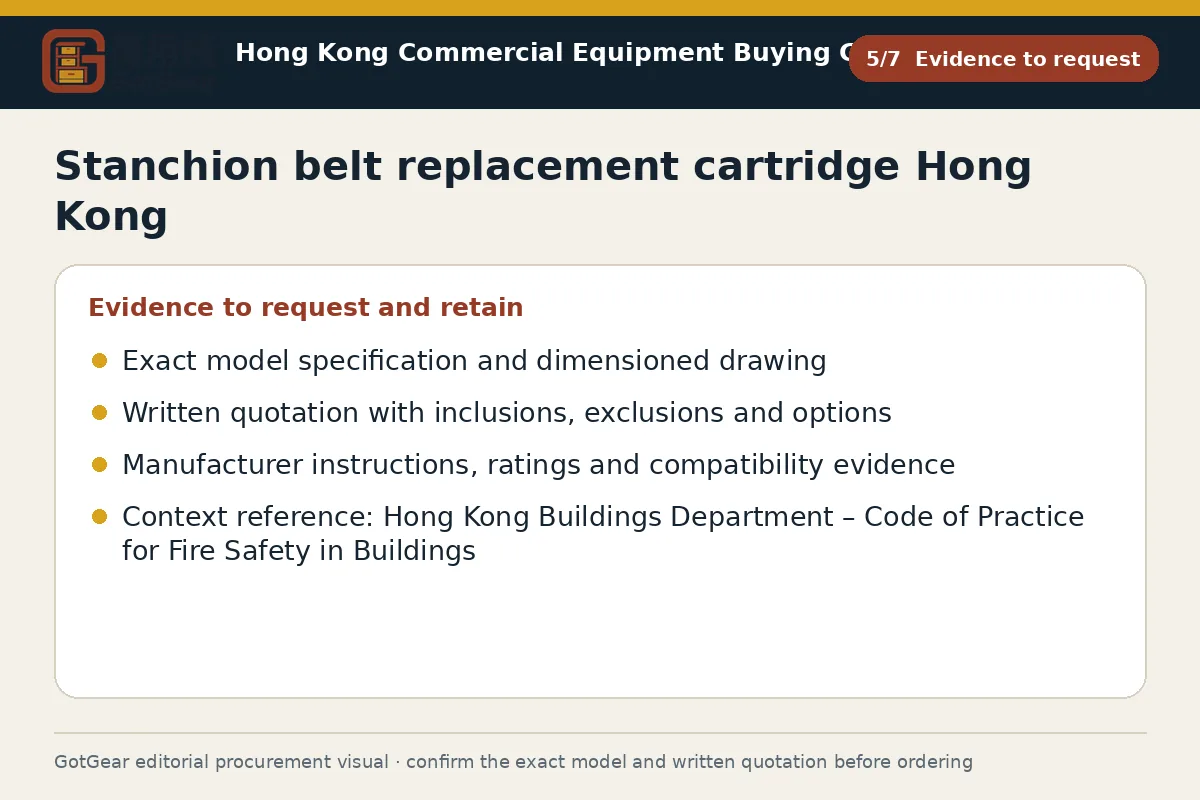
Stanchion belt replacement cartridge Hong Kong decision checklist
Confirm the post brand and head type with photos of the underside and belt exit. Measure belt width and approximate installed travel, and log the end-fitting and wall receiver style. Record the observed fault and its location code. Send a written enquiry asking for model number, belt material, width, length, colour or print orientation, finish, adapter or fixing inclusions, and warranty terms. State site constraints such as humid areas, cleaning agents used and access limits. On receipt, check bilingual instructions, condition, and interface match. After fitting, document multi‑cycle function tests and re‑verify placement against your venue’s requirements before reopening the queue.
- Operating use, quantity and expected frequency
- Dimensions, capacity, material and accessory requirements
- Delivery address, floor, goods lift and loading window
- Required documents, acceptance checks and after-sales arrangements
Key points for stanchion belt replacement cartridge Hong Kong
Hong Kong facilities often run barrier lines in lobbies, concourses and loading-level corridors where humidity, cleaning chemicals and frequent relocations stress cartridges. Replacement work may also need management-office permits, goods-lift booking and short loading windows in industrial buildings. Plan measurements and photography outside busy periods, and capture bilingual notes for internal approvals. This page offers practical procurement detail, not legal advice; confirm any safety or inspection requirements with your venue operator, building manager, insurer or the manufacturer before returning barriers to service.
Questions about stanchion belt replacement cartridge Hong Kong
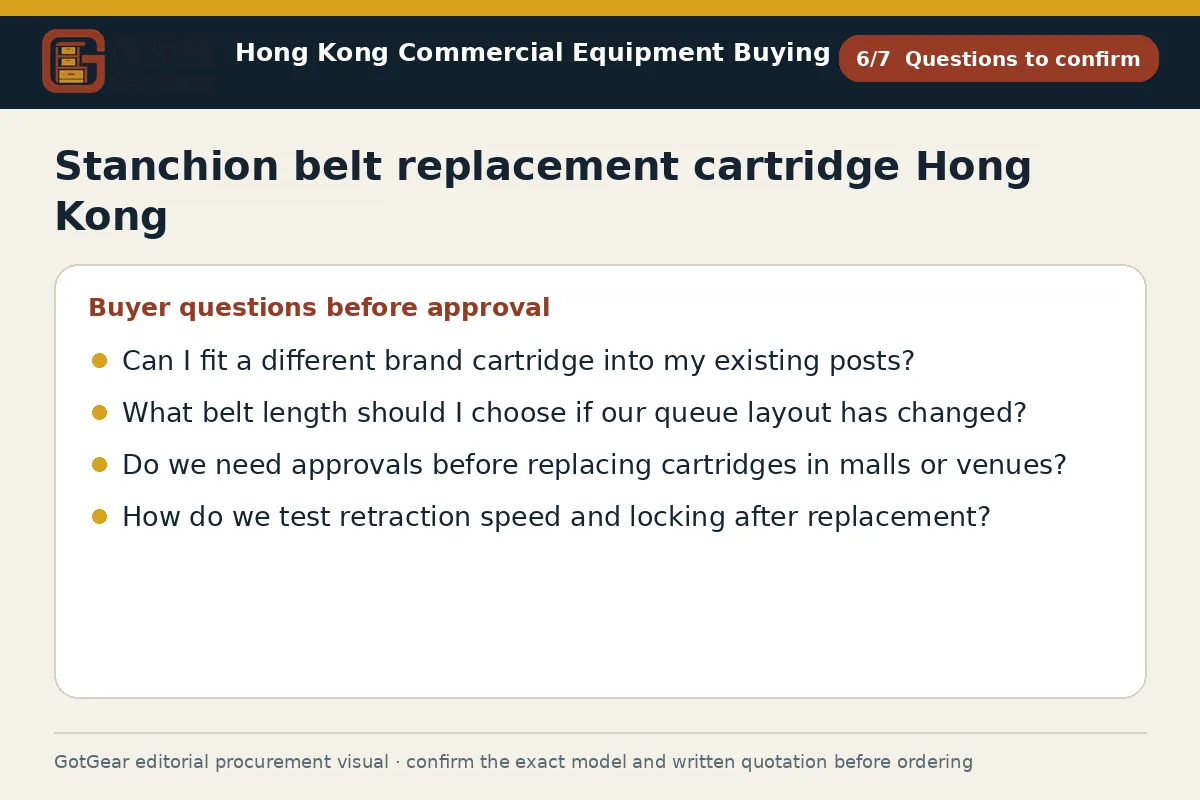
Can I fit a different brand cartridge into my existing posts?
Often yes, but only if the fixing pattern, belt exit alignment and end fitting match or an approved adapter is supplied. Ask the manufacturer for a written compatibility statement and drawings. Provide photos and measurements of your head underside and receiver. If compatibility is uncertain, select the original brand’s cartridge to avoid misfit and unintended snap‑back risks.
What belt length should I choose if our queue layout has changed?
Match the original length unless your spacing is being revised; then recalculate based on new post gaps and receiver positions. Provide a scaled sketch and request the supplier to propose options. Where routes are being redesigned, align choices with crowd management queue layout Hong Kong so visibility, reach and safe return speed are preserved for the intended environment.
Do we need approvals before replacing cartridges in malls or venues?
Some venues require management-office notification or a short works permit; confirm locally before starting. Where barriers control public flow, your safety lead may also request a brief risk note and test record. Requirements vary by site, operator and insurer. Keep bilingual documentation, and ensure the quotation’s model specification and instructions accompany your sign‑off file.
How do we test retraction speed and locking after replacement?
Extend the belt to normal operating distance, engage the lock, then release with control and observe for centred tracking and smooth, damped return. Repeat for several cycles and check end‑fitting engagement with both posts and wall receivers. Use any venue checklist if one exists. Treat any numeric thresholds as example starting points to be confirmed by your responsible party.
Continue with closely related procurement topics
These pages share equipment, operating or decision-stage signals with this guide.
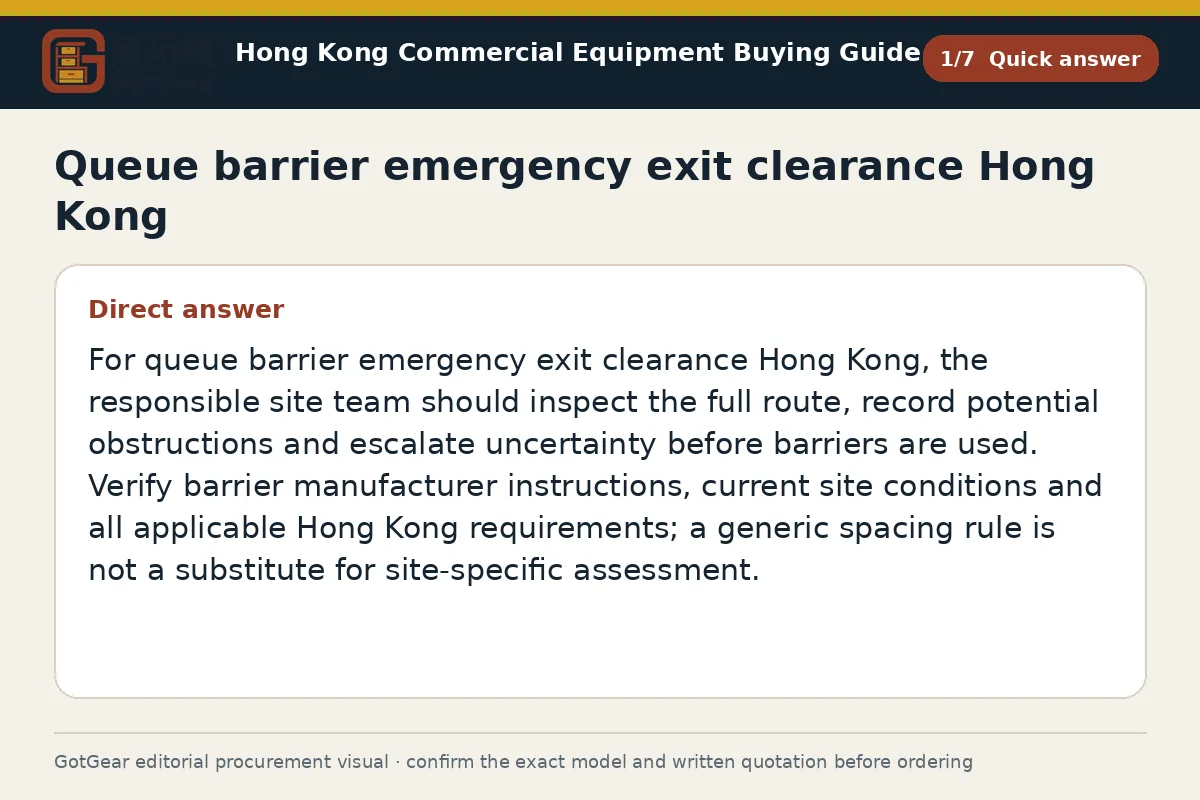
Queue barrier emergency exit clearance Hong Kong
GotGear explains queue barrier emergency exit clearance Hong Kong by mapping routes and testing positions, noting obstructions and flagging issues. It also advises regular condition checks and following manufacturer guidance.
Read the guide
Retractable belt barrier inspection checklist Hong Kong
Use a retractable belt barrier inspection checklist Hong Kong to inspect posts, bases, belts and connections on site. Record dated findings and assign follow-up actions for routine maintenance and site records with GotGear.
Read the guide
Slatwall display hooks Hong Kong
When selecting slatwall display hooks Hong Kong, check pack depth, hanging-hole format, facing count and panel fit for proper mounting. Compare slatwall display shelves Hong Kong for support and installation with GotGear.
Read the guide
Slatwall sign holders Hong Kong
Choose slatwall sign holders Hong Kong that match your insert size and intended viewing distance. Also select slatwall literature holders Hong Kong with appropriate pocket depth and reach height at GotGear in Hong Kong.
Read the guideRelated topic indexOpen more English procurement pages1 topics
Browse additional equipment families, applications and procurement questions relevant to a wider buying brief.