
For retractable belt barrier wall receiver Hong Kong, provide photographs or identifiers for the belt end, proposed receiving position, mounting surface and quantity. Ask respondents to state compatibility assumptions, then verify manufacturer instructions, site conditions and applicable Hong Kong requirements before installation or use.
Define the belt connection for retractable belt barrier wall receiver Hong Kong
Begin your enquiry with the belt interface. Specify the exact belt end that will dock into the receiver: its contour, the latch type (e.g., slot-and-tab, safety button, or magnetic), and any brand-specific locking feature. Measure the visible belt width and the male end's tab dimensions using a tape measure, and provide clear front, side and rear photos. As an example starting point only, note a measured belt width such as 50 mm and the distance from tab tip to latch shoulder; these figures must be confirmed by the responsible supplier or manufacturer against the selected model’s datasheet.
Finish and durability come next. State the required receiver finish (e.g., brushed stainless, black powder coat) and whether a tamper-resistant or low-profile housing is preferred. Indicate the approach side (left or right) and whether the belt will enter the receiver horizontally or on a slight incline. If you are also reviewing belts or housings, align the interface with any planned stanchion belt replacement cartridge for Hong Kong — for example, ensure subsequent decisions about replacements are consistent with the interface. For humidity-prone or coastal sites, ask respondents to declare their corrosion-resistance assumptions and to provide cleaning guidance. Your enquiry for a retractable belt barrier wall receiver for Hong Kong should ensure the supplier confirms compatibility in writing and provides a drawing showing the receiver slot geometry relative to the belt-end profile.
Record mounting position and quantities for retractable belt barrier wall receiver Hong Kong
Survey each proposed landing point and record the position, height and orientation. Photograph the approach direction and a wider contextual view to show door swings, corners and nearby signage. Provide a height-from-finished-floor measurement to the receiver centreline; as an example starting point only, many buyers review mounting heights in the 900–1,050 mm range, which must be confirmed in the written brief to suit the venue, crowd type and model instructions.
Note the substrate at each position (e.g., reinforced concrete, blockwork, metal stud with plasterboard, timber, glass, or tile-on-concrete). State a fixings preference only if dictated by the venue; otherwise ask suppliers to propose fixings with pull-out data suitable for the declared substrate. Flag obstructions such as electrical conduit or data trunking behind walls if known. Record the quantity by location, any finish variations, and the required hand (left/right catch). Where receivers are placed near circulation routes, cross-check against your own queue barrier emergency exit clearance Hong Kong, and consult the relevant guidance so that the final receiver position and protrusion are reviewed alongside local venue policies and insurer expectations.
What should buyers compare for retractable belt barrier wall receiver Hong Kong?
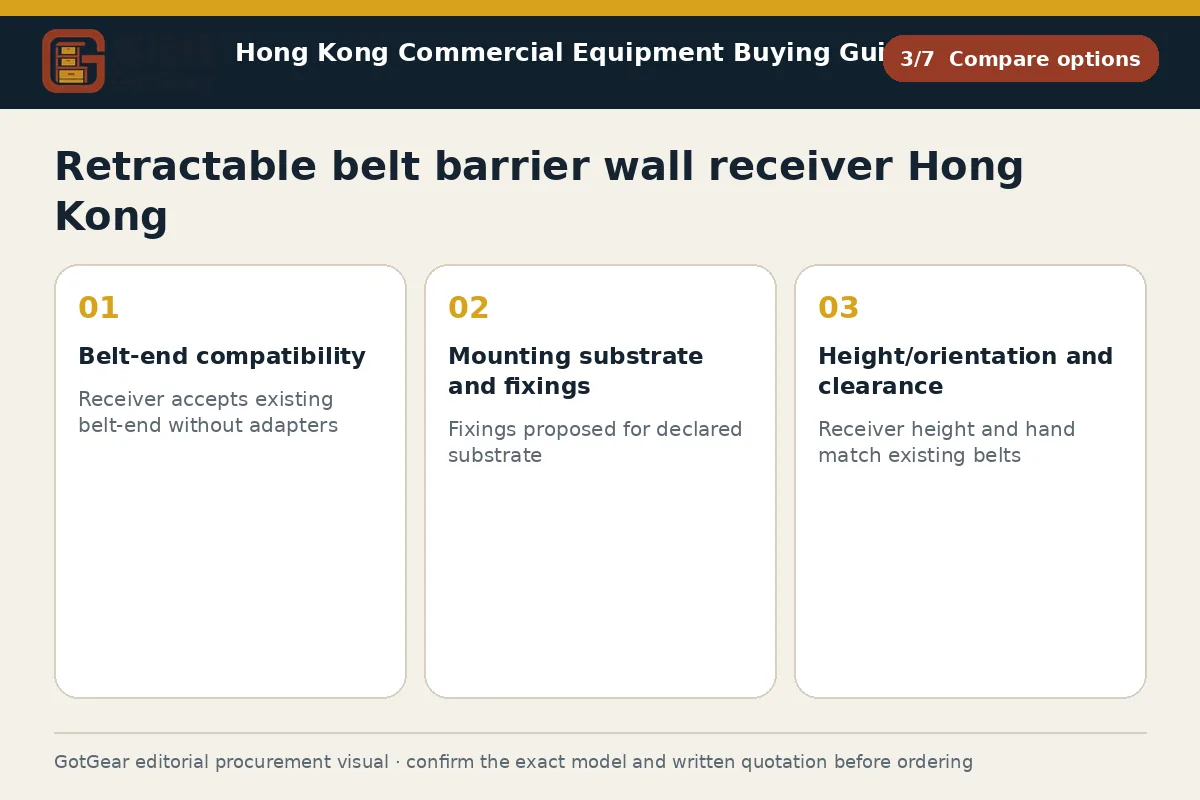
| Criterion | Straightforward requirement | More complex requirement | Evidence to provide |
|---|---|---|---|
| Belt-end compatibility | Receiver accepts existing belt-end without adapters | Receiver accepts multiple belt-end variants across sites | Photos, model identifiers, measured belt width (example starting point only), written compatibility statement |
| Mounting substrate and fixings | Fixings proposed for declared substrate | Engineering data for mixed/unknown substrates and edge distances | Substrate description per location, obstruction notes, pull-out/tension data or cited standard |
| Height/orientation and clearance | Receiver height and hand match existing belts | Position coordinated with doors, signage and egress paths | Measured centreline height (example starting point only), approach photos, confirmation of left/right hand |
| Finish and durability | Finish/colour match existing hardware | Corrosion/cleaning guidance for humid or outdoor areas | Finish code, environment description, cleaning chemicals used, care instructions |
| Documentation and assumptions | Basic instructions and template provided | Full list of assumptions, exclusions and maintenance intervals | Manufacturer instructions, drilling template, assumption list, maintenance recommendations |
This framework helps buyers create comparable written enquiries. Final model specifications, availability, delivery and commercial terms must be confirmed in a formal quotation.
Prepare site details for retractable belt barrier wall receiver Hong Kong
Package site conditions so respondents can propose commercial terms and programme transparently. Provide building access notes: goods-lift car dimensions and loading capacity, lift booking rules, delivery/collection windows, and the path from loading bay to floor. Add doorway clear widths on the route if unusually tight. Confirm whether works are in a live environment (e.g., school corridor, retail entrance, hospital lobby) and whether night works or silent tools are preferred by the management office.
Describe environmental factors: outdoor exposure, air-conditioning discharge, cleaning chemicals used, and general humidity. Ask for finish recommendations and maintenance intervals that suit those conditions. If receivers will guide emergency egress or interface with crowd flows at events, state whether bilingual pictograms or safety decals are required and request supplier samples for approval. Where your risk review applies, reference your internal crowd control barrier safety checklist Hong Kong so vendors understand the operational context. Request manufacturer installation instructions, substrate preparation notes and any conditional approvals needed from the building manager or competent adviser, making it clear that the model specification and formal written quotation prevail over preliminary discussions.
Compare documented RFQ responses for retractable belt barrier wall receiver Hong Kong
Compare responses line-by-line against your enquiry pack. Require a written compatibility statement naming the belt-end type and confirming that the supplied receiver accepts that end without adapters. Check that fixings are specified for your declared substrate, with pull-out/tension data or a cited standard where applicable. Confirm finish, colour code, hand (left/right), and any tamper-resistance features. Ask vendors to list all assumptions, exclusions and recommended accessories.
When quotations are close, weigh practical details: installation sequence relative to public opening hours, packaging for indoor logistics, and whether a drilling template is provided. On receipt, inspect finish quality, presence of fixing hardware, template or drawing, and the receiver slot profile against your approved sample or photo. Retain photographs of installed units for your asset file and schedule periodic checks using your own retractable belt barrier inspection checklist Hong Kong. Before use, verify the final position against site conditions, manufacturer instructions and applicable venue policies on egress, safeguarding or crowd control; if uncertain, escalate to the building manager or competent adviser for written confirmation.
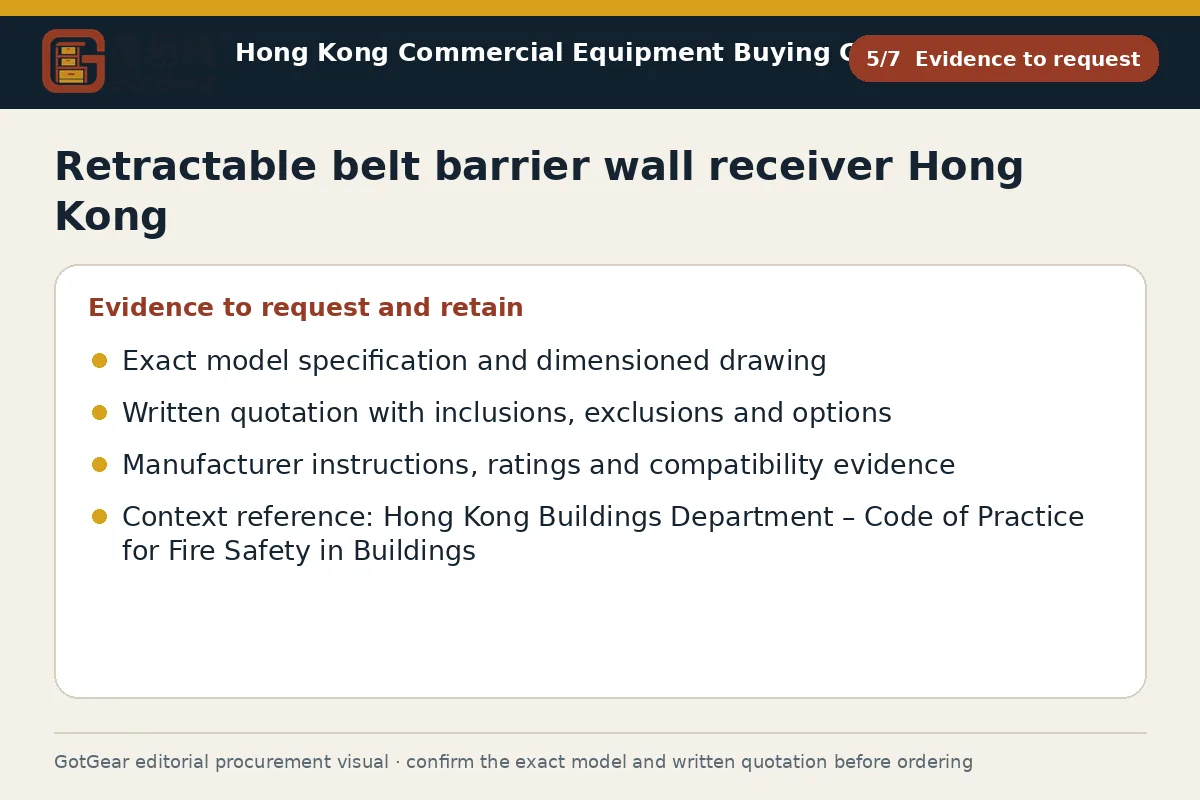
Retractable belt barrier wall receiver Hong Kong decision checklist
Confirm the belt-end type with photos and measured dimensions, then request a manufacturer drawing proving the receiver interface. State finish, colour and hand, plus any tamper-resistance needs. Record mounting height, substrate and obstacles, and list receiver quantities by location. Provide building access constraints, delivery windows and working-hour rules for Hong Kong facilities. Ask each respondent to declare compatibility assumptions, fixings, and maintenance guidance for humidity and cleaning chemicals. Compare quotations for inclusions, templates and documentation. On receipt, verify finish, hardware, slot profile and paperwork before installation, and keep installation photos with the approved plan and any building-manager sign-offs.
- Operating use, quantity and expected frequency
- Dimensions, capacity, material and accessory requirements
- Delivery address, floor, goods lift and loading window
- Required documents, acceptance checks and after-sales arrangements
Key points for retractable belt barrier wall receiver Hong Kong
Hong Kong venues often face constrained access, so include goods-lift dimensions, loading bay booking rules and quiet-hours restrictions in your enquiry to avoid missed delivery windows. Wall substrates vary widely in industrial buildings and retrofitted malls; declare what you know and ask suppliers to propose fixings matched to each substrate. Where receivers sit near exits or crowd pinch points, coordinate with the management office on local egress policies and signage needs. This guidance supports procurement planning only and should not be taken as legal advice; final positioning and fixings must follow the chosen model’s instructions and the venue’s written approvals.
Questions about retractable belt barrier wall receiver Hong Kong
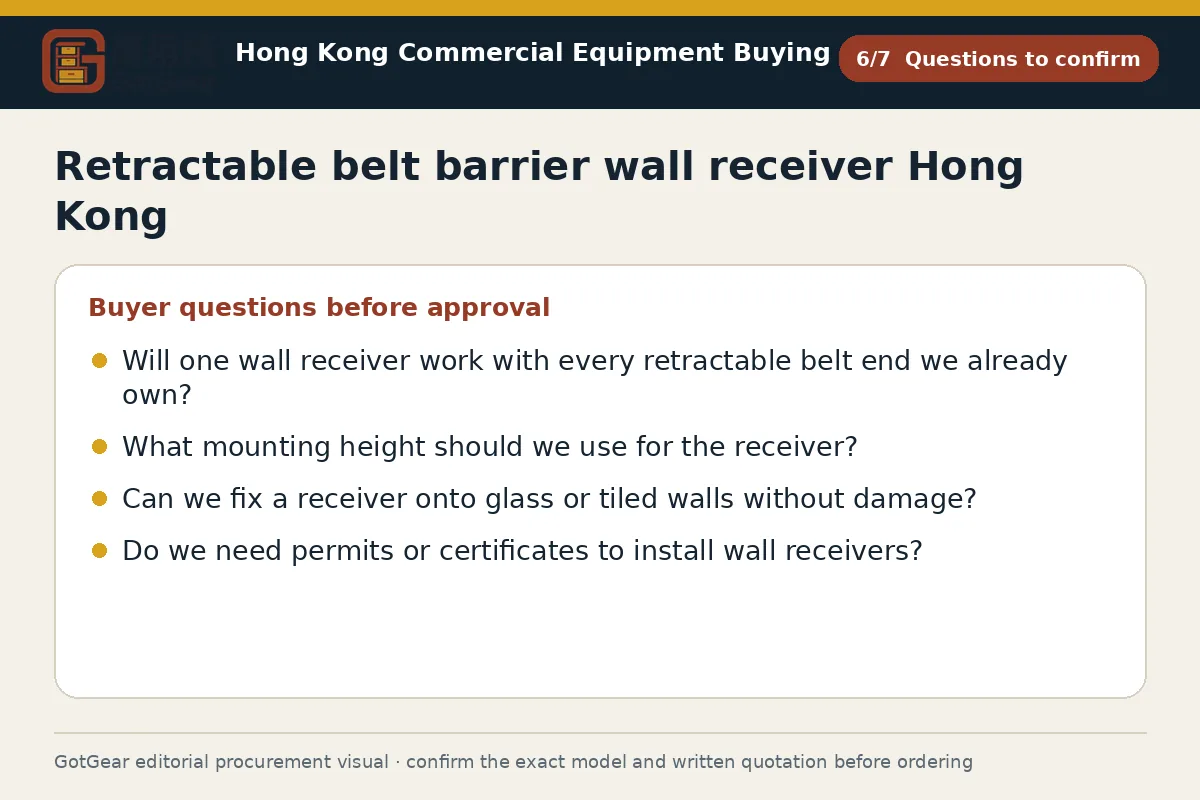
Will one wall receiver work with every retractable belt end we already own?
Not reliably. Receivers are shaped for specific belt-end profiles and safety locks. Ask respondents to confirm acceptance of your exact belt-end with photos and measurements. When brands or generations differ across sites, request a sample or test-fit guidance in writing, and consider standardising belt ends during future cartridge changes if feasible.
What mounting height should we use for the receiver?
Use a height that aligns with your existing belt ends and user flow, then confirm it against the model instructions. As an example starting point only, buyers often review 900–1,050 mm to the receiver centreline. Final height should reflect venue policy, signage sightlines, and any advice from the building manager or competent adviser.
Can we fix a receiver onto glass or tiled walls without damage?
Sometimes, with the right method. Options may include surface plates, through-glass hardware or adhesive systems specified by the manufacturer. Suitability depends on glass type, tile backing and venue approvals. Request written fixing proposals and pull-out data where relevant, and obtain building-manager consent before drilling or bonding.
Do we need permits or certificates to install wall receivers?
Many small installations proceed under venue approval, not external permits. Requirements vary by model, substrate and site rules. Ask the supplier for installation instructions and any documentation they expect the venue to hold, then check with your building manager and insurer for conditions on drilling, egress, signage or contractor qualifications.
Continue with closely related procurement topics
These pages share equipment, operating or decision-stage signals with this guide.
Slatwall panels Hong Kong
Explore slatwall panels Hong Kong with GotGear. We compare panel formats, groove layouts, panel dimensions and accessory compatibility to help you plan a slatwall display system Hong Kong.
Read the guide
Slatwall waterfall arms Hong Kong
GotGear offers a practical checklist for Hong Kong shops that compares visibility, capacity and projection of slatwall waterfall arms Hong Kong and slatwall faceout arms Hong Kong. It helps retailers plan displays and layout.
Read the guide
Slatwall display tower Hong Kong
Considering a slatwall display tower Hong Kong? Compare its fixed footprint and access with a slatwall spinner display Hong Kong or a slatwall gondola Hong Kong to assess fit and flow with GotGear.
Read the guide
Gridwall panel dimensions Hong Kong
Plan precise installations using gridwall panel dimensions Hong Kong: measure each unit's usable width, height and approach space, and record supports, skirtings and door swings to refine retail layouts with GotGear.
Read the guideRelated topic indexOpen more English procurement pages1 topics
Browse additional equipment families, applications and procurement questions relevant to a wider buying brief.