
For canopy tent weight floor protection Hong Kong, provide the venue with the ballast type, dimensions, contact material and proposed locations, then obtain approval for the intended protective layer. Inspect both ballast and floor before setup, and verify manufacturer instructions, actual site conditions and applicable Hong Kong requirements before use.
Venue surface details for canopy tent weight floor protection Hong Kong
Start by securing a written description from the venue of every surface that any ballast, pad or tray may touch, including floors, ramps, lift cars and loading bays. Ask for finish type (e.g. polished porcelain, terrazzo, natural stone, timber, vinyl), age, sealing or coating history, recent maintenance chemicals, and any prohibited materials. For clarity around canopy tent weight floor protection Hong Kong, request photos and a plan marking grout lines, movement joints, metal trims, thresholds, expansion covers and drainage points likely to sit under legs or weights.
Measure and record field details that influence point loads and staining risk. As an example starting point, note tile dimensions and grout width, joint spacing, slope to drains, and whether edges are bevelled; confirm all figures in the written brief with the venue or a competent adviser. Identify environmental factors that affect protection layers: expected humidity and condensation, air-conditioning schedules, cleaning times and any overnight floor-polish curing. Document site constraints specific to Hong Kong buildings: goods-lift cabin size and door clear width, lobby turns, loading-window slots, noise limits, and whether protective runners are mandated along the delivery route. Obtain the venue’s event house rules and any bilingual guidelines that define “non-marking” materials, use of water indoors, and required pre- and post-event surface photos. These records will guide pad selection and approval.
Mapping contact points in canopy tent weight floor protection Hong Kong
Translate the plan into a scaled layout that fixes every canopy leg and ballast position before equipment is ordered. Number each contact point, show offsets from grout lines and movement joints, and mark minimum clearances from egress routes, escalators and lift lobbies. Where floors are sloped to drainage, position loads so contact patches sit fully on one plane. If underground services are known beneath a zone, request a no-drill, low-bearings note from the venue and avoid stacking loads there. Include the intended protective layer at full size so the management office can assess trip risk at edges.
For each ballast, list model, filled mass or solid mass, footprint, contact material and edge radius. Ask the supplier for a dimensional sketch and any placement advice for clustered weights or stackable designs. Map the logistics path too: turning radii, thresholds, ramp gradients, lift sizes and whether dollies need soft tyres. Where water is proposed, add fill points and disposal routes, consistent with your Hong Kong canopy water weight leak-check procedure. For busier office or mall sites, attach your Hong Kong outdoor tent unloading access planning notes so building staff can pre-clear timing, signage and protection runners for corridors and lift cars. Submit the drawing with bilingual labels if the venue requires Chinese and English.
What should buyers compare for canopy tent weight floor protection Hong Kong?
| Criterion | Straightforward requirement | More complex requirement | Evidence to provide |
|---|---|---|---|
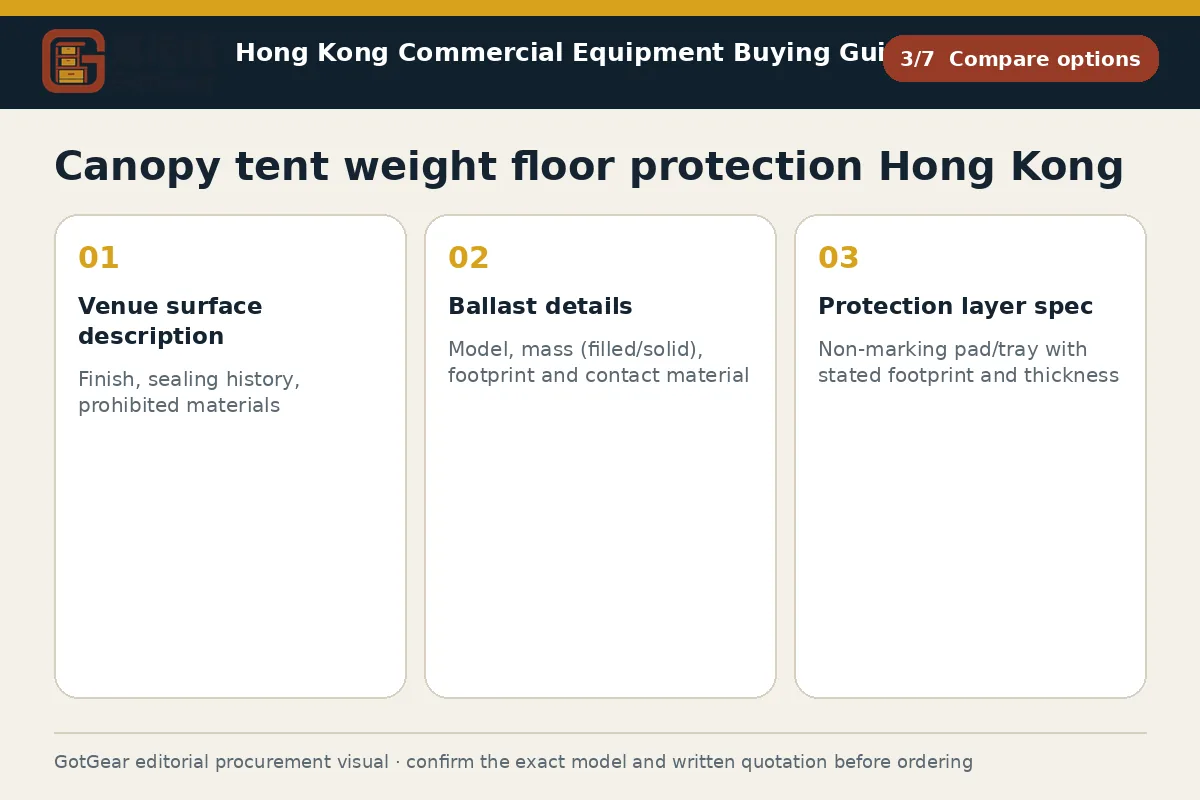
| Venue surface description | Finish, sealing history, prohibited materials | Movement joints, drains, trims, chemical cleaners and moisture risks | Photos, annotated plan, house rules extract (bilingual if required) |
| Ballast details | Model, mass (filled/solid), footprint and contact material | Edge radius, stacking/cluster advice and placement constraints | Dimensional sketch, instructions for use, supplier statement of contact surface |
| Protection layer spec | Non-marking pad/tray with stated footprint and thickness | Layered system (e.g. barrier + tray + pad) with trip-edge control | Material type, thickness, footprint per point, non-marking/colourfast confirmation |
| Access route protection | Basic runners for corridors and lift cars | Route plan with thresholds, ramps, lift sizes and timing windows | Route map, runner material data, lift dimensions and booking confirmation |
| Approvals and records | Venue written acceptance prior to delivery | Pre- and post-event photos and bilingual method note | Signed approval email/letter, dated photos, method statement and handover form |
This framework helps buyers create comparable written enquiries. Final model specifications, availability, delivery and commercial terms must be confirmed in a formal quotation.
Protection options to approve for canopy tent weight floor protection Hong Kong
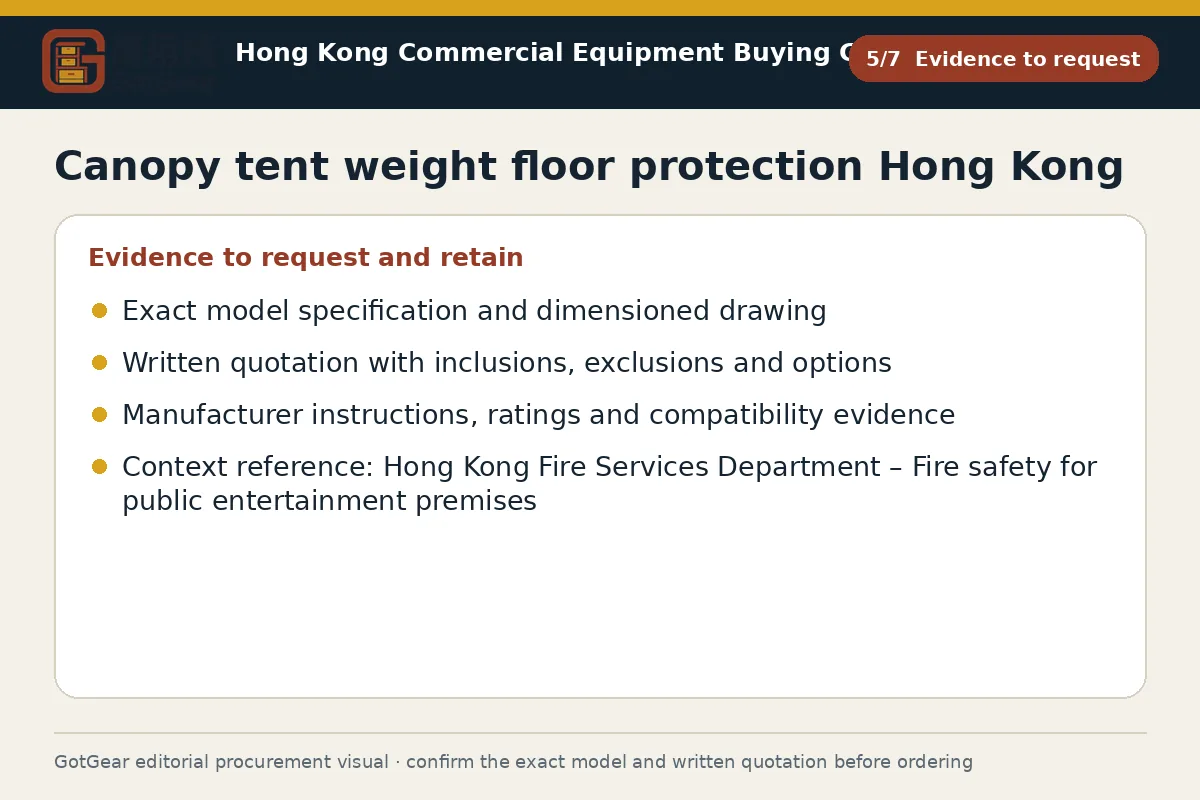
Select a protection method that the venue will accept in writing, based on surface sensitivity and the ballast’s contact geometry. Options include non-marking rubber pads, dense neoprene with fabric facing, HDPE trays, plywood with sealed edges and anti-slip underlay, interlocking composite tiles, or a layered approach such as geotextile under HDPE. For glossy tiles, many teams consider wider, rigid trays with chamfered edges to reduce local pressure and trip hazard; for stone likely to wick moisture, include a vapour barrier film. If water is used, add secondary containment and drip trays aligned with your canopy water weight leak check Hong Kong routine.
When requesting quotations, ask suppliers to state material type, thickness, footprint per point, surface hardness, claimed compressive performance and temperature/humidity tolerance. As an example starting point only, you might test-fit a 10–20 mm pad footprint larger than the ballast base; confirm any figure in the written brief issued to the venue and supplier. Require confirmation of “non-marking”, colourfastness and chemical compatibility with likely cleaners, plus cleaning instructions and whether edge ramps are included. For polished tile scenarios, seek advice on pop up gazebo weights for tiled floor Hong Kong to judge whether rigid trays outperform soft pads. Compare quotes line by line against the drawing: footprint, pad count, chamfered edges, containment for liquids and any evidence the venue requests (photos, samples or data sheets).
Pre-setup checks for canopy tent weight floor protection Hong Kong
Before setup day, assemble documents: the approved layout, supplier instructions for the ballast and pads, venue rules, bilingual risk notes and contact numbers for duty managers. Inspect the received items: trays lie flat without warp, pads are free of cuts, embedded grit or strong odours that could indicate carbon-black transfer, and metal or concrete ballast has no burrs, rust blooms or loose coating. Conduct a clean, dry wipe test of one pad on a sample offcut or a concealed area only with venue consent. Cross-check your folding tent anchoring checklist Hong Kong against the forecast and ensure the intended ballast scheme matches the model’s guidance.
On site, walk the delivery route first. Lay temporary runners where the venue requires protection, check lift car sizes and door swings, and protect thresholds. At the footprint, confirm the floor is dry, free from grit and matches the described finish. Place the approved layer exactly as drawn; keep edges flat, then land ballast carefully without scuffing. Secure water caps and inspect for weeping before positioning. Photograph each contact point after placement and after removal, then obtain the venue’s post-event sign-off. If conditions differ from the approved plan, stop and escalate to the management office or a competent adviser before proceeding.
Canopy tent weight floor protection Hong Kong decision checklist
Confirm a written surface description and house rules with the venue, then measure tile sizes, grout widths, joints and drainage slopes where contact points will sit. Produce a scale drawing that fixes leg locations and pad or tray footprints away from vulnerable lines. Request supplier sketches and data for ballast dimensions, contact materials and edge radii, and propose a protection layer with non-marking confirmation. Compare quotations against the drawing for footprint, thickness, chamfered edges, containment and cleaning guidance. Book loading windows and confirm goods-lift and corridor constraints. On receipt, inspect pads and trays for damage or grit and verify ballast condition and caps. Brief the crew with bilingual instructions, lay route protection if required, and land weight gently onto clean, dry, approved layers. Photograph before and after, and obtain the venue’s sign-off.
- Operating use, quantity and expected frequency
- Dimensions, capacity, material and accessory requirements
- Delivery address, floor, goods lift and loading window
- Required documents, acceptance checks and after-sales arrangements
Key points for canopy tent weight floor protection Hong Kong
In Hong Kong venues, approval for surface protection is typically routed through the building’s management office, with timing shaped by booking windows for loading bays and goods lifts that may be tight and shared. Many malls and hotels require bilingual submissions, protection runners along public corridors, and pre- and post-event surface photos before deposits are released. Humidity and air-conditioning schedules can cause condensation under pads, so moisture barriers and dry floors are often essential. Water ballast indoors may be restricted or require secondary containment. Always align your proposal with the venue’s written rules, the manufacturer’s instructions and any applicable Hong Kong requirements, and treat this page as planning guidance rather than legal advice.
Questions about canopy tent weight floor protection Hong Kong
Is sand, solid block or water ballast better for indoor venues?
Choose what the venue will approve in writing and what the tent model allows. Solid blocks avoid on-site filling but are heavy to route through lifts; water ballast reduces handling mass but needs leak prevention and disposal permissions. Confirm the model’s guidance, the venue’s rules on water use, secondary containment and floor protection, then document the accepted method before ordering.
What pad or tray footprint should I plan for polished tile floors?
Use a footprint large enough to spread load and keep edges flat, then validate on site. As an example starting point, many teams test a rigid tray larger than the ballast base with a thin non-marking layer beneath; confirm any dimensions with the venue, supplier and a competent adviser, and ensure trip edges are chamfered and accepted in writing.
How do I manage grout lines, movement joints and uneven spots?
Map them on a scale drawing and offset contact points so loads sit fully on one plane. Where avoidance is impossible, use wider, rigid trays to bridge gaps and add a compliant layer only if the venue approves. Seek written confirmation from the management office and the supplier’s placement guidance before setup, then photograph conditions pre- and post-event.
Who signs off protection measures and what evidence do they expect?
Usually the building management office or venue events team signs off, based on their house rules. Expect to provide a scale layout, product data sheets, non-marking statements, photos or samples, and sometimes bilingual labels. Some sites ask for before-and-after photos and confirmation that manufacturer instructions were followed. Always treat the venue’s written approval and the formal quotation as prevailing.
Continue with closely related procurement topics
These pages share equipment, operating or decision-stage signals with this guide.
Canopy tent weights for concrete Hong Kong
See the GotGear guide to canopy tent weights for concrete Hong Kong, pop up gazebo weights for tiled floor Hong Kong and canopy tent ground anchors for grass Hong Kong. Check venue approval and installation requirements.
Read the guide
Canopy tent weight distribution per leg Hong Kong
GotGear guide to canopy tent weight distribution per leg Hong Kong shows how to check each fixing and how to reassess canopy tent sidewalls wind anchoring Hong Kong and linked canopy tent anchoring Hong Kong after layout changes.
Read the guide
Canopy tent artwork bleed guide Hong Kong
Refer to the GotGear canopy tent artwork bleed guide Hong Kong to set bleed and safe areas. Also review canopy tent seam artwork Hong Kong and test custom canopy small text printing Hong Kong on a final-size proof.
Read the guide
Custom canopy QR code placement Hong Kong
GotGear recommends that for custom canopy QR code placement Hong Kong you position the code where approaching visitors can see it, use high contrast, maintain a clear margin and avoid seams. Test at realistic angles.
Read the guideRelated topic indexOpen more English procurement pages3 topics
Browse additional equipment families, applications and procurement questions relevant to a wider buying brief.