
For canopy tent weights for concrete Hong Kong, first confirm the permitted fixing method and the manufacturer’s instructions for the exact canopy and layout. There is no one-size-fits-all ballast or anchor value: verify site conditions, floor protection, underground constraints, venue approval and applicable Hong Kong requirements before setup.
Hard-surface planning for canopy tent weights for concrete Hong Kong
On hard surfaces, anchoring starts with measurement, not assumptions. For canopy tent weights for concrete Hong Kong, walk the exact footprint and note surface slope, drainage channels, expansion joints and any coatings that reduce friction. Photograph the leg locations, mark distances to edges and overhead obstructions, and record wind exposure (e.g., podium, rooftop, open waterfront). Ask the building manager for any slab load notes and restrictions on placing concentrated loads. Check the full delivery route: goods-lift size, door widths, ramp gradients and the turning radii for trolleys moving dense ballast blocks.
In your enquiry, request the manufacturer’s written anchoring guidance for the exact frame model, size, sidewalls and any linked bays. Ask for per-leg attachment details (base plate hole size, collar/strap interface), compatible tie-down straps, and corrosion resistance suitable for humid conditions. Specify block dimensions, handle design, stackability, and any protective sleeves or pads. When comparing quotations, require a leg-by-leg schedule stating the proposed method and an example starting point for ballast mass per leg to be confirmed in the written brief by the responsible supplier and venue. Confirm whether non-penetrating methods are mandated. Plan delivery by time slot and in lift-friendly consignments. On receipt, inspect castings or plates for burrs, coating damage and mismatched accessories, and keep packing lists for bilingual sign-off with the management office.
Surface protection: Canopy tent weights for concrete Hong Kong and pop up gazebo weights for tiled floor Hong Kong
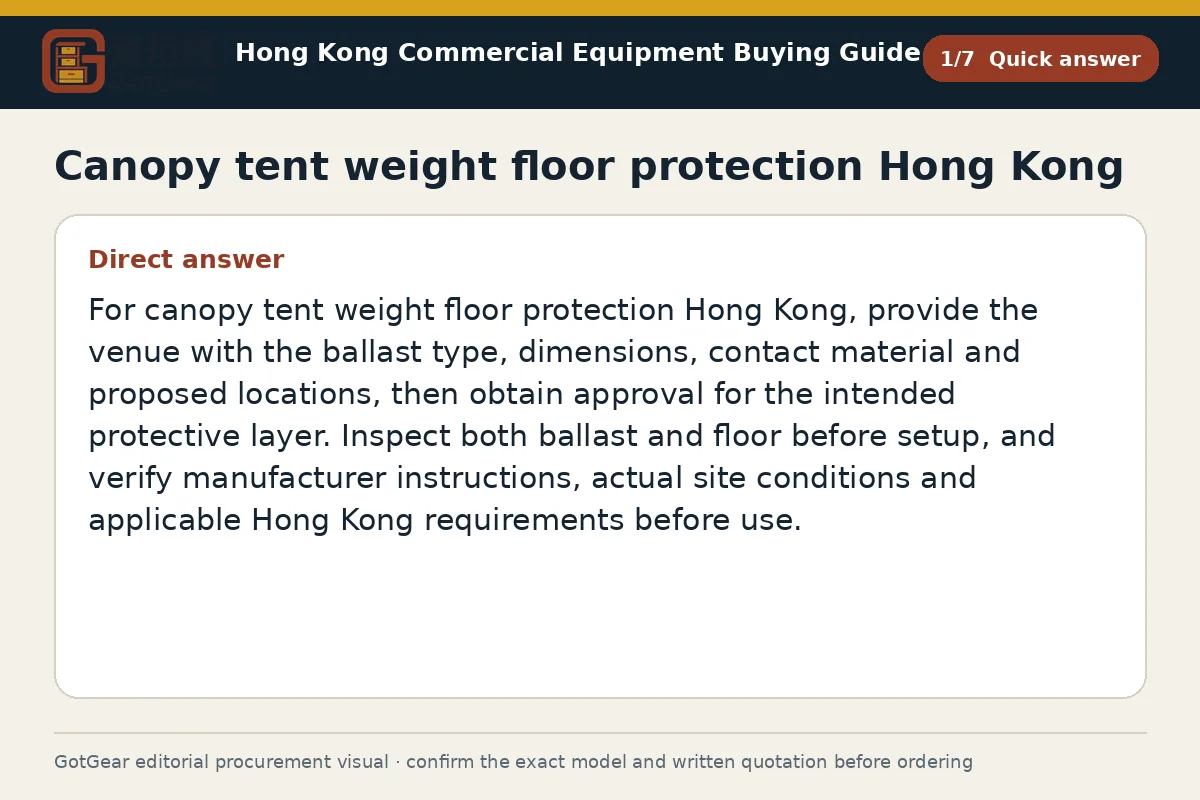
Tiles are as much a surface-protection concern as a stability one. Identify the tile type (porcelain, ceramic, natural stone), the finish, grout width and any hollow-sounding areas. Note slopes, polishing compounds and cleaning regimes that may affect slip risk. For polished lobbies and malls, specify pop-up gazebo weights for tiled floors in Hong Kong, with non-marking contact faces, and include interlayers such as rubber pads or rigid spreaders sized to the leg footprint. Ask the venue whether temporary protection (boards, runners, edge guards) is required not only under the legs but also along the trolley route from the loading bay to the goods lift.
In procurement, request finish details for any metal in contact with tiles (powder coat, rubberised base, protective caps), and written confirmation that materials are non-staining and compatible with common stone sealers. Ask for the footprint pressure of the proposed solution and the minimum spreader size the manufacturer recommends as an example starting point, to be confirmed in the venue’s method approval. Compare quotations on whether protection layers and on-floor signage are included. Provide clear floor photos and a small test area for approval if the venue requests it. On delivery, reject weights with sharp edges, oil residues or loose grit; fit protective pads before the first placement; and route tie-down straps so they do not chafe across tile edges or skirtings.
What should buyers compare for canopy tent weights for concrete Hong Kong?
| Criterion | Straightforward requirement | More complex requirement | Evidence to provide |
|---|---|---|---|
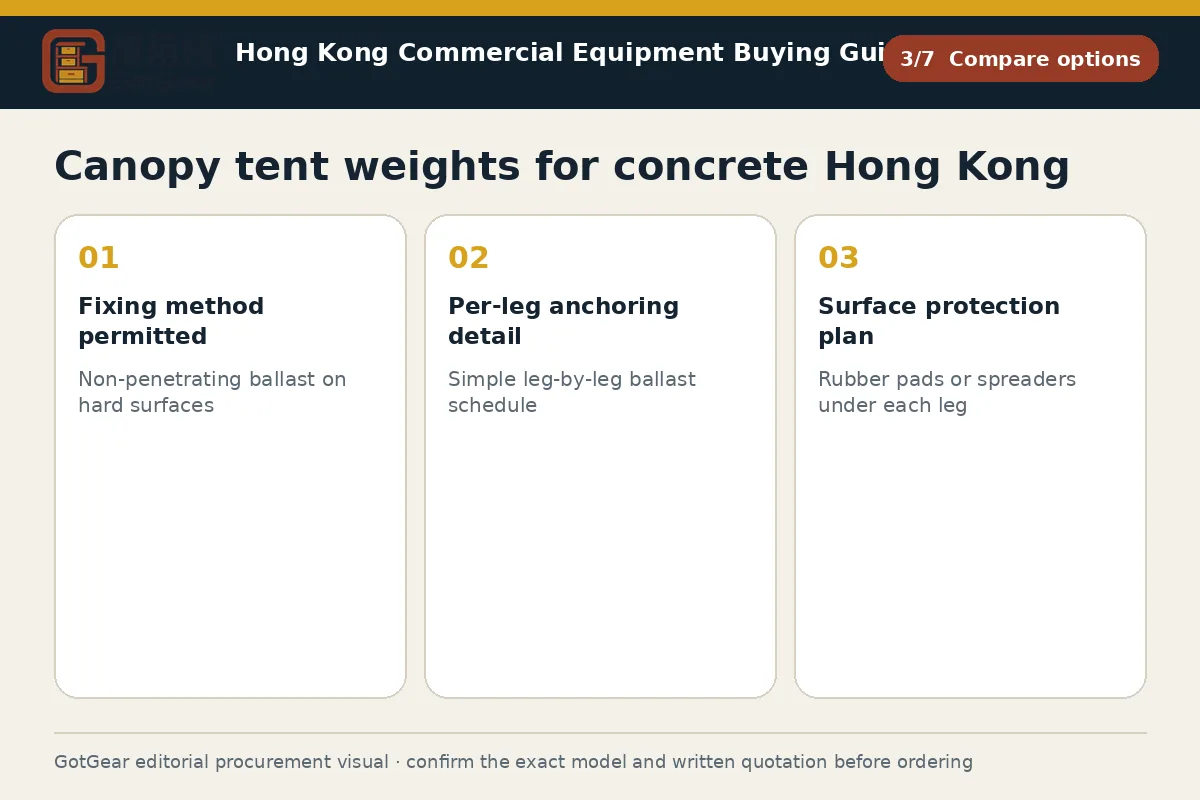
| Fixing method permitted | Non-penetrating ballast on hard surfaces | Penetrative anchors where the venue permits and ground allows | Venue’s written approval and manufacturer’s instructions for the exact model |
| Per-leg anchoring detail | Simple leg-by-leg ballast schedule | Mixed methods across legs (e.g., edge legs vs internal bays) | Manufacturer guidance and a layout drawing with marked leg positions |
| Surface protection plan | Rubber pads or spreaders under each leg | Route protection, edge guards and tile-friendly finishes | Photos of surfaces, material datasheets and a brief method statement |
| Site access and handling | Direct trolley access and lift-friendly consignments | Tight turns, split deliveries and timed loading windows | Measured lift and doorway sizes, route map and booking confirmation |
| Ground/utility checks (grass) | Venue confirms no services in footprint | Competent scan, marked exclusion zones, alternative ballast plan | Site notes from venue, service sketches and (if requested) test records |
This framework helps buyers create comparable written enquiries. Final model specifications, availability, delivery and commercial terms must be confirmed in a formal quotation.
Venue approval before using canopy tent weights for concrete Hong Kong
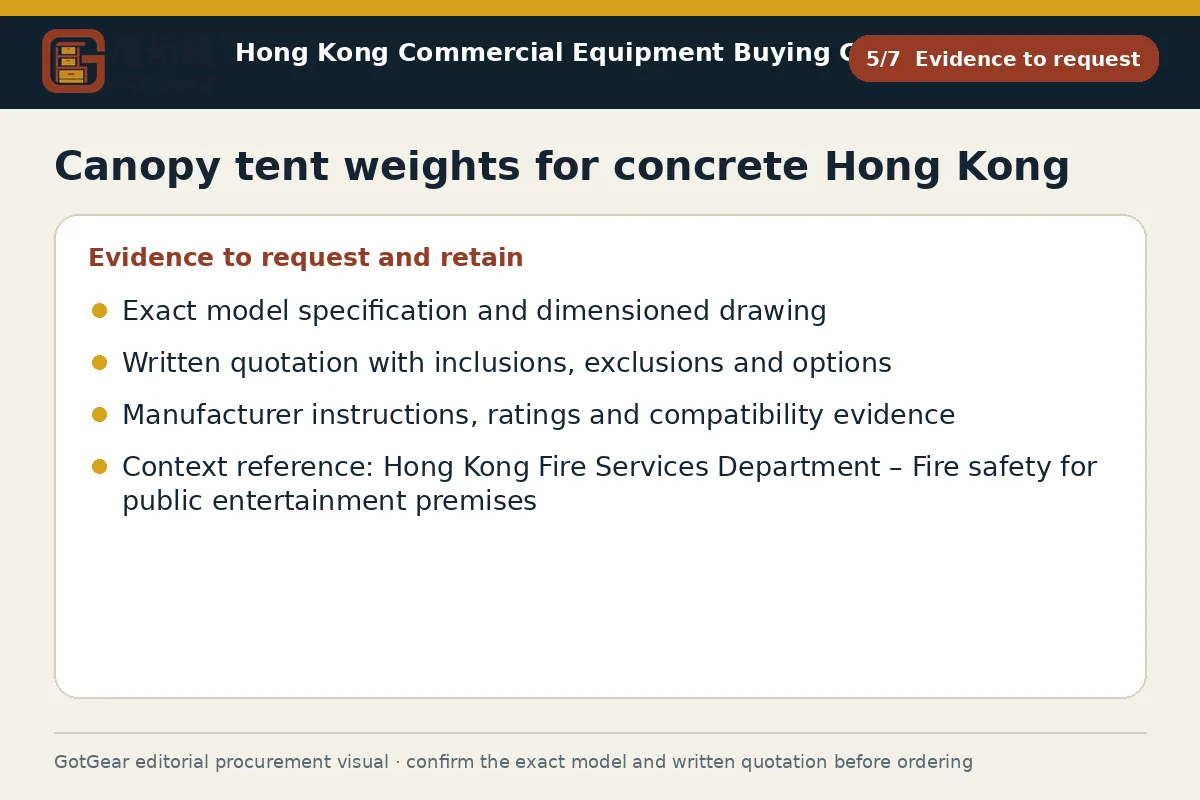
Before any order is placed, confirm what the venue allows and what documentation they require. Many Hong Kong sites limit drilling and prefer non-penetrating solutions, so submit a simple method statement showing the tent layout, leg locations, anchoring approach and housekeeping (trip prevention, drip trays, edge guards). Include the canopy model number, configuration, and the manufacturer’s current instructions covering anchoring and any tie-down straps. If the venue or organiser asks for wind mitigation notes, provide a brief description of exposure and your proposed control measures, and state that the model specifications and the venue’s written directions will prevail.
Expect practical conditions from building management: bilingual documentation, named responsible person and contact, loading-bay booking, goods-lift dimensions, protection for common areas, and restrictions during office hours. If the event is public-facing, the organiser may ask for evidence such as fabric fire-retardancy statements, electrical safety for any lighting, or a contingency plan for strong wind or rain; supply these only as applicable to the chosen model and the event format. For projects where the venue is concerned about slab marking or noise, propose a pre-start inspection with management, and obtain a written acceptance of the anchoring method before procuring accessories.
Ground checks for canopy tent weights for concrete Hong Kong and canopy tent ground anchors for grass Hong Kong
Grass requires below‑ground diligence and a weather plan. Request current site information from the venue on irrigation lines, electrical conduits, drainage and tree protection zones. If records are unclear, ask whether a competent person can scan the area or mark known services. Walk the pitch to assess saturation, thatch depth and gradients, and note adjacent hard edges where legs may straddle different surfaces. Where permitted, specify canopy tent ground anchors for grass surfaces in Hong Kong, including the manufacturer’s recommended type, installation method and an example starting point for target embedment to be confirmed by the responsible supplier and the venue. Some venues may request a proof or pull test for representative anchors; provide only if they ask for it.
If penetrative anchors are refused, propose non‑penetrating ballast with ground protection mats to prevent sinking and turf damage. Include details on extraction and reinstatement: how stakes will be removed, how divots will be repaired, and how waste will be controlled. Ask suppliers for the required tools, torque or impact rating for any screw‑in anchors, and corrosion protection suitable for coastal humidity. On receipt, inspect anchors and straps for coating defects and mismatched fittings, keep spare protective mats for high‑traffic legs, and mark anchor lines clearly to protect participants and the public.
Canopy tent weights for concrete Hong Kong decision checklist
Confirm the permitted fixing approach with the venue, then request the manufacturer’s current anchoring instructions for the exact model and layout. Survey the surface: slope, coatings, joints, utilities and wind exposure, and map the whole delivery route and lift constraints. Record restrictions on drilling, slab loading and protection, and propose a leg-by-leg method with photos. Ask suppliers for attachment details, example starting points for ballast or embedment to be confirmed in writing, finishes for humid conditions and non-marking contact faces. Compare quotations on a per-leg schedule, inclusion of protection layers, tools and installation notes. Submit a concise, bilingual method statement and secure written venue approval before ordering. Plan delivery by time slot, split consignments for lifts, and inspect on receipt for coating damage, burrs and mismatched fittings. Keep a wet-weather and strong-wind contingency that aligns with the venue’s directions and the manufacturer’s instructions.
- Operating use, quantity and expected frequency
- Dimensions, capacity, material and accessory requirements
- Delivery address, floor, goods lift and loading window
- Required documents, acceptance checks and after-sales arrangements
Key points for canopy tent weights for concrete Hong Kong, pop up gazebo weights for tiled floor Hong Kong, canopy tent ground anchors for grass Hong Kong
Hong Kong venues often require advance submission of an anchoring method, bilingual contacts, and protection for common areas during delivery and setup. Expect management-office coordination, loading-bay time slots and tight goods-lift limits that affect how dense ballast is moved. Rooftops and podiums can be wind-exposed, and coastal humidity accelerates corrosion if finishes are not specified. Public events may add conditions via the organiser or insurer. None of these are legal advice; obtain written instructions from the property manager or venue, and ensure the manufacturer’s current guidance for the exact canopy model and configuration is attached to your enquiry and approval request.
Questions about canopy tent weights for concrete Hong Kong
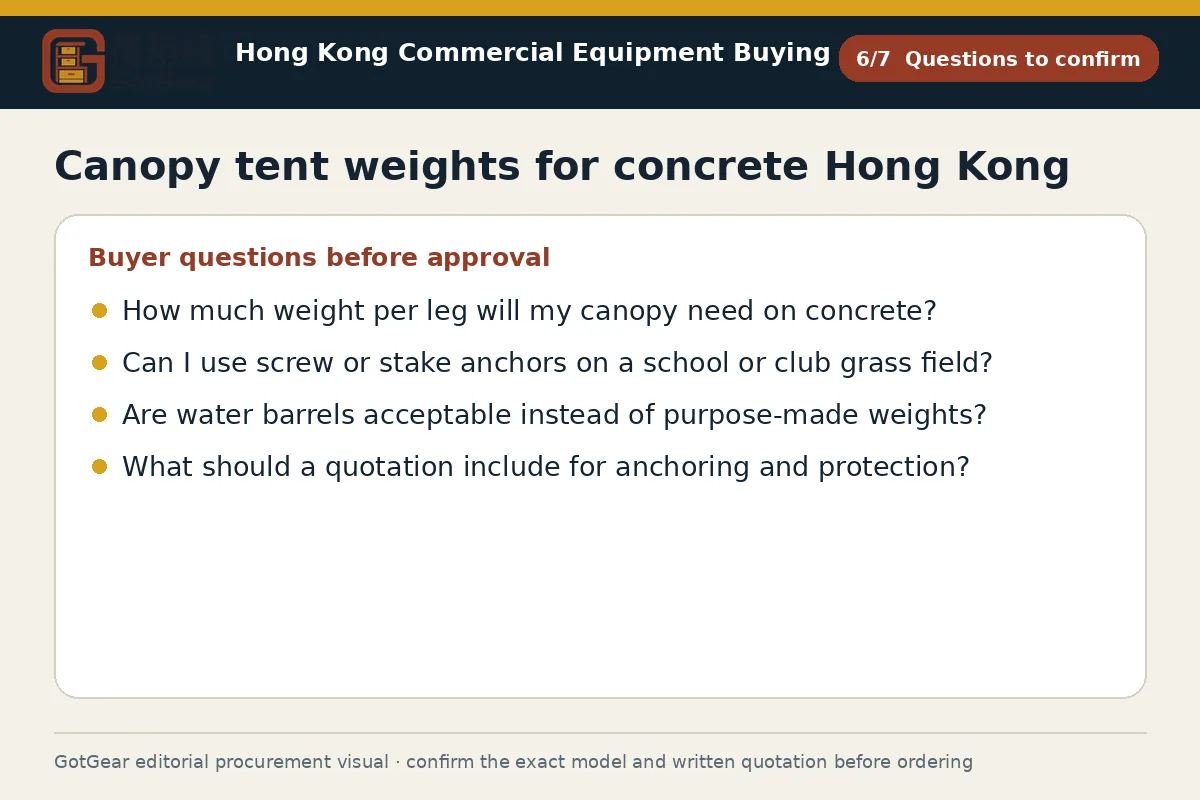
How much weight per leg will my canopy need on concrete?
It depends on the exact canopy model, size, sidewalls, exposure and the fixing method permitted. Always follow the manufacturer’s written instructions for the proposed configuration and site conditions. Treat any per-leg mass quoted by a supplier as an example starting point only. Seek written confirmation in the formal quotation, and ensure the venue accepts the non-penetrating approach before committing.
Can I use screw or stake anchors on a school or club grass field?
Only with written permission from the venue or property manager, and after checking for underground services. Some sites require a competent person to scan and may impose no-stake rules. If penetrative anchors are not allowed or ground conditions are unsuitable, specify non-penetrating ballast with turf protection. Follow the canopy manufacturer’s guidance and any venue-specific instructions for the event.
Are water barrels acceptable instead of purpose-made weights?
Sometimes venues or insurers do not accept improvised ballast due to stability, leakage and trip risks. If permitted, barrels must attach according to the manufacturer’s instructions and be considered in the method statement. Confirm acceptance in writing with the venue or organiser, and ensure handling, spill control and route protection are addressed before you choose this approach.
What should a quotation include for anchoring and protection?
Ask for a leg-by-leg anchoring schedule, attachment method, example starting points for ballast or embedment to be confirmed in writing, and finish details for humid and tiled areas. Include any protection layers, tools and installation notes, plus delivery routing and packaging suited to goods-lifts. Request current manufacturer instructions and product datasheets, and ensure exclusions or assumptions are clearly stated for venue approval.
Continue with closely related procurement topics
These pages share equipment, operating or decision-stage signals with this guide.
Canopy tent weight floor protection Hong Kong
GotGear provides a checklist to record floor finish, ballast and pad materials, pre-setup checks and venue sign-off for canopy tent weight floor protection Hong Kong.
Read the guide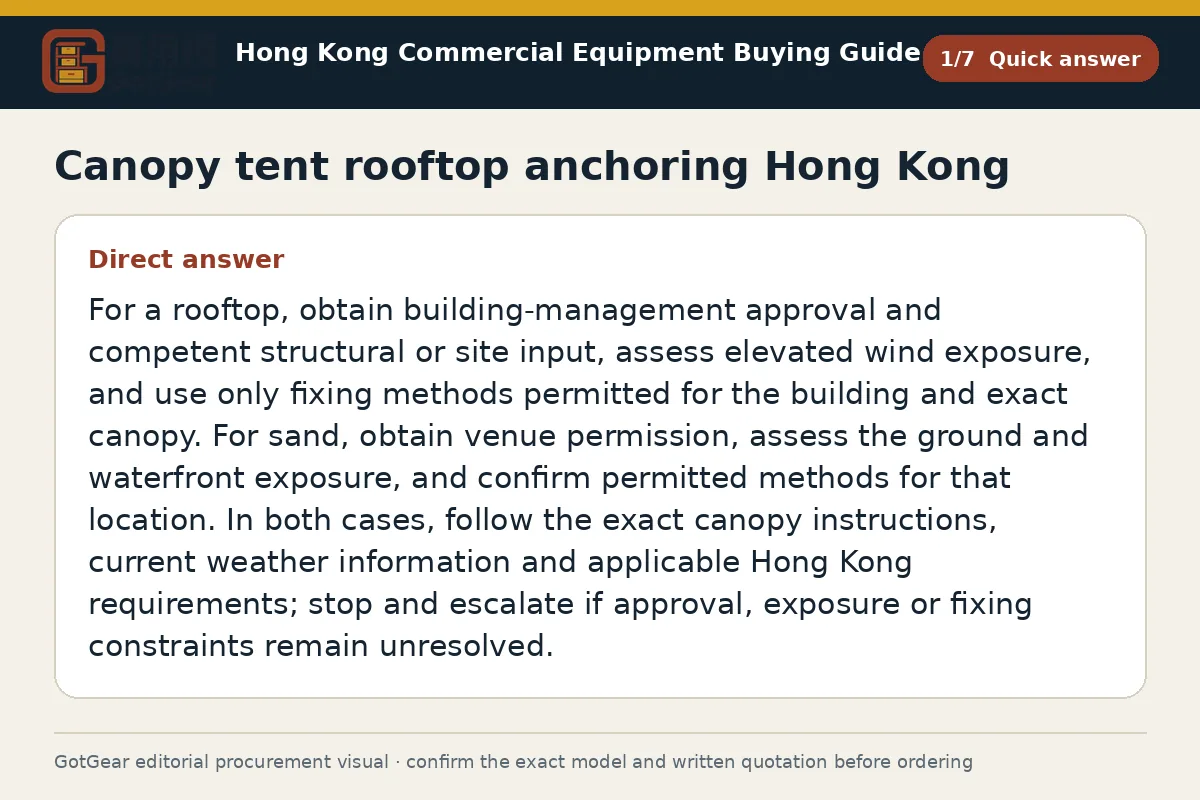
Canopy tent rooftop anchoring Hong Kong
GotGear offers guidance on approval, structural input, exposure, ground conditions and permitted fixing methods for canopy tent rooftop anchoring Hong Kong. It also covers measures for canopy tent anchoring on sand Hong Kong.
Read the guide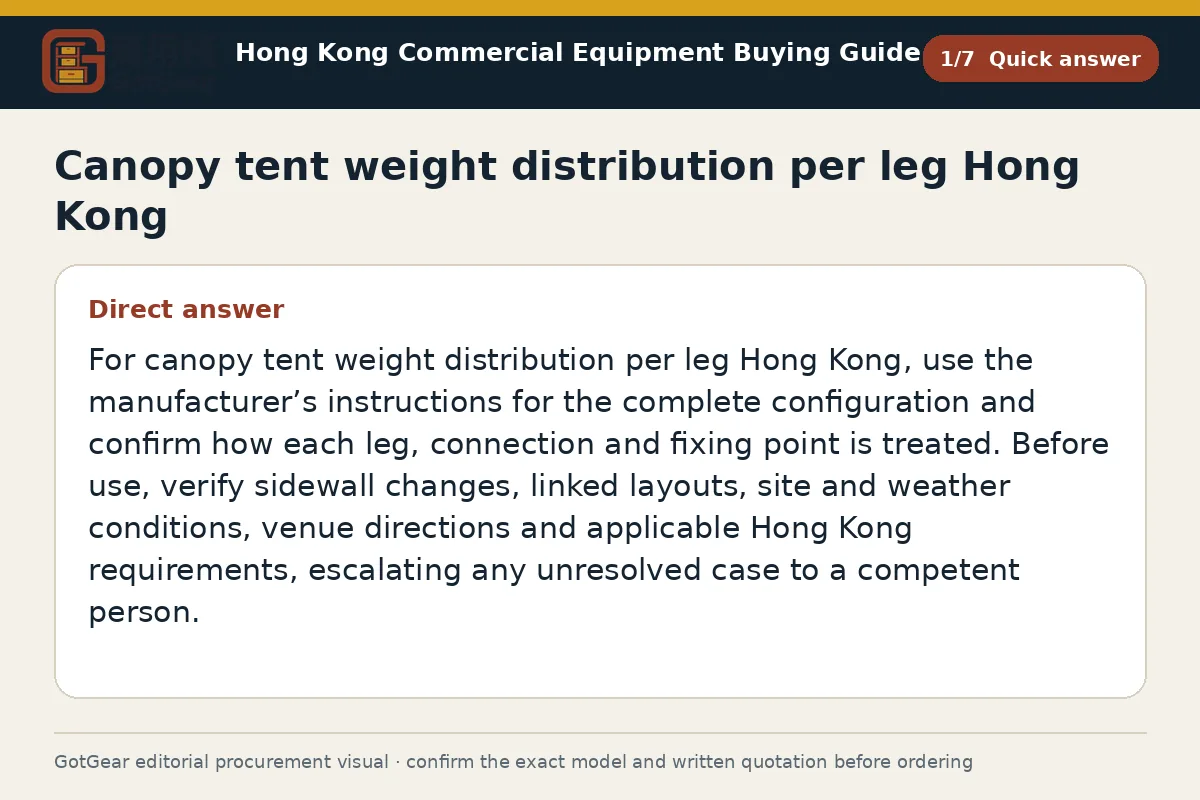
Canopy tent weight distribution per leg Hong Kong
GotGear guide to canopy tent weight distribution per leg Hong Kong shows how to check each fixing and how to reassess canopy tent sidewalls wind anchoring Hong Kong and linked canopy tent anchoring Hong Kong after layout changes.
Read the guide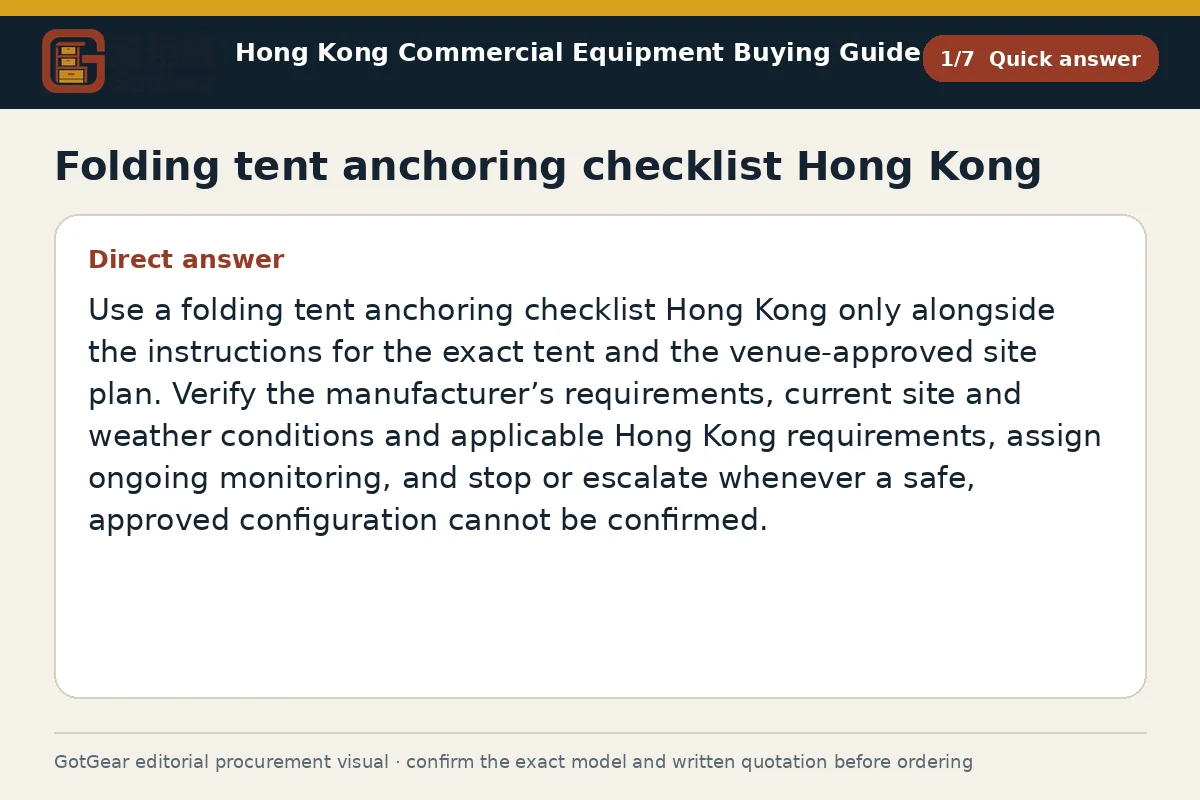
Folding tent anchoring checklist Hong Kong
Use the folding tent anchoring checklist Hong Kong to assess surface exposure, confirm layout and anchoring, and inspect fixings and ballast. Record checks, assign monitoring and include GotGear in your documentation.
Read the guideRelated topic indexOpen more English procurement pages2 topics
Browse additional equipment families, applications and procurement questions relevant to a wider buying brief.