
Confirm that the collapse feature suits the return route, define whether access control is needed and verify loading, stacking and handling limits in manufacturer instructions.
Collapsible pallet containers Hong Kong — Define Loads and Handling Interfaces
Start by describing the product mix and the handling risks. List typical contents, packaging condition and any sharp edges or liquids, then record gross mass per filled container and the weight distribution. As an example starting point, you may trial a provisional payload and stack plan, but confirm final limits in the supplier’s written specification. Request internal length, width, usable height, door aperture size, wall design, base style (deck and runners), fork-entry pattern, material (e.g. PP/HDPE), temperature tolerance and labelling features. Where food or hygiene is relevant, ask whether a food-contact statement is available for your model, subject to site and insurer requirements.
Document handling interfaces before shortlisting. Note the forklifts and pallet jacks to be used, fork dimensions, aisle widths, dock leveller width, and whether conveyors or turntables are in scope. Ask for drawings showing runner spacing, underside clearance for pallet jack entry and the position of handholds. Record access constraints typical of Hong Kong: goods-lift door width/height, internal car depth and lobby turning space. If smaller flows will ride with case-pick lines, align identification and tote sizing with any Hong Kong warehouse tote programme. For inbound acceptance and ongoing care of bases and runners, plan a site routine aligned to a Hong Kong plastic pallet inspection checklist, adapted to the specific model and your risk controls.
Collapsible pallet containers Hong Kong: Assess Access Control for Pallet Containers
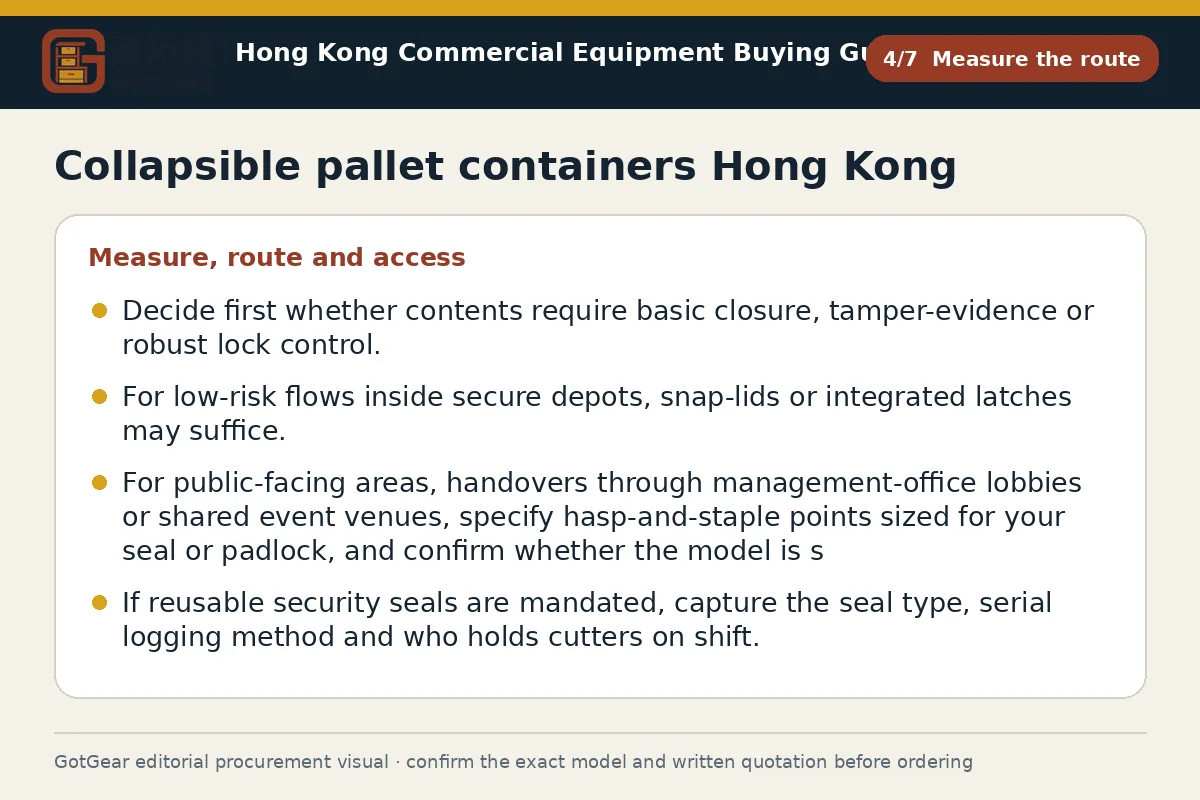
Decide first whether contents require basic closure, tamper-evidence or robust lock control. For low-risk flows inside secure depots, snap-lids or integrated latches may suffice. For public-facing areas, handovers through management-office lobbies or shared event venues, specify hasp-and-staple points sized for your seal or padlock, and confirm whether the model is stackable when lids are latched. If reusable security seals are mandated, capture the seal type, serial logging method and who holds cutters on shift.
When considering lockable pallet containers, Hong Kong buyers should compare latch materials, hinge design, and whether the lid or side-gate can be replaced without scrapping the bin. Ask for closure operating instructions and maximum permissible top load when closed, stated by the manufacturer. If sensitive goods transit mixed carriers, plan bilingual exterior notices and barcode/RFID placement that does not interfere with locking points. For any regulated or hazardous contents, obtain written requirements from the responsible authority or insurer and seek the supplier’s confirmation that the proposed model and closures are compatible; the model specification and formal quotation should prevail.
What should buyers compare for collapsible pallet containers Hong Kong?
| Criterion | Straightforward requirement | More complex requirement | Evidence to provide |
|---|---|---|---|
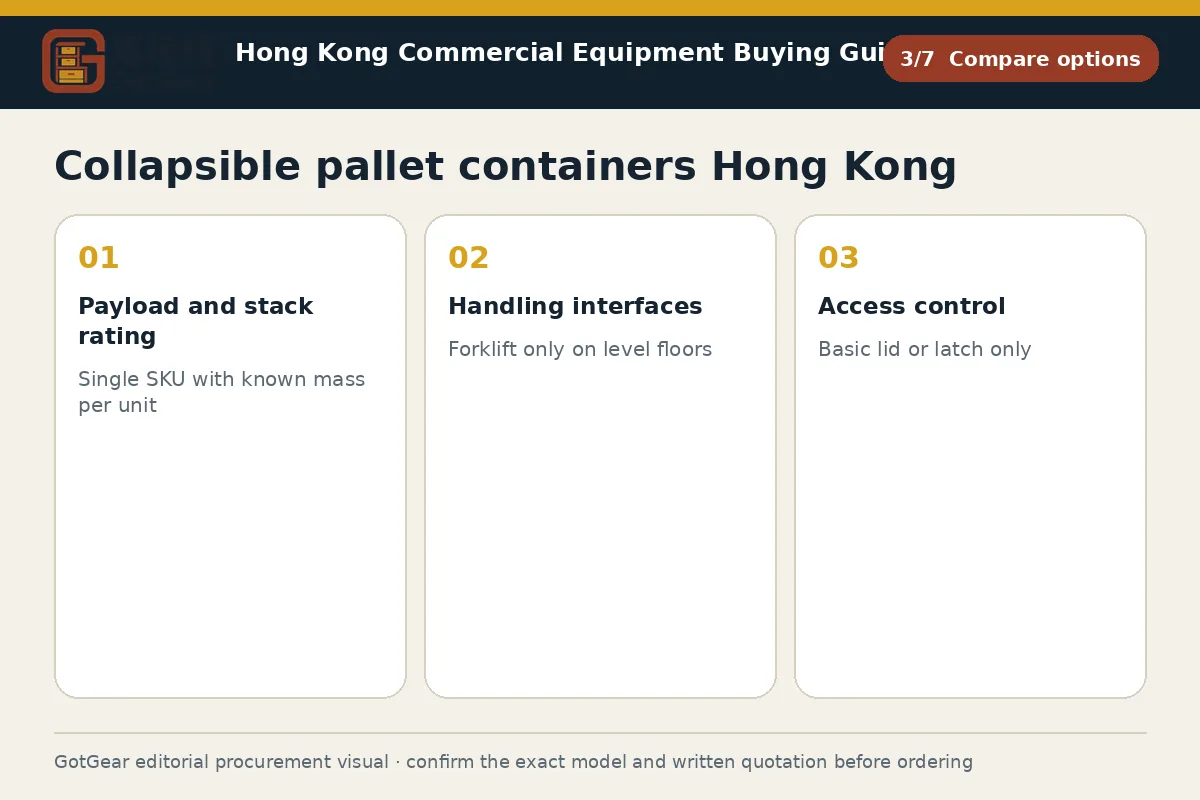
| Payload and stack rating | Single SKU with known mass per unit | Mixed SKU with variable density and centre of gravity | Max payload, dynamic/static stack loads, example load photos and masses |
| Handling interfaces | Forklift only on level floors | Forklift plus pallet jack and conveyors across docks and lifts | Fork sizes, jack wheel height, aisle/dock dimensions and lift car sizes |
| Access control | Basic lid or latch only | Lock points with tamper-evident or keyed control | Seal/padlock type, chain-of-custody process and bilingual exterior labels |
| Collapse and storage | Single-site empty storage on pallets | Multi-site returns via goods-lifts with stacked collapsed units | Collapsed height, safe stack per guide, tie-down method and bay booking notes |
| Hygiene and cleaning | Dry ambient goods, simple wipe-down | Frequent washing, food or sensitive goods in humid areas | Cleaning agents used, drying time, need for food-contact statement if applicable |
This framework helps buyers create comparable written enquiries. Final model specifications, availability, delivery and commercial terms must be confirmed in a formal quotation.
Collapsible pallet containers Hong Kong — Plan Collapse, Storage and Empty Returns
Plan the folded state with the same discipline as the outbound leg. Record collapsed height, footprint and the number of collapsed units that can be stacked and secured on your pallets or cages; treat any figures given here as example starting points to be validated in the manufacturer’s handling guide. Confirm who performs the collapse/erect cycle, the tools required, pinch‑point risks and where gloves are mandatory. In humid Hong Kong conditions, schedule drying time after washing so folded panels do not trap moisture and affect labels or odour.
Check whether your storage racks, mezzanines and goods‑lift cars can accommodate stacks of folded units, and agree stack heights with reference to the maker’s instructions and your risk assessment. For safe yard or warehouse stacking and tie‑down during backhauls, align site rules with your plastic pallet stacking safety policy and record any limits set by the building manager. When sourcing collapsible pallet containers, operations teams in Hong Kong should request exploded diagrams, parts lists for hinges and latches, and the recommended cycle‑life statement for the model. Ensure the return lane is mapped: empty storage location, lift access, booking windows for loading bays and the route to consolidation.
Collapsible pallet containers Hong Kong: Compare Pallet-Container Capacity and Route Fit
Capacity comparisons should begin with internal dimensions, usable height and wall geometry, then consider payload, dynamic handling, static stacking and any drop or impact claims the manufacturer provides. Walk the route: measure doorways, lift cars, aisle turns and truck decks, and weigh a typical production load. Ask for dimensional drawings and for the specific test method or internal standard referenced for load figures so quotations can be compared consistently.
Match the container family to the route. Projects in Hong Kong using plastic bulk containers that move between urban depots and industrial buildings will benefit from models with robust runners and clear fork entries; dense export routes may instead prioritise footprint coherence and return ratio. Where dunnage, dividers or liners are required, include these in the enquiry and check compatibility with side gates and lids. If some SKU flows are better served by case consolidation, align specifications with your Hong Kong returnable transport packaging strategy so containers, pallets and identification can be controlled as a single system. On receipt, verify that stacking lugs, hinge pins and base runners match the quoted drawing before putting units into service.
Collapsible pallet containers Hong Kong decision checklist
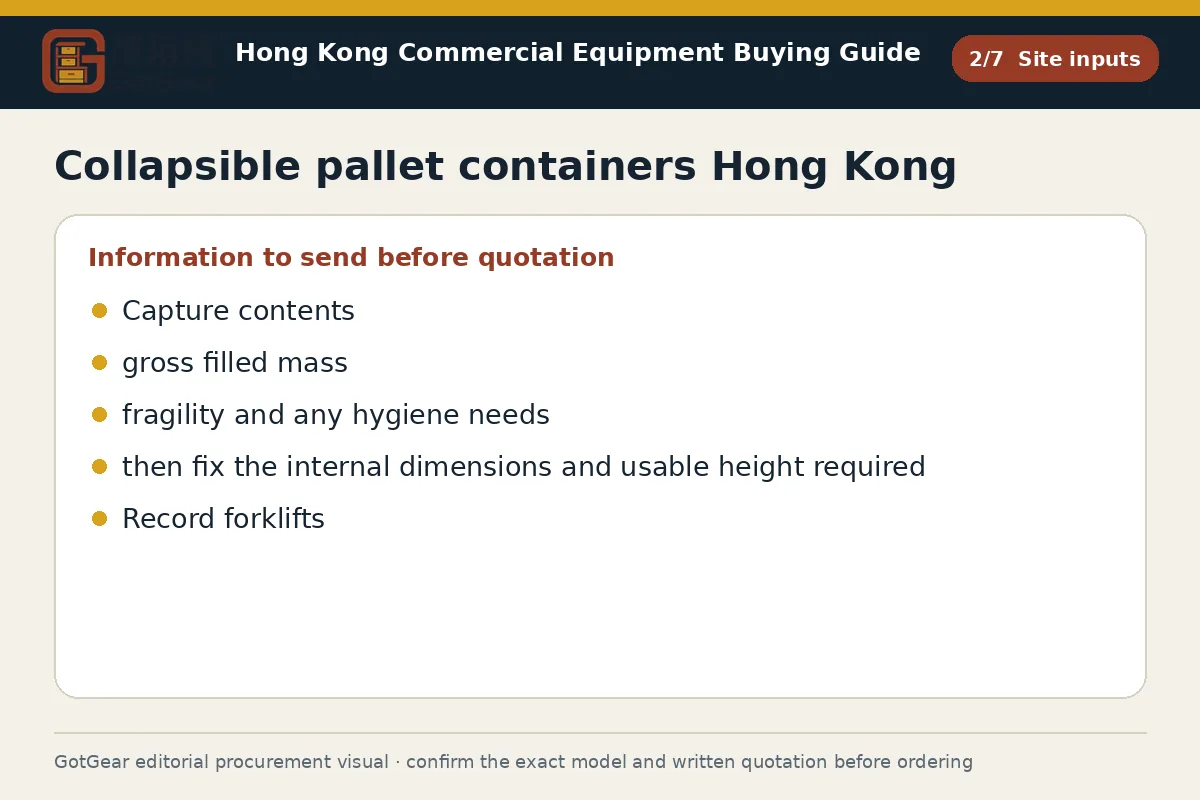
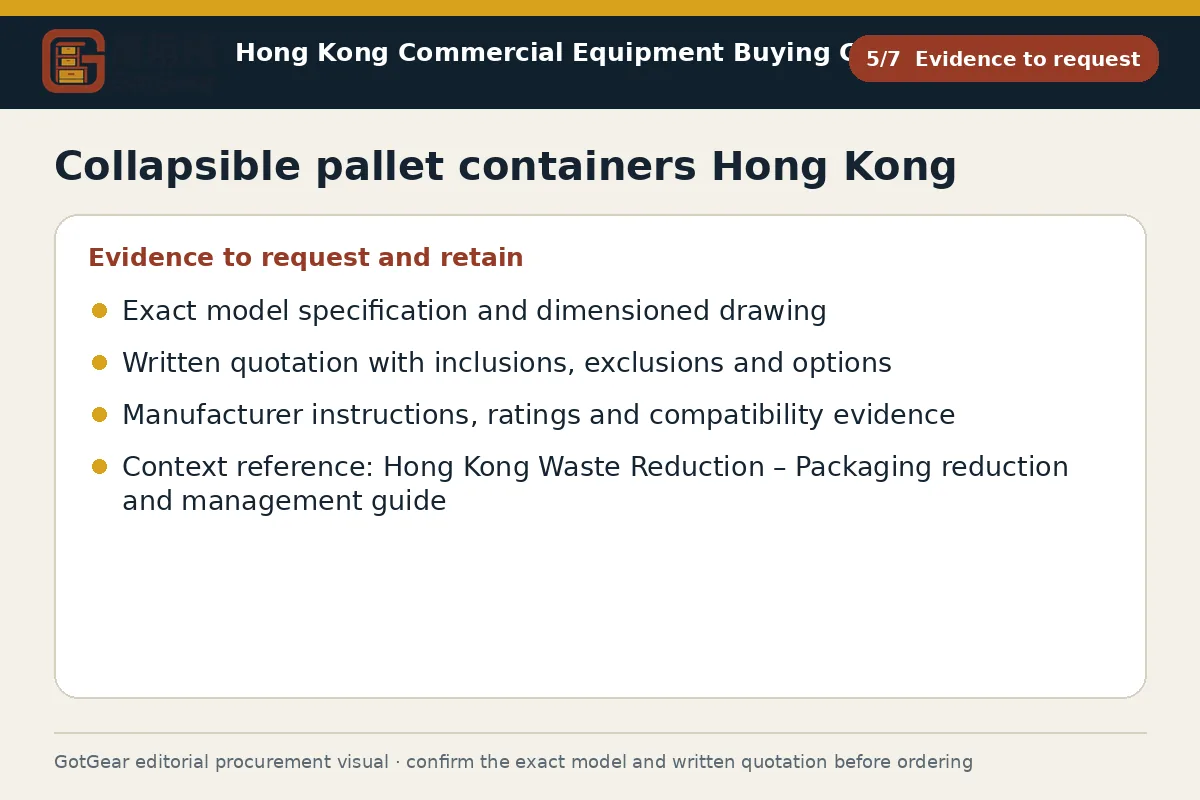
Capture contents, gross filled mass, fragility and any hygiene needs, then fix the internal dimensions and usable height required. Record forklifts, pallet jacks, aisle widths, dock interface and goods-lift limits. Decide the closure level and sealing process, including who controls keys or seal cutters. Request drawings, payload, dynamic/static stack ratings, runner layout and collapsed height, plus any food-contact or care-and-cleaning notes. Compare quotations line-by-line against those fields and the stated test method. On delivery, inspect walls, runners, hinges and latches against the drawings before commissioning. Any example figures used during scoping are starting points only; the supplier’s model specification and formal written quotation should prevail.
- Operating use, quantity and expected frequency
- Dimensions, capacity, material and accessory requirements
- Delivery address, floor, goods lift and loading window
- Required documents, acceptance checks and after-sales arrangements
Key points for collapsible pallet containers Hong Kong, lockable pallet containers Hong Kong, plastic bulk containers Hong Kong
Hong Kong buyers often face narrow lift lobbies, small goods-lift cars and tight booking windows at industrial buildings. Measure lift door width/height, car depth and approach angles, and confirm acceptable stack heights with the building manager. Many sites require advance loading-bay booking and coordinated paperwork at the management office; plan bilingual labels and handling sheets. Humid summers make drying after washing important before collapse and storage. Treat these as operating constraints to capture in your written brief rather than as legal advice or universal rules.
Questions about collapsible pallet containers Hong Kong
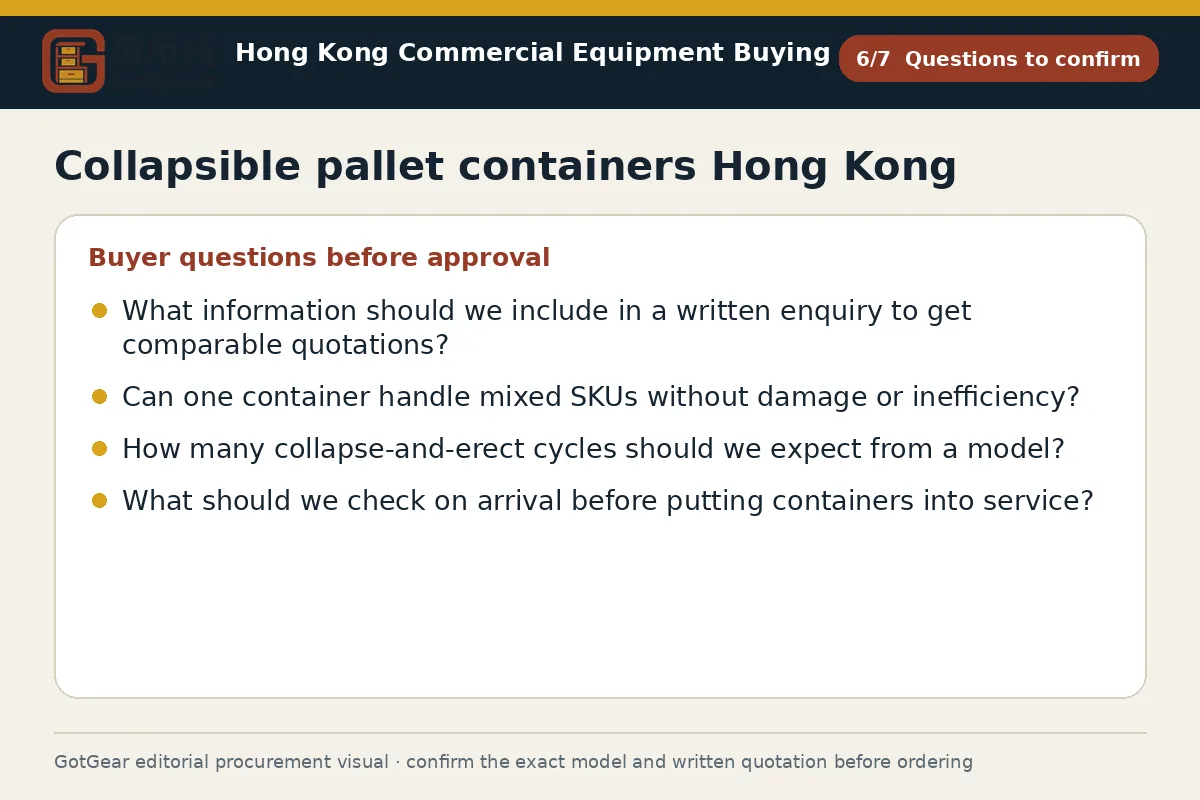
What information should we include in a written enquiry to get comparable quotations?
Provide internal L×W×usable height, payload, dynamic and static stack ratings, runner style, fork-entry pattern, closure type, collapsed height, material, expected cleaning method and any divider/liner needs. Add site constraints such as lift door size, aisle width and dock details. Ask for drawings, test-method references and replacement-parts availability so suppliers cost the same scope.
Can one container handle mixed SKUs without damage or inefficiency?
Yes, if internal dividers, dunnage or liners fit the model and loading plan. Confirm the internal dimensions, door aperture and weight distribution, and request the supplier’s recommended dunnage options. Trial with an example load and verify that side-gates and lids operate safely with the chosen inserts before scaling to full routes.
How many collapse-and-erect cycles should we expect from a model?
Cycle life varies by design, use and cleaning chemicals. As an example starting point for scoping only, some heavy-duty designs may target multi‑thousand cycles; confirm any figure in the manufacturer’s literature for the specific model. Ask for care instructions, hinge and latch part numbers and any conditions that would void the stated expectation.
What should we check on arrival before putting containers into service?
Check shells for cracks or warping, ensure hinges, latches and side-gates move freely, and confirm stacking lugs and runners match the approved drawing. Verify fork clearances and that lids or gates latch securely. Review the documentation pack for the correct model code and instructions. Quarantine any units that deviate from the quotation and seek the supplier’s written advice.
Continue with closely related procurement topics
These pages share equipment, operating or decision-stage signals with this guide.
Plastic storage bins with dividers Hong Kong
GotGear provides practical guidance to help teams choose plastic storage bins with dividers Hong Kong, including how compartment sizes and refill triggers support line-side movement for material flow bins Hong Kong.
Read the guide
Drawer containers Hong Kong
GotGear compares drawer containers Hong Kong by depth and labelling to help you choose the right parts drawer cabinet Hong Kong or transparent drawer storage cabinet Hong Kong.
Read the guide
Plastic storage cabinet Hong Kong
Choose a plastic storage cabinet Hong Kong by checking shelf and bin layout, door clearance and access to fit your space. At GotGear, explore lockable storage cabinet Hong Kong and bin storage cabinet Hong Kong.
Read the guide
Produce crates Hong Kong
GotGear explains considerations for produce crates Hong Kong, comparing airflow, temperature control and stacking practices. It also covers cold storage plastic crates Hong Kong and food distribution crates Hong Kong.
Read the guideRelated topic indexOpen more English procurement pages1 topics
Browse additional equipment families, applications and procurement questions relevant to a wider buying brief.