
Before releasing an institutional equipment purchase order Hong Kong, confirm that approvals are current and that the order has not changed the evaluated scope. Send the controlled version of the document to the functions that will receive, inspect and process the invoice.
Authority checks for an institutional equipment purchase order Hong Kong
Before an institutional equipment purchase order originating in Hong Kong leaves your system, verify delegated authority against your current approval matrix and the final evaluation note. The signatory must have authority for the total commitment, including delivery, installation, training and any optional items selected from the accepted quotation. Re‑check that the PO mirrors the evaluated scope: same manufacturer, model, configuration, quantities, unit details and Incoterms as the supplier’s written quotation that was approved. If a minor change is unavoidable, seek documented re‑approval before issuing.
Confirm the supplier’s correct legal entity, registered address and billing email as required by your institution. Where bilingual details are needed, include the Chinese entity name as provided by the supplier. Quote the approved quotation reference and version to avoid disputes over re-quoting. Assign a controlled PO number and lock edits via your ERP or documented PDF process. Set the 3‑way match expectation in your internal notes (PO, delivery note, invoice). Keep the evaluation, approval log and PO together in a single file path for audit. If you used a structured comparison to reach award, reference that file in the PO notes so receivers and finance can trace how specifications were selected and what optional accessories were excluded.
Funding and project references on an institutional equipment purchase order Hong Kong
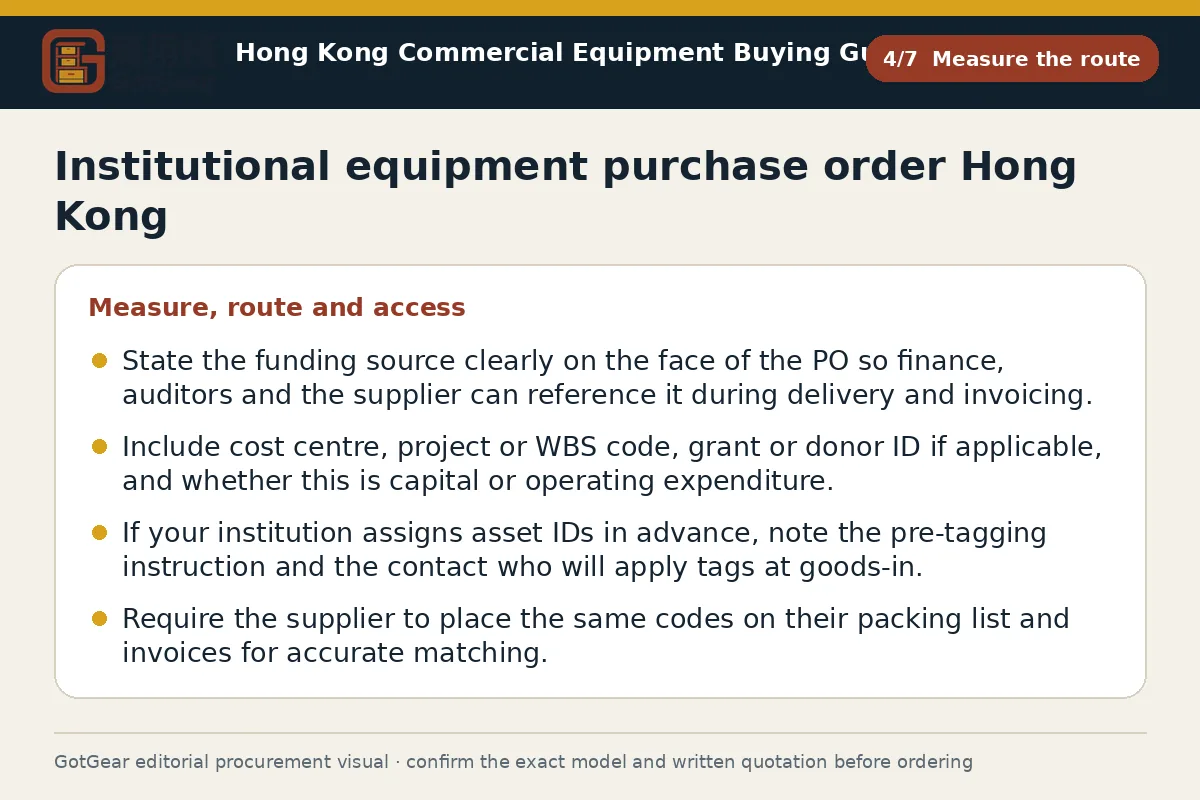
State the funding source clearly on the face of the PO so finance, auditors and the supplier can reference it during delivery and invoicing. Include cost centre, project or WBS code, grant or donor ID if applicable, and whether this is capital or operating expenditure. If your institution assigns asset IDs in advance, note the pre‑tagging instruction and the contact who will apply tags at goods‑in. Require the supplier to place the same codes on their packing list and invoices for accurate matching.
If payment is tied to milestones, record the event that enables invoicing (for example, delivery to site or completion of commissioning; example starting points only). Where projects are partially grant‑funded, split PO lines to reflect each funding stream rather than blending costs. For schools, healthcare or public‑venue projects, note any conditions linked to the funding, such as training for designated staff or provision of manufacturer documentation, if required by the funder or insurer. Keep attachments concise: approved quotation, specification schedule, drawing or layout extract, and any authority correspondence that the supplier must follow. Model specifications and the supplier’s formal written quotation prevail in case of inconsistency.
What should buyers compare for institutional equipment purchase order Hong Kong?
| Criterion | Straightforward requirement | More complex requirement | Evidence to provide |
|---|---|---|---|
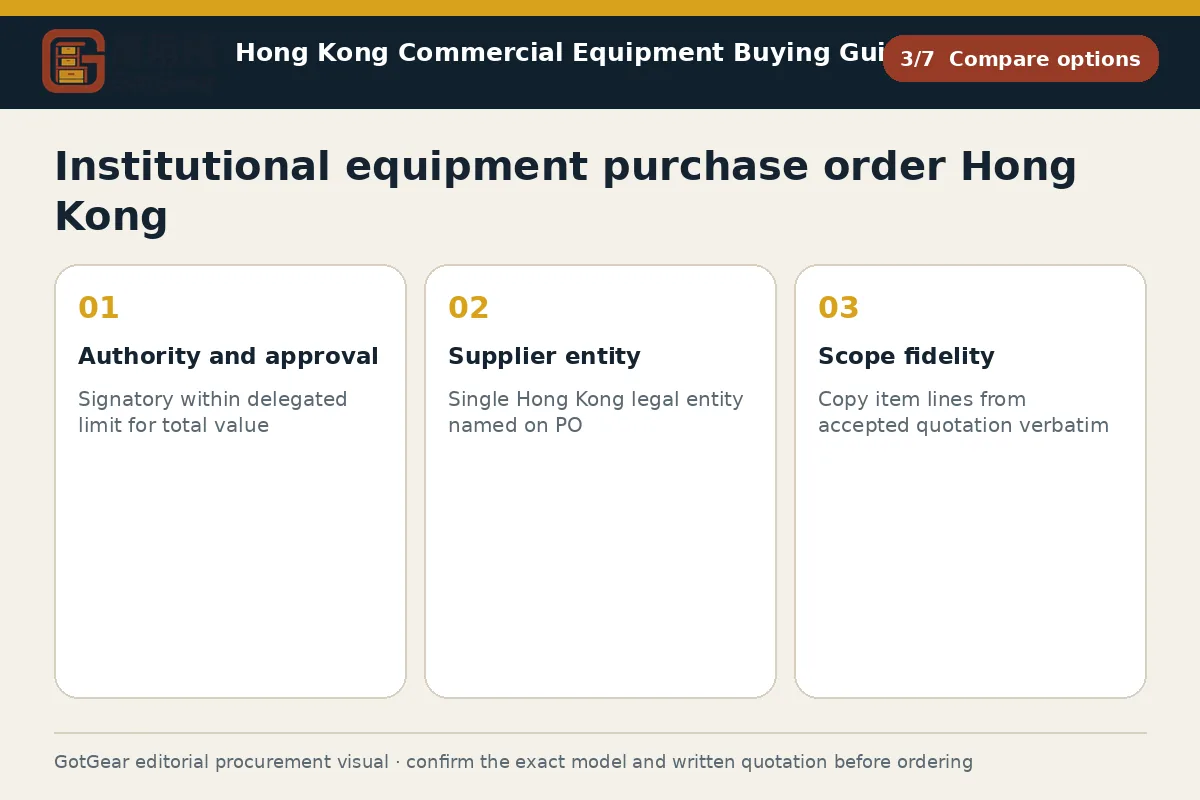
| Authority and approval | Signatory within delegated limit for total value | Multiple signatories for staged scope or framework call‑offs | Approval log reference, authority matrix link, date/time stamp |
| Supplier entity | Single Hong Kong legal entity named on PO | Group vendor with branch performing delivery and separate billing | Registered name and address, billing email, supplier quotation reference |
| Scope fidelity | Copy item lines from accepted quotation verbatim | Complex bundle with options, commissioning and training milestones | Manufacturer/model codes, option lists, service inclusions, Incoterms |
| Funding references | One cost centre and project code | Split funding across lines for grants and capex/opex mix | Cost codes per line, pre‑assigned asset IDs, milestone payment note |
| Delivery and receipt | Simple weekday delivery with open access | Booked loading bay, tight lift/doorway, humidity‑sensitive goods | Access measurements, booking ID, receiving checklist, acceptance tests |
This framework helps buyers create comparable written enquiries. Final model specifications, availability, delivery and commercial terms must be confirmed in a formal quotation.
Transfer the approved scope to an institutional equipment purchase order Hong Kong
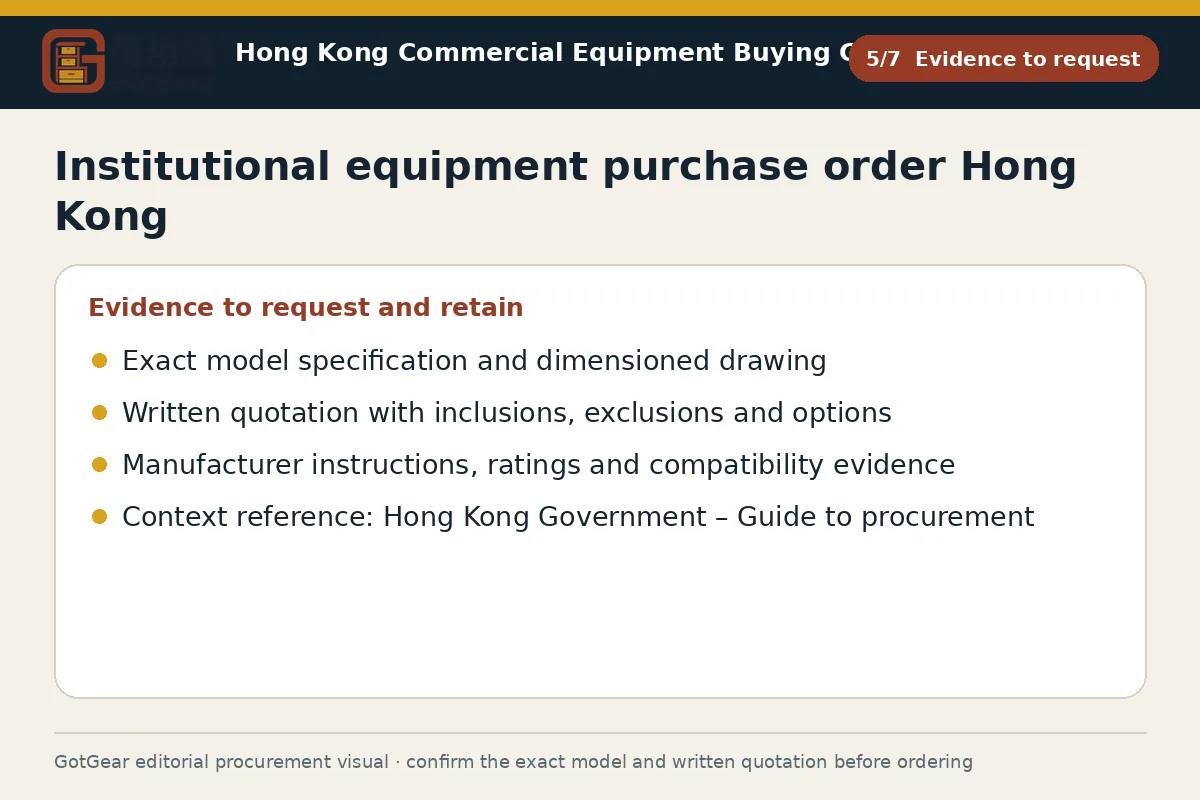
Transfer the approved scope line‑by‑line from the accepted quotation. For each item, state manufacturer, full model code, option packs, accessories, finishes, electrical plug type, and any commissioning or training included. Add the site name, floor, room and a short description of the final location. Under delivery notes, list access constraints that matter in Hong Kong: goods‑lift internal car size, door clear width, corridor turns, and booking requirements with the management office. Dimensions you record should be verified by a competent survey; any figures used before issue are example starting points and must be confirmed in writing by the responsible site contact.
Request the supplier to acknowledge utilities needed for installation: power supply (voltage, phase and maximum demand), heat output, ventilation or drainage if relevant, and noise limits for testing. In humid months, ask for packaging that protects sensitive components until installation, if the model warrants it. Specify acceptance activities on delivery, such as functional checks, serial‑number capture, and photos of the installed location, to support the 3‑way match. Where bilingual user labels or manuals would aid campus or venue staff, ask the supplier to confirm availability; if not available, record the language you will accept. Use this guide to compare specifications and prepare a written enquiry; reference that finalised comparison when populating scope lines.
Distribution of an institutional equipment purchase order Hong Kong
Release the controlled PO to the supplier and, internally, to the receiving store, project lead, end‑user representative, finance (accounts payable), and the building management contact responsible for confirming loading‑bay and goods‑lift bookings. Share only the final, signed version. In the cover message, ask the supplier to send a written order confirmation that repeats the PO number, model codes, lead time, requested delivery window, and the name of the on‑site contact. File the confirmation with the PO.
Provide a concise receiving brief to the team that will accept the goods: a copy of the PO item schedule, a site plan snippet for placement, the inspection checklist, and the escalation path for discrepancies. If industrial‑building access restricts vehicle height or timing, include the confirmed booking reference and security instructions. Tell accounts payable to hold invoices without the matching delivery note and acceptance record, noting if part‑shipments are permitted. After the order confirmation arrives, compare it against the PO; any conflict on scope or delivery conditions should trigger a controlled change and re‑approval before work proceeds.
Institutional equipment purchase order Hong Kong decision checklist
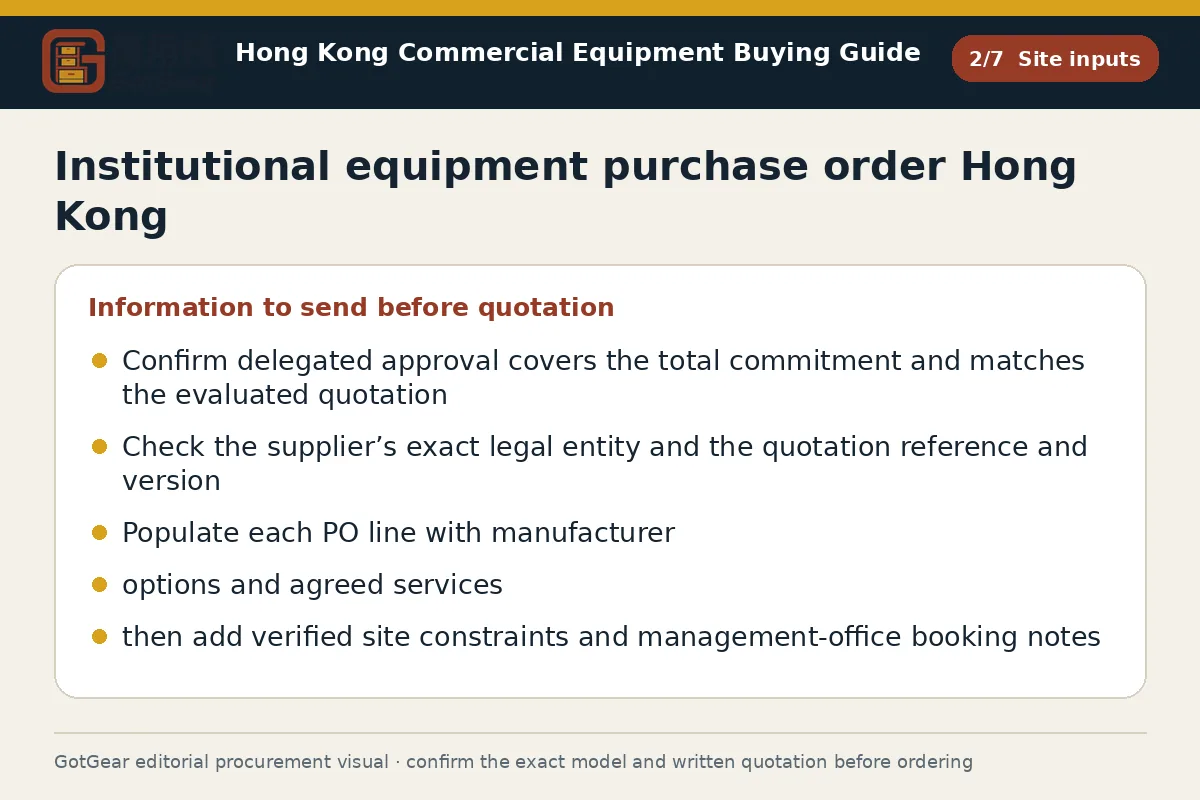
Confirm delegated approval covers the total commitment and matches the evaluated quotation. Check the supplier’s exact legal entity and the quotation reference and version. Populate each PO line with manufacturer, model, options and agreed services, then add verified site constraints and management‑office booking notes. Insert funding details: cost centre, project or grant codes, and any pre‑assigned asset IDs. Attach only the final quotation, scope schedule and essential drawings. Issue the controlled PO to supplier, receiving, project lead, building management and accounts payable. Request a written order confirmation mirroring your PO. Prepare a receiving brief with inspection steps, serial‑number capture and acceptance criteria. Hold invoices until the goods are received and accepted or commissioning is completed as specified.
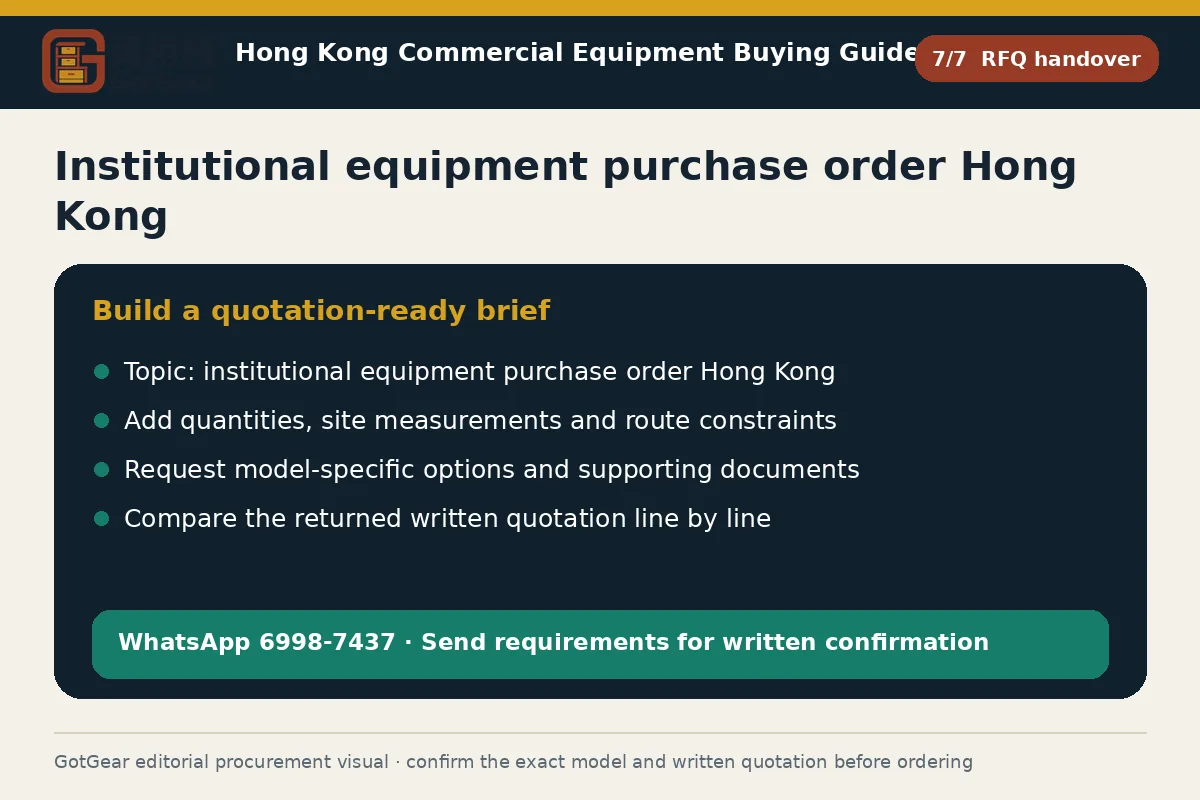
- Operating use, quantity and expected frequency
- Dimensions, capacity, material and accessory requirements
- Delivery address, floor, goods lift and loading window
- Required documents, acceptance checks and after-sales arrangements
Key points for institutional equipment purchase order Hong Kong
Hong Kong institutions often must book loading bays and goods‑lifts through a management office, with fixed windows and strict security. Many buildings have narrow lift cars and doorways, so site measurements should be confirmed before order issue. Public‑event venues may limit delivery hours, and campuses may restrict term‑time movements. Bilingual supplier and site names reduce errors at gatehouses. Humid conditions can affect packaging and storage before installation. These are operating constraints to plan for; obtain competent advice where specific approvals or technical checks are needed.
Questions about institutional equipment purchase order Hong Kong
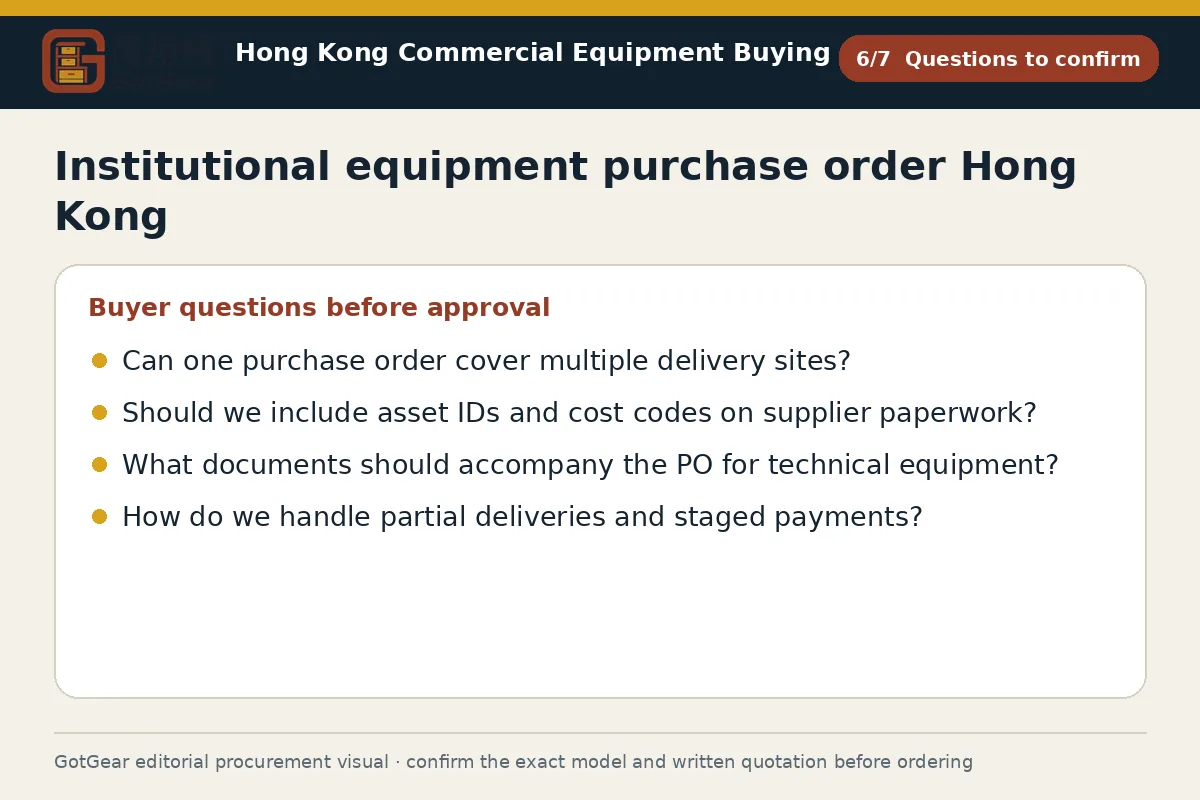
Can one purchase order cover multiple delivery sites?
Yes, if your institution permits and the supplier agrees to split packing lists and invoices by site. State each site as a separate PO line group with the location, contact and access notes. Some building managers require named bookings per address, so you may still need separate delivery references even under one PO. Confirm with all parties in writing before issue.
Should we include asset IDs and cost codes on supplier paperwork?
Yes. Tell the supplier to show your asset IDs, cost centre and project codes on the delivery note and invoice to streamline matching. If pre‑tagging is needed, add clear instructions and a contact. Where funding rules require separate reporting, split PO lines per code. The supplier’s ability to print custom fields should be confirmed at quotation stage.
What documents should accompany the PO for technical equipment?
Provide the accepted quotation, scope schedule and any essential layout or power/data point drawings. Where the model or venue may need certificates, manuals or commissioning sheets, state that the supplier will provide them at delivery or handover. Requirements depend on the model, insurer, venue and building manager; do not assume a universal set of documents applies.
How do we handle partial deliveries and staged payments?
Allow part‑shipments only if approved and practical for your site. Define the acceptance event for each stage and link it to invoicing, e.g., delivery, installation or commissioning (example starting points). State how serial numbers and accessories will be tracked per stage. Accounts payable should only release payment when the matching acceptance evidence is filed.
Continue with closely related procurement topics
These pages share equipment, operating or decision-stage signals with this guide.
Institutional equipment procurement Hong Kong
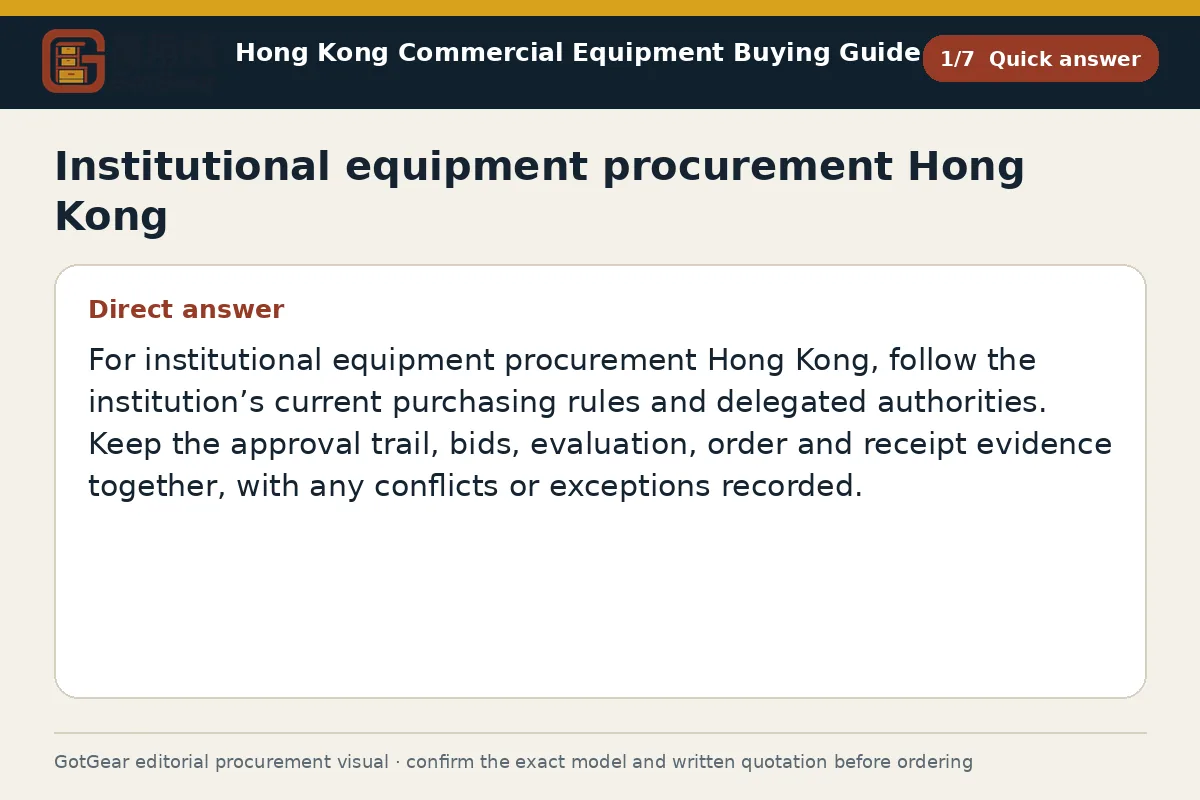
GotGear provides a checklist for institutional equipment procurement Hong Kong to align needs, approvals and specifications and to give a clear scope and clarification route for institutional equipment quotation Hong Kong.
Read the guide
Commercial equipment purchase order Hong Kong
GotGear explains approvals, receipts and discrepancies for commercial equipment purchase order Hong Kong and commercial equipment purchase order and invoice Hong Kong, with guidance on recordkeeping in Hong Kong.
Read the guide
Commercial equipment purchase order checklist Hong Kong
Commercial equipment purchase order checklist Hong Kong verifies approvals, supplier identity, item references, quantities, totals, delivery and contact details. Each line must trace to the approved quotation by GotGear.
Read the guide
Commercial equipment bulk order quotation Hong Kong
For commercial equipment bulk order quotation Hong Kong, GotGear offers a request for quotation guide. It explains schedules, tier logic, location splits, minimums, inclusions, alternatives, and approved-quantity comparisons.
Read the guideRelated topic indexOpen more English procurement pages1 topics
Browse additional equipment families, applications and procurement questions relevant to a wider buying brief.