
Laboratory trolley Hong Kong — Match load capacity, storage layout, manoeuvrability and materials to the defined laboratory workflow. Chemical or cleaning compatibility must be confirmed from manufacturer information and site procedures; laboratory use alone does not establish suitability or compliance.
Laboratory trolley Hong Kong — List instruments, vessels, consumables and waste streams
Start by creating a movement inventory of what actually travels between benches, stores and disposal points. List instruments (balances, PCR thermocyclers, small centrifuges, label printers), vessels (carboys, media bottles, reagent trays), consumables (tips, plates, wipes) and segregated waste (solvent, acid/alkali, biohazard, sharps). Note the heaviest single item and the largest footprint and height. Map the route: corridor width, door swing, slope, threshold strips, floor finish and turning space at each destination. Record the lift car and door dimensions and any booking rules from building management.
Specify a laboratory trolley that teams in Hong Kong can manoeuvre through existing lift cars and corridors without removing protective doors. Capture access needs: single-side or two-side retrieval, shelf lip height, rails, drawers, bin rails, bottle racks and label holders. For waste runs, define secondary containment and wheeled waste frames. Ask EHS which spill kit travels with the trolley. Include the laboratory’s cleaning agents and disinfection contact times, because materials and wheels must tolerate them. In the enquiry, request overall dimensions, shelf internal dimensions, load rating per shelf and total (dynamic), guard lip height, handle position, wheel diameter and material, brake type, finish and any lock types. State noise limits if the laboratory shares walls with classrooms, clinics or offices.
Laboratory trolley Hong Kong — Match materials and cleaning to laboratory procedures
Match construction and finishes to what the trolley will carry and how it will be cleaned. Stainless steel is common, but grade and finish matter; 316 with an electropolished finish may resist chlorides better than 304, while powder‑coated steel can chip if regularly exposed to disinfectants. Polypropylene or HDPE trays offer good chemical resistance for acids and alkalis; phenolic or epoxy tops can help with mild solvents. Wheel compounds vary: thermoplastic rubber offers low noise, nylon rolls easily under heavier loads but can transmit vibration.
Share your reagent list and the lab’s cleaning SOP in the enquiry. Ask for a chemical‑resistance chart and a written cleaning method statement from the manufacturer that covers ethanol, IPA, hypochlorite, peroxides or quats used on your site. For instruments sensitive to vibration, request options such as damped platforms; for sterile zones, check whether a cleanroom trolley that suppliers in Hong Kong propose offers minimal crevices and closed welds. If a microscope or spectrometer will ride regularly, consider whether an instrument trolley used by buyers in Hong Kong for vibration‑sensitive devices is a better fit than a general utility design. Request sample material swatches for on‑site wipe tests where practical, and confirm that wheel hubs and bearings also withstand your cleaning regime.
What should buyers compare for laboratory trolley Hong Kong?
| Criterion | Straightforward requirement | More complex requirement | Evidence to provide |
|---|---|---|---|
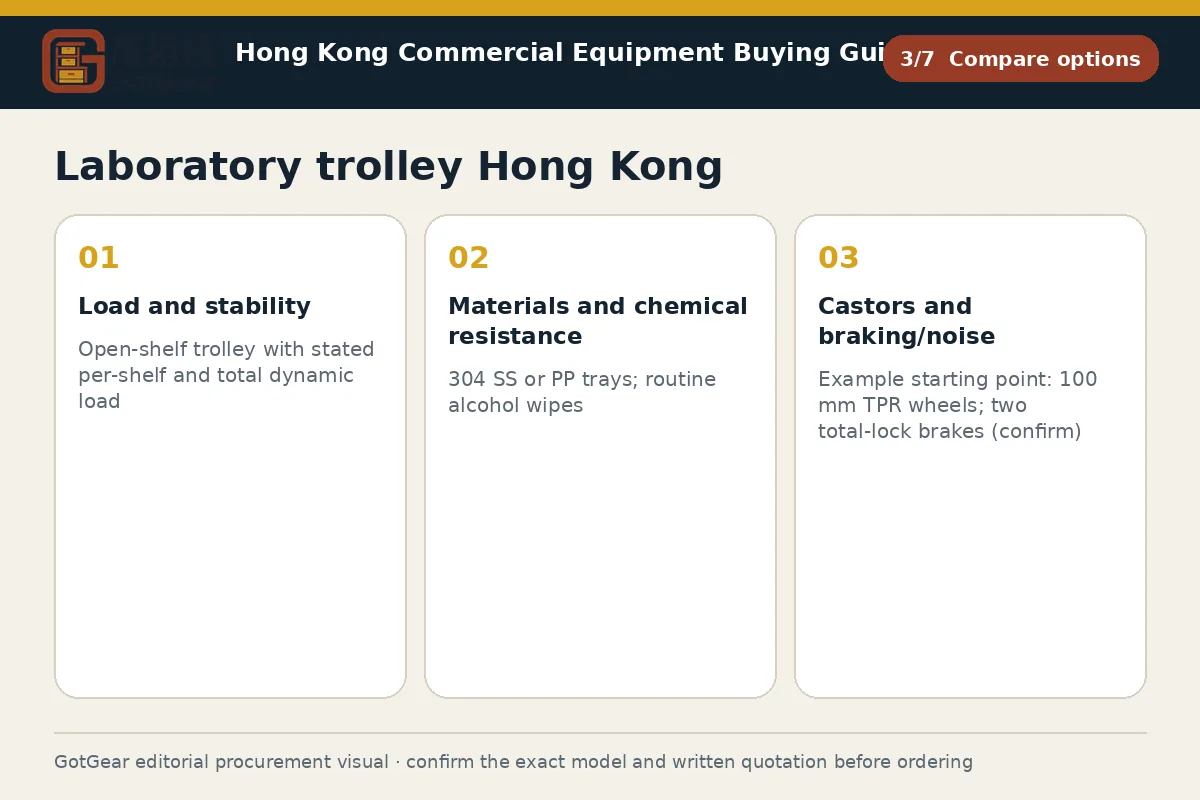
| Load and stability | Open‑shelf trolley with stated per‑shelf and total dynamic load | Mixed instruments, point loads and liquids in motion | List item weights, dimensions, centre of mass; worst‑case load map; ramps/gradients |
| Materials and chemical resistance | 304 SS or PP trays; routine alcohol wipes | Exposure to hypochlorite, peroxides, acids/solvents; frequent disinfection | Provide reagent and cleaning list; request chemical‑resistance chart and statement |
| Castors and braking/noise | Example starting point: 100 mm TPR wheels; two total‑lock brakes (confirm) | Low‑noise, antistatic, directional lock and floor‑protection requirements | State floor type, thresholds, turning space, noise limits; ask wheel compound details |
| Storage and containment | Two shelves with lips (example starting point only: 15 mm; confirm) and bin rail | Lockable cabinet, secondary containment tray, waste/sharps frames | Containment volume target, access side(s), lock type, bin brands/sizes to fit |
| Documentation and site constraints | Spec sheet and assembly instructions | Bilingual manuals, compatibility statement, warranty terms, delivery plan | Model number, finish, wheel/brake spec, lift/door sizes, loading‑bay booking rules |
This framework helps buyers create comparable written enquiries. Final model specifications, availability, delivery and commercial terms must be confirmed in a formal quotation.
Laboratory trolley Hong Kong — Separate containment, storage and access requirements
Separate the questions of containment, storage and access before discussing models. Containment concerns liquids and hazardous waste: define whether secondary trays are needed beneath reagent bottles, how much volume they should hold (example starting point only: target at least the largest single container; confirm with your EHS/insurer), and whether doors must be lockable. For sharps and biohazard, ask for brackets that accept your approved bins by brand and size. For solvents, confirm if drip trays, earthing options and approved signage are required by your procedures.
Storage and access are about productivity and ergonomics. Decide between open shelves for fast picking and enclosed cabinets for dust‑sensitive items. Note if retrieval is one‑side only (against a wall) or two‑side (central aisle). Specify adjustable shelf spacing, rail or lip height to prevent roll‑off, and whether you need clear panels to view contents. Record preferred push‑handle height and direction changes. If you also need a screen, keyboard or label printer onboard, a mobile workstation trolley Hong Kong, which teams use in sample‑receiving, may be appropriate; state cable routing, power‑strip location, and any battery/UPS kept on the trolley. Include site realities: tight goods‑lifts, low door closers, ramp gradients and noise expectations for libraries, clinics or teaching areas.
Laboratory trolley Hong Kong — Verify chemical compatibility and model limitations
Verification should be written and model‑specific. Provide your list of reagents, concentrations and cleaning chemicals, and ask the manufacturer for a compatibility statement covering every wetted surface, including wheels, hubs, bearings, seals and door gaskets. Confirm the load rating per shelf and the total dynamic load in motion; state the test basis (example starting point only: request a brief test description), the brake type (total‑lock vs wheel‑only), and the wheel diameter and compound.
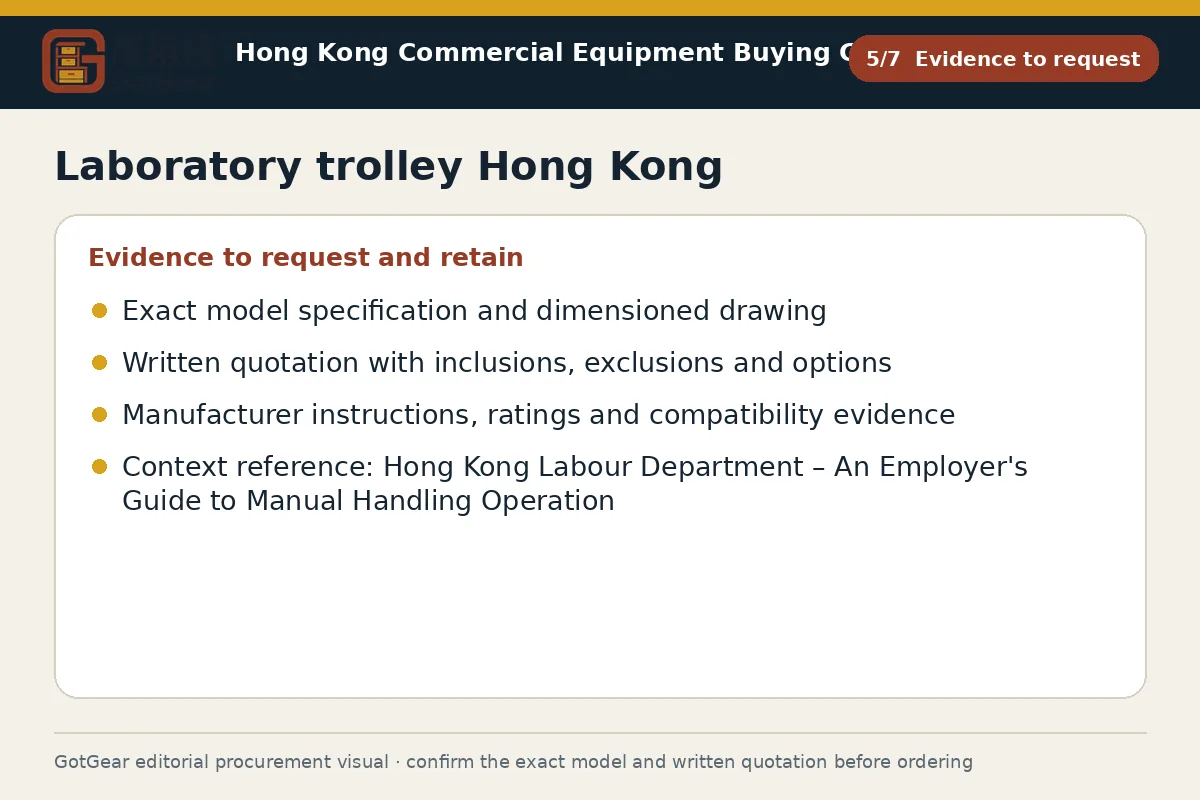
State environmental limits. Humidity and frequent mopping in Hong Kong can corrode poor finishes; ask for details of passivation, powder‑coat thickness or electropolish. If steam sterilisation is proposed, seek explicit confirmation that the model, wheels and lubricants tolerate that temperature and duration. Where flammables or ESD‑sensitive work is involved, request the maker’s limitations and any available earthing provision; if not supported, specify a different solution. Ask for bilingual manuals, parts lists and cleaning instructions. Before sign‑off, compare written quotations for exact model numbers, materials, finishes, wheels, brakes and included accessories; the formal quotation prevails. On receipt, use your trolley inspection checklist Hong Kong. Local teams maintain this checklist to record dimensions, frame integrity, castor function, brake hold on a slope, level shelves, fasteners and finish quality before the trolley enters service.
Laboratory trolley Hong Kong decision checklist
Finalise an itemised move list, including heaviest item, tallest item and all waste streams. Measure routes end‑to‑end, including lift car and door clearances, turning spaces and thresholds. Send suppliers your reagent and cleaning lists and require a written materials and wheel compatibility statement. Specify shelves, lips, rails, drawers, containment trays, lock types and access side. Request per‑shelf and total dynamic load ratings, wheel diameter and compound, and brake type. Compare written quotations line‑by‑line for model number, materials, finishes, accessories, delivery method, packaging and documentation. Coordinate delivery with the management office’s loading schedule. On receipt, verify dimensions, frame alignment, welds, wheel spin, brake hold, level shelves and finish; document findings before use and keep manuals and statements on file.
- Operating use, quantity and expected frequency
- Dimensions, capacity, material and accessory requirements
- Delivery address, floor, goods lift and loading window
- Required documents, acceptance checks and after-sales arrangements
Key points for laboratory trolley Hong Kong
In Hong Kong, access and coordination can determine the right trolley as much as the specification. Many industrial and institutional buildings have narrow goods‑lifts and strict loading‑bay booking windows managed by the building office; confirm lift car size, door clearance and delivery hours in writing. Humidity and saline air accelerate corrosion, so finishes and wheel materials should be confirmed for local cleaning practices. If the trolley will cross public areas or event venues, expect restrictions on noise, route control and timing. This is practical guidance, not legal advice; follow your organisation’s procedures and the management office’s written requirements.
Questions about laboratory trolley Hong Kong
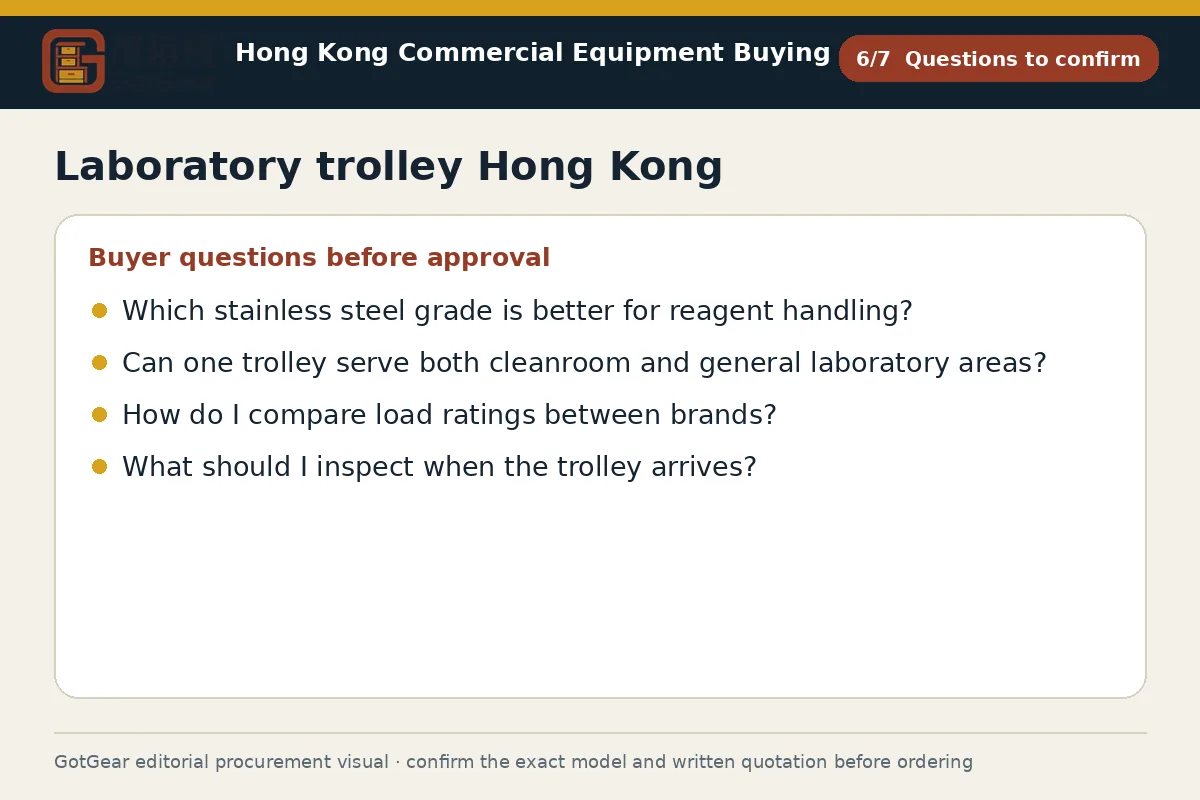
Which stainless steel grade is better for reagent handling?
For frequent exposure to chlorides and some acids, 316 stainless often performs better than 304. However, grade alone does not guarantee suitability. Provide your reagent list and cleaning chemicals, then ask the manufacturer for a written compatibility statement for all trolley surfaces and wheels. Where hypochlorite is used routinely, consider electropolished finishes and confirm rinse procedures in your cleaning SOP.
Can one trolley serve both cleanroom and general laboratory areas?
Usually, separate units are preferred to avoid cross-contamination and to match finishes to cleaning regimes. If a single platform must cross zones, request details on surface finish, closed welds, crevice reduction and cleaning validation, and confirm with your quality team. A dedicated cleanroom trolley Hong Kong, as offered by providers, may still be required by your internal SOP or the facility's management office.
How do I compare load ratings between brands?
Ask for per‑shelf and total dynamic load ratings, plus a short description of the test basis. Clarify whether ratings apply in motion and on ramps, and whether point loads are permitted. Compare wheel diameter and compound, as they affect real‑world stability. Treat brochures as indicative only; the formal written quotation and the manufacturer’s data sheet should prevail for approval.
What should I inspect when the trolley arrives?
Check overall dimensions against the order, frame squareness, weld quality, finish integrity, shelf levels, and that castors spin freely and brakes hold on a gentle slope. Verify that accessories and documentation are present and bilingual where required. Record findings with photos before the trolley enters service and report any discrepancies immediately, following your institution’s acceptance process.
Continue with closely related procurement topics
These pages share equipment, operating or decision-stage signals with this guide.
Medical trolley Hong Kong
If you are sourcing a medical trolley Hong Kong, this procurement checklist from GotGear helps Hong Kong facilities compare contents, access, security, cleanability and manoeuvring.
Read the guide
Instrument trolley Hong Kong
This procurement checklist for facilities covers instrument trolley Hong Kong and lists instruments, trays and dimensions. It compares shelf and drawer layouts, raised edges, brakes, materials and cleaning regime from GotGear.
Read the guide
Drum trolley Hong Kong
This quotation checklist helps facilities and EHS teams plan for drum trolley Hong Kong. It guides you on drum size, filled mass, orientation, pickup method, retention and route conditions, and is provided by GotGear.
Read the guide
Gas cylinder trolley Hong Kong
GotGear's checklist for a gas cylinder trolley Hong Kong outlines key considerations such as cylinder size, filled mass, valve guards, correct loading, safe gradients, and checks with the trolley manual and site rules.
Read the guide