
Drum trolley Hong Kong — Select equipment for a defined drum and movement task rather than for drums in general. Verify model-specific capacity, gripping or retention compatibility and operating instructions; also review site conditions and applicable Hong Kong requirements for the substance being handled.
Drum trolley Hong Kong — Describe drum type, dimensions, mass and orientation
Begin the enquiry with a clear definition of the drum. Specify the construction material (steel, plastic or fibre), whether it is open-top with a clamp ring or tight-head with bung closures, and any chime profile that will affect gripping. Measure the outside diameter at the widest point, record the overall height, and note whether ribs, rolling hoops or internal liners are present. State the substance contained, the expected temperature range, and whether fumes or residues are likely at pickup or set-down. Record the filled mass and confirm whether the drum must remain upright for the entire move or may be tilted.
When procuring a drum trolley in Hong Kong, the operations team should describe where the drum originates (pallet, floor or bund), how it is currently restrained, and the handedness or approach direction required in confined corridors. Include clear photographs of typical drums and any outliers, together with example starting-point measurements that the supplier must confirm: outside diameter, overall height and the approximate centre-of-gravity position when filled. If the drum is labelled with any handling symbols or has special closures, capture those in the brief. State the quantity of drums, the typical batch size per move, and who is authorised to operate drum equipment on site. Make clear that the model specifications and the formal written quotation prevail over any informal notes.
Drum trolley Hong Kong — Assess floor transitions, containment and storage interfaces
Record the full route from pickup to set‑down. Note floor materials (epoxy, tiles, brushed concrete), wet or oily areas, and the tightest doorway, corridor and aisle widths. For each transition, measure thresholds, floor joints, lift gaps, ramp lengths and turning spaces; provide example starting‑point gradients or heights that the supplier must verify. Identify any kerbs, dock plates, manhole covers and cable ramps. If using goods lifts, include car dimensions, door type, load rating signage and building‑management booking rules, especially where loading windows are enforced.
Define containment expectations. State whether drums sit in bunds, drip trays or sumps, and whether the trolley must interface with them without lifting the drum higher than a specified safe limit. Describe storage interfaces: pallet type (wood, plastic, steel), rack beam clearances, stacking prohibitions, and any dolly or cradle already in use. If drums are stored outdoors or near seawater exposure, flag corrosion concerns so wheel bearings and finishes can be proposed accordingly. Provide photos and sketches of the transition points and storage interfaces, and make clear which dimensions are must‑meet constraints versus preferences. The supplier’s model specification and written quotation should explicitly address these route and containment details.
What should buyers compare for drum trolley Hong Kong?
| Criterion | Straightforward requirement | More complex requirement | Evidence to provide |
|---|---|---|---|
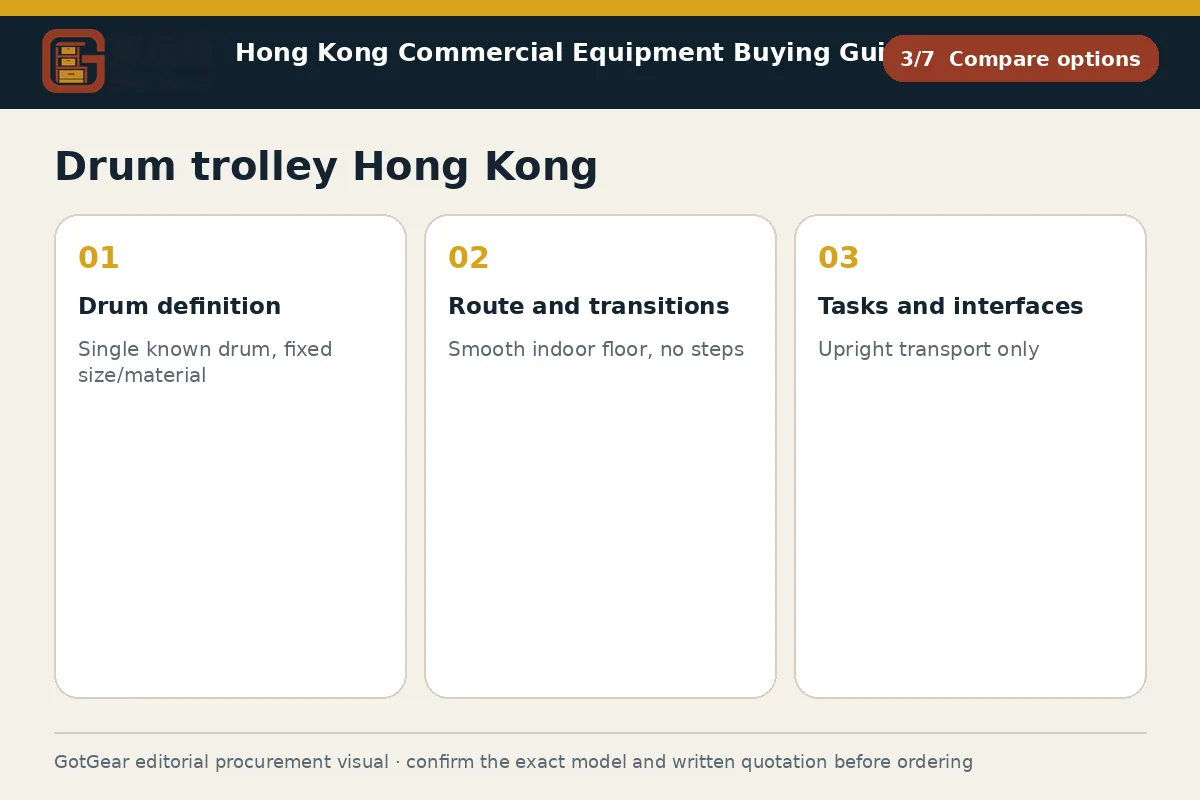
| Drum definition | Single known drum, fixed size/material | Mixed sizes/materials, differing chimes | Provide OD, height, closure type, filled mass, photos of each drum |
| Route and transitions | Smooth indoor floor, no steps | Thresholds, ramps, lifts, kerbs, outdoor patches | Give widths, heights/gaps, example gradients, turning spaces, photos |
| Tasks and interfaces | Upright transport only | Pickup from pallet/bund, tipping and controlled pour | State pickup points, decant height/angle, duty cycle (example) |
| Containment and EHS | No leak risk, no bunds | Bunds/drip trays, spill control and guarding needs | Describe bund dimensions, materials, site policy references |
| Capacity verification | Static rating above filled mass | Dynamic/tipping loads and wheel ratings | Request model code, datasheet, capacity label photo, test statement |
This framework helps buyers create comparable written enquiries. Final model specifications, availability, delivery and commercial terms must be confirmed in a formal quotation.
Drum trolley Hong Kong — Specify pickup, retention, tipping and discharge tasks
List the handling tasks in the order they occur. For pickup, specify whether the operator must engage the drum from the side or end, grip type preferred (rim clamp, band/strap, jaw, V‑saddle), and whether pickup is from floor, pallet or bund. If pallets are used, record the pallet footprint, overhangs and pallet‑deck openings. For retention, state whether a positive latch or ratchet strap is needed, any requirement to lock the drum against rotation, and whether tamper‑evident seals are required by site policy.
For tipping and discharge, define the decant height to the receiving vessel, required tilt angle and whether controlled pouring, partial decant or full emptying is expected. Note if a spout, tap or funnel is used and who provides it. State the maximum filled mass at the moment of tilt and whether two‑person control is allowed or if single‑operator operation is required. Provide an example starting‑point duty cycle (e.g., moves per hour and typical route length) for the supplier to confirm bearing, brake and wheel specifications. If electrostatic sparking, vapours or heat are possible, indicate the hazard so the quotation can address conductive wheels, grounding straps or non‑sparking contact surfaces as applicable. Confirm that operating instructions, inspection guidance and the trolley’s labelled limitations will accompany the delivered model.
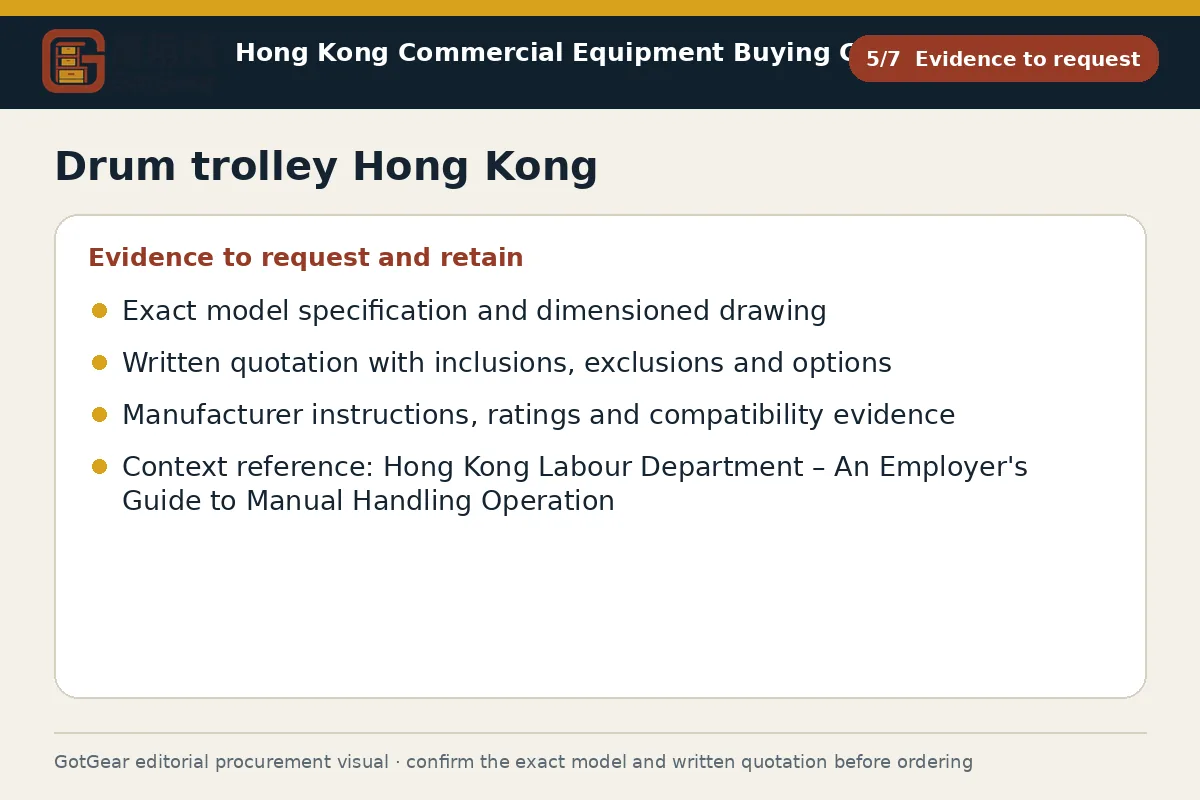
Drum trolley Hong Kong — Request capacity and compatibility evidence for the proposed model
Ask for model‑specific capacity and compatibility evidence in writing. Require the exact model code, upright transport rating and any reduced capacity when clamping, inverting or tilting. Request the allowable drum diameter and height range, compatible shell materials (steel, HDPE, fibre), and chime profiles supported. Seek the wheel type, diameter and per‑wheel load rating, plus the proposed brake or parking system and how it is engaged on slopes. Where tipping is involved, ask for the method used to restrain the drum during rotation and the maximum mass at the onset of pour.
For compatibility, request confirmation that the gripping surfaces, straps and seals resist the site’s substances and cleaning agents; where relevant, ask for a manufacturer statement naming the materials of construction. Ask for dimensional drawings showing approach clearances and the minimum turning radius. For assurance, request photos of the model’s capacity label, an operation and maintenance instruction sheet, and a parts list. If demonstrations or reference videos are offered, make clear they are illustrative only and that the model specification and formal written quotation prevail. Where bilingual use is expected, request English/Traditional Chinese documentation for operator training and approval routing.
Drum trolley Hong Kong decision checklist
Before issuing the RFQ, confirm the drum’s construction, closure type, outside diameter, height and filled mass, and state whether the drum must remain upright. Map the route with widths, thresholds, lift details and turning spaces; mark any bunds or storage interfaces. Define pickup, retention and tipping tasks, required tilt angle and decant height. Provide photos and example starting‑point measurements for the supplier to verify. Ask for the exact model code, capacity ratings for transport and tilt, compatible drum ranges, wheel specifications and braking method. Require drawings and a statement on materials of construction and chemical resistance where relevant. Compare written quotations by model code, route fit, evidence provided and inclusions (instructions, parts list). On receipt, inspect welds, clamps, straps, wheels and labels, and ensure bilingual instructions are provided where requested. The model specification and the formal written quotation prevail over summaries and notes.
- Operating use, quantity and expected frequency
- Dimensions, capacity, material and accessory requirements
- Delivery address, floor, goods lift and loading window
- Required documents, acceptance checks and after-sales arrangements
Key points for drum trolley Hong Kong
Hong Kong sites commonly move drums through narrow corridors and goods lifts with strict booking slots. Capture the tightest doorway and lift dimensions, turning spaces and any building‑management rules that affect delivery or daily operation. Humid, coastal conditions can promote corrosion and wheel bearing wear; specify expected storage and cleaning practices so finishes and components are proposed accordingly. If drums pass public or shared areas, include traffic‑management and guarding expectations. Where bilingual operation is needed, request English/Traditional Chinese product labels and instructions. Coordinate with the management office for delivery timing and lift protection, and ensure the quotation confirms model code, capacity label and route fit before approval. This guidance is for procurement planning and does not replace competent site‑specific advice.
Questions about drum trolley Hong Kong
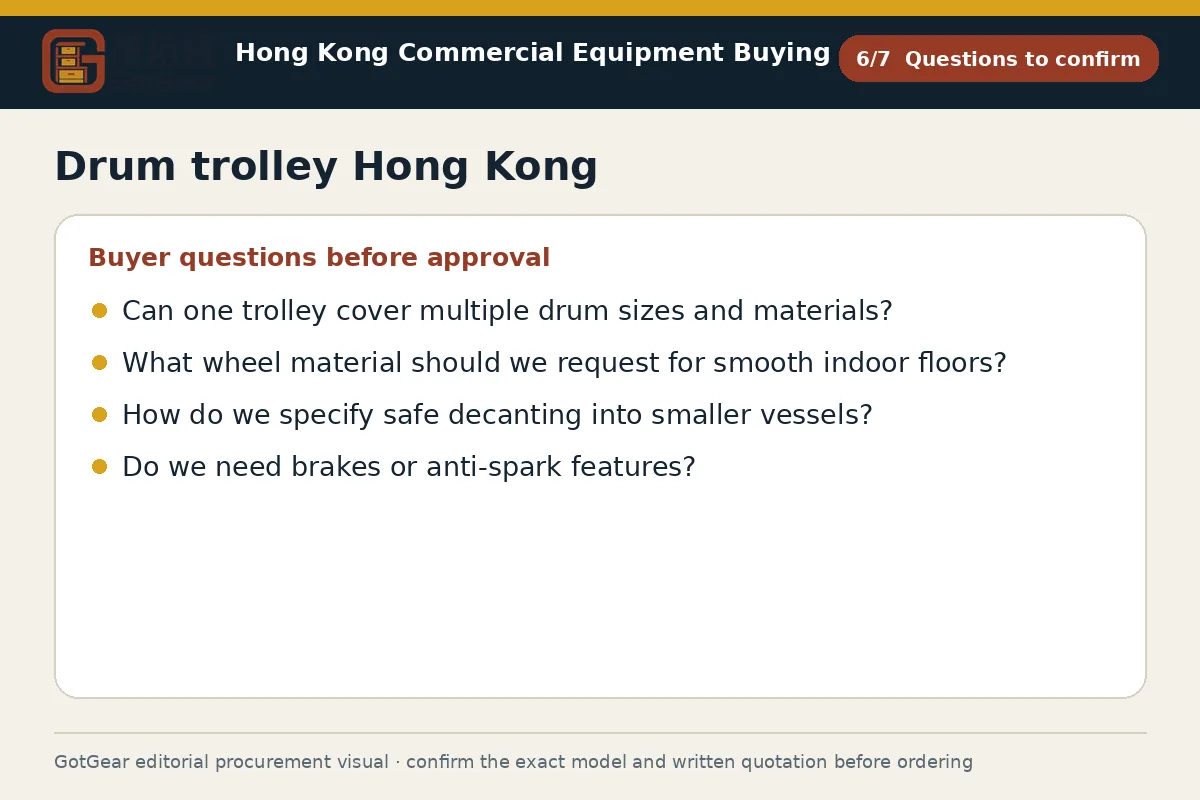
Can one trolley cover multiple drum sizes and materials?
Often yes, if the gripping head or saddle accommodates a diameter range and the strap or clamp suits steel and plastic surfaces. However, mixed chime profiles or soft‑wall drums may need different grips. Ask for the proposed model’s compatible diameter/height range and materials list, plus any change‑parts required. The formal model specification and written quotation should confirm these limits.
What wheel material should we request for smooth indoor floors?
Non‑marking rubber or polyurethane wheels usually roll quietly and protect epoxy or tile finishes. If oils or chemicals are present, ask for the wheel’s compound and bearing type, and request the per‑wheel load rating. On thresholds or outdoor routes, a larger diameter may be appropriate. The supplier should match wheels to your route and confirm in the written quotation.
How do we specify safe decanting into smaller vessels?
State the receiving vessel height, opening size and any funnel or tap used, and define whether single‑operator control is required. Ask for a positive retention method during tilt, and for the maximum mass permitted at the onset of pour. Include an example starting‑point tilt angle and request the supplier to confirm it with the selected model and instructions in writing.
Do we need brakes or anti‑spark features?
Where routes include slopes or loading ramps, a parking brake or wheel chock is typically advisable; request the proposed braking method and how it is applied. If flammable vapours or static are a concern, ask about conductive wheels or grounding straps, subject to your risk assessment. The final configuration should be confirmed in the model specification and quotation.
Continue with closely related procurement topics
These pages share equipment, operating or decision-stage signals with this guide.
Gas cylinder trolley Hong Kong
GotGear's checklist for a gas cylinder trolley Hong Kong outlines key considerations such as cylinder size, filled mass, valve guards, correct loading, safe gradients, and checks with the trolley manual and site rules.
Read the guide
Glass trolley Hong Kong
GotGear guide to glass trolley Hong Kong explains how to specify equipment and plan sites by comparing rated capacity, support geometry, contact materials and restraints, pane size, loading method and route clearances.
Read the guide
Pipe trolley Hong Kong
For pipe trolley Hong Kong enquiries to GotGear, please provide pipe length and diameter, bundle mass and form, support spacing, end overhang, and restraint and turning clearance.
Read the guide
Panel trolley Hong Kong
GotGear offers a practical guide to panel trolley Hong Kong that helps facilities record dimensions, mass, surface finishes, support angles, contact materials, retention methods and route clearances.
Read the guideRelated topic indexOpen more English procurement pages1 topics
Browse additional equipment families, applications and procurement questions relevant to a wider buying brief.