
Gas cylinder trolley Hong Kong — Ensure the intended cylinder can be retained securely throughout controlled loading, travel and set-down. Buyers should verify trolley and cylinder instructions, site storage rules and all applicable Hong Kong requirements; never infer compatibility from appearance alone.
Gas cylinder trolley Hong Kong — Identify cylinder dimensions, mass and valve protection needs
When requesting quotations for a gas cylinder trolley Hong Kong, teams should start with the precise cylinder envelope and filled mass. Measure the overall cylinder height including any valve guard or removable cap, the maximum shell diameter, and the outer diameter and depth of the foot ring. Record the filled mass from the supplier's data sheet and note the gas family and the cylinder code used on-site. If twin cylinders are handled (e.g., oxygen and fuel gas), capture the full set for each. Any example dimensions you sketch (for instance, a 230 mm body diameter or a 1,250 mm overall height) must be marked as example starting points and confirmed in the written brief; the supplier’s formal quotation prevails.
Describe valve protection and top geometry: cap, open guard, or integrated shroud, plus any lifting lugs or collars that affect strap placement. Specify whether cylinders must remain strictly vertical during travel and set-down. Ask vendors to state the working load limit as a mass, the cradle/base diameter range, contact padding or liners, and the number and height of restraints. Include handle height range, overall trolley width, and turning clearance requirements for your tightest doorway or goods-lift. If more than one cylinder size is possible on-site, request the adjustable range and any change parts needed, so compatibility is unambiguous in writing.
Gas cylinder trolley Hong Kong — Review gradients, thresholds, storage and transfer positions
Survey the full movement route from delivery or store to point-of-use and back. Record the narrowest doorway and corridor widths, lift door width and lift car depth and height, the tightest turning radius, and any ceiling or sprinkler obstructions. Measure ramp gradients with an inclinometer and note the direction of travel under load. Log each threshold, kerb, drain cover, speed hump and cable ramp, with its height and width. Where stairs are unavoidable, state the number of steps and the rise of each step. For loading bays and docks in industrial buildings, capture booking windows and any management-office coordination needs.
Document storage and transfer positions: whether the cylinder is set into a stand, chained to a wall, or parked free-standing. Confirm if transfer happens onto scales, carts, or laboratory benches and whether the cylinder must rotate in place. Surface and moisture conditions matter in Hong Kong; note tiles, epoxy, gratings, outdoor paving and frequent wet patches. Conduct a practical trolley route assessment for the Hong Kong site. Operations can repeat it during trials and consider a material handling floor condition checklist Hong Kong. Teams can adopt that checklist to flag loose tiles, slick paint, or uneven expansion joints that influence wheel size, tread and brake selection.
What should buyers compare for gas cylinder trolley Hong Kong?
| Criterion | Straightforward requirement | More complex requirement | Evidence to provide |
|---|---|---|---|
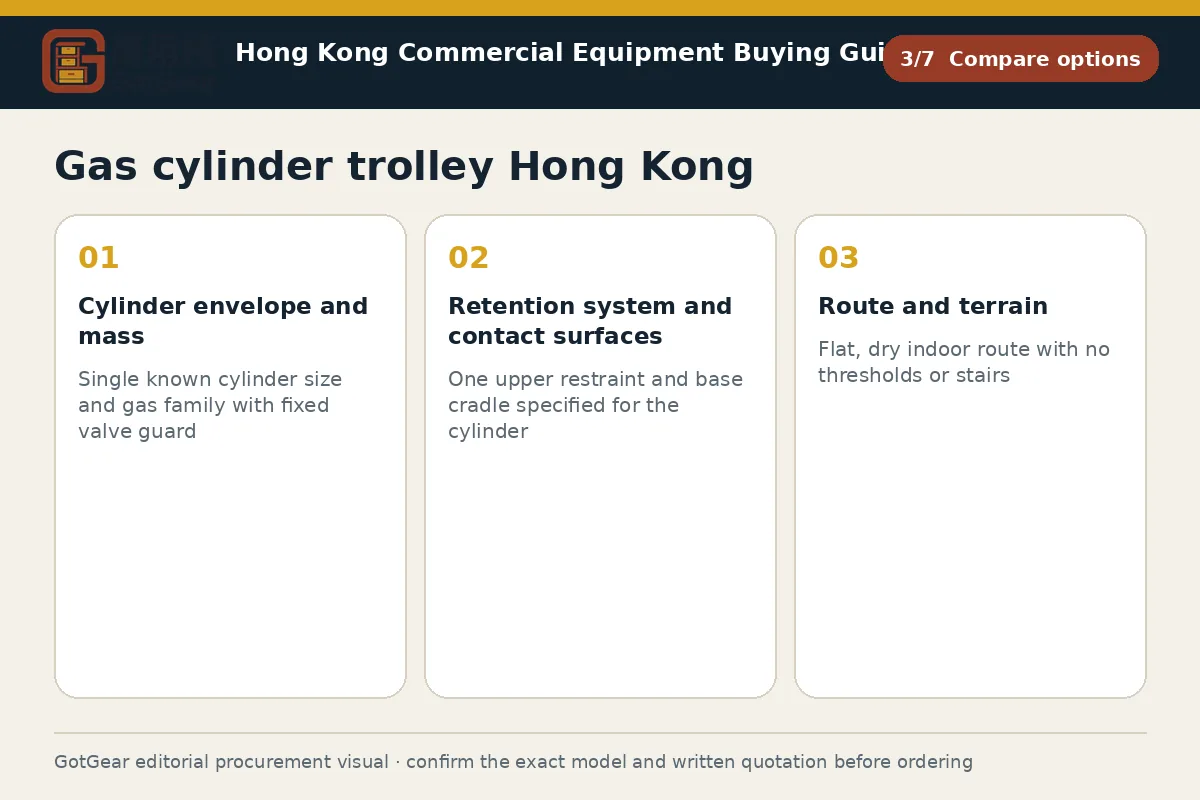
| Cylinder envelope and mass | Single known cylinder size and gas family with fixed valve guard | Multiple cylinder sizes/families and variable guards or caps | Measured height incl. guard/cap, body and foot-ring diameters, filled mass, supplier data sheet references |
| Retention system and contact surfaces | One upper restraint and base cradle specified for the cylinder | Dual independent restraints, shaped liners, and valve-guard locating feature | Required strap positions and circumference range, strap/chain type, padding/liner need, quick-release preference |
| Route and terrain | Flat, dry indoor route with no thresholds or stairs | Mixed surfaces, ramps (e.g., example 1:10), thresholds (e.g., example 20 mm), lifts | Route map with widths, gradients, threshold dimensions, tightest turn, lift car/door sizes |
| Wheels and brakes | Two wheels with basic parking brake for level floors | Stair-climber or four-wheel stability with axle/wheel brake and kickstand | Wheel diameter/material, bearing corrosion resistance, brake type, need for kickstand or nose rollers |
| Documentation and approvals | English manual and capacity label available | Bilingual labels, maintenance plan, building-management submission requirements | Manuals, inspection checklist scope, confirmation of compatibility, management-office approval emails if applicable |
This framework helps buyers create comparable written enquiries. Final model specifications, availability, delivery and commercial terms must be confirmed in a formal quotation.
Gas cylinder trolley Hong Kong — Specify retention points and loading method
Define how the cylinder will be secured on the trolley throughout loading, travel and set‑down. State the number and position of restraints (e.g., one upper strap to the shoulder and one mid/belly strap), the required circumference range, and the preferred medium (web strap with cam buckle, ratchet strap, or captive chain) with quick‑release needs. Ask for contact surfaces to be non‑abrasive and oil‑resistant, and note any requirement for liners or shaped cradles that locate on the foot ring. Where a valve guard is present, confirm whether a locating yoke is allowed by the cylinder supplier. For twin‑cylinder work, request a divider and independent restraints per cylinder.
Specify the loading method: tilt‑under from standing, roll‑on using a toe plate or rollers, or lift‑in from a bench. If thresholds are common, ask for a chamfered or rollerised nose. State whether a kickstand is needed for stable parking, and what brake is acceptable (wheel brake, axle brake or parking bar). Note wheel diameter and tread material preferences, with corrosion resistance for bearings in humid conditions. Frame clearance to valve gear and operator handles should be explicit. If your controls require it, reference 'trolley load securing Hong Kong' procedures so vendors match strap hardware and labelling to site practice.
Gas cylinder trolley Hong Kong — Verify instructions and requirements for the cylinder and site
Before approval, obtain the trolley manufacturer’s instructions, the cylinder supplier’s handling guidance, and written confirmation that the proposed restraints and cradle are suitable for the named cylinder sizes and valve protection. Request maintenance and inspection instructions, parts lists for straps and wheels, and material specifications for frames, axles and bearings where corrosion resistance is important in humid areas. Ask for labelling content and languages; many Hong Kong teams require English and Chinese for safe-use notices and capacity markings. Where a site or insurer requires it, ask for a statement of rated capacity and any test evidence relevant to the model.
Check site-specific rules early: building management approvals for goods-lift use, loading-window bookings, and supervision requirements at laboratories, schools or public-event venues. Confirm whether training or a toolbox briefing must be provided at handover, and what records your institution needs for procurement file closure. Plan an acceptance check using a trolley inspection checklist Hong Kong. Supervisors can complete it, covering fit to measured cylinders, strap function, brake operation, wheel rotation and frame integrity. Ensure the model specification and the supplier’s formal written quotation prevail over drawings or examples captured during the enquiry.
Gas cylinder trolley Hong Kong decision checklist
Start with the exact cylinders: measure height including guard or cap, shell and foot-ring diameters, and confirm filled mass from the data sheet. Document valve protection and restraint positions allowed by the cylinder supplier. Map the complete route with widths, gradients, thresholds and lift constraints, and note storage and transfer interfaces. Specify retention hardware, wheel diameter and tread, brake type, handle height and corrosion resistance needs. Ask vendors to confirm rated capacity, adjustable ranges and compatibility in writing. Compare quotations line by line against your measurements and site constraints, not stock images. On receipt, verify labelling, restraint operation, brake function, wheel rotation and fit to your measured cylinders before first use, and file manuals and inspection guidance for supervisors.
- Operating use, quantity and expected frequency
- Dimensions, capacity, material and accessory requirements
- Delivery address, floor, goods lift and loading window
- Required documents, acceptance checks and after-sales arrangements
Key points for gas cylinder trolley Hong Kong
Hong Kong movements often hinge on tight doorways and compact goods-lifts, so confirm the trolley’s overall width, turning clearance and handle height against the narrowest points on your route. Management offices may impose loading windows, lift escorts and route restrictions in industrial buildings and schools, which should be captured in the enquiry. Humid coastal conditions can accelerate corrosion of frames, axles and bearings; request materials and finishes suitable for your environment. Many buyers require bilingual labels and instructions. This summary highlights local constraints and is not legal advice; verify detailed requirements with your building manager, supplier, competent adviser or authority.
Questions about gas cylinder trolley Hong Kong
Can one trolley safely handle multiple cylinder sizes on our site?
Possibly, if the frame, cradle and restraints have an adjustable range that matches each cylinder’s envelope and filled mass. Ask for the exact diameter and strap range in writing, plus any change parts needed. The cylinder supplier’s instructions and the trolley maker’s manual should both confirm the acceptable combinations for your site before approval.
Do we need a stair-climber or four-wheel design for our routes?
Choose the design to match measured gradients, thresholds, and the need to pause on slopes. Two-wheel trolleys suit flat routes; stair-climbers aid steps; four-wheel or tilt-back units improve stability and parking. Base the decision on a documented route survey and request examples as starting points only; the formal model specification and quotation prevail.
What wheel material and bearings work best in Hong Kong conditions?
Non-marking rubber or polyurethane treads with sealed or stainless-steel bearings are often chosen for wet floors and humidity. Detail your surfaces, typical contaminants, and cleaning chemicals so vendors propose suitable materials. Treat any suggested sizes or compounds as examples to be confirmed in the written brief and on the final quotation.
Which documents should we request before accepting delivery?
Request the trolley manual, rated-capacity and identification labels, restraint operating instructions, maintenance and inspection guidance, and parts information for straps and wheels. Where required, ask for bilingual labelling. If your site or insurer sets conditions, seek written confirmation of suitability for your named cylinders and route before scheduling acceptance checks.
Continue with closely related procurement topics
These pages share equipment, operating or decision-stage signals with this guide.
Drum trolley Hong Kong
This quotation checklist helps facilities and EHS teams plan for drum trolley Hong Kong. It guides you on drum size, filled mass, orientation, pickup method, retention and route conditions, and is provided by GotGear.
Read the guide
Panel trolley Hong Kong
GotGear offers a practical guide to panel trolley Hong Kong that helps facilities record dimensions, mass, surface finishes, support angles, contact materials, retention methods and route clearances.
Read the guide
Glass trolley Hong Kong
GotGear guide to glass trolley Hong Kong explains how to specify equipment and plan sites by comparing rated capacity, support geometry, contact materials and restraints, pane size, loading method and route clearances.
Read the guide
Library book trolley Hong Kong
Use the GotGear procurement guide to compare capacity, dimensions, wheels and brakes, noise, route clearance and lift and aisle measurements. It helps buyers choose the right library book trolley Hong Kong for their facility.
Read the guideRelated topic indexOpen more English procurement pages2 topics
Browse additional equipment families, applications and procurement questions relevant to a wider buying brief.