
Trolley inspection checklist Hong Kong — Cover visible damage, loose parts, wheel movement, braking, deck condition, labels and load restraints before use. Set maintenance frequency from duty, environment and manufacturer instructions, and withdraw equipment when a defect could affect safe operation.
Trolley inspection checklist Hong Kong — Inspect wheels, frame, deck, handle, restraints and brakes
A trolley inspection checklist Hong Kong, one that teams can act on, should begin at floor level. Spin each wheel, feel for roughness, and look for cuts, flat spots or embedded debris. Check swivel heads for smooth rotation and measure side-play; as an example starting point, any noticeable wobble should be confirmed against the manufacturer's tolerance before use. Verify axle nuts, kingpins and mounting plates are present and tight. Where brakes or direction locks are fitted, apply and release the mechanism and confirm the pedal, lever or handle returns positively without dragging.
Move up to the frame and deck. Look for bent members, cracked welds, rust pitting, loose bolts and sharp edges. The platform should sit flat, with no delamination, soft timber, lifted anti-slip, or missing corner bumpers. Ensure the handle is straight, at a comfortable height for your users, and firmly secured. Inspect restraints: straps, chains or rails must be intact, with buckles or ratchets operating correctly. Check labels are legible in English and Chinese, including model, safe working load, and any brake instructions. For procurement and receiving, request and compare wheel diameter and tread material, bearing type, brake arrangement, deck material/finish, frame coating, handle height and restraint capacity. On delivery, re-measure critical dimensions for tight goods-lifts and doorways, and record asset IDs for maintenance tracking and for trolley parking safety procedures in Hong Kong.
Trolley inspection checklist Hong Kong — Set pass, isolate and report criteria for users
Set unambiguous pass, isolate and report outcomes so users do not guess. A pass means no obvious deformation, no loose or missing fasteners, free-rolling wheels, functioning brakes where fitted, sound deck and secure handle and restraints. A report (but continue-in-service) outcome may suit minor issues that do not affect safe operation, such as a scuffed bumper or faded paint, provided the defect is logged for attention. Isolate means remove from service immediately, tag, and notify the supervisor.
Define simple field cues. As an example starting point to be confirmed by your competent person: isolate on cracked welds, missing axle hardware, wheel chunks missing, wheel side-play beyond the supplier’s tolerance, brakes not holding, or loose handle movement that risks loss of control. Report if labels are illegible, restraints are frayed yet still effective, or anti-slip is starting to lift. Use bilingual tags (PASS, REPORT, ISOLATE) and QR-coded asset IDs so staff can scan, record photos and note location. If isolation occurs in a public or managed area, move the trolley to a non-public bay, advise the management office and EHS, and arrange safe removal within the site’s loading window.
What should buyers compare for trolley inspection checklist Hong Kong?
| Criterion | Straightforward requirement | More complex requirement | Evidence to provide |
|---|---|---|---|
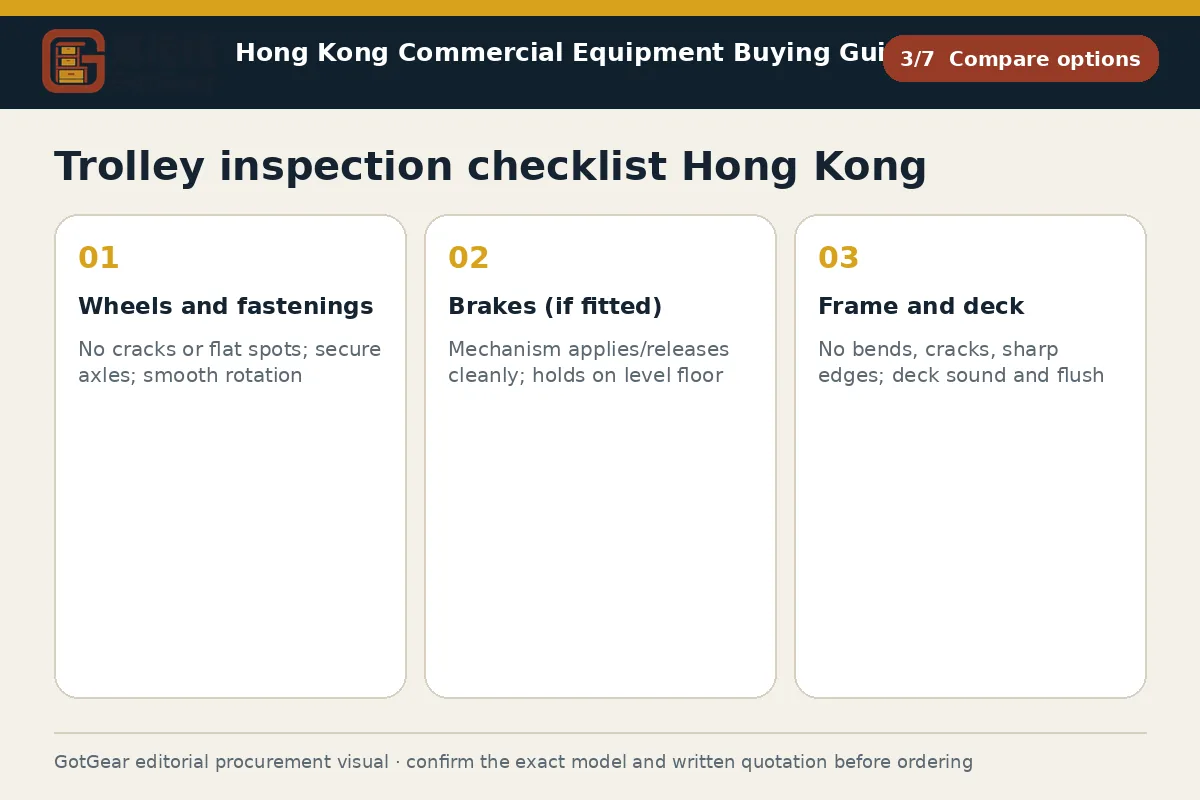
| Wheels and fastenings | No cracks or flat spots; secure axles; smooth rotation | Corrosion-resistant bearings and stainless/zinc hardware; defined replacement threshold | Photos; wheel material and diameter; bearing type; fastener size/grade from datasheet |
| Brakes (if fitted) | Mechanism applies/releases cleanly; holds on level floor | Holds on a stated slope (example starting point 1:12) with described load; direction lock where needed | Test note with load and slope used; brake model; maintenance procedure |
| Frame and deck | No bends, cracks, sharp edges; deck sound and flush | Load rating confirmed by maker; anti-corrosion finish for humid areas | Model datasheet with safe working load; coating/finish details; photos of condition |
| Handles and restraints | Handle tight; straps/chains present and usable | Ergonomic handle height range; restraint capacity suitable for the load | Handle height in mm; restraint type and working load info; supplier confirmation |
| Documentation and labels | Legible ID and instructions in English/Chinese | Preventive-maintenance schedule and parts list; QR/asset ID provision | Copy of manual and maintenance plan; parts diagram; sample asset/QR tag |
This framework helps buyers create comparable written enquiries. Final model specifications, availability, delivery and commercial terms must be confirmed in a formal quotation.
Trolley inspection checklist Hong Kong — Trolley preventive maintenance Hong Kong: Move defects from the daily check into planned maintenance
Plan to move recurring defects from the daily check into structured work orders. For trolley preventive maintenance Hong Kong, operators should build tasks around wheels, fastenings, brakes, decks and labels, using the manufacturer’s instructions as the baseline. Examples include cleaning and lubricating swivels and bearings if serviceable, re-torquing handle and frame bolts, adjusting or replacing brake cables and pedals, and renewing anti-slip or deck fixings before they fail. In humid back-of-house areas, include corrosion inspection and fastener replacement with stainless or zinc-plated parts where the model allows.
When requesting quotations, ask suppliers for a preventive-maintenance schedule, lubrication points, torque settings, brake-adjustment procedure, an exploded diagram, parts list, and recommended spares. Confirm availability of wheels, bearings, brake pads, straps and fasteners, and specify that bilingual user and maintenance guidance is provided. Align the plan with your operation: schedule maintenance during building loading windows, and plan swap-out units so service does not halt. Bring related topics into scope, such as caster wheel selection Hong Kong for surface compatibility and trolley load securing Hong Kong for strap condition and working load limits. On receipt of new units, verify documentation and add models to your asset register so future defects automatically flow into planned work.
Trolley inspection checklist Hong Kong — Keep maintenance intervals tied to duty and manufacturer guidance
Intervals should reflect real duty and the maker’s guidance, not a one-size rule. Start with the supplier’s manual, then refine by usage: trips per shift, typical and peak loads, travel distance, gradients, and floor type. As an example starting point only, a light-duty office porter trolley might warrant a monthly fastener and wheel check, while a high-duty warehouse unit on rough concrete could justify weekly checks and early-life inspections after the first fortnight. Always confirm intervals in the written brief agreed with your competent person and the manufacturer.
Use condition data to tune the plan. Track wheel wear, brake adjustments, loose-fastener frequency and corrosion incidents; shorten or lengthen cycles accordingly. If units operate in public venues, coordinate with the management office rules and keep noise and parking controls in mind, referring to trolley parking safety Hong Kong, and to any venue guidance. For institutions and schools, loop approvals through EHS and procurement so any change to interval or spare-parts policy is recorded. When comparing quotations, ask suppliers to state their recommended service intervals, spare-part life expectations under your described duty, and any special tools or lubricants required. The model specification and formal quotation should prevail.
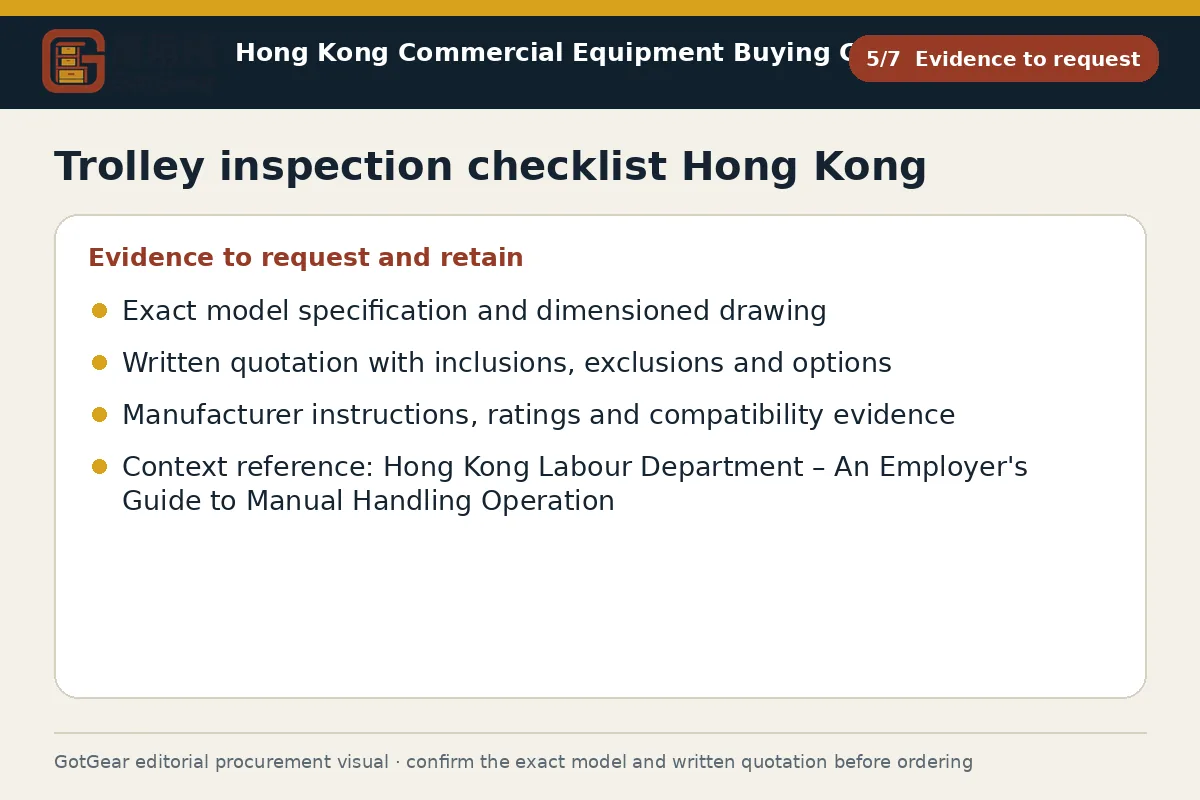
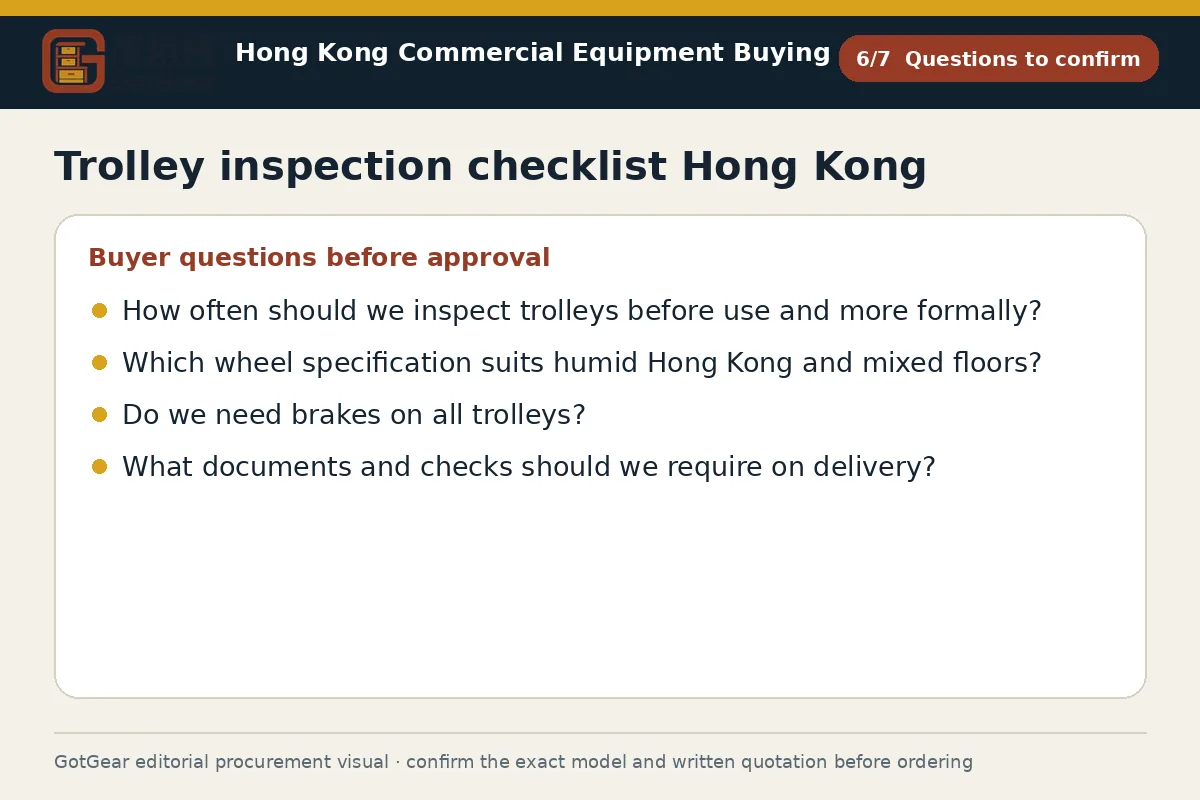
Trolley inspection checklist Hong Kong decision checklist
Confirm the route: door and lift clearances, turning space, gradients and floor finishes. Match the model’s safe working load, deck size, wheel material and brake type to those constraints, and request bilingual manuals, maintenance instructions and a parts list in the quotation. Set pre-use checks for wheels, frame, deck, handle, restraints and brakes; pass if safe, report minor non-safety issues, and isolate anything that could impair control or stability. Record outcomes with an asset ID, location and photos. Move repeated defects into planned maintenance, schedule work within loading windows, and keep spare wheels, fasteners and brake parts where applicable. On receipt, verify labels, dimensions and smooth wheel rotation, and add the trolley to your register. Where public access is involved, agree parking, routing and incident reporting with the management office.
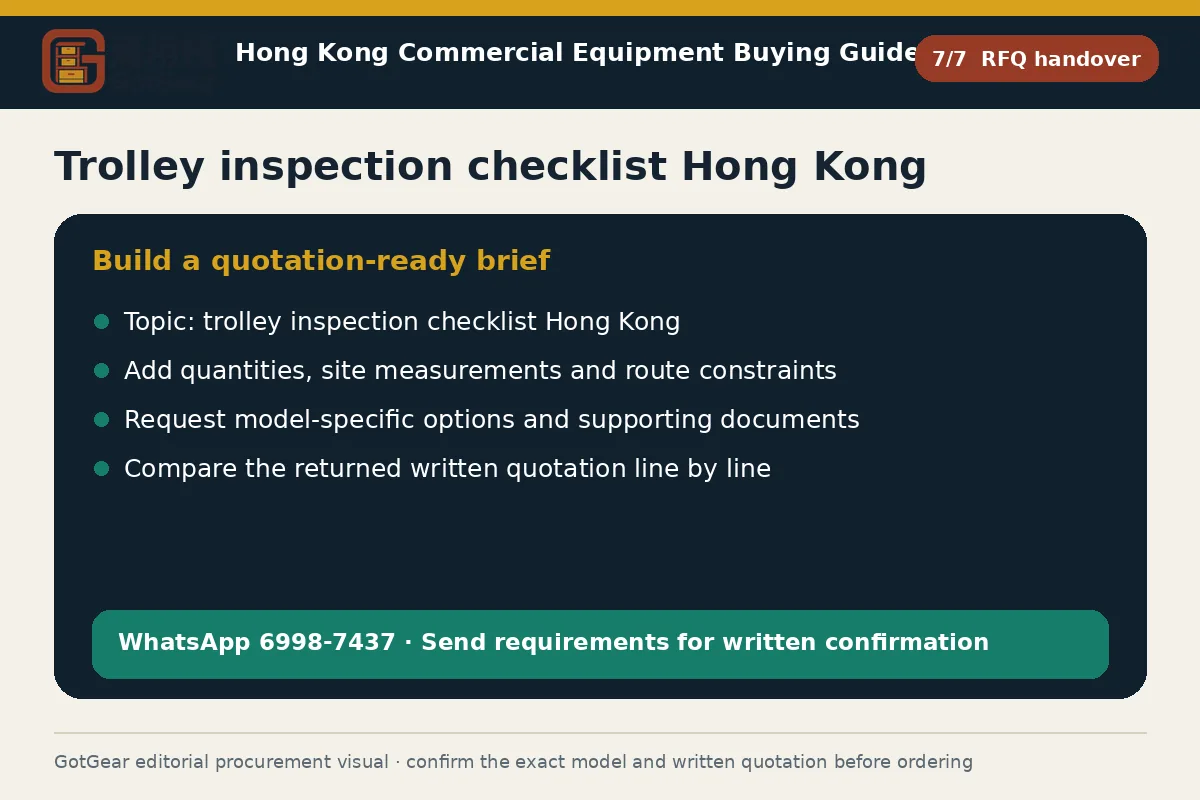
- Operating use, quantity and expected frequency
- Dimensions, capacity, material and accessory requirements
- Delivery address, floor, goods lift and loading window
- Required documents, acceptance checks and after-sales arrangements
Key points for trolley inspection checklist Hong Kong, trolley preventive maintenance Hong Kong
Hong Kong sites often have tight goods-lifts, narrow doorways and busy back-of-house corridors. Measure clear widths, lift car sizes and turning spaces before specifying wheel size, handle height and deck length, and confirm the route with the building manager. Humid conditions favour corrosion-resistant finishes and sealed bearings, while steep service ramps and tiled floors may justify brakes and softer treads. Public-event and mall operations typically require management-office coordination, bilingual user information and attention to noise and trolley parking. This page offers practical planning, not legal advice; always follow the manufacturer’s instructions and your venue, insurer or authority requirements where applicable.
Questions about trolley inspection checklist Hong Kong
How often should we inspect trolleys before use and more formally?
Do a brief pre-use check every shift or handover, then add periodic maintenance based on the maker’s guidance and your duty. As an example starting point, some sites review fasteners and wheels weekly under heavier use. Confirm intervals with the supplier and a competent person, and adjust using your own wear and defect data. Building rules may also influence timing.
Which wheel specification suits humid Hong Kong and mixed floors?
Use non-marking treads suited to your floors, and consider sealed bearings and corrosion-resistant fasteners for humidity. Softer elastomer treads may help on tiles, while harder treads suit rough concrete. Ask for wheel diameter, tread compound, bearing type and mounting plate size in the quote, and confirm with your supplier after a route walk and surface assessment.
Do we need brakes on all trolleys?
Not always. Brakes are advisable on slopes, near public areas, in lifts, or where loads are tall or mobile. Direction locks can help with long, straight pushes. Whether brakes are needed depends on your route, load and venue rules. Request the brake type, holding method and adjustment procedure in writing, and confirm suitability with the manufacturer or venue.
What documents and checks should we require on delivery?
Request a model datasheet, bilingual user and maintenance instructions, a parts list and serial/asset information. On receipt, check labels, dimensions against your lift and doorway measurements, wheel rotation and brake action, handle security, restraint operation and finish quality. Photograph any defects and note them on the delivery record. Follow-up actions should match the agreed quotation and model specification.
Continue with closely related procurement topics
These pages share equipment, operating or decision-stage signals with this guide.
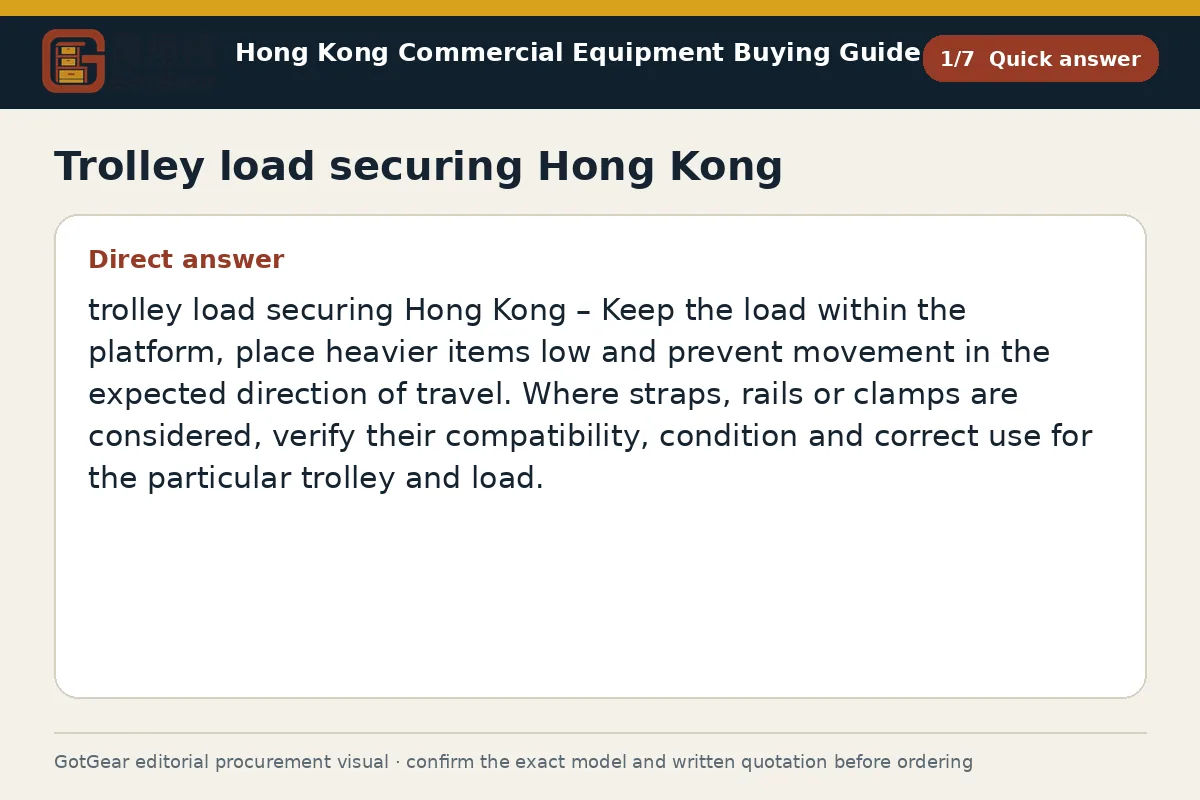
Trolley load securing Hong Kong
GotGear provides guidance on trolley load securing Hong Kong, explaining how to check the centre of gravity, identify restraint points and compare straps, rails and clamps. It also covers trolley load stability Hong Kong.
Read the guide
Material handling floor condition checklist Hong Kong
GotGear links material handling floor condition checklist Hong Kong with workplace transport risk assessment Hong Kong and warehouse loading bay trolley safety Hong Kong. It logs defects, gradients, edges and vehicle paths.
Read the guide
Mobile workstation trolley Hong Kong
A practical checklist for facility teams using a mobile workstation trolley Hong Kong to map tasks and stops and to list checks for surface condition, power and cables, security, user adjustment and parking, produced by GotGear.
Read the guide
Manual handling risk assessment Hong Kong
GotGear explains what to record during a manual handling risk assessment Hong Kong and how to use a manual handling safety checklist Hong Kong. The guide also describes how to prioritise material handling risk controls Hong Kong.
Read the guideRelated topic indexOpen more English procurement pages1 topics
Browse additional equipment families, applications and procurement questions relevant to a wider buying brief.