
Cleanroom trolley Hong Kong — Shortlist a trolley only when its model-specific materials and construction can be assessed against the intended cleanroom and cleaning procedure. Request supporting documentation and verify compatibility with site standards, manufacturer guidance and applicable Hong Kong requirements.
Cleanroom trolley Hong Kong — Define the controlled area and site acceptance criteria
When procuring a cleanroom trolley Hong Kong, buyers should start by clearly defining the controlled area the trolley will enter and the acceptance criteria it must meet. Record the area classification used by your organisation, the allowable materials and finishes, the cleaning regime (agents, frequency, method), and any internal restrictions on lubricants, labels or elastomers. Map the full travel route from loading bay to clean zone, noting floor types, thresholds, ramps, turning spaces, lift sizes and management booking rules. Confirm the maximum trolley footprint and height that will clear doors, pass‑throughs and airlocks without contact. If your SOP specifies surface roughness or weld finish, state the requirement explicitly in the enquiry.
Set site acceptance criteria in writing. Typical items include: no exposed raw steel, no porous or coated chipboard, continuous welds where fluid can pool, sealed tube ends, flush or capped fasteners, and wheels that do not mark floors. Define permitted cleaning agents and the test you will use on receipt (for example, a practical starting point is a white‑wipe visual check, then confirmation with your quality team). Include EHS notes for safe working load per shelf, stability with full load, braking performance on slight slopes en route, and packaging controls so transit debris does not enter controlled areas. Your written criteria should be quoted back, model‑by‑model, by each supplier.
Cleanroom trolley Hong Kong — Check compatibility with cleaning agents and procedures
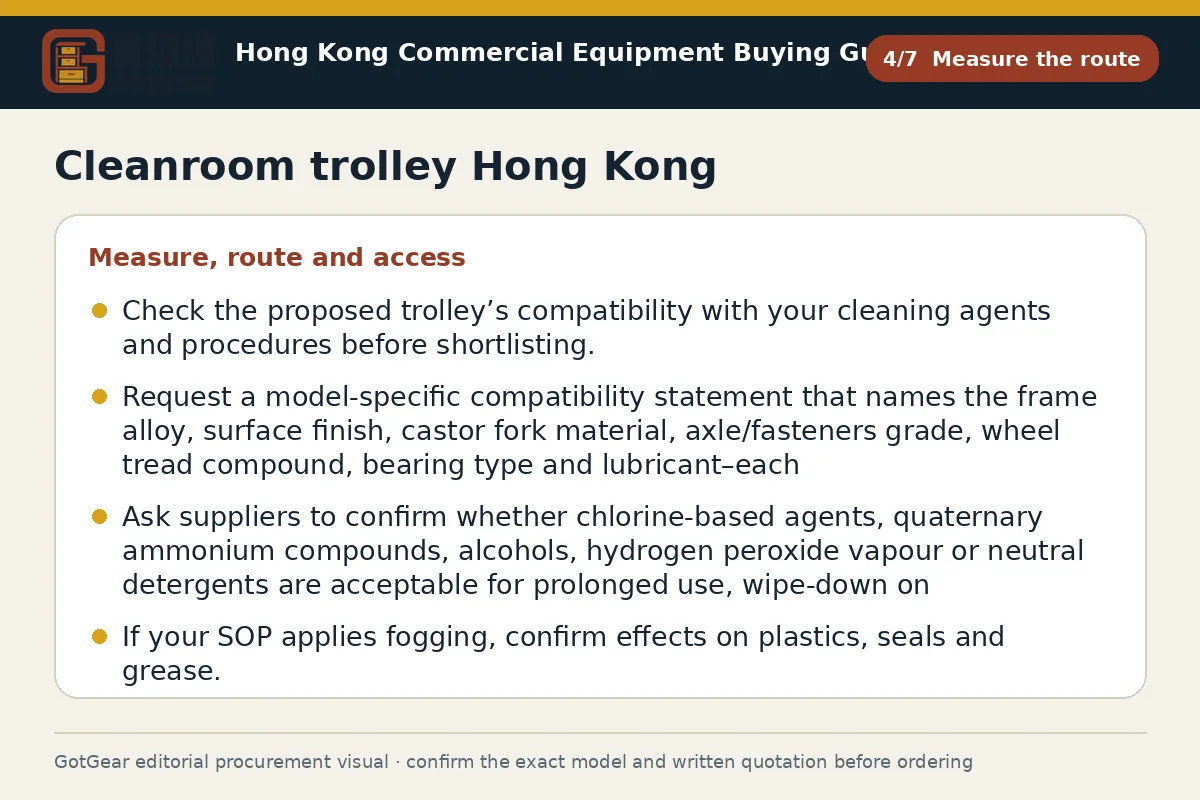
Check the proposed trolley’s compatibility with your cleaning agents and procedures before shortlisting. Request a model-specific compatibility statement that names the frame alloy, surface finish, castor fork material, axle/fasteners grade, wheel tread compound, bearing type and lubricant—each cross-referenced against your disinfectants. Ask suppliers to confirm whether chlorine-based agents, quaternary ammonium compounds, alcohols, hydrogen peroxide vapour or neutral detergents are acceptable for prolonged use, wipe-down only, or not recommended. If your SOP applies fogging, confirm effects on plastics, seals and grease.
Where chlorides or high humidity are present along the route, probe for crevice and stress-corrosion risks and whether 316 stainless (instead of 304) is indicated by your cleaning matrix. If your baseline is alcohol, specify the concentration you intend to use (As a starting point, 70% IPA, to be confirmed by your competent person) and request dwell-time guidance. Obtain any available test data, sample coupons of wheel material for soak tests, and SDS for greases and elastomers. Ensure the cleaning procedure (tools, cloth types, rinsing) will not damage wheel tread or remove necessary identification labels, and that the manufacturer’s instructions are available in bilingual form for Hong Kong teams.
What should buyers compare for cleanroom trolley Hong Kong?
| Criterion | Straightforward requirement | More complex requirement | Evidence to provide |
|---|---|---|---|
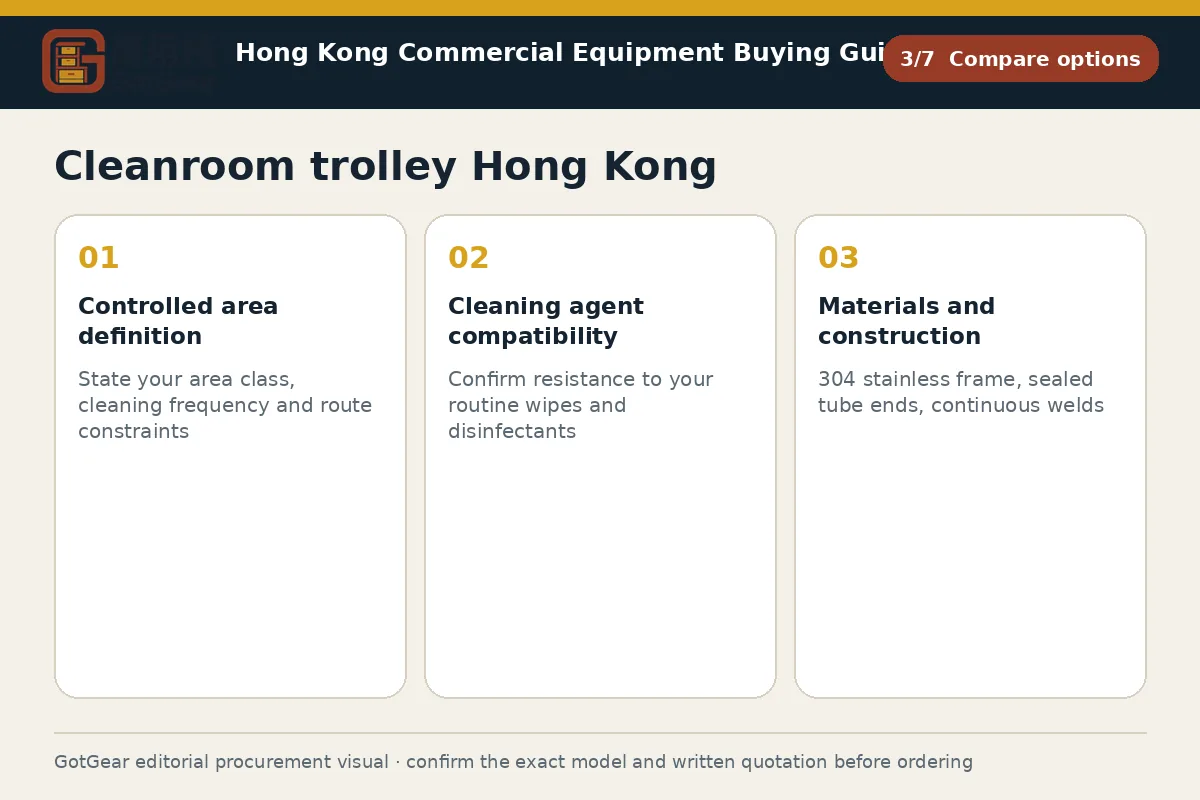
| Controlled area definition | State your area class, cleaning frequency and route constraints | Include boundary decontamination steps and staging zones with humidity controls | Provide SOP excerpt and route map with key dimensions and management booking notes |
| Cleaning agent compatibility | Confirm resistance to your routine wipes and disinfectants | Assess fogging/vapour exposure and prolonged contact or soak scenarios | Submit your agent list; request supplier matrix, SDS and any test data |
| Materials and construction | 304 stainless frame, sealed tube ends, continuous welds | 316 stainless and electropolished surfaces where SOP demands | Provide finish method, weld photos and component-grade breakdown in the quote |
| Castors and wheels | Non-marking tread, sealed bearings, effective brakes | Stainless forks/axles, thread guards, ESD options if specified by SOP | Provide wheel compound datasheet, bearing type, diameter and brake configuration |
| Documentation and acceptance | Bilingual cleaning/maintenance instructions included | Model-level evidence pack aligned to site acceptance test | Attach BOM, drawings, load ratings, cleaning instructions and packaging plan |
This framework helps buyers create comparable written enquiries. Final model specifications, availability, delivery and commercial terms must be confirmed in a formal quotation.
Cleanroom trolley Hong Kong — Review materials, joints, surfaces and particle traps
Evaluate materials, joints, surfaces and potential particle traps with photos, drawings and a hands-on sample where feasible. Prefer fully welded, continuous TIG joints on frames and shelves, with ground and blended welds where your hygiene or particle controls demand smooth transitions. Ask for proof that tube ends are sealed, internal voids are minimised, and drain or access holes (if present) are closed with hygienic plugs. Request the stated finish (e.g., satin, polished, electropolished) and the method used to remove fabrication residues, noting that any Ra target should come from your SOP and be confirmed in the quotation.
Inspect design features that influence shedding and cleanability: shelf edge profiles that do not trap lint, underside folds that are closed, smooth castor forks without dirt-collecting webs, and fasteners that are recessed or capped. Require stainless fasteners compatible with the frame grade to reduce galvanic coupling; avoid painted steel brackets. For wheels, look for sealed bearings, stainless axles, tread compounds that do not chalk, and effective thread guards. Check that bumpers and corner protectors are non-marking and securely fitted. Ask suppliers to declare adhesives, labels and protective films and how these are removed without leaving residue inside controlled zones.
Cleanroom trolley Hong Kong — Request model evidence without assuming cleanroom suitability
Do not assume that a general-purpose trolley is suitable—ask for model-specific evidence. Your enquiry should request: a bill of materials by component (frame, shelves, forks, axles, fasteners, wheels, bearings, bumpers); material grades and finishes; weld details with close-up photos; confirmation of sealed tube ends; lubricant and wheel compound datasheets; and the manufacturer’s cleaning and maintenance instructions. If available, ask for any in-house cleanability trials, outgassing or particle-shedding indications, clearly noting that your own site acceptance will prevail.
Structure quotations so they are comparable. Require the exact model code, dimensioned drawings (overall footprint and height), shelf clearances, safe working load per shelf and total, castor diameter and type, brake configuration, and any anti-static options as line items. Specify delivery to the building’s loading bay within the booked window, protection that avoids loose fibre/cardboard entering clean zones, and bilingual documentation upon receipt. On arrival, inspect for continuous welds, sharp edges, oil or residue, wheel free-rolling and brake hold, capped fasteners, intact caps/plugs, and that stated materials match the paperwork. Quoted specifications and approved samples should govern the acceptance decision.
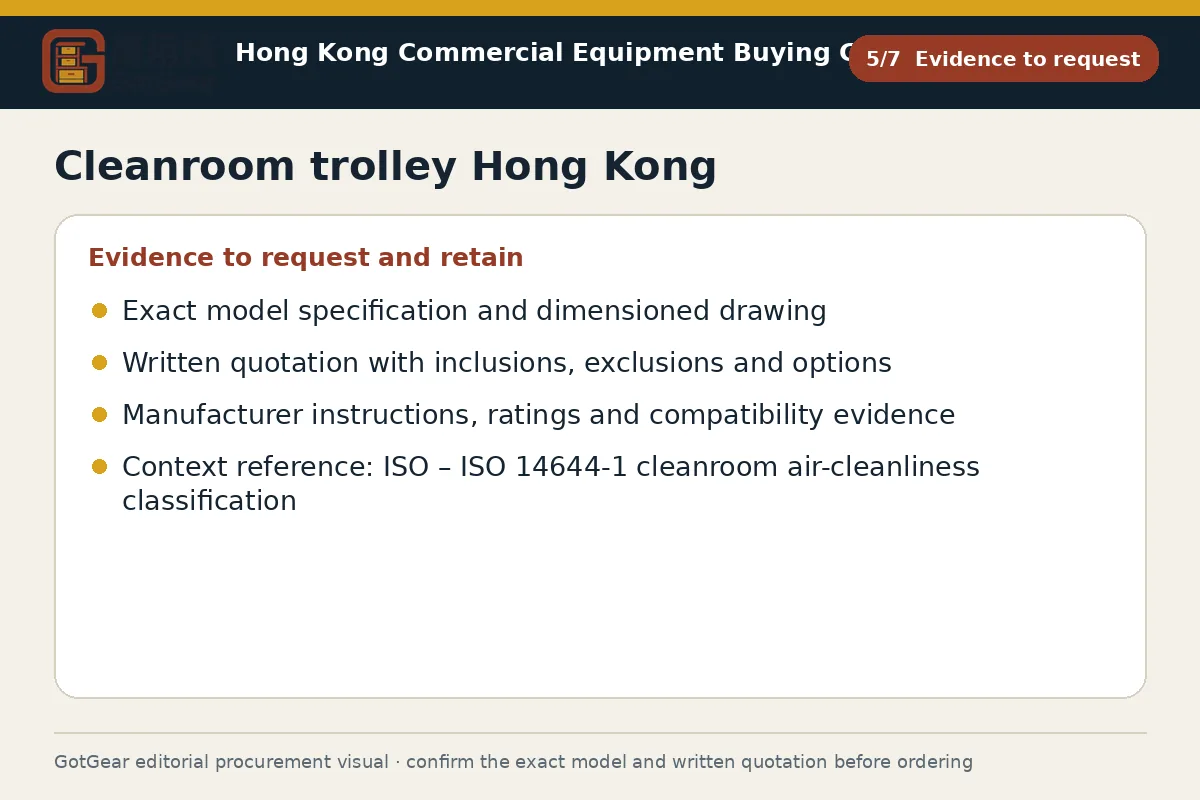
Cleanroom trolley Hong Kong decision checklist
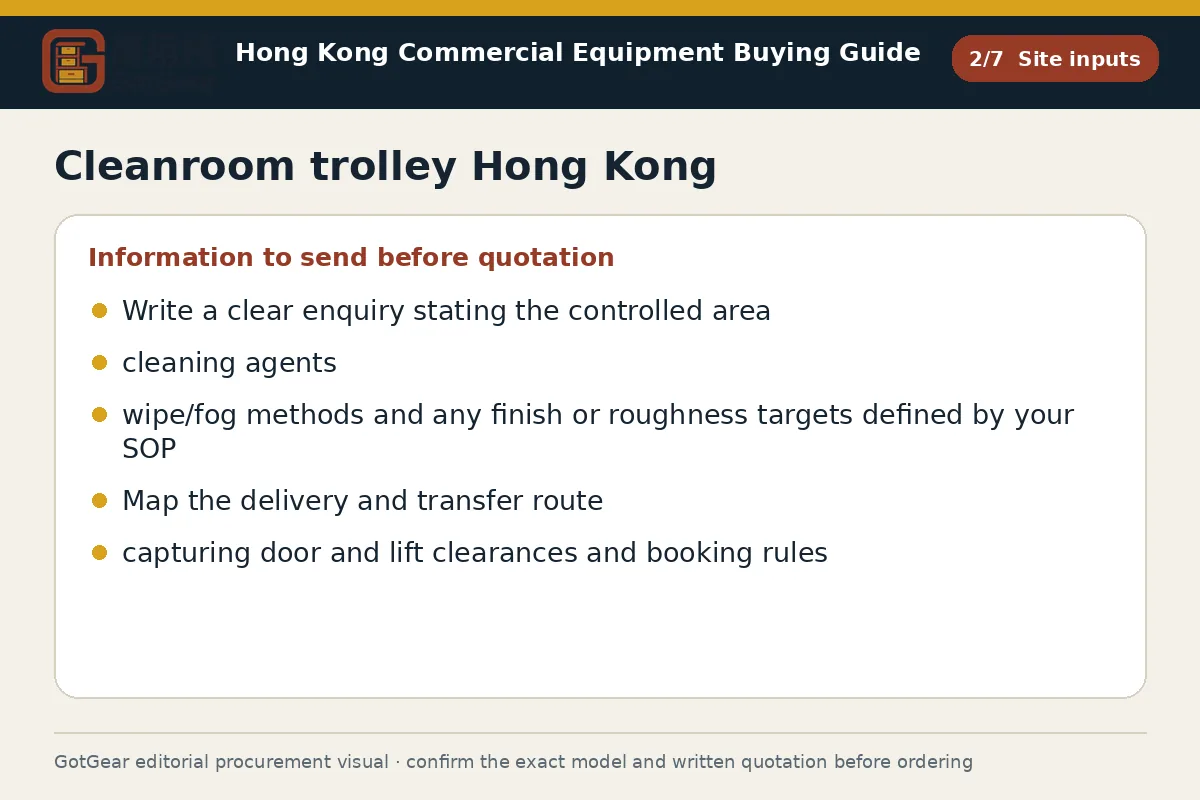
Write a clear enquiry stating the controlled area, cleaning agents, wipe/fog methods and any finish or roughness targets defined by your SOP. Map the delivery and transfer route, capturing door and lift clearances and booking rules. Ask for model-level materials, weld details, wheel and lubricant datasheets, and cleaning instructions. Require dimensioned drawings, load ratings, brake type and footprint in the quotation. Compare quotations line-by-line against your acceptance criteria. Before delivery, confirm packaging that will not shed fibres. On receipt, inspect weld continuity, sealed tube ends, capped fasteners, wheel smoothness, non-marking treads and documentation completeness. Record deviations and quarantine the trolley outside controlled areas until resolved by the supplier’s written response.
- Operating use, quantity and expected frequency
- Dimensions, capacity, material and accessory requirements
- Delivery address, floor, goods lift and loading window
- Required documents, acceptance checks and after-sales arrangements
Key points for cleanroom trolley Hong Kong
Hong Kong facilities often face tight goods-lift cars, narrow service corridors and building-management booking windows. Confirm the lift car dimensions, door clearances and turning spaces from loading bay to controlled area, and secure delivery slots early with the management office. High humidity and chloride exposure during transit or staging can accelerate corrosion, so agree packaging that keeps the trolley dry and clean. Bilingual instructions and labels help mixed teams verify cleaning agents and acceptance checks without delay. Treat any venue or institutional requirements as site-specific and confirm in writing.
Questions about cleanroom trolley Hong Kong
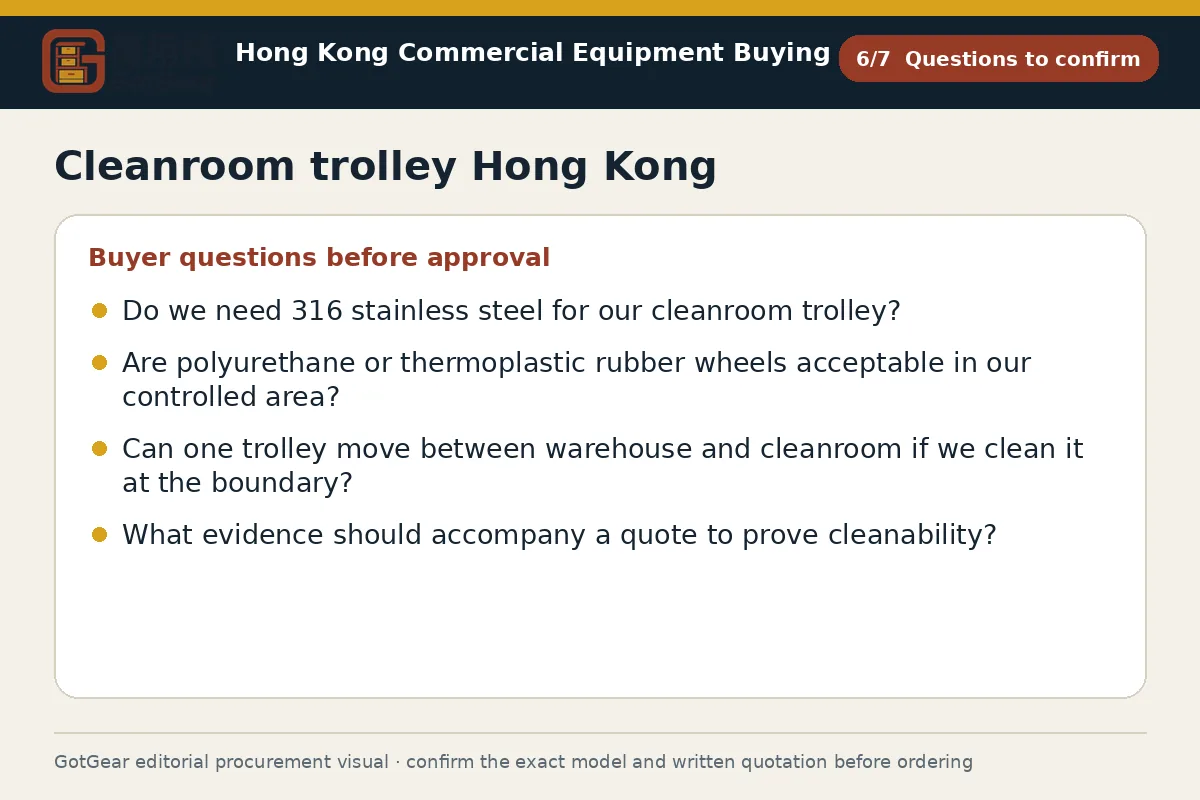
Do we need 316 stainless steel for our cleanroom trolley?
Choose 316 when your cleaning matrix or environment involves chlorides, aggressive disinfectants or prolonged humidity exposure along the route. Otherwise, quality 304 may suffice if your SOP permits it. Decide with your competent person, referencing the exact agents and wipe/fog methods used, and ask the supplier to confirm compatibility for the specific model in their written quotation.
Are polyurethane or thermoplastic rubber wheels acceptable in our controlled area?
They can be acceptable if they are low-shedding, non-marking, and compatible with your disinfectants, and if bearings are sealed with stainless axles. Request the wheel compound datasheet and run a small-area wipe/soak trial first. Confirm that your floors tolerate the tread material and that the supplier’s maintenance instructions align with your cleaning frequency.
Can one trolley move between warehouse and cleanroom if we clean it at the boundary?
Only if your procedures allow decontamination to a defined acceptance level and the trolley’s design has no dirt traps. Set a written boundary-cleaning method and inspection step before entry. Consider separate units if outdoor dust, pallet splinters or lubricants from the warehouse risk contamination, and obtain EHS approval for the specific workflow.
What evidence should accompany a quote to prove cleanability?
Ask for model-specific materials and finishes, weld photos, sealed-end confirmation, wheel and lubricant datasheets, and the manufacturer’s cleaning instructions. Where available, request sample coupons for soak tests and any internal cleanability notes. Your site acceptance criteria and approved sample will still prevail over brochures, so ensure the quotation mirrors your written requirements.
Continue with closely related procurement topics
These pages share equipment, operating or decision-stage signals with this guide.
Drum trolley Hong Kong
This quotation checklist helps facilities and EHS teams plan for drum trolley Hong Kong. It guides you on drum size, filled mass, orientation, pickup method, retention and route conditions, and is provided by GotGear.
Read the guide
Gas cylinder trolley Hong Kong
GotGear's checklist for a gas cylinder trolley Hong Kong outlines key considerations such as cylinder size, filled mass, valve guards, correct loading, safe gradients, and checks with the trolley manual and site rules.
Read the guide
Panel trolley Hong Kong
GotGear offers a practical guide to panel trolley Hong Kong that helps facilities record dimensions, mass, surface finishes, support angles, contact materials, retention methods and route clearances.
Read the guide
Glass trolley Hong Kong
GotGear guide to glass trolley Hong Kong explains how to specify equipment and plan sites by comparing rated capacity, support geometry, contact materials and restraints, pane size, loading method and route clearances.
Read the guideRelated topic indexOpen more English procurement pages1 topics
Browse additional equipment families, applications and procurement questions relevant to a wider buying brief.