
Instrument trolley Hong Kong — Organise and retain the defined instruments while allowing controlled movement and the required cleaning process. Confirm materials, dimensions, capacity, brakes and care instructions for the proposed model against facility procedures and applicable requirements.
Instrument trolley Hong Kong — Describe instruments, trays and point-of-use access
Start by mapping the complete set of instruments that must travel together, including tray footprints, the tallest item height, any sharp or delicate pieces, and the order in which users need to access them at the bench, bedside or workcell. If your brief references instrument trolley Hong Kong, specify the clinical or technical environment, shift patterns, and whether the trolley will move between sterile and non-sterile areas. Note the heaviest single item, any liquids, and whether barcodes, labels or liners must be visible on approach.
Translate this into measurable requirements. State the maximum tray length, width and height, acceptable shelf clearance above each tray, and the preferred working height for top-shelf tasks. Confirm whether instruments must be lifted out in a fixed sequence or removed in whole trays. Indicate whether removable bins, side rails, hooks for PPE, label holders, sharps attachments or waste rings are needed. Identify who will push, from which side, and typical turning spaces. Record the most constrained route segment—tightest doorway, goods lift and corridor—and whether the trolley must dock under counters or pass through automatic doors without striking sensors or frames.
Instrument trolley Hong Kong — Review materials, cleaning and cross-contamination controls
Materials and finish determine cleaning success and residual risk. Ask suppliers to state the base material and surface treatment for frames, shelves and handles, plus weld finish and joint design. For example only, buyers may shortlist 304 stainless for general use and 316 stainless near corrosives; final material must be confirmed in writing against the site’s chemicals. Where polymer shelves are proposed, request information on heat resistance, chemical compatibility and repairability. Specify if removable mats, perforated shelves or drainage are required after wet work.
Define the cleaning process in the enquiry: products used, contact times and whether wipes, sprays or immersion are involved. Require the manufacturer’s cleaning and disinfection guidance, in English and Chinese where possible, and state if autoclaving or thermal disinfection is expected for trays or inserts. To reduce cross-contamination, indicate colour-coding, dedicated-zone trolleys, optional covers or curtains, and any need for sealed or capped castors. If sterile presentation is important, ask for edge radii, smooth internal corners and flush fasteners to aid wipe-down, and request spare parts availability for castors, drawer slides and handles as standard maintenance items.
What should buyers compare for instrument trolley Hong Kong?
| Criterion | Straightforward requirement | More complex requirement | Evidence to provide |
|---|---|---|---|
| Instrument and tray capacity fit | Shelves sized to stated tray footprint; visible labels | Dedicated positions for sequence-picking and delicate items | Tray L×W×H, item count, heaviest item, access order diagram |
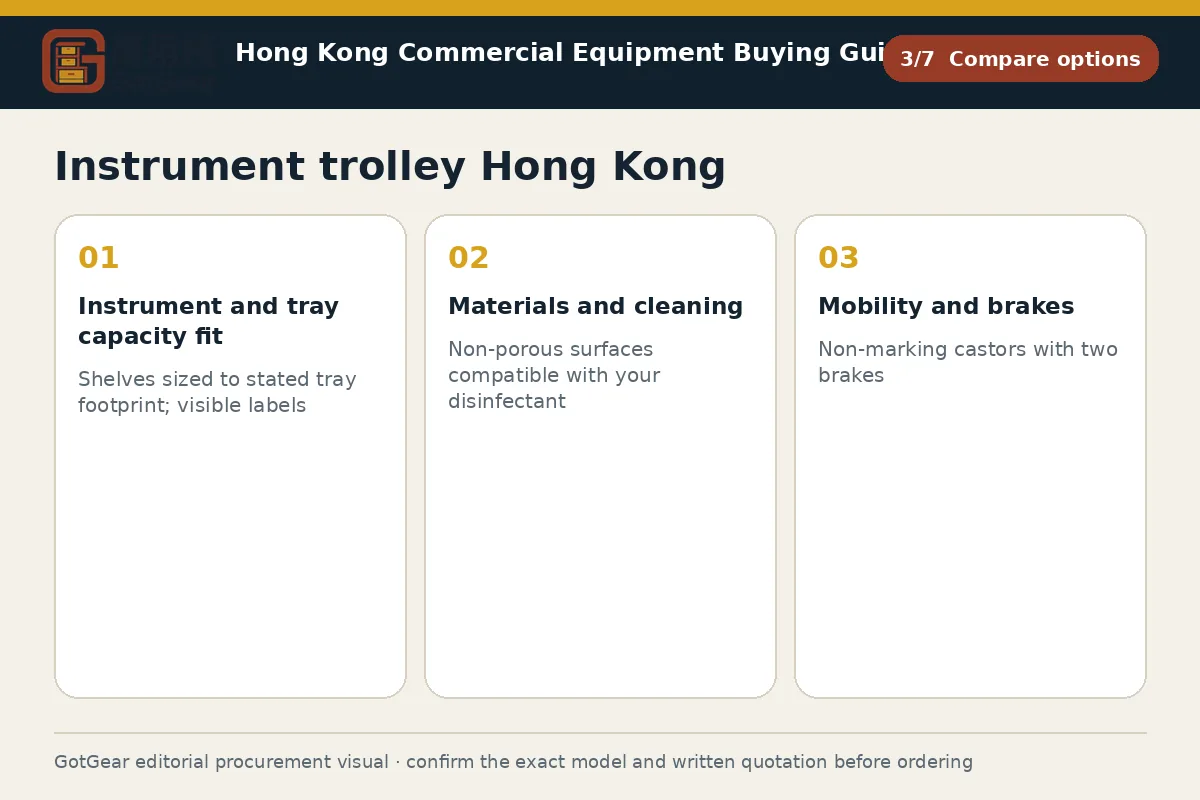
| Materials and cleaning | Non-porous surfaces compatible with your disinfectant | Removable inserts, smooth welds, sealed castors to limit residue | Named chemicals, contact times, cleaning method, material grade/finish |
| Mobility and brakes | Non-marking castors with two brakes | Directional lock and total-lock brakes for long corridors and ramps | Castor diameter, wheel material, brake type and test method |
| Shelves, drawers, edges and restraints | Adjustable shelves with lipped edges | Full-extension drawers with dividers; rails, straps or mats for restraint | Shelf pitch, lip height, drawer size, divider spec, restraint type |
| Dimensions and access route | Fits rooms and standard doors on intended route | Clears booked goods-lift car and tightest pinch-point with packaging | Trolley footprint, overall height, packaging size, route measurements |
This framework helps buyers create comparable written enquiries. Final model specifications, availability, delivery and commercial terms must be confirmed in a formal quotation.
Instrument trolley Hong Kong — Define shelf, drawer, edge and securing requirements
Convert handling needs into shelf and drawer specifications. State the number of shelves and whether they must be height-adjustable; if so, indicate the adjustment increment you can accept (for example only, a 25 mm pitch). Define shelf type—flat, lipped or perforated—and request the minimum raised edge height to prevent roll-off during braking (for example only, a 10 mm lip). If trays should glide, ask for low-friction liners. Where small parts are used, specify drawers with full-extension slides, internal dividers and label windows.
Set out restraint requirements. Confirm if side rails, bungee straps, silicone mats, foam inlays or clamp points are needed for glassware or delicate instruments. If covers are required, decide between soft covers, hard doors or tambour shutters, and whether locks are needed in public corridors. Quote both total load and per-shelf or per-drawer load limits you require, along with tolerance for deflection. Note any preference for push handles at one or both ends and whether they must be removable to pass tight clearances. Ask the supplier to describe how accessories mount—universal rail, perforations or proprietary mounts—and the impact on cleaning.
Instrument trolley Hong Kong — Check dimensions, brakes and model documentation
Site fit and control are decisive at handover. Record maximum trolley footprint, overall height including handles, and castor diameter. Measure the tightest lift car and door openings, corridor pinch-points and threshold ramps on the intended route. As an example starting point only, compare turning within a 1.6 m by 1.6 m square; confirm the correct value for your site. State whether low-noise, non-marking or anti-static castors are required for labs, and if you need total-lock brakes and a directional lock to hold a straight line on long corridors.
Ask for a dimensioned drawing, model code, weight empty, stated total and per-shelf load ratings, brake type and test method, plus care and cleaning instructions. Request bilingual user information where institutional policy requires it. For public or clinical spaces, confirm if your venue, insurer or infection-control lead requires any additional documentation, such as materials data for covers. In quotation comparisons, align inclusions: delivery to floor within booked loading windows, assembly, removal of packaging, and confirmation of packaging size to clear the goods lift. On receipt, check welds, shelf level, drawer alignment, fastener torque, brake function, castor rotation and serial identification against the written quotation and model literature.
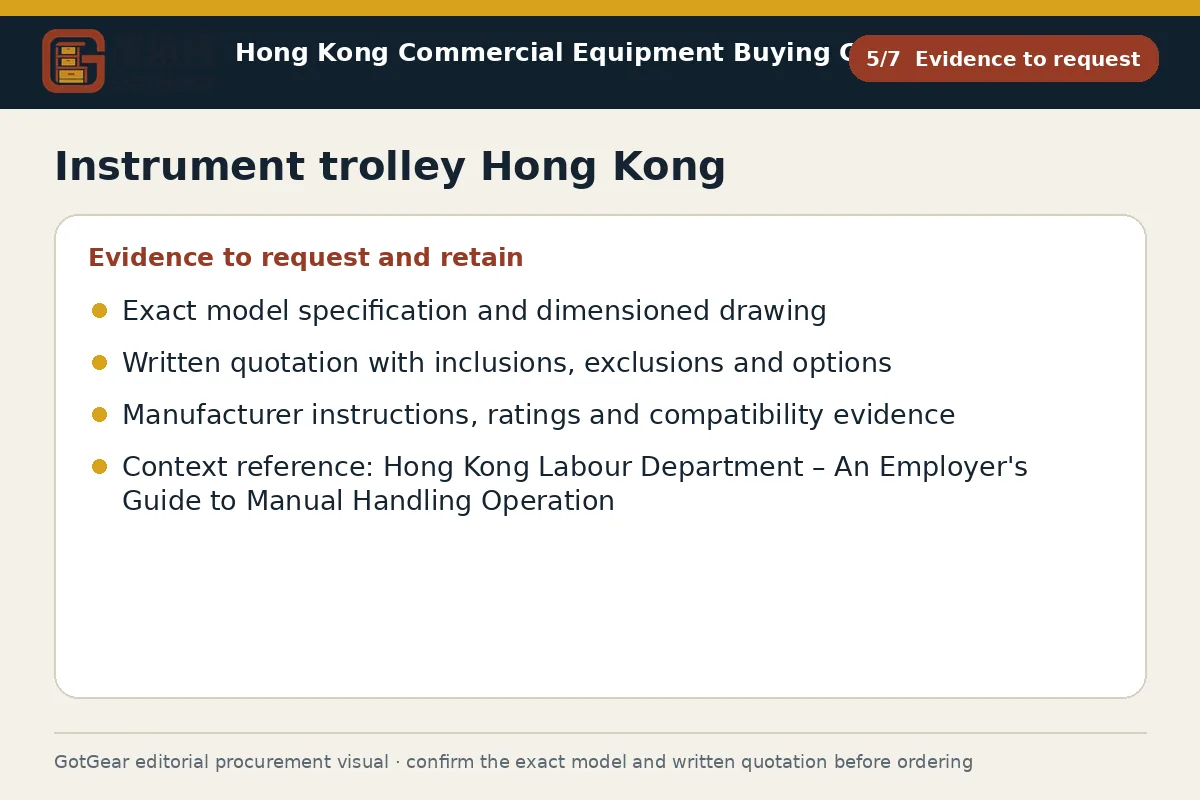
Instrument trolley Hong Kong decision checklist
Confirm the instrument inventory, tray footprints, heaviest item and access sequence, then translate these into shelf types, drawer needs, raised edges and restraints. Measure corridor, doorway and goods-lift constraints, and define preferred handle orientation, castor type, brake controls and working heights. Request model drawings, total and per-shelf load ratings, materials, finishes and cleaning guidance, ideally in English and Chinese. Compare written quotations on identical specifications, inclusions and packaging dimensions for access. Coordinate delivery bookings with the management office. On receipt, inspect welds, shelf spacing, drawer travel, brake holding, castor swivel, fastener torque and identification plates, and reconcile all items against the model documentation and the accepted quotation.
- Operating use, quantity and expected frequency
- Dimensions, capacity, material and accessory requirements
- Delivery address, floor, goods lift and loading window
- Required documents, acceptance checks and after-sales arrangements
Key points for instrument trolley Hong Kong
Hong Kong buildings often impose tight access and booking controls. Before ordering, verify the route from loading bay to room, confirm goods-lift car size and door clearances, and book delivery windows with the management office. Humid conditions and the city’s salt air can accelerate corrosion, so validate materials and finishes for your environment. If the trolley will pass through public areas or venues, seek the organiser’s or landlord’s approval for movement times and protective floor coverings. Where bilingual documentation is mandated by institutional policy, state this in the enquiry so the supplier can confirm availability.
Questions about instrument trolley Hong Kong
How do I determine the right load rating for our instruments and trays?
State both total trolley load and per-shelf or per-drawer limits in your enquiry. As an example starting point only, some buyers request 40 kg per shelf and 120 kg total; confirm your figures with the manufacturer and facilities team. Include the heaviest single item and whether loads are dynamic during movement. The model specification and written quotation should prevail.
Which material is better for cleaning and durability in Hong Kong?
Stainless steel frames and shelves are widely chosen for durability and wipe-down cleaning; polymers can be lighter and quieter but need verified chemical and heat resistance. As an example only, 304 stainless suits general use, with higher grades considered near corrosives. In humid environments, request finish details and cleaning guidance from the supplier. Confirm compatibility with your approved disinfectants in writing.
Do we need locks or covers on an instrument trolley used near public areas?
If the trolley will pass through public corridors or event spaces, specify lockable drawers or a cover to prevent interference and contain contents. Where cross-contamination is a concern, a soft or hard cover can reduce exposure during transit. Requirements vary by venue, insurer and department policy, so obtain approval from the responsible manager and confirm options with the supplier in writing.
How can we compare quotations fairly across different models?
Issue a clear specification and ask suppliers to respond line-by-line with model code, materials, load ratings, shelf and drawer details, castor and brake types, documentation provided, and delivery inclusions. Request packaging dimensions for lift clearance and assembly notes. Evaluate on matched criteria and ask clarifications in writing so the accepted quotation and model literature align. The written quotation should govern the order.
Continue with closely related procurement topics
These pages share equipment, operating or decision-stage signals with this guide.
Laboratory trolley Hong Kong
This procurement checklist for laboratory trolley Hong Kong from GotGear helps Hong Kong laboratories consider load capacity, containment, shelf layout, manoeuvrability, cleaning compatibility, route width and spill response.
Read the guide
Drum trolley Hong Kong
This quotation checklist helps facilities and EHS teams plan for drum trolley Hong Kong. It guides you on drum size, filled mass, orientation, pickup method, retention and route conditions, and is provided by GotGear.
Read the guide
Gas cylinder trolley Hong Kong
GotGear's checklist for a gas cylinder trolley Hong Kong outlines key considerations such as cylinder size, filled mass, valve guards, correct loading, safe gradients, and checks with the trolley manual and site rules.
Read the guide
Panel trolley Hong Kong
GotGear offers a practical guide to panel trolley Hong Kong that helps facilities record dimensions, mass, surface finishes, support angles, contact materials, retention methods and route clearances.
Read the guideRelated topic indexOpen more English procurement pages1 topics
Browse additional equipment families, applications and procurement questions relevant to a wider buying brief.