
Mobile workstation trolley Hong Kong — Match the surface, device position, adjustment range and storage to the user task without compromising movement or visibility. Verify electrical and equipment instructions, site rules and route conditions before deciding on a configuration.
Mobile workstation trolley Hong Kong — Map where the workstation starts, stops and parks
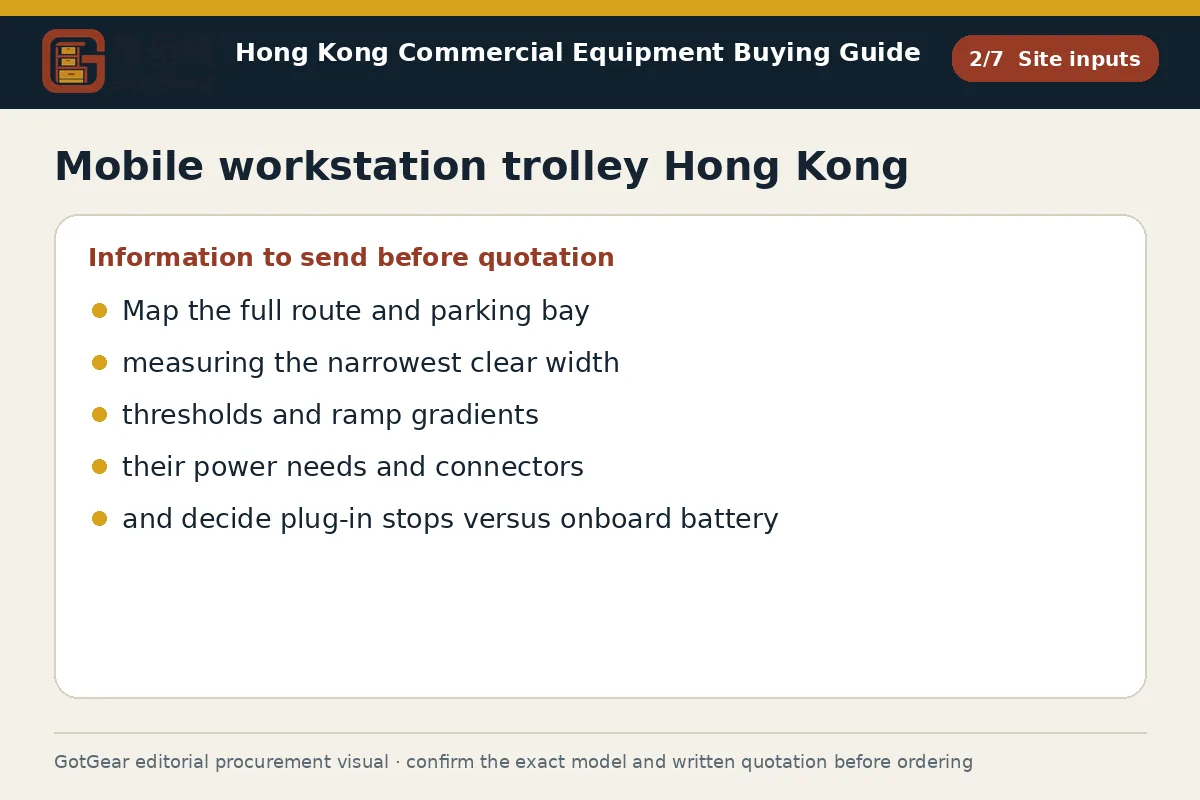
For a mobile workstation trolley in Hong Kong, teams should first map where it starts, stops and parks. Walk the full route with a tape measure and camera. Record the narrowest doorway, corridor pinch-points, lift car and door clear openings, threshold heights, ramp gradients, and turning space at each stop. Note floor types (epoxy, tile, carpet, concrete), surface transitions and any wet areas that may affect traction or cause corrosion. Sketch stop locations on a plan, including queueing space so the trolley does not block fire routes or goods traffic.
Confirm who will authorise movement across lobbies or public space, and whether the building management office requires advance booking, security passes or an escort. Identify a permanent parking bay between rounds with proximity to charging power and minimal obstruction risk. Mark where operators will stand and how doors, gates and lift buttons will be reached without overreaching from the handle. Time a full trial lap during a typical shift. If the route crosses loading docks or event areas, verify the site’s traffic-management rules and any peak-hour restrictions. Include photos and measured notes in your written enquiry so suppliers can comment on feasibility and caster/brake options in their quotation, and reference mobile workstation trolley Hong Kong so suppliers understand the project context.
Mobile workstation trolley Hong Kong — Plan cable, power and device security arrangements
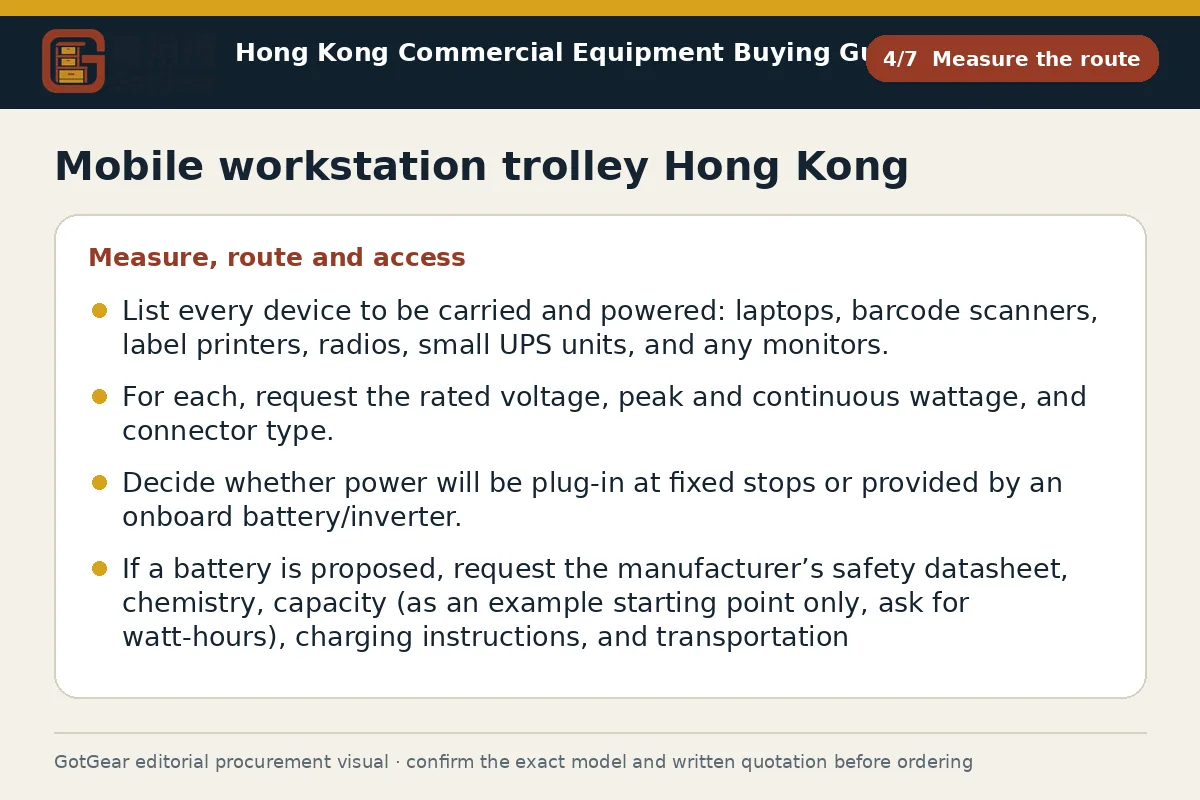
List every device to be carried and powered: laptops, barcode scanners, label printers, radios, small UPS units, and any monitors. For each, request the rated voltage, peak and continuous wattage, and connector type. Decide whether power will be plug-in at fixed stops or provided by an onboard battery/inverter. If a battery is proposed, request the manufacturer’s safety datasheet, chemistry, capacity (as an example starting point only, ask for watt-hours), charging instructions, and transportation guidance, and confirm any site policy on indoor charging and storage.
Plan tidy and safe cable paths. Specify grommeted pass-throughs, strain relief at the device and at the trolley frame, and either a retractable reel or a protected hook for mains cable stowage. Ask for a cable-management drawing showing bend radii and anchor points. For device security, define lock points for laptops and tablets, monitor security screws, printer tie-downs, and lockable compartments. In public or school environments, consider privacy filters and a screen shroud; in healthcare or catering, request wipe-clean cable jackets. Confirm plug type and outlet rating with building services, and if the venue requires residual-current protection or test labels, ask the supplier to state compatibility in writing.
What should buyers compare for mobile workstation trolley Hong Kong?
| Criterion | Straightforward requirement | More complex requirement | Evidence to provide |
|---|---|---|---|
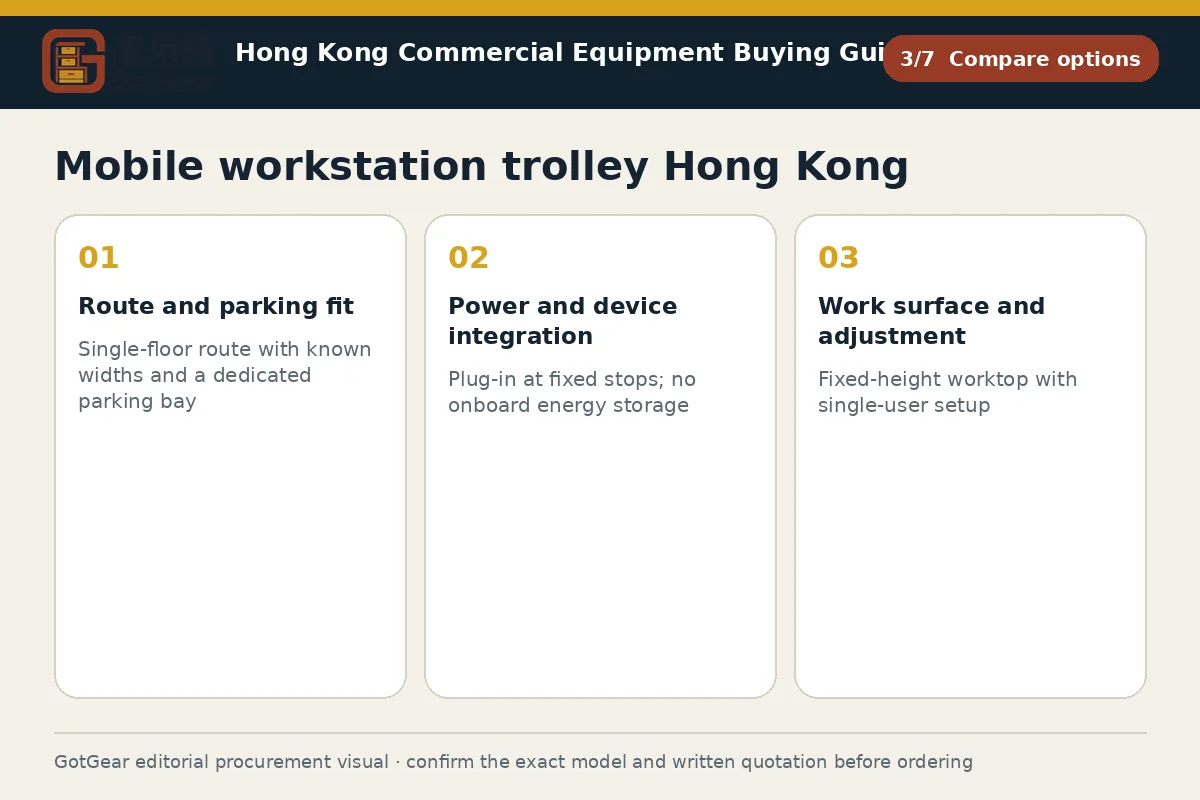
| Route and parking fit | Single-floor route with known widths and a dedicated parking bay | Multi-floor route using lifts and public space with shared access | Measured widths, lift car and door dimensions, route map with parking and photos |
| Power and device integration | Plug-in at fixed stops; no onboard energy storage | Onboard battery/inverter supporting continuous operation | Device power list (peak/continuous), plug types, battery SDS and charging plan |
| Work surface and adjustment | Fixed-height worktop with single-user setup | Multi-user tool-free height/tilt adjustment and VESA mounts | Required height range, user anthropometrics, monitor VESA and weight data |
| Storage and security | Open shelves/totes for low-risk items | Lockable drawers, device anchors and privacy provisions | Inventory of devices/consumables, lock type, access control needs |
| Control and braking | Two wheel brakes for parking on level floors | Central brake, direction lock and bumpers for ramps and crowds | Slope and threshold measurements, floor types, visibility notes |
This framework helps buyers create comparable written enquiries. Final model specifications, availability, delivery and commercial terms must be confirmed in a formal quotation.
Mobile workstation trolley Hong Kong — Define work surface, storage and user-adjustment needs
Start with the task: typing, scanning, picking, label printing, data entry, or supervisory work. Define the usable worktop size, edge style and cleaning standard. If liquids or small-parts kitting are involved, consider an upstand or anti-spill lip and a light-coloured, matte surface for visibility. Where disinfectants are used, ask for material compatibility statements and whether stainless fixings are provided. Document required payload: total trolley payload, per-shelf and drawer loads, and any single-device mass. Any example numbers you collect are only starting points and must be confirmed in the supplier’s formal specification and quotation.
For user fit, specify the handle and worktop height ranges, monitor height/tilt, and keyboard angle. If multiple users share the unit, request tool-free adjustments with clear scales. For monitors, state VESA pattern, weight and required focal distance. Detail storage types by function: open totes for fast picking, lockable drawers for controlled items, and a dedicated, ventilated bay for printers. Include noise expectations for night shifts and hospitals, and ask for caster diameter, tread material and wheel bearings suitable for your floor types. Provide the centre-of-gravity considerations to the supplier: where heavy devices sit relative to axles, and whether movement will include ramps or lift thresholds that could shift loads.
Mobile workstation trolley Hong Kong — Test visibility and control through the complete route
Before committing, simulate the full round with a loaded prototype or a similar trolley. Check sightlines over the worktop and any mounted screens; the operator should see floor hazards within a short distance ahead without leaning. Assess one-hand and two-hand control at walking speed, cornering stability, and the reach to brakes. Verify that monitor posts, baskets and antennas do not snag doorframes, lift jambs or racking.
On inclines and thresholds, test whether brakes hold securely and whether a direction-lock or central brake would aid control. Observe noise on different surfaces and whether softer treads are needed for night operations near residences or wards. Confirm the turning circle in lifts and at island displays. Record observations and feed them back into the specification: handle height changes, relocating a printer to improve visibility, or adding corner bumpers or reflectors for shared spaces. At receipt inspection, check that casters swivel smoothly, brakes engage positively, welds and fasteners are sound, adjustment clamps hold under load, finishes are free from sharp edges, and all manuals and safety labels are present in bilingual form with serial numbers noted.
Mobile workstation trolley Hong Kong decision checklist
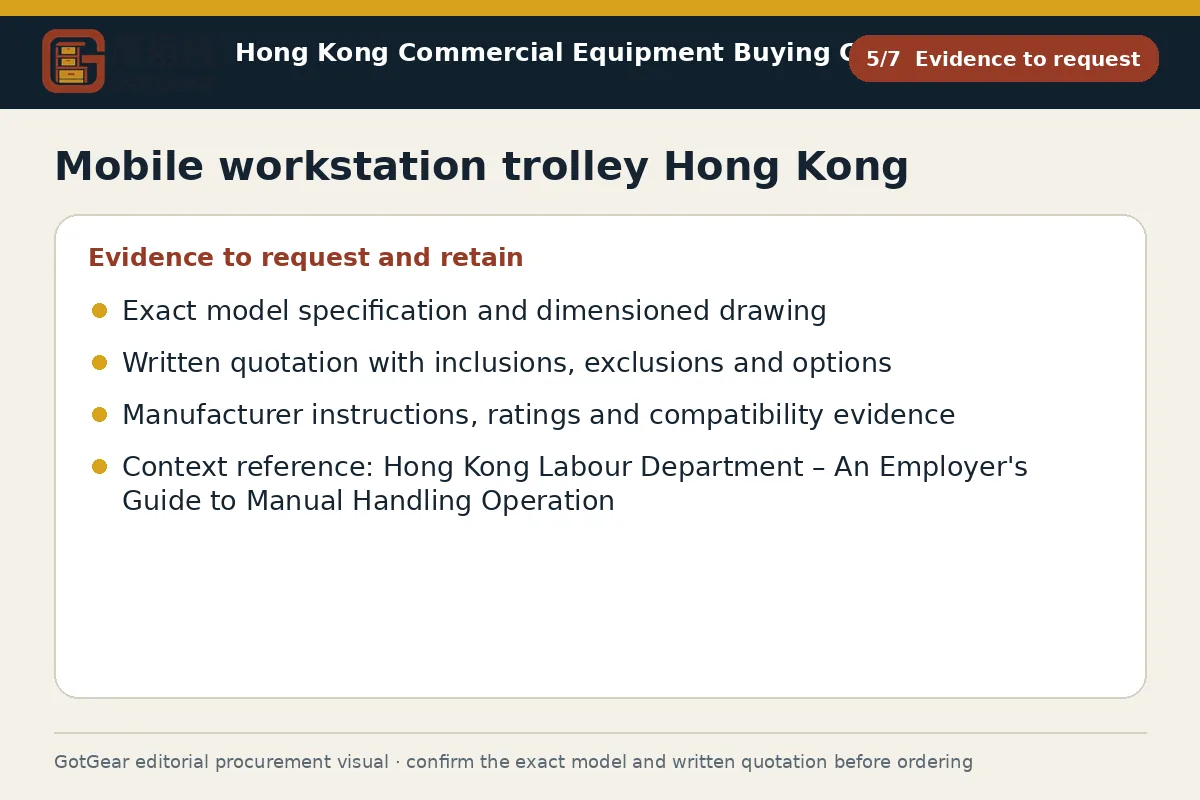
Map the full route and parking bay, measuring the narrowest clear width, lift interior, thresholds and ramp gradients. List devices, their power needs and connectors, and decide plug-in stops versus onboard battery. Define worktop size, adjustability ranges and storage types by task, noting cleaning and material requirements. State caster diameter, tread and brake type for each floor surface and slope. Describe any visibility constraints and minimum turning space. Confirm building-office access rules, loading windows and charging locations. In your enquiry, request drawings for cable paths, lock points and adjustment mechanisms, plus statements on load ratings and materials. Compare quotations line by line against your list and the written specification. Before sign-off, arrange a route trial, agree delivery access, and prepare a receipt inspection checklist with bilingual manuals required.
- Operating use, quantity and expected frequency
- Dimensions, capacity, material and accessory requirements
- Delivery address, floor, goods lift and loading window
- Required documents, acceptance checks and after-sales arrangements
Key points for mobile workstation trolley Hong Kong
Hong Kong routes often pass through tight goods lifts, managed lobbies and shared corridors, so booking lift cars and confirming a non-blocking parking bay with the management office can be the most decisive constraint. Measure the lift cabin and door clear widths, plus the smallest doorway and corridor turns on the route. Humid conditions and salt-laden air in some districts may justify corrosion-resistant fasteners and wipe-clean surfaces. Where the trolley crosses public areas or event venues, align with on-site traffic controls and request bilingual operating labels. Treat all site rules and building instructions as prevailing over general practice.
Questions about mobile workstation trolley Hong Kong
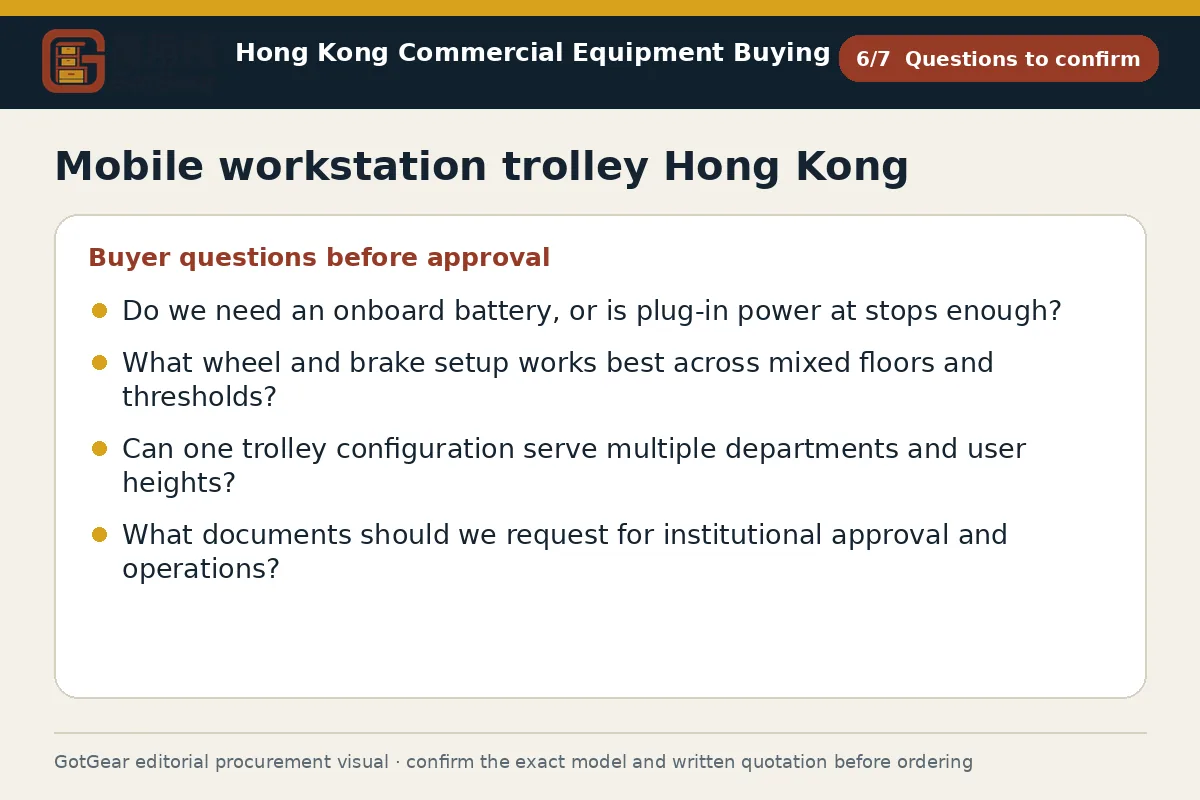
Do we need an onboard battery, or is plug-in power at stops enough?
Choose plug-in if stops have convenient outlets and tasks can pause for connection. Use onboard power when stops lack sockets or devices must run continuously. Confirm building policies on indoor charging and storage, and request the manufacturer’s battery safety datasheet, charging instructions and transport guidance. The final choice should match your measured route and the supplier’s written specification.
What wheel and brake setup works best across mixed floors and thresholds?
Specify larger-diameter casters and soft treads for smoother rolling across transitions, paired with reliable parking brakes. Where ramps or slopes exist, consider a direction-lock or central brake for control. Provide measured threshold heights, slope details, and floor types with your enquiry so the supplier can propose bearings, treads and brake mechanisms in their quotation and manual.
Can one trolley configuration serve multiple departments and user heights?
It can if you define a broad, tool-free adjustment range and modular storage that can be reconfigured without tools. Confirm the tallest and shortest user anthropometrics and typical device sets. Ask for scale markings on height points, keyed-alike locks where needed, and written limits for load and centre of gravity. The supplier’s formal specification must prevail over examples.
What documents should we request for institutional approval and operations?
Ask for a formal specification, load-rating statements, materials list, user and maintenance manuals, and device-mount drawings. If batteries are included, request the manufacturer’s safety datasheet and charging guidance. Where cleaning or infection control applies, request material compatibility notes. If the venue has electrical test or labelling policies, seek written confirmation of compatibility. Institutional requirements vary by site and insurer.
Continue with closely related procurement topics
These pages share equipment, operating or decision-stage signals with this guide.
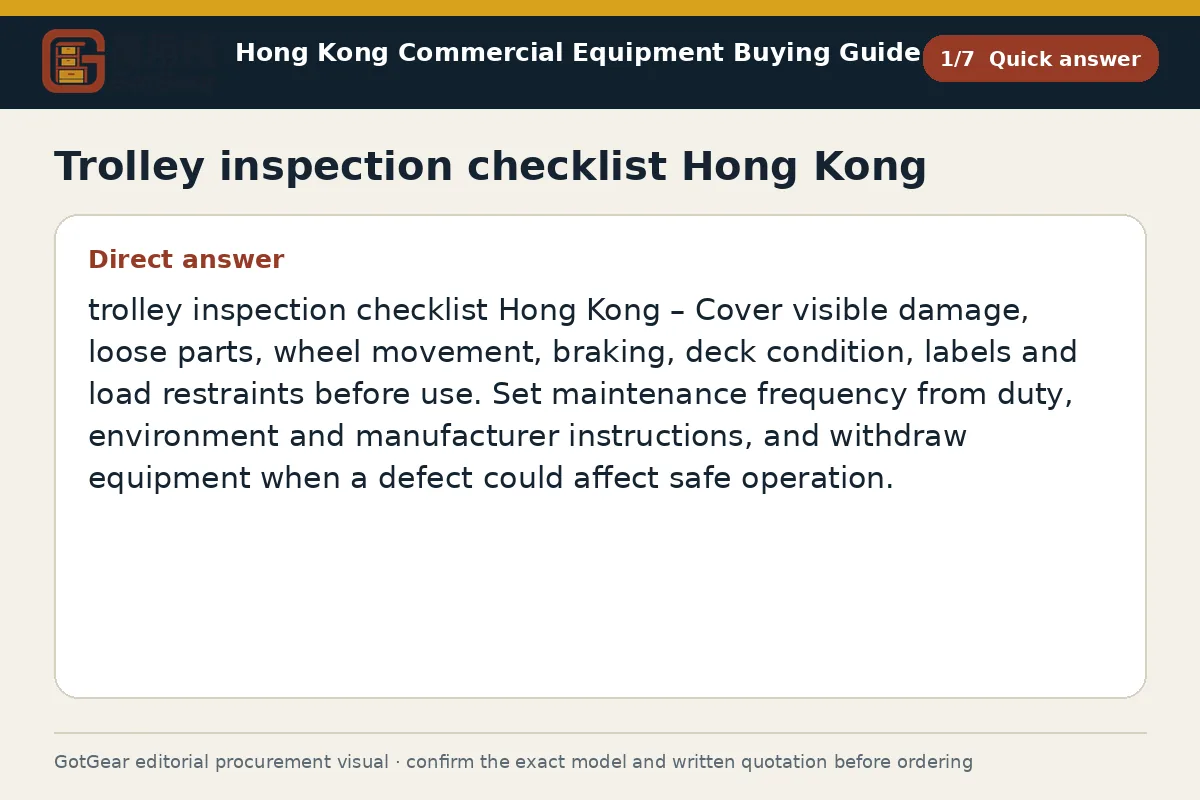
Trolley inspection checklist Hong Kong
GotGear’s trolley inspection checklist Hong Kong and trolley preventive maintenance Hong Kong explain how to inspect wheels and brakes, log defects and schedule servicing under maker guidance.
Read the guide
Trolley load securing Hong Kong
GotGear provides guidance on trolley load securing Hong Kong, explaining how to check the centre of gravity, identify restraint points and compare straps, rails and clamps. It also covers trolley load stability Hong Kong.
Read the guide
Trolley anti-slip deck Hong Kong
GotGear explains how to assess a trolley anti-slip deck Hong Kong by reviewing load retention, material, contamination and contact risks. It also outlines considerations for trolley bumper protection Hong Kong.
Read the guide
Trolley traffic management Hong Kong
GotGear explains trolley traffic management Hong Kong, trolley route assessment Hong Kong and trolley parking safety Hong Kong for mapped pedestrian, vehicle and parking controls.
Read the guideRelated topic indexOpen more English procurement pages2 topics
Browse additional equipment families, applications and procurement questions relevant to a wider buying brief.