
Manual handling risk assessment Hong Kong — Document the load, actions, frequency, environment and people exposed, then rank practicable controls. Safety decisions should be checked against current Hong Kong requirements, site procedures and the instructions for any equipment under review.
Manual handling risk assessment Hong Kong — Observe the real lift, push, pull and carry task
Start by observing the task as it truly occurs across a normal shift. Shadow the team, with permission, and record the load description, actual mass measured with a calibrated scale, overall dimensions, centre‑of‑mass clues (e.g., liquid slosh or asymmetric packing), grip surfaces and the height at which the load is first grasped and finally released. Measure travel distance door‑to‑door, the number of stops, and any lift waits or queueing that alters pace. Use a handheld force gauge to sample initial push, rolling push and pull forces on the same route and note footwear, gloves and floor condition at the time. For a manual handling risk assessment Hong Kong, also capture turning space, shelf heights, doorway and corridor clear widths, goods‑lift car size and any thresholds that require extra effort.
Document environmental and organisational factors that drive risk: time pressure during loading windows, tight hand‑over periods between lessons or services, wet or humid conditions that lower friction, lighting and visibility where vehicles and people mix, and noise that masks warnings. Note individual capability and team composition for the actual shift (new starters, part‑timers, contractors). Confirm whether photos or short clips may be taken for internal review. Teams exploring push pull trolley ergonomics Hong Kong often benefit from noting handle height versus user elbow height, two‑hand versus one‑hand control when opening doors, and whether the route forces backwards pulling in congested areas.
Manual handling risk assessment Hong Kong — Material handling risk controls Hong Kong: Prioritise elimination, redesign and suitable handling aids
Prioritise removing or redesigning the handling before adding aids. Can the supplier deliver closer to point‑of‑use or break consignments into smaller, stable units? Could storage be re‑slotted so the heaviest SKUs sit between knee and mid‑chest height, or can gravity lanes bring cartons to the picker? Where elimination is not practicable, select fit‑for‑purpose aids and engineered changes within material handling risk controls Hong Kong, such as route smoothing, threshold ramps, lane guides, and dedicated staging at working height.
When specifying trolleys, skates or dollies, request written quotations that state rated capacity, deck size, usable platform area, wheel material and diameter, bearing type, braking method, handle geometry and finish. Ask for corrosion‑resistant options for humid plant rooms, non‑marking wheels for polished malls, directional locks for long straight corridors, and bumpers where displays or doors are close. As an example starting point to evaluate manoeuvrability, some buyers trial larger wheels (for example, 150 mm) on uneven routes, but the responsible supplier or competent adviser must confirm suitability. Request manufacturer instructions, stability guidance, spare‑parts lists and any maintenance recommendations. If loads need restraint, incorporate strap points or side gates and align with trolley load securing Hong Kong. Always let model specifications and the formal written quotation prevail over assumptions made during site walks.
What should buyers compare for manual handling risk assessment Hong Kong?
| Criterion | Straightforward requirement | More complex requirement | Evidence to provide |
|---|---|---|---|
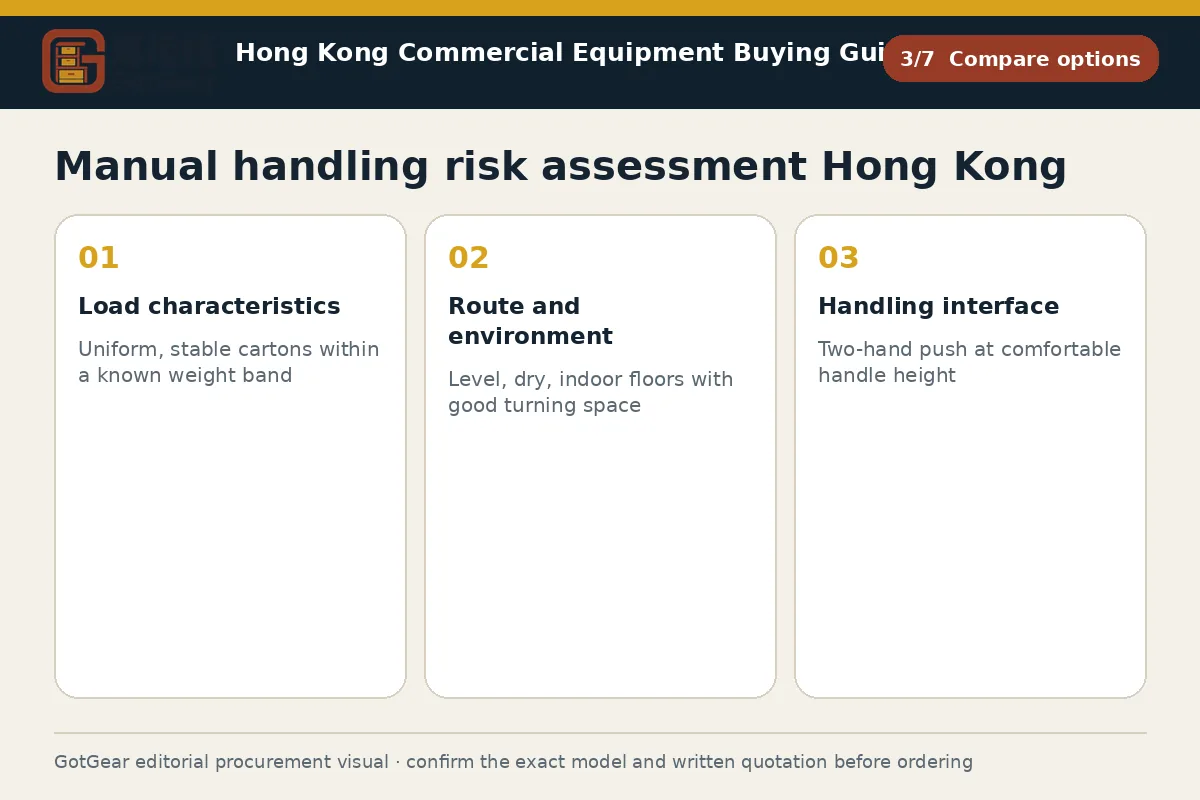
| Load characteristics | Uniform, stable cartons within a known weight band | Mixed sizes, unstable items, liquids or hot/cold goods | Maximum weight, footprint, height, centre‑of‑mass notes, packaging type |
| Route and environment | Level, dry, indoor floors with good turning space | Ramps, thresholds, outdoor areas, tight lifts and doors | Sketch/photos, gradient estimate, threshold list, lift/door clear widths and loading‑window notes |
| Handling interface | Two‑hand push at comfortable handle height | One‑hand control, door holds, backward pulls or glove use | Preferred handle height range, glove type, task frequency and duty cycle |
| Equipment specification | Standard 4‑wheel flat deck, non‑marking PU wheels | Brakes, directional locks, bumpers, corrosion‑resistant finish | Requested capacity, deck size, wheel diameter/material, bearing and brake details |
| Documentation and delivery | Datasheet and instructions in English | Bilingual docs, building‑management booking and disposal plan | Required language, delivery time window, access restrictions, serial/batch tracking method |
This framework helps buyers create comparable written enquiries. Final model specifications, availability, delivery and commercial terms must be confirmed in a formal quotation.
Manual handling risk assessment Hong Kong — Manual handling safety checklist Hong Kong: Convert findings into actions and a repeatable check
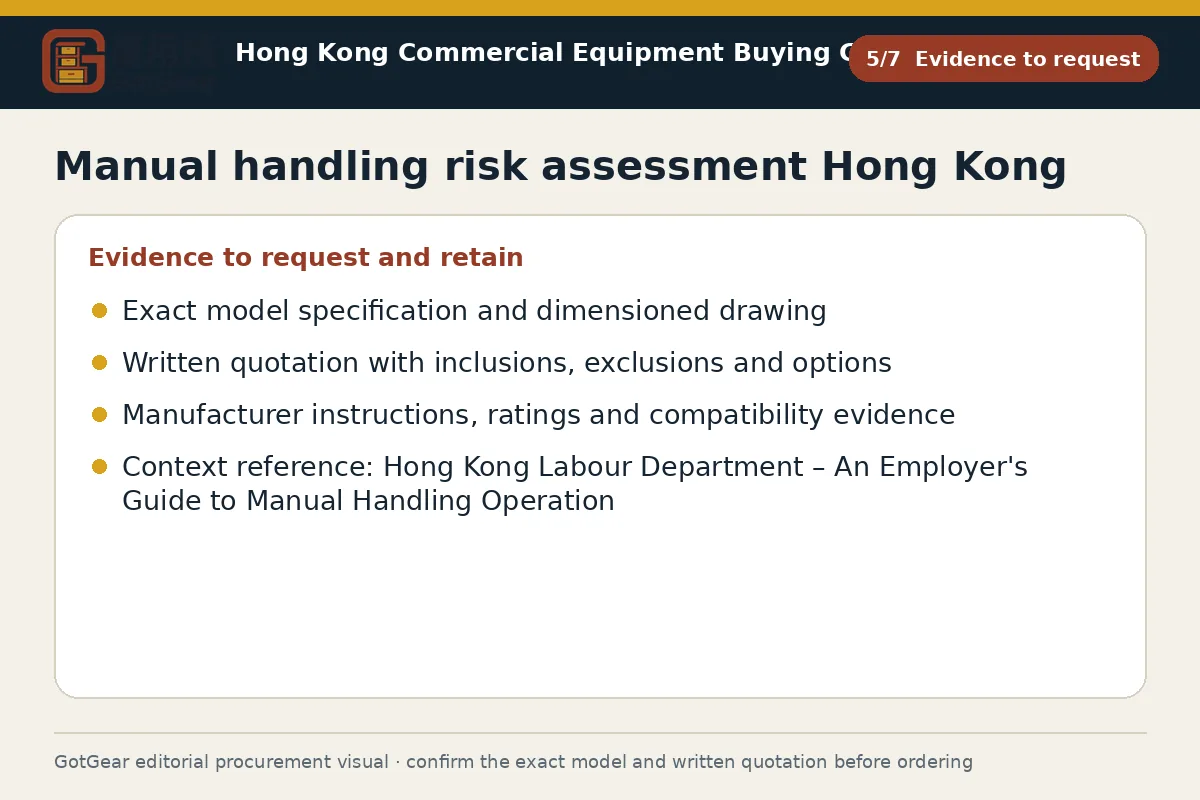
Turn observations into a clear action list and a simple check you can repeat. A Hong Kong manual handling safety checklist should capture the task ID and location, load description and measured weight range, a route sketch showing pinch points, measured initial and rolling forces with the instrument and method used, the chosen controls in the order of elimination, redesign, and aids, and who will implement each change by when. Add training, signage and supervision actions. Record whether instructions and warnings for new equipment will be available in bilingual form, and how residual risks will be communicated to agency or event staff.
For procurement, align quotations so you can compare directly: rated capacity, deck dimensions, wheel diameter and material, bearing type, brake on fixed or swivel castors, handle height, finish/coating, corner bumpers, and any accessories. Ask suppliers to state packaging dimensions, total delivery weight, and the planned delivery method compatible with your building’s goods‑lift and loading bay rules, including booking a time slot with the management office. Record route constraints such as narrow doors, tight turns, or shared back‑of‑house corridors, and reference your material handling floor condition checklist for Hong Kong so vendors understand wet zones, ramps or gratings. On receipt, inspect the rating plate, weld quality, castor fastenings, brake engagement, and that documentation matches the quotation and the model delivered.
Manual handling risk assessment Hong Kong — Reassess after changes to loads, routes or staffing
Reassess whenever loads, routes, equipment or staffing change. New packaging, seasonal stock, floor resurfacing, a different loading window, or event layouts can alter forces, posture and congestion. After maintenance or wheel replacement, re‑measure initial and rolling forces on the same benchmark route. If a near‑miss or strain complaint arises, repeat the check, interview the team and confirm whether the route now involves more door holds or backwards pulling. Where a public‑facing shortcut has been introduced, confirm segregation and stewarding during peaks and refer to your trolley route assessment Hong Kong notes.
Update the action plan accordingly: adjust storage heights, refine turns with guides, add or relocate brakes, and refresh user training. Keep instructions and risk records bilingual, and include any new accessory such as straps or bins within your review of trolley load securing Hong Kong. If a model revision or alternative brand is proposed, obtain the latest datasheet and instructions and check compatibility with existing docks, lifts and racking clearances. Where powered assistance or work on public land is contemplated, confirm with the venue, building manager, insurer or competent adviser whether additional documentation or approvals are required. Ensure the written quotation and model specification remain the single sources of truth for operation and maintenance.
Manual handling risk assessment Hong Kong decision checklist
Confirm the exact task, then measure load weight and dimensions, grip features, start/end heights and travel distance. Map the route with doorway and lift clearances, thresholds, slopes and busy periods, and sample initial and rolling push/pull forces using the same method each time. Eliminate avoidable handling, redesign storage and routes, then specify handling aids with clear fields: capacity, deck size, wheel material/diameter, bearings, brakes, handle height and finish. Provide site constraints, building‑management booking rules and any bilingual‑document needs in the enquiry. Compare written quotations like‑for‑like and agree delivery packaging, access and timing. On receipt, inspect rating plate, welds, fasteners and brakes against the quotation and instructions. Train users, communicate residual risks and set a trigger to reassess after changes or incidents, keeping the signed model specification as the operating reference.
- Operating use, quantity and expected frequency
- Dimensions, capacity, material and accessory requirements
- Delivery address, floor, goods lift and loading window
- Required documents, acceptance checks and after-sales arrangements
Key points for manual handling risk assessment Hong Kong, manual handling safety checklist Hong Kong, material handling risk controls Hong Kong
Manual handling programmes in Hong Kong must reflect dense, mixed‑use buildings, tight goods‑lift cars and narrow back‑of‑house corridors that complicate turning and team handling. Loading bays often run on booked windows controlled by a management office, so assessments should capture queuing and pace changes. Humid conditions and rain increase rolling resistance on thresholds and ramps, while public areas require stewarding and clear bilingual information. Record these realities within your assessment and procurement brief. This guidance is practical planning support rather than legal advice; confirm any specific approval or documentation requirements with your building or venue manager, insurer, competent adviser and the equipment manufacturer.
Questions about manual handling risk assessment Hong Kong
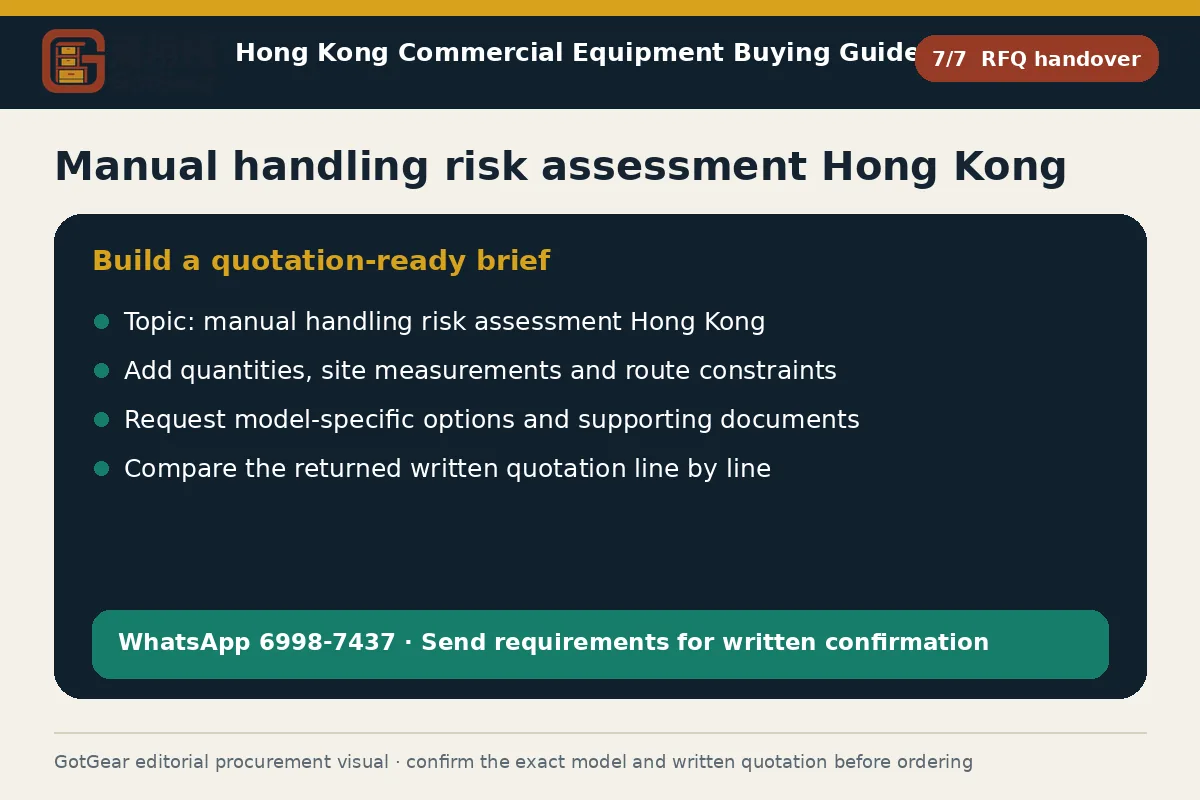
During a manual handling risk assessment Hong Kong, how should we capture push/pull forces for trolleys?
Use a handheld force gauge to record initial push, rolling push and pull on the actual route, noting floor condition, gradient, load and castor orientation. Repeat a few runs to understand normal variation. As an example starting point only, some teams set an internal trigger band (e.g., 150–200 N initial push) for review, but confirm any threshold with your competent adviser and the manufacturer’s instructions.
Which wheels and brakes suit mixed indoor corridors and occasional outdoor ramps?
Choose non‑marking, medium‑soft polyurethane wheels with sealed bearings for smooth indoor floors, and consider larger diameters and corrosion‑resistant hardware if ramps, thresholds or wet areas are common. Add total‑stop brakes or braked swivels where slopes or loading edges exist. This is general guidance; verify wheel material, diameter, bearing type and brake arrangement with the site route and the supplier’s model specification.
When should we consider powered assistance such as a tug?
Consider powered options when elimination and redesign have been maximised but forces, frequency or distance still create significant strain, or when terrain, slopes or door pressures remain high. Check turning radii, charging, ventilation and storage constraints, plus any venue or insurer requirements. Trial on the actual route where possible, and let the model specification and written quotation define limits and accessories.
What documents should we request with quotations and on delivery?
Ask for a datasheet stating capacity, dimensions, wheel/brake details, finish, and the exact model code, plus operating and maintenance instructions, ideally in bilingual form. For delivery, request packaging dimensions, total weight, and a plan compatible with building‑management booking rules. On receipt, verify the rating plate, serial or batch ID and that the documentation matches the supplied unit. Additional approvals may be required by your venue or insurer.
Continue with closely related procurement topics
These pages share equipment, operating or decision-stage signals with this guide.
Material handling floor condition checklist Hong Kong
GotGear links material handling floor condition checklist Hong Kong with workplace transport risk assessment Hong Kong and warehouse loading bay trolley safety Hong Kong. It logs defects, gradients, edges and vehicle paths.
Read the guide
Trolley traffic management Hong Kong
GotGear explains trolley traffic management Hong Kong, trolley route assessment Hong Kong and trolley parking safety Hong Kong for mapped pedestrian, vehicle and parking controls.
Read the guide
Trolley inspection checklist Hong Kong
GotGear’s trolley inspection checklist Hong Kong and trolley preventive maintenance Hong Kong explain how to inspect wheels and brakes, log defects and schedule servicing under maker guidance.
Read the guide
Trolley load securing Hong Kong
GotGear provides guidance on trolley load securing Hong Kong, explaining how to check the centre of gravity, identify restraint points and compare straps, rails and clamps. It also covers trolley load stability Hong Kong.
Read the guideRelated topic indexOpen more English procurement pages3 topics
Browse additional equipment families, applications and procurement questions relevant to a wider buying brief.