
Trolley load securing Hong Kong — Keep the load within the platform, place heavier items low and prevent movement in the expected direction of travel. Where straps, rails or clamps are considered, verify their compatibility, condition and correct use for the particular trolley and load.
Trolley load securing Hong Kong — Assess centre of gravity, overhang and movement within the load
Start with the geometry of the load against the deck. Measure the usable platform length and width, then record the load’s footprint and any parts that could overhang. Photograph how cartons, bins or components sit on the deck and note gaps that could allow sliding. If shrink wrap, straps or stretch film are present, check how tightly they bind the layers and whether inner items can move independently. For cylindrical, drum or roll loads, confirm whether chocks or cradles are available and whether they locate positively on the deck.
Estimate the centre of gravity by stacking the densest items as low and as central as practical, then sketch the approximate vertical midpoint of mass in your job sheet. Identify the likely direction of acceleration and braking, and mark the faces that need restraint. Where the platform is marginal, specify anti-slip surface, edge lips or containment sides. Record any requirement to keep the load entirely within the deck for lifts and corridor clearances typical in Hong Kong buildings. For procurement, request written confirmation of rated deck dimensions, edge-lip height if applicable, anchor-point type and spacing, and any limits on overhang permitted by the manufacturer. Ask for a manufacturer statement if overhang is proposed, and require photos or drawings showing recommended placement for the stated load type.
Trolley load securing Hong Kong — Test stability through starts, stops, turns and gradients
Prove stability with a short, controlled route representative of daily operations. Begin with an empty trolley to verify brakes, casters and handles, then add the intended load and repeat. On-site, observe how the load behaves during a firm start, a normal stop and a planned emergency stop conducted in a safe area. Perform left and right turns at walking pace and slower, watching for sway, twisting of straps, or wheels lifting. Where there are ramps or kerb-ramps, test up and down travel with a spotter and document the steepest segment. Include door thresholds, lift sills and any changes in floor texture.
Record times, locations and observers in your test log and capture photos of the set-up and restraint configuration used. Where space is constrained, schedule tests within the building’s loading window and coordinate with the management office. As part of trolley route assessment Hong Kong, take clear measurements of corridor widths, turning circles, lift car clear width and height, and the heaviest expected traffic periods. Request from the supplier a written method or guidance for conducting stability checks, and keep this with your site risk assessment and toolbox brief for future repeat tasks or staff training.
What should buyers compare for trolley load securing Hong Kong?
| Criterion | Straightforward requirement | More complex requirement | Evidence to provide |
|---|---|---|---|
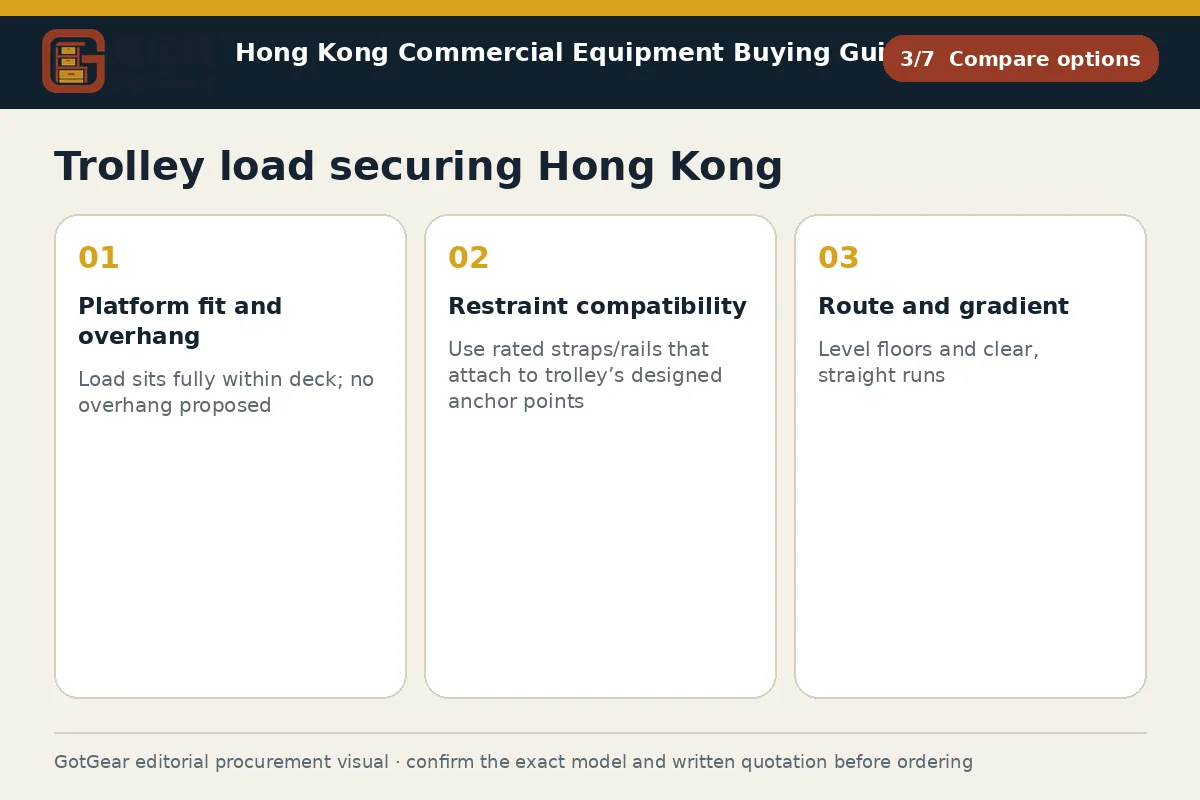
| Platform fit and overhang | Load sits fully within deck; no overhang proposed | Limited overhang with confirmed centre of gravity inside wheelbase and approved restraint | Deck size, load footprint, photos, proposed overhang dimension and manufacturer note |
| Restraint compatibility | Use rated straps/rails that attach to trolley’s designed anchor points | Irregular shapes need nets, clamps, edge protectors and anchor verification | Trolley make/model, anchor spacing, strap/net rating, manual extract on use |
| Route and gradient | Level floors and clear, straight runs | Ramps, thresholds, tight turns and lift interfaces validated by test | Route map, measured gradients, door/lift clear width/height, loading window approval |
| Load type and centre of gravity | Stable cartons stacked low and central | Liquids, drums or cylinders restrained with cradles or specialist trolleys | Packing list, CoG estimate method, photos, note on drum handling requirements |
| Documentation and labelling | Visible capacity plate and readable instructions | Bilingual instructions and institution or venue sign-off required | Photos of labels/plates, manuals (EN/ZH), sign-off template or email confirmation |
This framework helps buyers create comparable written enquiries. Final model specifications, availability, delivery and commercial terms must be confirmed in a formal quotation.
Trolley load securing Hong Kong — Trolley load stability Hong Kong: Choose restraint around the load and trolley design
Match restraint to both the load and the trolley’s design. Side rails, cages and lips physically block movement; straps, nets and clamps actively bind the load. Confirm the trolley provides rated lashing points and that straps or clamps attach without sharp bending or contact with casters and brakes. For soft packaging, specify edge protectors to prevent cutting, and consider an anti-slip surface where permitted. If you are considering anti-slip deck options for the trolley in Hong Kong, request the surface material type, the claimed coefficient of friction and maintenance guidance, with a note on performance in the humid conditions common in Hong Kong.
For irregular items, ask whether moulded cradles, pipe wedges or drum rings are supported by the model without modifying the frame. Nets should quote mesh size and rated capacity; straps should state width, buckle type and safe working limit. In written quotations, require the supplier to confirm compatibility of each restraint with the named trolley model and the typical load. Where internal policies specify trolley load stability in Hong Kong, align the restraint choice to those criteria. If your enquiry focuses on securing trolley loads in Hong Kong, include photos or drawings of anchor locations, proposed strap routing paths and any clearance limits for lifts or doors, so the manufacturer can validate the configuration in writing.
Trolley load securing Hong Kong — Confirm capacity and restraint instructions before each task
Before each move, verify the rating plate, the restraint instructions and the condition of every component. Check that wheels, brakes, rails and anchor points are intact and that straps, buckles and nets are free from cuts, corrosion or deformation. Confirm that instructions are legible in English and Chinese if your team requires bilingual information. Repack the load if any shifting is visible or if the centre of gravity appears high. Where floors are wet or dusty, cross-check with your material-handling floor condition checklist for Hong Kong and reduce speed accordingly.
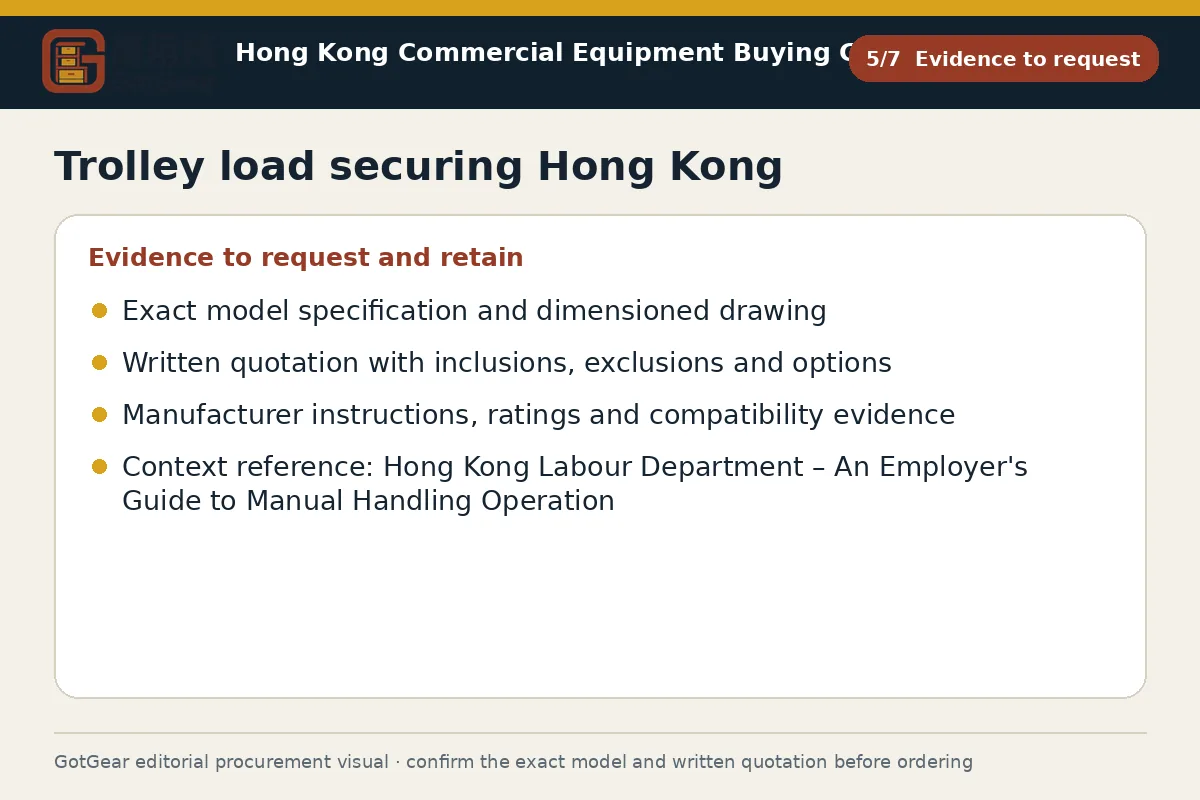
For special loads such as drums, cylinders or liquids, confirm whether a dedicated attachment or a separate drum trolley for Hong Kong is the safer option, and request the relevant attachment instructions and a capacity statement from the manufacturer. Keep a simple pre-use record noting the model, plate capacity, restraint type used and route constraints such as gradients and lift dimensions. If the operation is part of a school, hospital or venue event, secure institutional approval before the task. When quotations arrive, compare the written restraint-use instructions, any user training materials offered by the manufacturer, and the warranty terms for restraint components, noting that the supplier’s formal specification and quotation always prevail.
Trolley load securing Hong Kong decision checklist
Document the load’s footprint and likely movement direction, then select a trolley platform that contains the load or justify any proposed overhang with the manufacturer’s written approval. Measure corridor widths, lift car clearances, thresholds and gradients, and schedule tests within approved loading windows. Choose restraint matched to the trolley’s anchor points and the load type, and request ratings and compatibility in the quotation. Conduct start/stop/turn and gradient trials with the intended load, photographing the set-up. Before each task, confirm the capacity plate, restraint condition and bilingual instructions, and record route constraints. For liquids, drums or irregular shapes, ask whether dedicated cradles or specialist trolleys are recommended and attach the manufacturer’s instructions to the job file.
- Operating use, quantity and expected frequency
- Dimensions, capacity, material and accessory requirements
- Delivery address, floor, goods lift and loading window
- Required documents, acceptance checks and after-sales arrangements
Key points for trolley load securing Hong Kong, trolley load stability Hong Kong
In Hong Kong, load restraint planning is often dictated by tight goods-lift cars, narrow service corridors and fixed loading windows controlled by management offices. Confirm clear lift dimensions, turning spaces and route gradients before committing to a trolley and restraint combination. Humid conditions can reduce grip on smooth decks and affect strap behaviour, so specify materials accordingly. If operating at public events or within institutions, seek site-specific approval and any venue rules that affect routes or timings. The advice here is practical guidance, not legal direction; always follow the manufacturer’s documentation and the venue’s written requirements.
Questions about trolley load securing Hong Kong
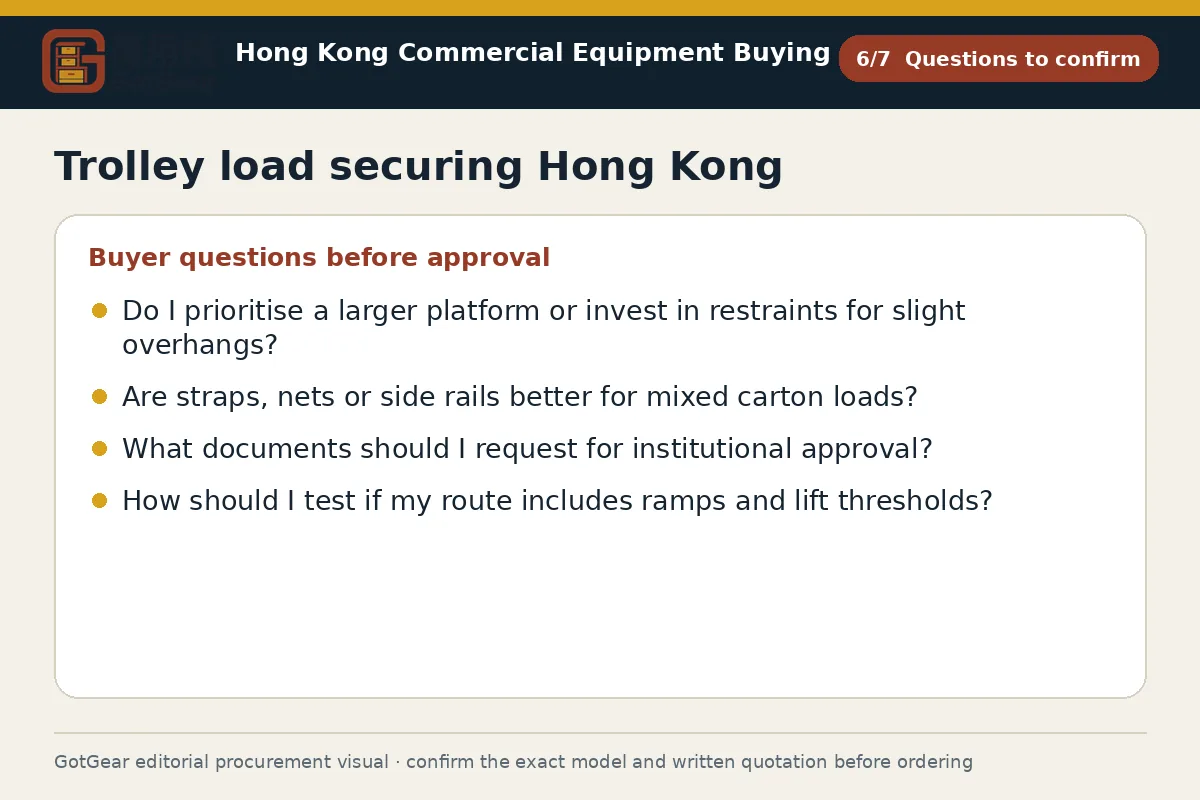
Do I prioritise a larger platform or invest in restraints for slight overhangs?
Keep the load within the deck where possible; it simplifies stability and approvals. If overhang is unavoidable, obtain the manufacturer’s written confirmation that the centre of gravity remains within the wheelbase and that stated restraints are compatible. Treat lift and doorway clearances as hard constraints and include photos and measurements with your enquiry to avoid rejection on delivery.
Are straps, nets or side rails better for mixed carton loads?
Side rails and lips prevent gross movement; straps and nets bind layers together. For mixed cartons, a lip plus a pair of rated straps often works, while a net reduces top-layer creep. Request ratings, attachment methods and maintenance instructions. Confirm that strap paths do not foul wheels or brakes and that rails or nets fit the named trolley model without modification.
What documents should I request for institutional approval?
Ask for the trolley’s model specification, capacity plate photo, restraint ratings, and the user instructions in English and Chinese if required. Include a simple route plan with measured lifts and corridors, and your stability test notes. Some venues may ask for a risk assessment or method statement; align these to the manufacturer’s guidance and any site-specific rules they issue.
How should I test if my route includes ramps and lift thresholds?
Conduct a controlled trial with the intended load, including starts, stops and turns on the ramp, and a slow approach and roll-over of thresholds. Use a spotter and document the steepest ramp and any floor transitions. Coordinate with the management office to test within loading windows, and include photos of the restraint set-up in your record for future repeat tasks.
Continue with closely related procurement topics
These pages share equipment, operating or decision-stage signals with this guide.
Trolley inspection checklist Hong Kong
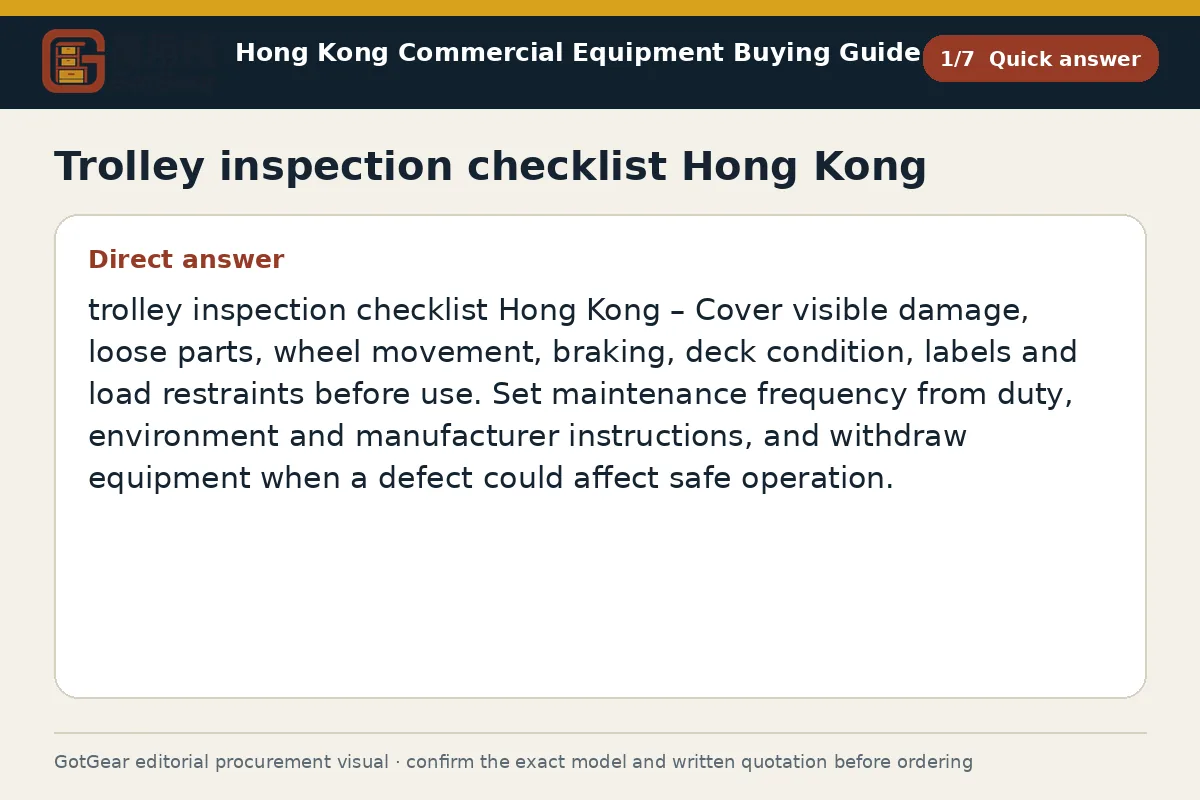
GotGear’s trolley inspection checklist Hong Kong and trolley preventive maintenance Hong Kong explain how to inspect wheels and brakes, log defects and schedule servicing under maker guidance.
Read the guide
Material handling floor condition checklist Hong Kong
GotGear links material handling floor condition checklist Hong Kong with workplace transport risk assessment Hong Kong and warehouse loading bay trolley safety Hong Kong. It logs defects, gradients, edges and vehicle paths.
Read the guide
Manual handling risk assessment Hong Kong
GotGear explains what to record during a manual handling risk assessment Hong Kong and how to use a manual handling safety checklist Hong Kong. The guide also describes how to prioritise material handling risk controls Hong Kong.
Read the guide
Trolley anti-slip deck Hong Kong
GotGear explains how to assess a trolley anti-slip deck Hong Kong by reviewing load retention, material, contamination and contact risks. It also outlines considerations for trolley bumper protection Hong Kong.
Read the guideRelated topic indexOpen more English procurement pages1 topics
Browse additional equipment families, applications and procurement questions relevant to a wider buying brief.