
Push pull trolley ergonomics Hong Kong — Choose a method that preserves visibility and control while reducing awkward force, recognising that the safer direction depends on the task and site. Assess actual users and loads, then verify equipment setup and use against manufacturer instructions and workplace requirements.
Push pull trolley ergonomics Hong Kong — Measure starting, sustained and turning effort in context
For push pull trolley ergonomics Hong Kong, start by measuring how much effort is needed on the actual route your teams use. Walk the route and sketch the path, noting surface types, joints, thresholds, goods-lift sill steps, door closers and any gradients. Use a simple inclinometer app to record ramps as example starting points only, to be confirmed with your venue or building manager. Mark turning points, queue pinch-points and the narrowest doorway so you can relate effort to context.
Use a calibrated push–pull force gauge or load cell strap to capture three values with a representative load: peak starting force on level, sustained rolling force at steady pace, and turning force for 90° and 180° manoeuvres in aisle. Repeat on dry and, if relevant, damp surfaces typical of Hong Kong humidity. Document wheel type, diameter and tread, as these strongly influence readings; if your findings flag high resistance on textured concrete, note this for caster wheel selection in the enquiry. Where lifts, estate ramps or external paving are involved, include the gradient, surface condition and any crossfall. Record who performed the trials and their approximate stature so you can later judge handle position effects. Keep photos and short clips as evidence to attach to supplier questions and to benchmark incoming quotations.
Push pull trolley ergonomics Hong Kong — Material handling ergonomics Hong Kong: Observe grip, pace, gradients and stopping control
Beyond the numbers, observe how people actually hold and control the trolley along the whole route. For material handling ergonomics Hong Kong, teams should watch for neutral wrists, relaxed shoulders and an upright trunk when pushing, and ensure there is sufficient knuckle clearance near racking and parked pallets. Check that gloves, if used for handling, do not compromise grip on smooth handles in humid conditions. Note whether the handle thickness matches hand size and whether, for two-handed use, symmetric holds are practical without elbows colliding with the load.
Track natural pace on level, upslope and downslope segments, and whether operators shorten their steps to maintain control. When turning, check foot placement and space for the hips — tight corners can force twisting or shoulder hiking. On descents, verify stopping control: do operators rely on a service brake, a deadman lever or on foot resistance? Time to full stop is a useful example metric only and should be confirmed by your competent person. Log incidents of caster flutter, wheel skid on polished stone and any tendency for the load to obscure the path ahead. These observations should feed directly into specifications for brakes, handle geometry and visibility requirements.
What should buyers compare for push pull trolley ergonomics Hong Kong?
| Criterion | Straightforward requirement | More complex requirement | Evidence to provide |
|---|---|---|---|
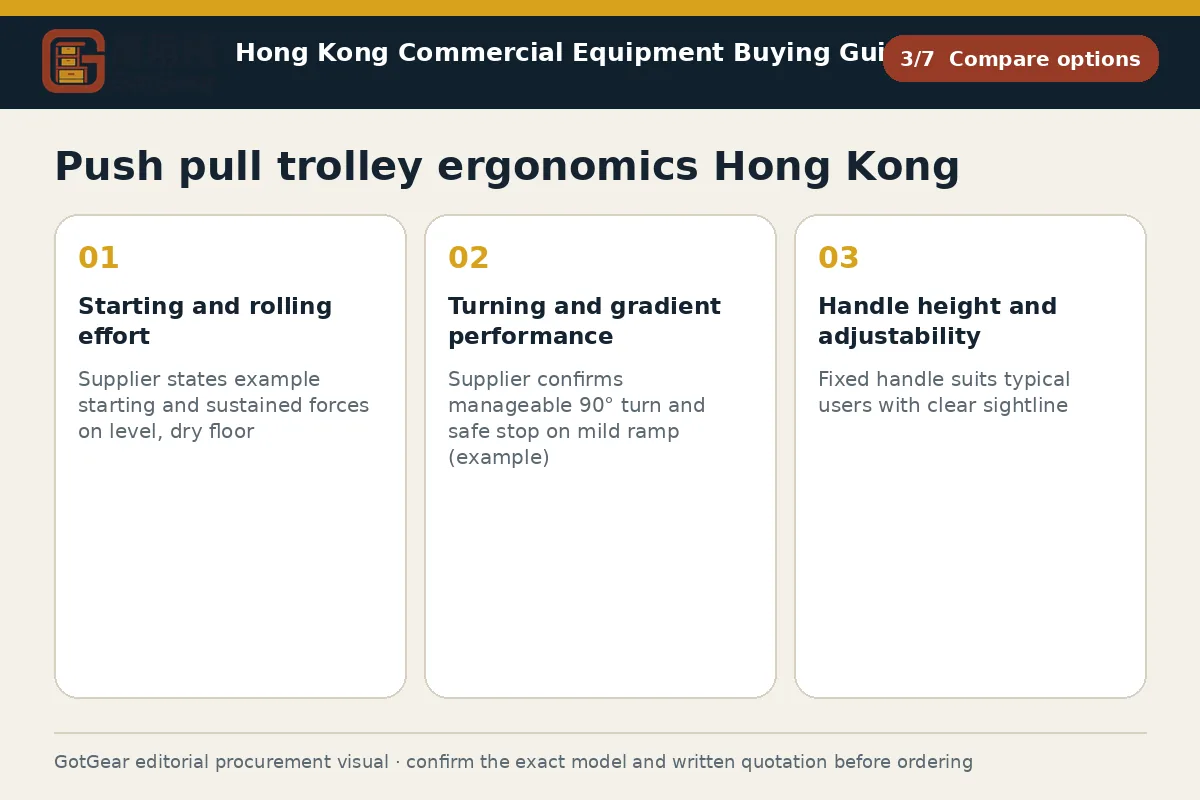
| Starting and rolling effort | Supplier states example starting and sustained forces on level, dry floor | Forces declared for each surface on your route, dry and damp, with wheel spec noted | Force values, test surface, wheel details, load used, measurement method |
| Turning and gradient performance | Supplier confirms manageable 90° turn and safe stop on mild ramp (example) | Declared turning force and stopping control for tight aisles and specified gradients | Turning radius, turning force, ramp angle, brake type, video evidence |
| Handle height and adjustability | Fixed handle suits typical users with clear sightline | Tool-free multi-position or dual-end handles with angle options | Height range, detents/locks, end-handle details, visibility notes |
| Wheels and braking | Basic wheels and parking brake suitable for dry indoor floors | Wheel diameter/tread tuned to mixed floors; service brake or limiter for descents | Wheel size/material/bearing, brake type, surfaces covered, maintenance guidance |
| Dimensions and documentation | Overall size fits doors and lift openings; operating instructions provided | Evidence of fit within tight goods-lifts; bilingual instructions and service schedule | Width/length/height, lift and doorway clearances, instruction language, maintenance plan |
This framework helps buyers create comparable written enquiries. Final model specifications, availability, delivery and commercial terms must be confirmed in a formal quotation.
Push pull trolley ergonomics Hong Kong — Trolley handle height ergonomics Hong Kong: Relate handle height to users, posture and task visibility
Relate handle position to the range of people who will use the trolley, the height of the load and the visibility required around pedestrians and doorways. As an initial example only, some teams test handle heights that allow a roughly elbow-height push, or slightly lower, with neutral wrists; this must be confirmed with your workforce and supplier. If stacked totes block the line of sight, a higher crossbar may improve posture but reduce visibility—record both effects and define what matters most for each route.
When addressing trolley handle height ergonomics Hong Kong, buyers often need adjustability to suit mixed-height staff and shared shifts across buildings. Ask whether the handle offers tool-free adjustment, multiple fixed detents or interchangeable positions at both ends, and whether angle as well as height can be set. On routes with frequent reversing into lifts, evaluate handles at both ends or consider perimeter rails. Confirm that the chosen handle position does not conflict with lift buttons, card readers or door closers. If equipment will pass through tight goods-lift cars or under low store-room lintels, capture the overall height in each handle position as an example figure to be verified during quotation. Ensure adequate hand clearance when staff wear cut-resistant or cold-room gloves, where applicable.
Push pull trolley ergonomics Hong Kong — Use ergonomic findings in equipment procurement
Turn the ergonomic findings into a clear written enquiry. State the test load and route, then request supplier-declared starting, sustained and turning effort on comparable surfaces, with the wheel specification used for their figures. If your measurements showed high turning force, ask for caster geometry options and the expected effect. Specify brakes (parking, service or speed-limiting), cornering stability and whether two-person operation is envisaged. Include required handle adjustability range, end handles, and visibility around typical load heights.
Record site constraints: door and lift clear openings, sill details, tightest turning radius, floor materials, exposure to rain at loading windows, and storage footprint. Ask for product dimensions, load rating, wheel diameter, tread and bearing type, corrosion resistance for humid conditions, and noise characteristics on hard floors—always with the model specification and formal written quotation prevailing. Compare quotations line by line on the same load, wheel set, handle positions, brakes and documentation. On receipt, inspect labelling, handle mechanisms, brake function and wheel orientation; verify basic forces on your route with your example test load. Request bilingual operating instructions, maintenance guidance and any manufacturer statements your insurer or institution requires, subject to the proposed model and venue rules.
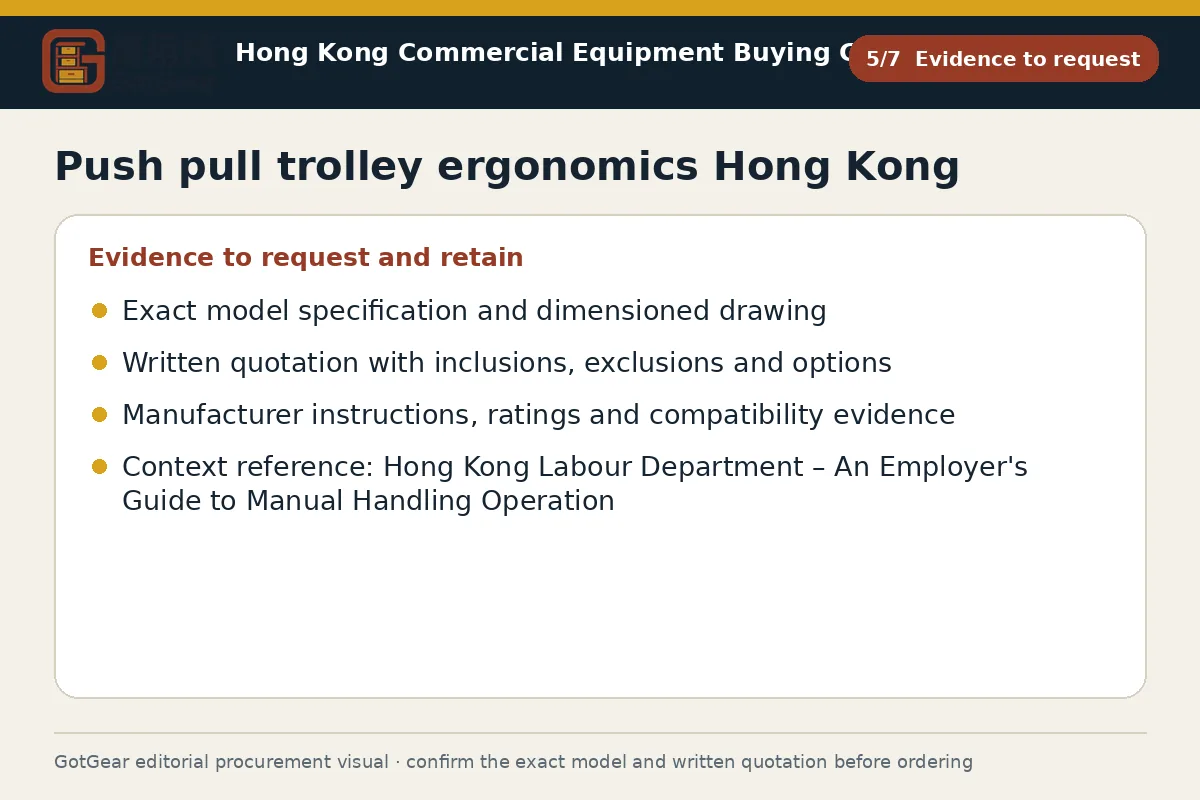
Push pull trolley ergonomics Hong Kong decision checklist
Define the task, real load and route, then measure peak start, sustained roll and turning effort where the trolley will operate. Note surfaces, ramps, thresholds and lift sills. Observe grip, posture, pace and stopping on descents. Record the range of user heights and what handle positions preserve both posture and visibility. Specify wheels, brakes and handle adjustability, along with overall dimensions that clear the tightest lift and doorway. Request supplier-declared forces on comparable surfaces and full wheel specifications. Ask for bilingual instructions and maintenance guidance appropriate to your venue. Compare quotations on identical load, wheel set and handle configuration. On delivery, inspect labels, adjusters, brakes and wheels, and verify forces with your example test load on your route.
- Operating use, quantity and expected frequency
- Dimensions, capacity, material and accessory requirements
- Delivery address, floor, goods lift and loading window
- Required documents, acceptance checks and after-sales arrangements
Key points for push pull trolley ergonomics Hong Kong, trolley handle height ergonomics Hong Kong, material handling ergonomics Hong Kong
Hong Kong routes often combine polished stone lobbies, outdoor paving and compact goods-lifts, so start, turn and stop forces can vary sharply within a single trip. Record the narrowest doorway, lift car depth and any ramp between loading bay and lift, as many industrial buildings operate within fixed loading windows. Humidity and sudden rain create slick surfaces; specify wheels and braking accordingly. Public-event venues may require bilingual instructions and steward control plans. This guidance is practical purchasing advice, not legal advice—confirm requirements with your building manager, institution, insurer or competent adviser.
Questions about push pull trolley ergonomics Hong Kong
Is it safer to push or pull a trolley?
Push when you can see ahead and keep a stable, neutral posture; pulling is appropriate only when it preserves better control or visibility for the task. The direction depends on your route, load height and stopping needs. Test both on site with your actual users and confirm the chosen method against manufacturer instructions and workplace requirements.
What handle height suits mixed-height teams?
Choose adjustable or multi-position handles so shorter and taller users can keep neutral wrists and clear sightlines past the load. As an example starting point only, teams often trial elbow-height or slightly lower. Confirm final positions with your workforce, building constraints and supplier advice, and check clearances in lifts and through low door headers.
How should we measure push force on our site?
Use a calibrated push–pull gauge or load cell strap with your representative load, then record peak start, sustained roll and turning forces along the actual route. Repeat on the main surfaces and gradients you’ll encounter. Treat measurements as comparative evidence for procurement and confirm the method and acceptance ranges with your competent person and supplier.
When do we need brakes or speed control on a trolley?
If routes include ramps, crowded areas or frequent stops, specify a reliable parking brake and consider a service brake or speed limiter. The need depends on gradient, surface, load and visibility around pedestrians. Verify brake type, test method and maintenance guidance with the manufacturer, and check any venue or insurer requirements for your operation.
Continue with closely related procurement topics
These pages share equipment, operating or decision-stage signals with this guide.
Material handling floor condition checklist Hong Kong
GotGear links material handling floor condition checklist Hong Kong with workplace transport risk assessment Hong Kong and warehouse loading bay trolley safety Hong Kong. It logs defects, gradients, edges and vehicle paths.
Read the guide
Manual handling risk assessment Hong Kong
GotGear explains what to record during a manual handling risk assessment Hong Kong and how to use a manual handling safety checklist Hong Kong. The guide also describes how to prioritise material handling risk controls Hong Kong.
Read the guide
Trolley inspection checklist Hong Kong
GotGear’s trolley inspection checklist Hong Kong and trolley preventive maintenance Hong Kong explain how to inspect wheels and brakes, log defects and schedule servicing under maker guidance.
Read the guide
Trolley load securing Hong Kong
GotGear provides guidance on trolley load securing Hong Kong, explaining how to check the centre of gravity, identify restraint points and compare straps, rails and clamps. It also covers trolley load stability Hong Kong.
Read the guideRelated topic indexOpen more English procurement pages2 topics
Browse additional equipment families, applications and procurement questions relevant to a wider buying brief.