
Trolley traffic management Hong Kong — Separate movements where practicable, control conflict points and keep routes visible, level and sufficiently clear for the selected equipment. Verify the arrangement through a site assessment and against applicable Hong Kong requirements rather than relying on generic aisle rules.
Trolley traffic management Hong Kong — Map pedestrians, vehicles, blind corners and transfer points
Start with a site walk and mark up a scaled plan showing all shared routes, lift lobbies, door swings, pallet drop zones and blind corners. For trolley traffic management Hong Kong, capture the narrowest clear width along each run, door leaf and frame widths, door hold‑open behaviour, lintel and soffit heights, and lift car and landing dimensions. Note surface transitions, thresholds, kerbs and the ramp gradient as a percentage. Photograph every blind corner from both approaches and record what obstructs the view (columns, stacked goods, signage, screens or catering carts).
Time the flows. Record when contractors, retail replenishment or catering pushes overlap with passenger or student movement, and check building loading windows with the management office. Mark conflict points such as lift exits into busy corridors, crossing points near reception, and goods entrances that open onto public walkways. Observe actual turning paths and measure where wheels track outside nominal aisle lines. Note lighting, noise levels and whether warning beacons or mirrors are already in place. These observations form the evidence base for route separation, one‑way systems, speed control and stopping‑distance decisions that will later inform trolley specifications, parking allocation and any request for signage or floor marking.
Trolley traffic management Hong Kong — Trolley parking safety Hong Kong: Review visibility, crossings, gradients and doorways
When planning trolley parking safety Hong Kong practices, assess visibility first. A parking bay at a corner or beside an opening door can hide a moving person or trolley; stand at each approach and verify that the full bay is visible at normal pushing height. Avoid placing bays where lift doors open directly into them, or within the arc of any automatic door. Confirm the floor is level; if the gradient cannot be avoided, specify trolleys with effective brakes and use physical wheel cups or rails to resist creep. At crossings, position bays so that a queuing trolley does not spill into the path of vehicles or pedestrians.
Convert these checks into procurement detail. Ask vendors to state brake type and holding method, wheel diameter and tread compound, swivel‑lock options, and whether fixed‑direction casters can face away from traffic when parked. Request recommended minimum visibility distances and any accessory compatibility (wheel chocks, cups, rail guides). Where slopes exist, ask the manufacturer for a written statement of parking performance on a measured gradient (example starting point: confirm capability on a 1–2% slope), to be verified in your site brief. Specify bilingual bay IDs and markings, and surface‑prep requirements for paint or tape in humid conditions.
What should buyers compare for trolley traffic management Hong Kong?
| Criterion | Straightforward requirement | More complex requirement | Evidence to provide |
|---|---|---|---|
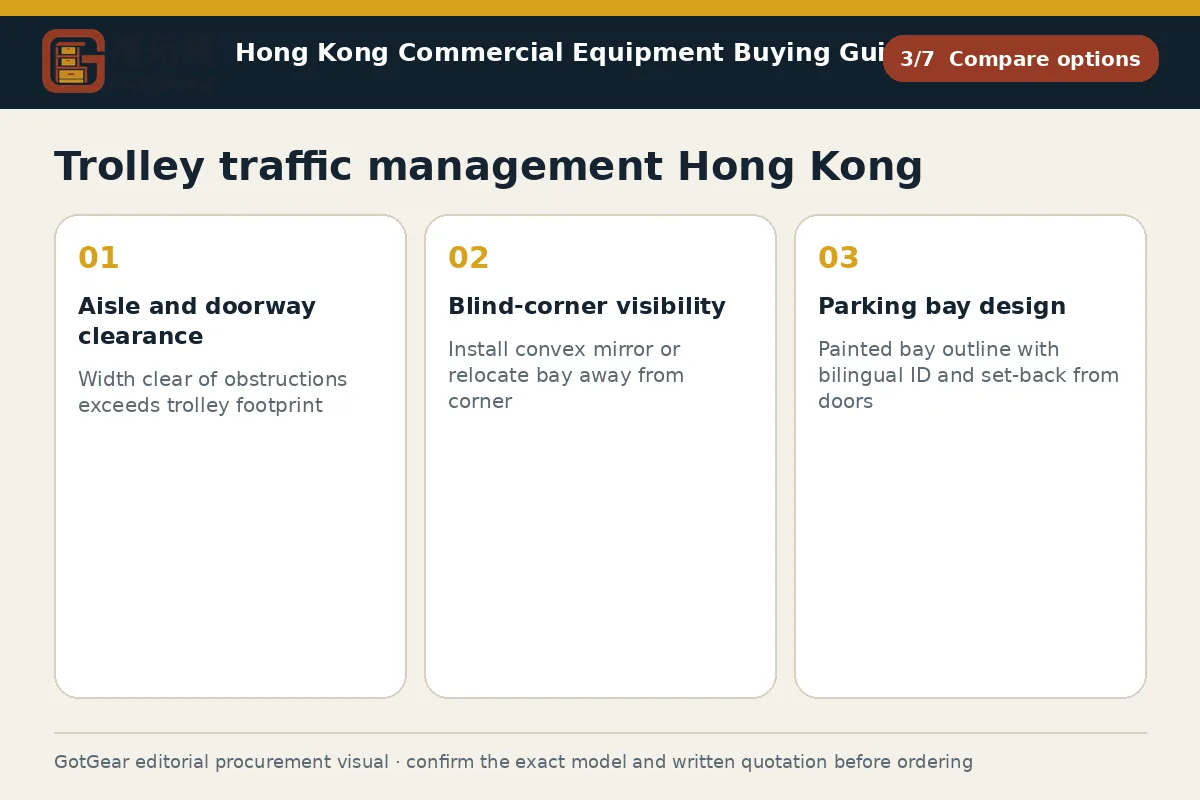
| Aisle and doorway clearance | Width clear of obstructions exceeds trolley footprint | Turning paths validated for the tightest corner with opposing flows | Measured widths, door/lift dimensions, turning template for stated model |
| Blind‑corner visibility | Install convex mirror or relocate bay away from corner | Combine mirror with one‑way flow and floor markings plus stop line | Annotated photos, visibility distance at push‑handle height, mirror spec |
| Parking bay design | Painted bay outline with bilingual ID and set‑back from doors | Wheel cups/rail stops and swivel‑lock orientation marked on floor | Scaled bay dimensions, floor condition, marking/fixture method |
| Gradients and stopping | Level floor with parking brake engaged | Controlled slope with brake, chock/cup and standard wheel‑facing | Measured gradient (%), brake type, accessory compatibility note |
| Shared‑route scheduling | Peak movements separated by timetable | Physical separation with barriers and supervised crossings | Loading‑window plan, staffing/communication method, proposed barriers |
This framework helps buyers create comparable written enquiries. Final model specifications, availability, delivery and commercial terms must be confirmed in a formal quotation.
Trolley traffic management Hong Kong — Trolley route assessment Hong Kong: Use route findings to define safe parking positions
Use your map findings to identify locations where trolleys can wait safely without obstructing movement. A Hong Kong trolley route assessment exercise should translate measurements into a simple schedule of bays: location; bay count; bay width and length; orientation; ground condition; and the route each bay serves. Dimension each bay to accommodate the largest trolley footprint that will use it, allowing clearance for handles and other protrusions. As an example starting point, allow the trolley length plus a buffer for safe coupling or decoupling; confirm actual values with the model specification and building drawings. Where doors or shutters are nearby, include an agreed keep‑clear distance and note the door swing or shutter path.
Record these positions in your enquiry. Ask bidders to submit a scaled drawing that overlays the proposed bays and traffic direction on your plan, and include turning templates for the stated trolley. Request product data for brakes, casters and wheel guards; sample bay markings (colour and wording); and installation method statements covering surface preparation, curing time and staging during short Hong Kong loading windows. Note any building‑management approvals or insurer conditions that could affect the layout, and require suppliers to acknowledge these constraints in their written quotation. State that the approved drawing and model specifications take precedence over general guidance.
Trolley traffic management Hong Kong — Keep parked trolleys out of escape and working routes
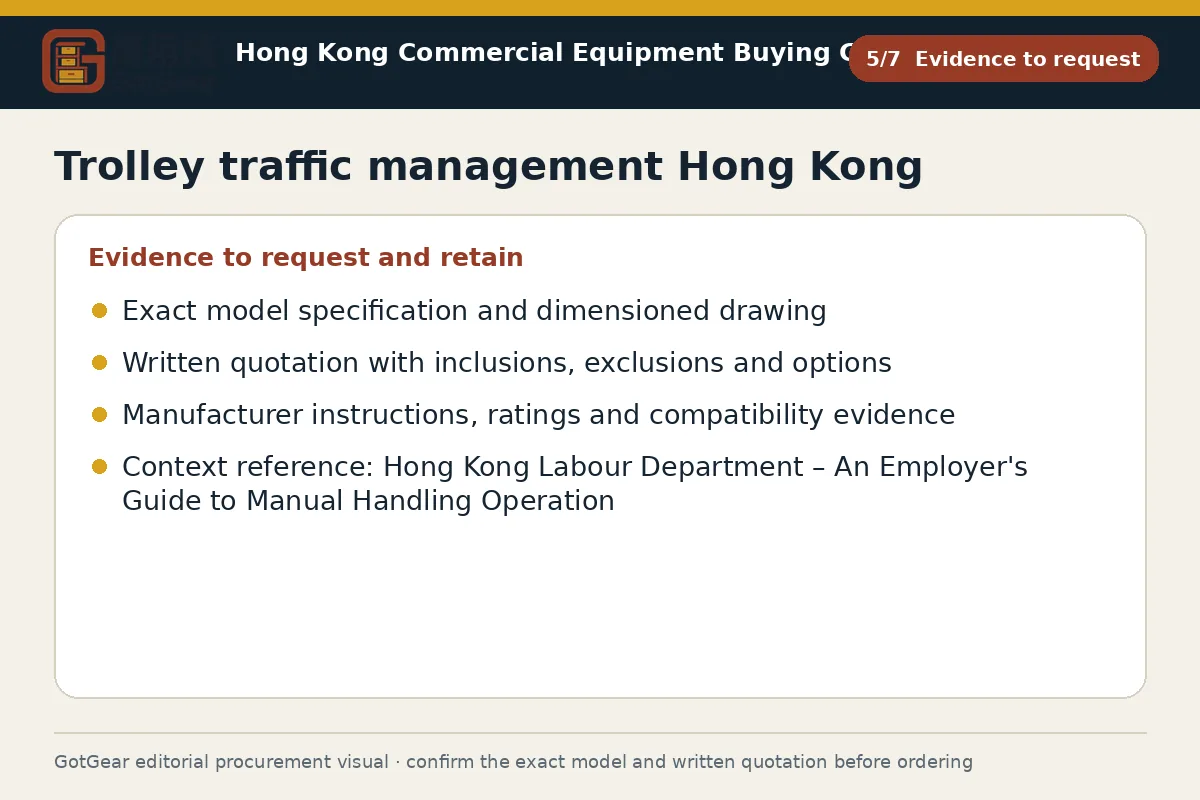
Keep parked trolleys entirely out of escape routes and active work corridors by making the “home” position unmistakable and enforceable. Use floor markings with unique bay IDs, fixed wheel cups or a low parking rail so wheels cannot drift into circulation. At busy nodes, one‑way flow combined with set‑back bays prevents a queue from blocking entrances. For doorways, place bays on the hinge‑side wall and outside the door arc so people passing through do not meet hidden equipment. On slopes, combine brakes with a physical stop and a standardised wheel‑facing convention.
Translate this into purchasing and operations controls. In your enquiry, request options for wheel cups, rails, swivel‑lock detents and parking brake styles, and ask for the manufacturer’s maintenance and inspection guidance for those parts. On receipt, check brakes hold on your measured example slope under a supervised, example starting load, verify casters track and lock as specified, and confirm bay labels and any signage are durable and bilingual. For venues and events, include a marshal or steward note in the plan so temporary flows do not consume bays, and record who can authorise a bay to be moved or suspended.
Trolley traffic management Hong Kong decision checklist
Start with a scaled plan and measured widths, heights, gradients and turning paths. Mark blind corners, lift exits and crossing points, and note peak‑time overlaps agreed with the management office. Define parking bays away from door arcs and visibility obstructions, on level ground where practicable. Convert findings into a written enquiry: trolley dimensions, brake type, wheel material and diameter, swivel‑lock options, and accessories for fixed parking. Ask for a scaled overlay drawing, sample bay markings, and a method statement for surface prep and staging within Hong Kong loading windows. Require confirmation of parking performance on your measured example gradient, and state that the model specification and the approved drawing govern. On delivery, verify brakes, locks, wheel direction and durability of markings against the quotation.
- Operating use, quantity and expected frequency
- Dimensions, capacity, material and accessory requirements
- Delivery address, floor, goods lift and loading window
- Required documents, acceptance checks and after-sales arrangements
Key points for trolley traffic management Hong Kong, trolley route assessment Hong Kong, trolley parking safety Hong Kong
Hong Kong sites often combine tight goods‑lift lobbies, narrow door frames and short loading windows controlled by the building management office. Plan around these constraints before selecting equipment or fixing parking. Humid conditions and sudden rain can leave smooth tiles or painted concrete slippery; specify wheel treads and floor‑marking systems accordingly. Many campuses, malls and industrial buildings require bilingual signage and prior approval for markings or mirrors. Where routes pass near escape corridors or fire‑service access, confirm the arrangement with the building manager, competent adviser or, where required, the relevant authority under applicable Hong Kong requirements.
Questions about trolley traffic management Hong Kong
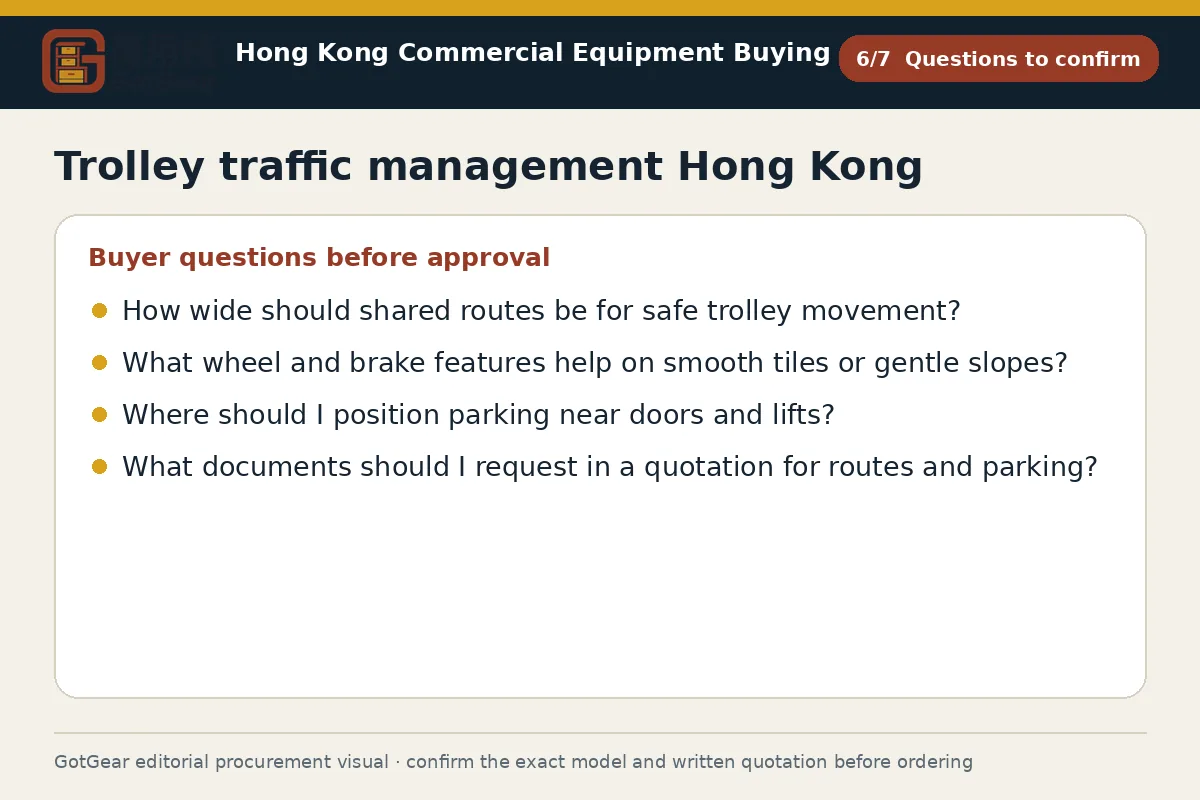
How wide should shared routes be for safe trolley movement?
Provide enough clear width for the trolley’s widest point plus a manoeuvring margin, increasing where people or vehicles mix. As an example starting point, many sites test layouts around the trolley width plus 200–400 mm, but confirm with turning paths, site obstacles and the building manager’s requirements. For two‑way sections, consider one‑way flow if width is constrained.
What wheel and brake features help on smooth tiles or gentle slopes?
Specify a parking brake that positively locks wheels, swivel‑lock options to keep casters straight when parked, and a tread suited to smooth or damp tiles. Larger diameters roll more easily over thresholds. Ask the manufacturer to confirm holding performance on your measured example gradient and to provide maintenance guidance for brake components and tread wear.
Where should I position parking near doors and lifts?
Keep bays outside door arcs and out of lift landing paths, with lines of sight from approaching routes. Set them back so queuing trolleys do not protrude into crossings. Include an example keep‑clear distance in your plan and confirm it with your building manager or competent adviser. Use physical wheel cups or rails if floors are slightly sloped.
What documents should I request in a quotation for routes and parking?
Ask for a scaled overlay drawing of routes and bays, model‑specific data sheets (brakes, casters, footprint), sample bilingual bay markings, and a method statement for surface prep and staged works during loading windows. Where slopes exist, request a written statement of parking performance on your measured gradient. The approved drawing and model specification should prevail.
Continue with closely related procurement topics
These pages share equipment, operating or decision-stage signals with this guide.
Material handling floor condition checklist Hong Kong
GotGear links material handling floor condition checklist Hong Kong with workplace transport risk assessment Hong Kong and warehouse loading bay trolley safety Hong Kong. It logs defects, gradients, edges and vehicle paths.
Read the guide
Manual handling risk assessment Hong Kong
GotGear explains what to record during a manual handling risk assessment Hong Kong and how to use a manual handling safety checklist Hong Kong. The guide also describes how to prioritise material handling risk controls Hong Kong.
Read the guide
Trolley inspection checklist Hong Kong
GotGear’s trolley inspection checklist Hong Kong and trolley preventive maintenance Hong Kong explain how to inspect wheels and brakes, log defects and schedule servicing under maker guidance.
Read the guide
Trolley load securing Hong Kong
GotGear provides guidance on trolley load securing Hong Kong, explaining how to check the centre of gravity, identify restraint points and compare straps, rails and clamps. It also covers trolley load stability Hong Kong.
Read the guideRelated topic indexOpen more English procurement pages2 topics
Browse additional equipment families, applications and procurement questions relevant to a wider buying brief.