
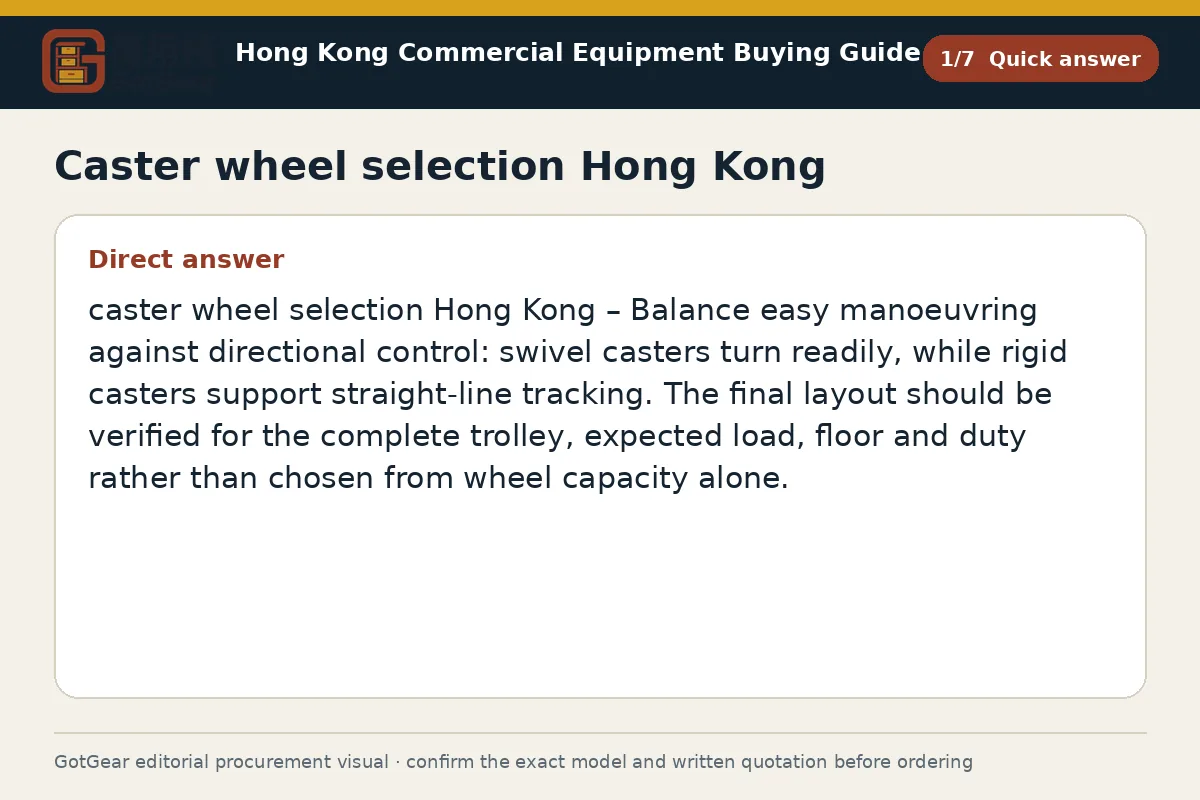
Caster wheel selection Hong Kong — Balance easy manoeuvring against directional control: swivel casters turn readily, while rigid casters support straight-line tracking. The final layout should be verified for the complete trolley, expected load, floor and duty rather than chosen from wheel capacity alone.
Caster wheel selection Hong Kong — Match wheel material and diameter to floors and obstacles
For caster wheel selection Hong Kong, begin by mapping the entire route: polished concrete in a warehouse, epoxy or terrazzo in lift lobbies, ceramic tiles near storefronts, and any outdoor aprons. Wheel material should match both load and surface. Thermoplastic rubber is quiet and floor-friendly for malls and institutions. Polyurethane resists cuts and carries higher loads on smooth floors. Nylon rolls very easily but can be noisy and unforgiving on tiles, especially when wet. Pneumatic or foam-filled wheels cushion over uneven yards but are taller and need more clearance.
Wheel diameter governs rolling resistance and obstacle clearance. A larger wheel bridges joints and thresholds more easily, but raises deck height and can conflict with lift car limits. As an example starting point only, some buyers shortlist 150–200 mm wheels for small internal thresholds; confirm this range in your written brief with the supplier and building manager. Record threshold heights and widths, expansion-joint gaps, drain grates and the tightest aisle or lift opening. Ask quotations to state wheel diameter, tread width, durometer (with scale), material and core, non-marking claim, anti-static option, thread guards, and bearing type. Compare like-with-like on these fields, and request manufacturer datasheets for dynamic load ratings and any floor-compatibility statements before approving.
Caster wheel selection Hong Kong — Calculate demand across the loaded trolley and duty cycle
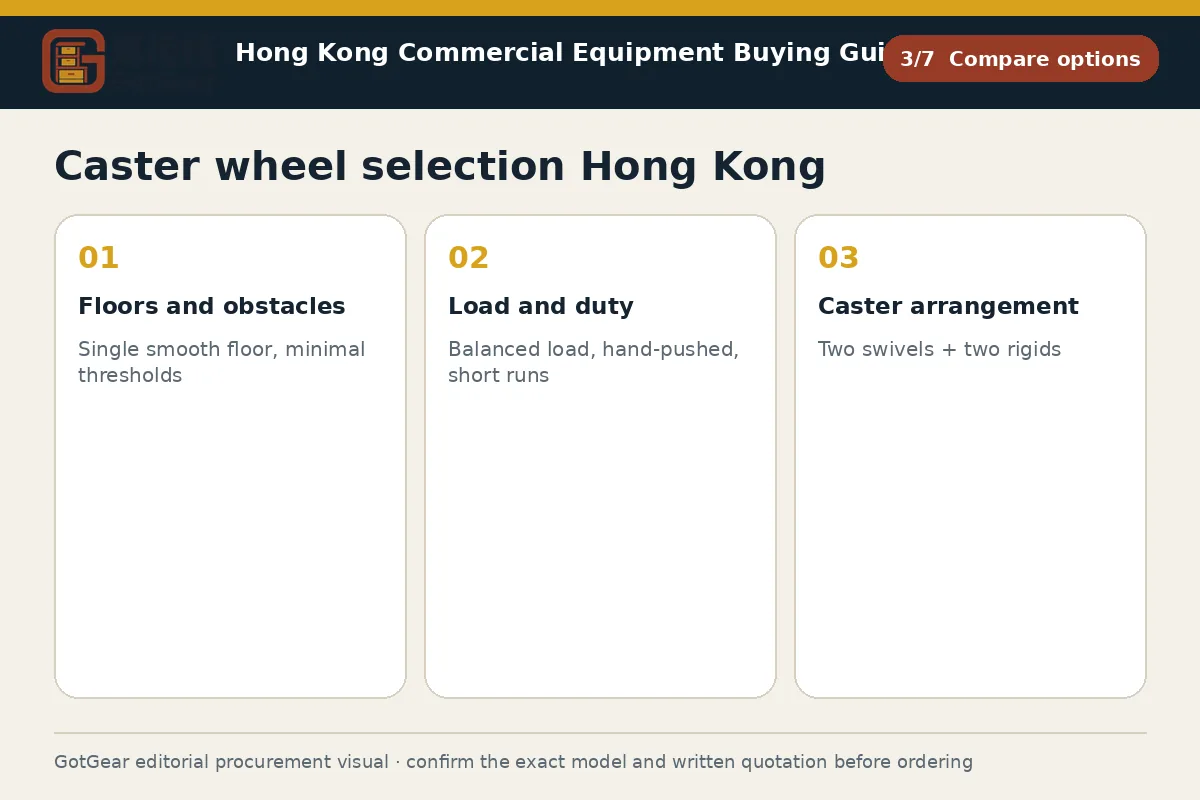
Translate mass and motion into per-caster demand. Total loaded mass includes trolley, bins and typical contents, not just the nominal payload. Consider how the centre of gravity shifts when bins are stacked or a single heavy item sits off-centre. A conservative example method some teams use is to divide total mass by three, not four, on a four-caster trolley to reflect uneven floors; treat this only as a starting assumption and confirm the calculation basis in the brief.
Duty cycle matters as much as weight. State how often the trolley moves per shift, typical walking speed, stops and starts at doorways, and any gradients at loading docks or car parks. Note whether the trolley is ever towed, as towing changes swivel dynamics and heat build-up. In the enquiry, ask for the dynamic load rating per caster at your stated speed and surface, recommended operating temperature, and guidance on shock over thresholds. Specify mounting plate size and bolt-hole pattern to match your frames. On receipt, inspect for the marked load rating, durometer and bearing type; confirm that swivel and wheel rotation are smooth without excessive play, and that fasteners and washers match the quoted grade and pattern.
What should buyers compare for caster wheel selection Hong Kong?
| Criterion | Straightforward requirement | More complex requirement | Evidence to provide |
|---|---|---|---|
| Floors and obstacles | Single smooth floor, minimal thresholds | Mixed tiles, epoxy, outdoor aprons, raised sills and drains | Photos, floor types by area, threshold heights/widths, joint gaps, worst-case surface |
| Load and duty | Balanced load, hand-pushed, short runs | Off-centre loads, frequent stops, ramps or towing | Total loaded mass, CG notes, duty profile with frequency/speed, slope details |
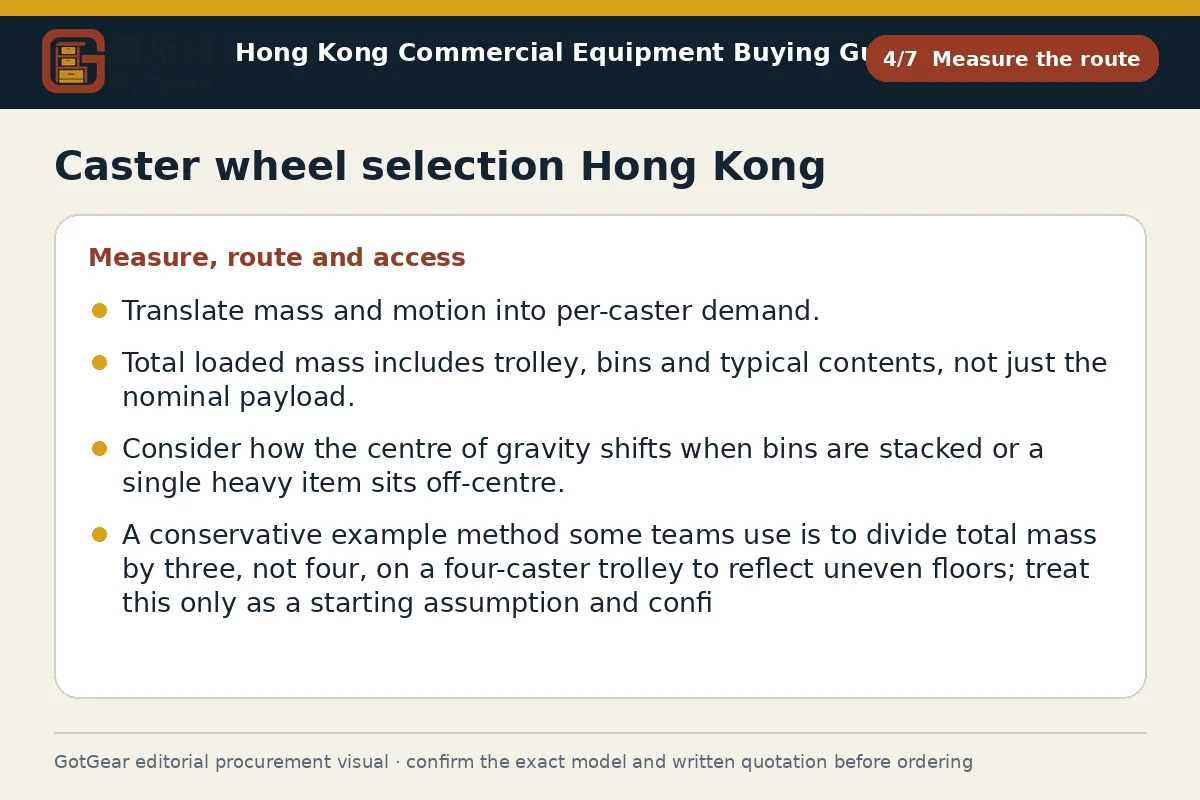
| Caster arrangement | Two swivels + two rigids | Four swivels with directional locks, or six-caster layouts | Aisle widths, turning radius, lift car depth, push/pull method, towing intent |
| Wheel specification | Non-marking TPR, medium diameter | PU over alloy core, debris guards, ESD option | Diameter, tread width, durometer scale, core material, non-marking/ESD statements |
| Environment, brakes, bearings | Foot brake, shielded bearings, indoor use | Total lock, stainless/galvanised, sealed bearings, washdown or chemicals | Brake type and pedal orientation, bearing type/seal, materials, chemical list |
This framework helps buyers create comparable written enquiries. Final model specifications, availability, delivery and commercial terms must be confirmed in a formal quotation.
Caster wheel selection Hong Kong — Swivel caster vs rigid caster Hong Kong: Compare steering freedom with directional tracking
Choosing between steering freedom and tracking discipline is the heart of the comparison. Swivels excel in tight corridors, ferrying through office towers and around pillars, while rigids keep a long trolley straight along warehouse aisles. The phrase swivel caster vs rigid caster Hong Kong often hides context: route geometry, aisle width, ramp approaches and goods-lift depth all decide which mix serves you best.
Common layouts include two swivels plus two rigids for stable straight-line runs with controlled turning at the handle end. Four swivels give maximum manoeuvrability in service corridors and crowded backrooms; add directional locks to convert one or two swivels into ‘temporary rigids’ for long pushes. For oversized platforms, some teams consider six casters: rigids central for tracking, swivels at corners for turning. In your request, specify the arrangement, any required directional or swivel locks, expected turning radius, and whether the trolley is pushed or pulled. Ask suppliers to declare swivel offset, fork thickness and whether the swivel is kingpin or kingpinless for impact resistance. Compare written quotations on these dimensions and lock features to avoid surprises during site trials.
Caster wheel selection Hong Kong — Specify brakes, bearings and environmental resistance separately
Brakes, bearings and environmental protection should be specified explicitly, not assumed from load rating. Decide whether you need wheel brakes (stop the wheel only), total-lock brakes (lock wheel and swivel), or directional locks (index a swivel to behave like a rigid for straight runs). Identify where pedals sit so they do not foul lift sills or kerbs, and consider toe guards if the trolley operates near the public at events or in school corridors, subject to venue policies.
Select bearings for both load and environment. Precision ball bearings roll lightly with lower push force; tapered rollers suit heavier, slower duties; plain bushes tolerate washdown and grit but need more effort. In humid Hong Kong, specify zinc-plated, galvanised or stainless steel components as required to manage corrosion; ask for sealed or shielded bearings for frequent outdoor moves. List any contact with cleaners or food areas and request the manufacturer’s chemical-resistance and temperature statements where relevant. In the quotation, require bearing type, seal rating, brake style, pedal orientation, and materials of fork, axle and fasteners. On delivery, check brake engagement, clearance to the floor at full lock, and that seals and finishes match the stated construction.
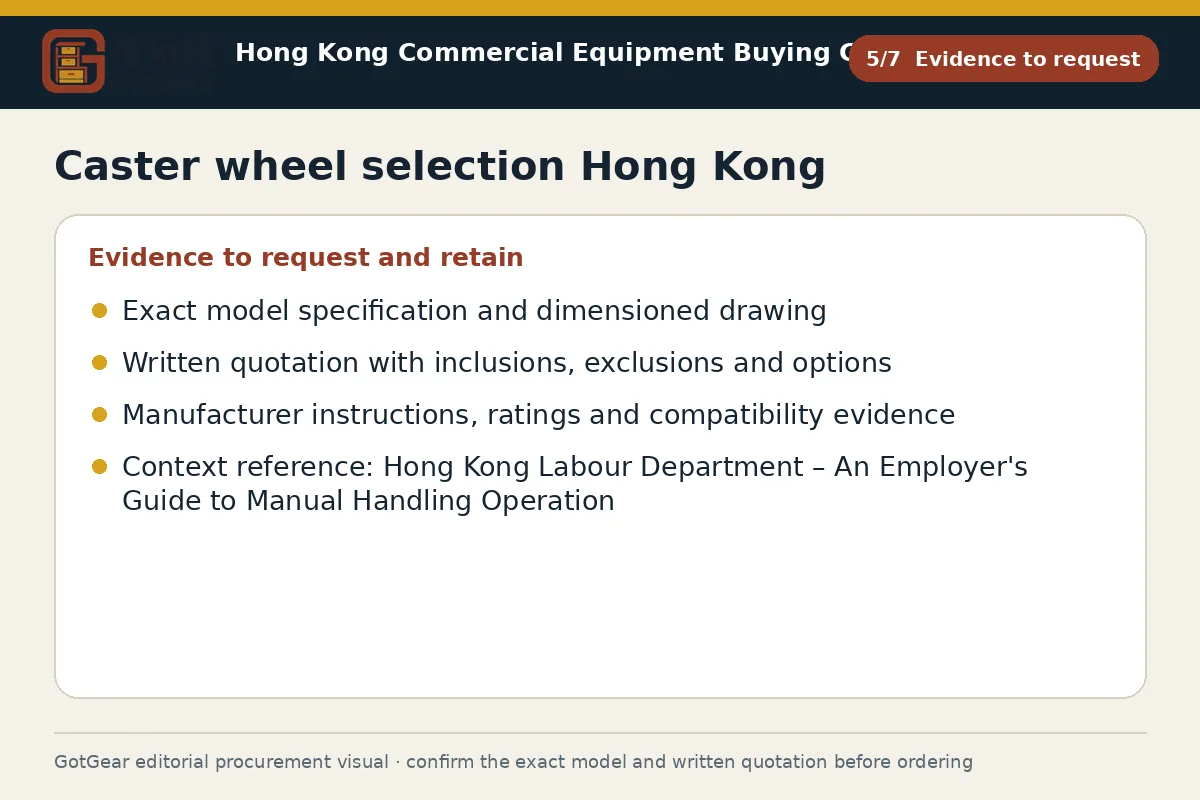
Caster wheel selection Hong Kong decision checklist
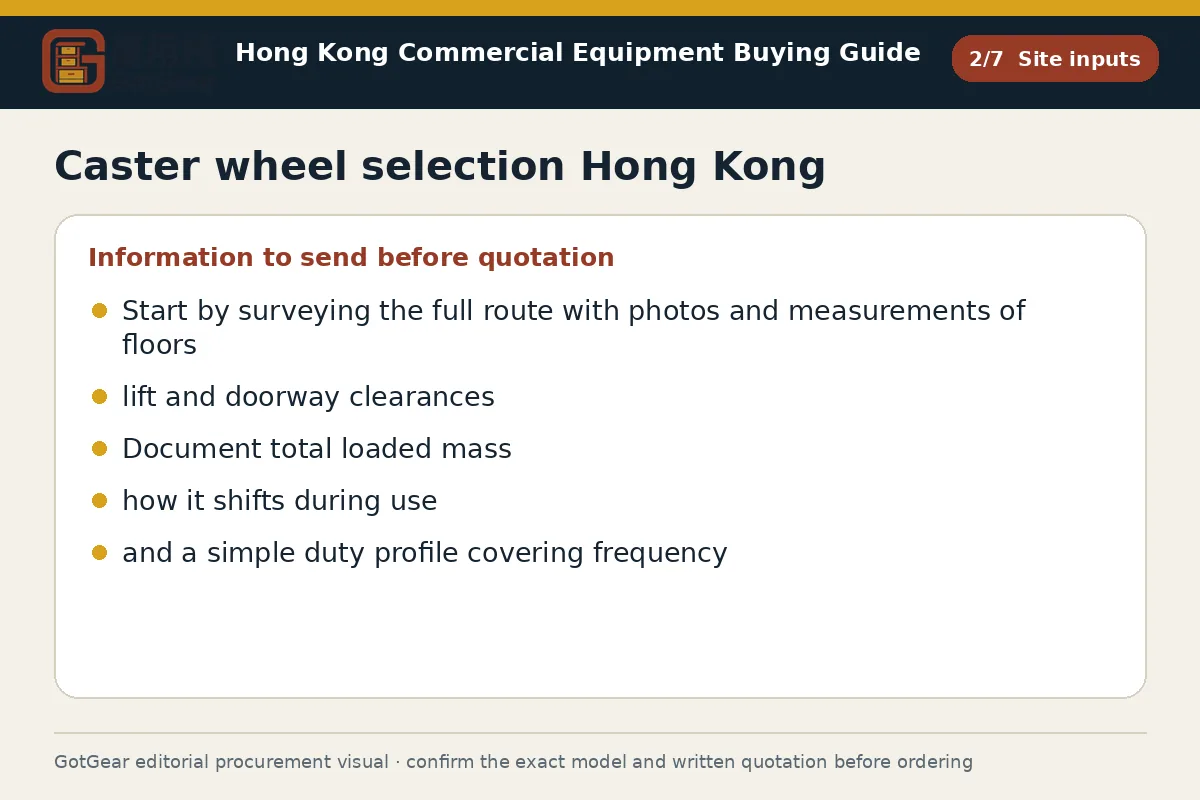
Start by surveying the full route with photos and measurements of floors, thresholds, slopes, lift and doorway clearances. Document total loaded mass, how it shifts during use, and a simple duty profile covering frequency, speed and ramps. Choose wheel material and diameter to match the worst surface and the tightest space. Specify the caster arrangement, swivel offset, and required locks or brakes. Request manufacturer datasheets for dynamic load rating at your duty, durometer scale, bearing type and corrosion protection. Ensure mounting plate and bolt pattern match your frames. Compare quotations line-by-line on these fields. On receipt, inspect markings, finish, seals, brake function and smooth rotation, then conduct a controlled site trial before sign-off.
- Operating use, quantity and expected frequency
- Dimensions, capacity, material and accessory requirements
- Delivery address, floor, goods lift and loading window
- Required documents, acceptance checks and after-sales arrangements
Key points for caster wheel selection Hong Kong, swivel caster vs rigid caster Hong Kong
Hong Kong routes often cross polished lobby tiles, goods-lift sills and tight office corridors before reaching loading bays with limited booking windows. Measure lift car depth, door clear width and sill height, and confirm with the management office which paths and hours are approved; this page offers practical considerations, not legal or facilities advice. Humidity and sea air accelerate corrosion, so surface finish and sealed bearings merit attention. Mixed-use buildings may request quiet, non-marking wheels and bilingual product information for internal approvals.
Questions about caster wheel selection Hong Kong
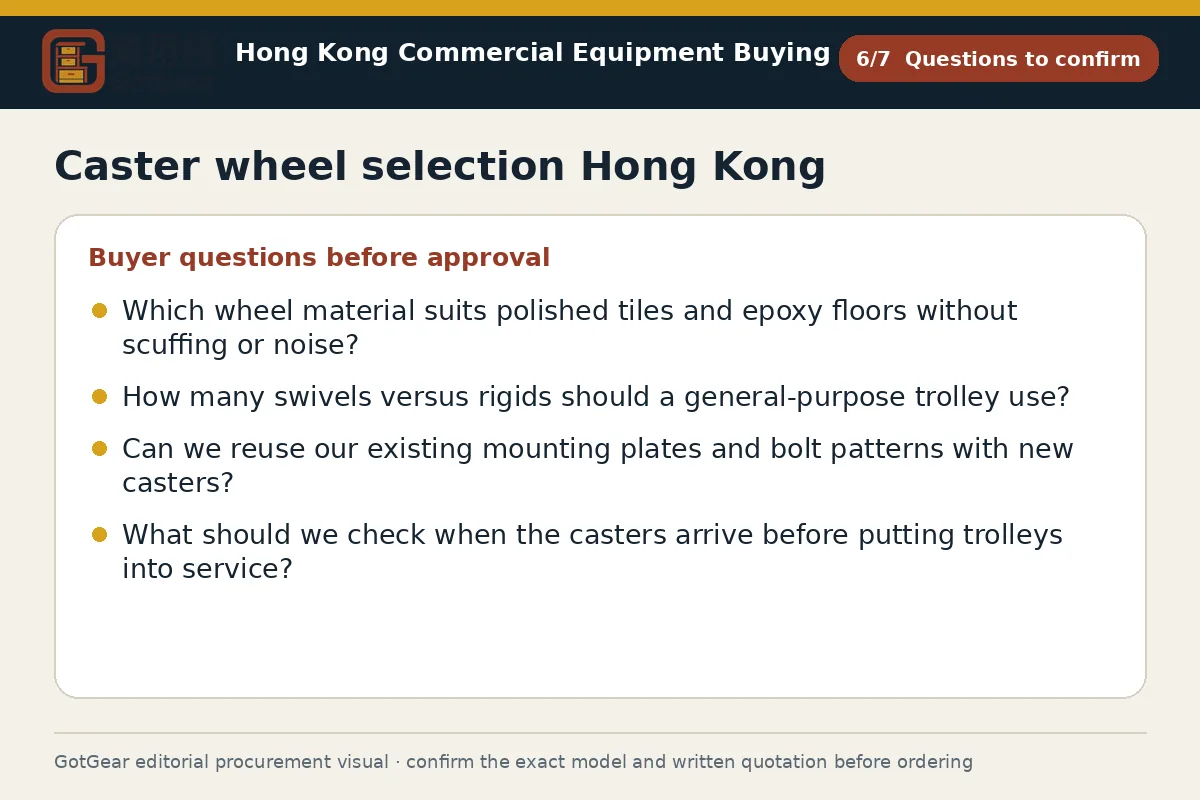
Which wheel material suits polished tiles and epoxy floors without scuffing or noise?
Thermoplastic rubber or soft polyurethane with non-marking tread is usually the first shortlist for quiet operation and floor care. Verify durometer on the datasheet and ask for a non-marking statement from the manufacturer. If loads are high, a softer PU over a robust core can balance protection and capacity, but confirm push force and turning on your actual floors during trials.
How many swivels versus rigids should a general-purpose trolley use?
A common starting point is two swivels and two rigids for good tracking yet manageable turns. In tighter corridors or backrooms, four swivels plus directional locks improve manoeuvring and still allow straight runs. For long platforms, mixed six-caster layouts may help. Treat these as examples only and confirm the final arrangement against route geometry, load and any towing plans.
Can we reuse our existing mounting plates and bolt patterns with new casters?
Sometimes, if the top-plate size, bolt-hole spacing, and fastener grade match the new caster’s requirements. Ask suppliers to state plate dimensions, hole pattern, axle size and recommended torque in writing. If patterns differ, consider adapter plates approved by the trolley maker. Always confirm frame capacity and any warranty implications with the responsible manufacturer before installation.
What should we check when the casters arrive before putting trolleys into service?
Verify wheel diameter, tread width and durometer against the quotation, then check bearing type and that swivels and wheels roll smoothly with no grinding. Test brake engagement and clearance at full swivel lock. Inspect finishes or seals for corrosion protection, and confirm plate size and bolt pattern fit your frames. Run a short, supervised route trial and record observations before rollout.
Continue with closely related procurement topics
These pages share equipment, operating or decision-stage signals with this guide.
Scissor lift table Hong Kong
Compare scissor lift table Hong Kong models by rated load, platform size, lowered and raised heights, mobility, controls and operator access for warehouse use in Hong Kong. See full specifications and model details at GotGear.
Read the guide
Manual stacker Hong Kong
GotGear's guide to manual stacker Hong Kong outlines key considerations such as load centre, lift height, pallet interface, aisle width and floor condition. It also explains controls, braking and residual capacity.
Read the guide
Material handling equipment Hong Kong
GotGear buyer checklist for material handling equipment Hong Kong helps purchasers record loads and lift heights and plan routes and operating frequency. It also guides buyers to verify capacity, dimensions and equipment controls.
Read the guide
Manual handling risk assessment Hong Kong
GotGear explains what to record during a manual handling risk assessment Hong Kong and how to use a manual handling safety checklist Hong Kong. The guide also describes how to prioritise material handling risk controls Hong Kong.
Read the guideRelated topic indexOpen more English procurement pages2 topics
Browse additional equipment families, applications and procurement questions relevant to a wider buying brief.