
Material handling floor condition checklist Hong Kong — Record every location where wheel travel, stability, braking or operator footing could be affected, then assign corrective action and a review date. Site teams should verify controls against actual operations, manufacturer instructions and applicable Hong Kong workplace requirements.
Material handling floor condition checklist Hong Kong — Record defects, gradients, transitions and contamination
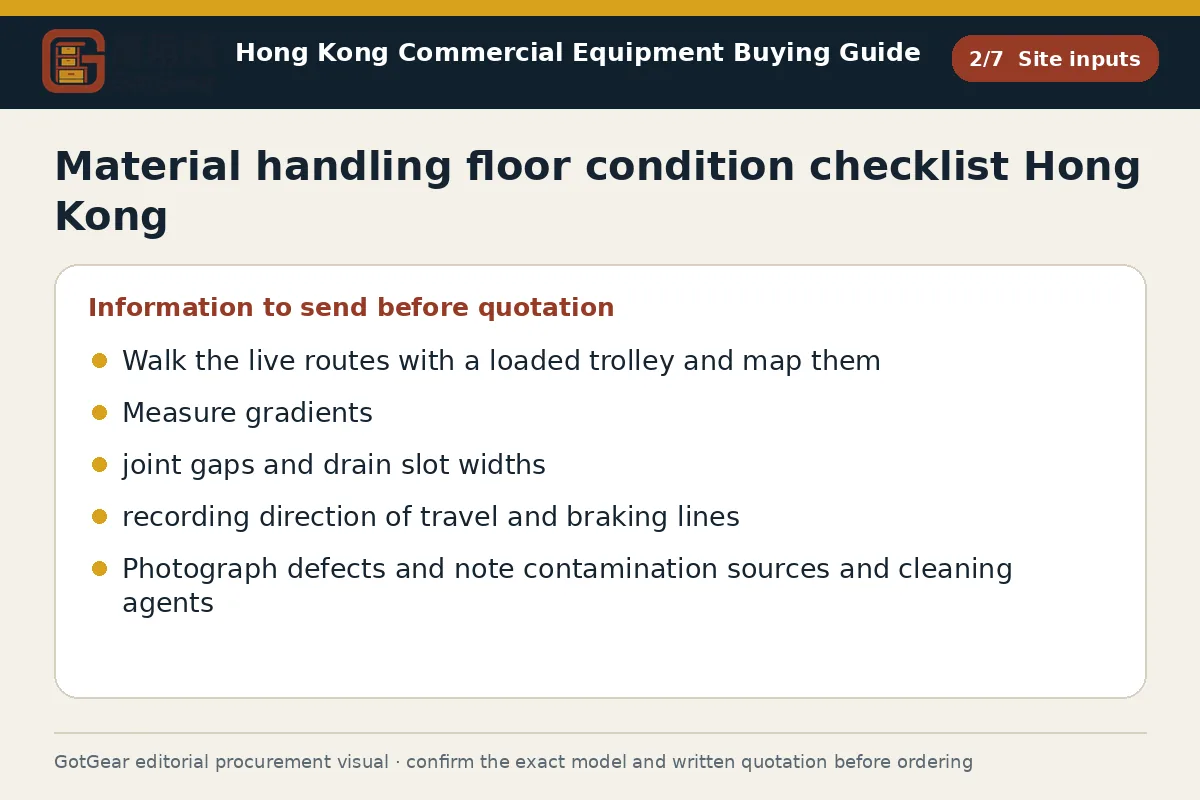
Start by walking every trolley, cart and pallet route, sketching a simple plan and numbering locations. Measure floor gradients with an inclinometer or digital level, noting direction of travel and braking lines. As an example starting point, flag any sustained slope steeper than 1:20 for a competent review, then confirm acceptance criteria with your building manager or adviser. Check transitions where floor types meet or where thresholds, ramps and plates occur. Record lip heights and lengths; as an example starting point, small castors may struggle where abrupt lips exceed about 6 mm, pending site confirmation.
Inspect joints and gaps: expansion joints, cracked tiles, worn grout and gratings. Measure gap width and edge step; as an example starting point, narrow wheels may drop into 10 mm slots or square drainage grates, which should be verified in situ. Note contamination sources—rain blow-in, condensation at chilled zones, spill-prone prep areas—and whether cleaning agents match wheel tread materials. If you are revisiting caster wheel selection Hong Kong, capture finish, hardness, and chemical exposure so quotations specify compatible tread compounds. Use a material handling floor condition checklist Hong Kong to consistently record defects, gradients, transitions and wet areas, linking each observation to a photo and exact location number for follow-up.
Material handling floor condition checklist Hong Kong — Warehouse loading bay trolley safety Hong Kong: Inspect dock edges, plates, drains and weather exposure
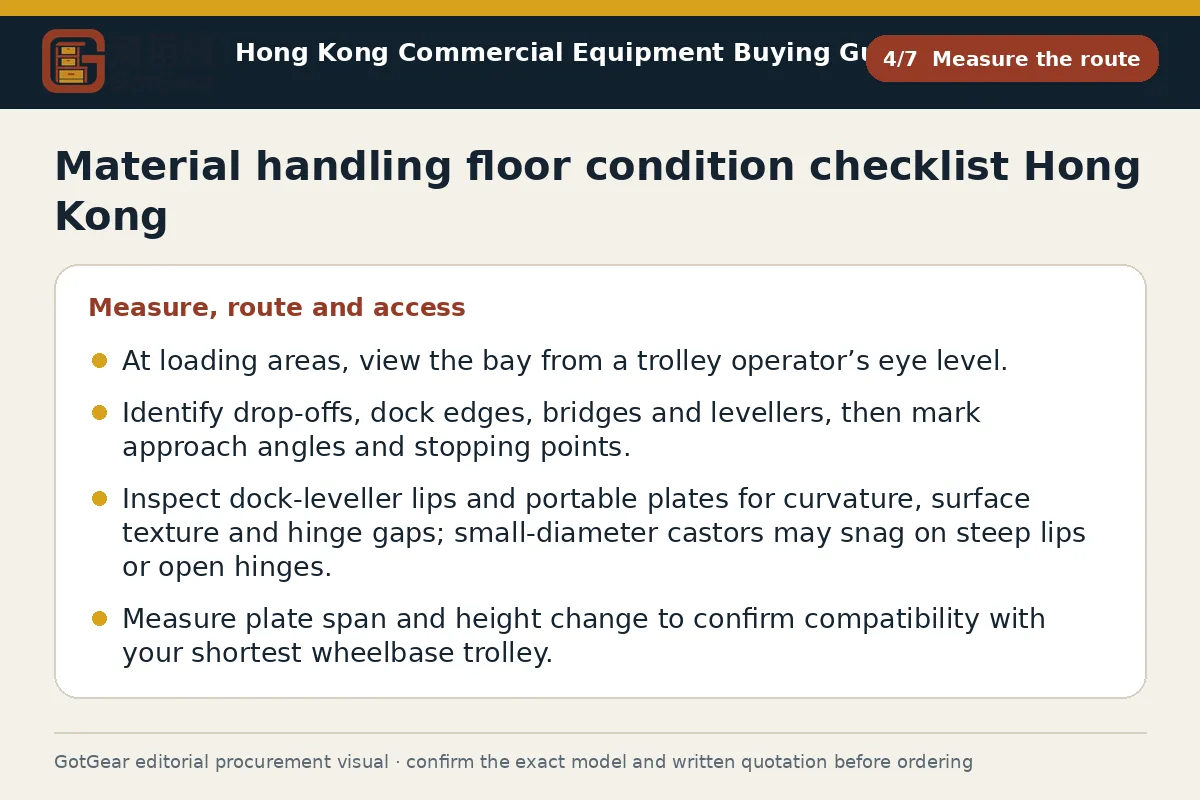
At loading areas, view the bay from a trolley operator’s eye level. Identify drop-offs, dock edges, bridges and levellers, then mark approach angles and stopping points. Inspect dock-leveller lips and portable plates for curvature, surface texture and hinge gaps; small-diameter castors may snag on steep lips or open hinges. Measure plate span and height change to confirm compatibility with your shortest wheelbase trolley. Check drains, gulleys and channel covers that sit in wheel paths, noting slot direction versus travel and any silt build-up after heavy rain.
Assess weather exposure: canopy coverage, wind-driven rain, and whether typhoon shutters affect gradients or surface traction when closed. Verify visual warnings—painted edge lines, chains or barriers—are intact and bilingual where needed. Request the plate or leveller’s stated safe working load, instructions, and any service recommendations from the manufacturer or service provider; the model specification and formal quotation should prevail. For warehouse loading bay trolley safety Hong Kong, couple the physical inspection with a short observation of vehicle movements, reversing practices and the marshalling method. Where routes are complex, plan a trolley route assessment Hong Kong so the same findings feed into purchasing and traffic controls.
What should buyers compare for material handling floor condition checklist Hong Kong?
| Criterion | Straightforward requirement | More complex requirement | Evidence to provide |
|---|---|---|---|
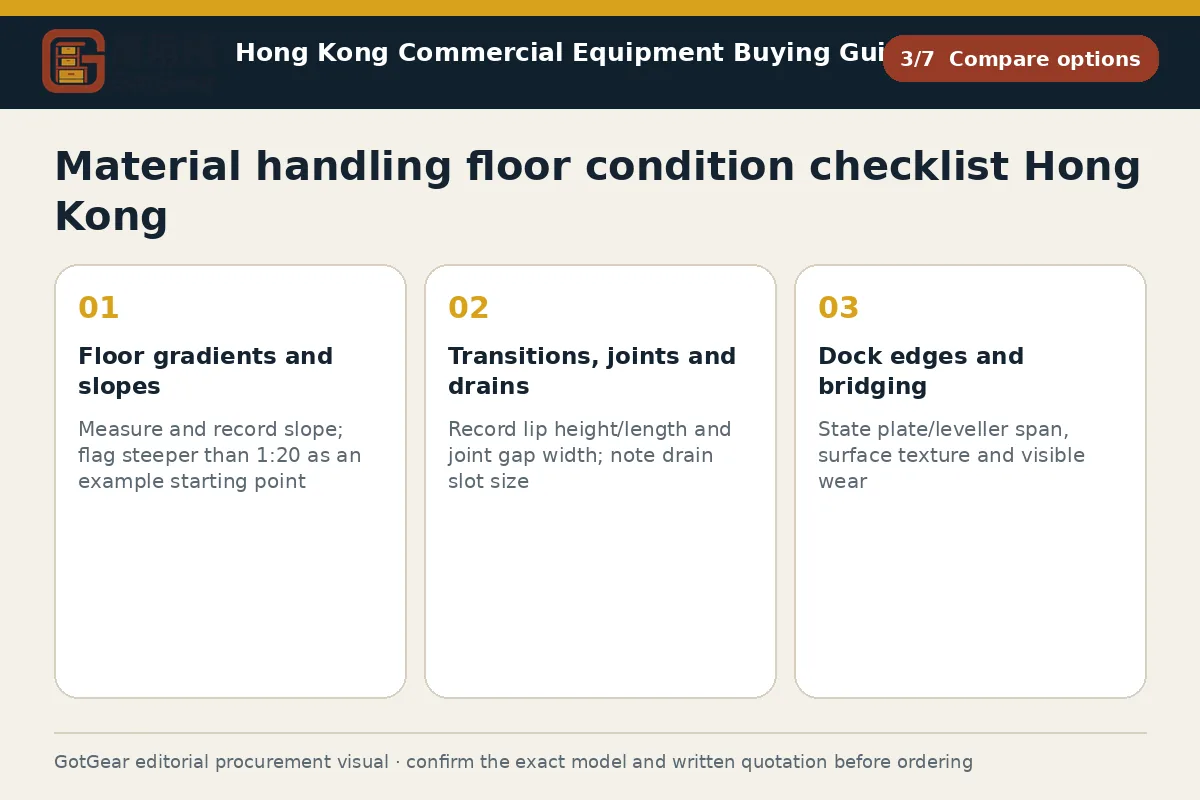
| Floor gradients and slopes | Measure and record slope; flag steeper than 1:20 as an example starting point | Detail direction of travel, braking lines and loaded descent/ascent tests to be confirmed on site | Sketch with locations, photos, gradient readings and test notes |
| Transitions, joints and drains | Record lip height/length and joint gap width; note drain slot size | Assess slot orientation vs travel, edge steps and grating movement under turning loads | Dimensions, material type, fixing condition and wheel diameter likely to cross |
| Dock edges and bridging | State plate/leveller span, surface texture and visible wear | Confirm smallest wheel and shortest wheelbase crossing; note weather exposure and pooling | Manufacturer SWL statement, instructions and site measurements |
| Traffic and interfaces | Provide simple one-way routes and marked crossings | Where public mixes with handling, add timed moves, spotters and visual controls | Traffic plan extract, site-induction notes and observation records |
| Access constraints | List door widths, sill steps and lift car size | Add landlord loading windows, ramp gradients and staging areas | Drawings with measured clear openings, lift data and management-office conditions |
This framework helps buyers create comparable written enquiries. Final model specifications, availability, delivery and commercial terms must be confirmed in a formal quotation.
Material handling floor condition checklist Hong Kong — Workplace transport risk assessment Hong Kong: Extend the floor review to traffic and loading-bay risks
Extend the floor review into traffic flows. Map pedestrian walkways, trolley corridors, forklift aisles and vehicle yards as a single picture. Measure aisle widths, turning radii and headroom; as an example starting point, record any pinch-point narrower than your widest trolley plus a sensible operating margin, then confirm acceptance with your competent person. Note door-closer forces, raised thresholds, lift sill steps and lift car sizes; Hong Kong goods lifts and back-of-house corridors can be tight, and loading windows set by the management office may drive staging on lift lobbies.
Check where routes intersect public areas (malls, schools, event venues). Plan crossings, sightlines, mirrors and speed limits appropriate to the venue, and decide whether stewards are needed during peak moves. Verify that delivery bays and vehicle routes are signed and that contractors receive a practical site induction. For workplace transport risk assessment Hong Kong, align your findings with the written traffic plan, incident records and any insurer or landlord conditions. If moving heavier equipment, note when hand trolleys should give way to machinery moving skates Hong Kong, and identify where cylinders or kegs need a purpose-built gas cylinder trolley Hong Kong to manage stability on slopes and wet surfaces.
Material handling floor condition checklist Hong Kong — Set actions, owners and reinspection dates
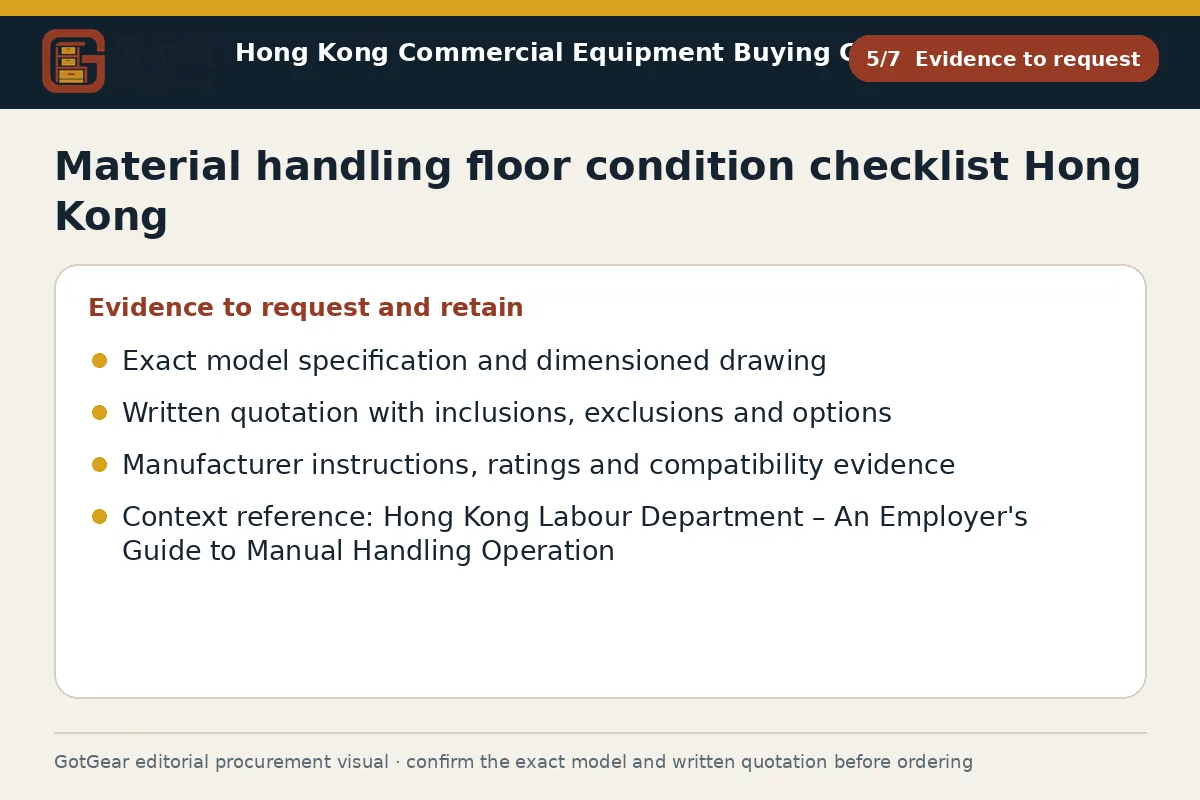
Turn observations into actions with clear ownership, scope and a reinspection date. Use location numbers from your route map so each action—repair a broken edge, replace a grating, add a ramp strip—references the exact spot and photo. As an example starting point, schedule an early check of high-risk locations within two to four weeks after remedial work, then agree an ongoing review cycle with your management office; always let the confirmed site plan and quotation prevail.
Embed procurement details in your enquiry. Provide drawings, measured gradients, lip heights, gap widths, door and lift sizes, and environmental notes (wet, oily, corrosive, chilled). Ask suppliers to state wheel diameter, tread compound and hardness, bearing type, frame material, corrosion protection, brake type, swivel lock options, overall dimensions, and stated load capacity with operating surface assumptions. Compare quotations like-for-like on these fields. On receipt, inspect dimensions against route constraints, wheel rolling and swivel action, brake hold on your steepest measured slope, fastener tightness and any labels or instructions; request bilingual documentation from the manufacturer where your site requires it. If loads or routes change, update actions and reinspection dates accordingly.
Material handling floor condition checklist Hong Kong decision checklist
Walk the live routes with a loaded trolley and map them. Measure gradients, lip heights, joint gaps and drain slot widths, recording direction of travel and braking lines. Photograph defects and note contamination sources and cleaning agents. Inspect loading-bay edges, plates and levellers; confirm plate span, surface texture and the smallest wheel likely to cross. Observe vehicle movements and public interfaces, then mark crossings and sightlines. Compile a written enquiry with route drawings, access constraints and environmental notes, requesting wheel diameter, tread, bearing and frame specifications. Compare quotations on identical fields and ask the manufacturer for instructions and stated load assumptions. On receipt, check rolling, braking and fit through lifts and doors. Assign actions, owners and reinspection dates, then review after any layout or process change.
- Operating use, quantity and expected frequency
- Dimensions, capacity, material and accessory requirements
- Delivery address, floor, goods lift and loading window
- Required documents, acceptance checks and after-sales arrangements
Key points for material handling floor condition checklist Hong Kong, workplace transport risk assessment Hong Kong, warehouse loading bay trolley safety Hong Kong
Hong Kong sites often combine tight goods lifts, narrow back-of-house corridors and short loading windows controlled by management offices. Rainy-season downpours, sea spray and high humidity can leave floors wet, while typhoon shutters and ramps alter gradients and traction at loading bays. Many facilities operate bilingual teams and contractors, so route markings and instructions may need Chinese and English versions. Some venues or landlords require permits to work or pre-approved delivery schedules. Treat this summary as practical operating context, not legal advice, and confirm controls with your competent person, building manager and the product manufacturer.
Questions about material handling floor condition checklist Hong Kong
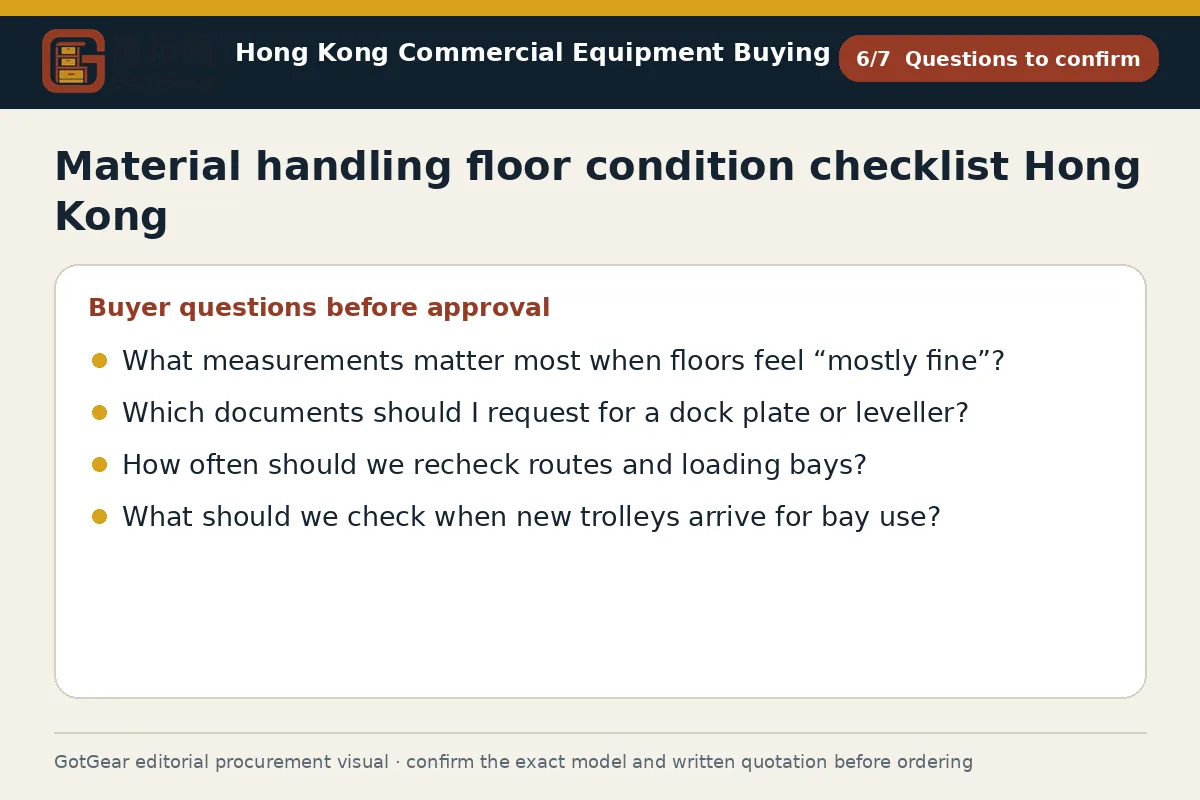
What measurements matter most when floors feel “mostly fine”?
Measure slope (rise and run), threshold lip height and length, joint gap width and edge step, plus any drain slot size and orientation. These determine wheel stability, brake hold and snag risk. Treat suggested thresholds as examples only and confirm acceptance criteria with your competent person, building manager and the manufacturer’s instructions for your selected trolley wheels.
Which documents should I request for a dock plate or leveller?
Ask for the manufacturer’s stated safe working load, intended vehicle and surface conditions, installation or use instructions, and service recommendations. Some models may also come with product data sheets. Requirements vary by equipment type and site policy; confirm what your building manager, insurer or competent adviser expects, and let the formal specification and quotation prevail.
How often should we recheck routes and loading bays?
Set intervals based on risk, not a fixed calendar. Reinspect after repairs, layout changes, seasonal weather shifts or incident reports. As an example starting point, many teams review higher-risk zones within weeks of changes, then agree a periodic cycle with the management office. Confirm frequency with your competent person and ensure records reflect actual operations.
What should we check when new trolleys arrive for bay use?
Verify overall dimensions against lift cars, doorways and plate spans, confirm wheel and swivel action under load, and test brakes on your steepest measured slope. Inspect fasteners, frame integrity, and labelling or instructions, requesting bilingual documentation where required. Any acceptance test should follow your agreed site plan and the manufacturer’s guidance for that specific model.
Continue with closely related procurement topics
These pages share equipment, operating or decision-stage signals with this guide.
Manual handling risk assessment Hong Kong
GotGear explains what to record during a manual handling risk assessment Hong Kong and how to use a manual handling safety checklist Hong Kong. The guide also describes how to prioritise material handling risk controls Hong Kong.
Read the guide
Trolley traffic management Hong Kong
GotGear explains trolley traffic management Hong Kong, trolley route assessment Hong Kong and trolley parking safety Hong Kong for mapped pedestrian, vehicle and parking controls.
Read the guide
Trolley inspection checklist Hong Kong
GotGear’s trolley inspection checklist Hong Kong and trolley preventive maintenance Hong Kong explain how to inspect wheels and brakes, log defects and schedule servicing under maker guidance.
Read the guide
Trolley load securing Hong Kong
GotGear provides guidance on trolley load securing Hong Kong, explaining how to check the centre of gravity, identify restraint points and compare straps, rails and clamps. It also covers trolley load stability Hong Kong.
Read the guideRelated topic indexOpen more English procurement pages2 topics
Browse additional equipment families, applications and procurement questions relevant to a wider buying brief.