
For a mop frame Hong Kong, match the attachment mechanism, working dimensions, handle connector and intended pad or head. Ask the manufacturer or supplier to confirm compatibility with the recorded system, particularly when selecting replacement heads separately.
Record attachment dimensions for mop frame Hong Kong
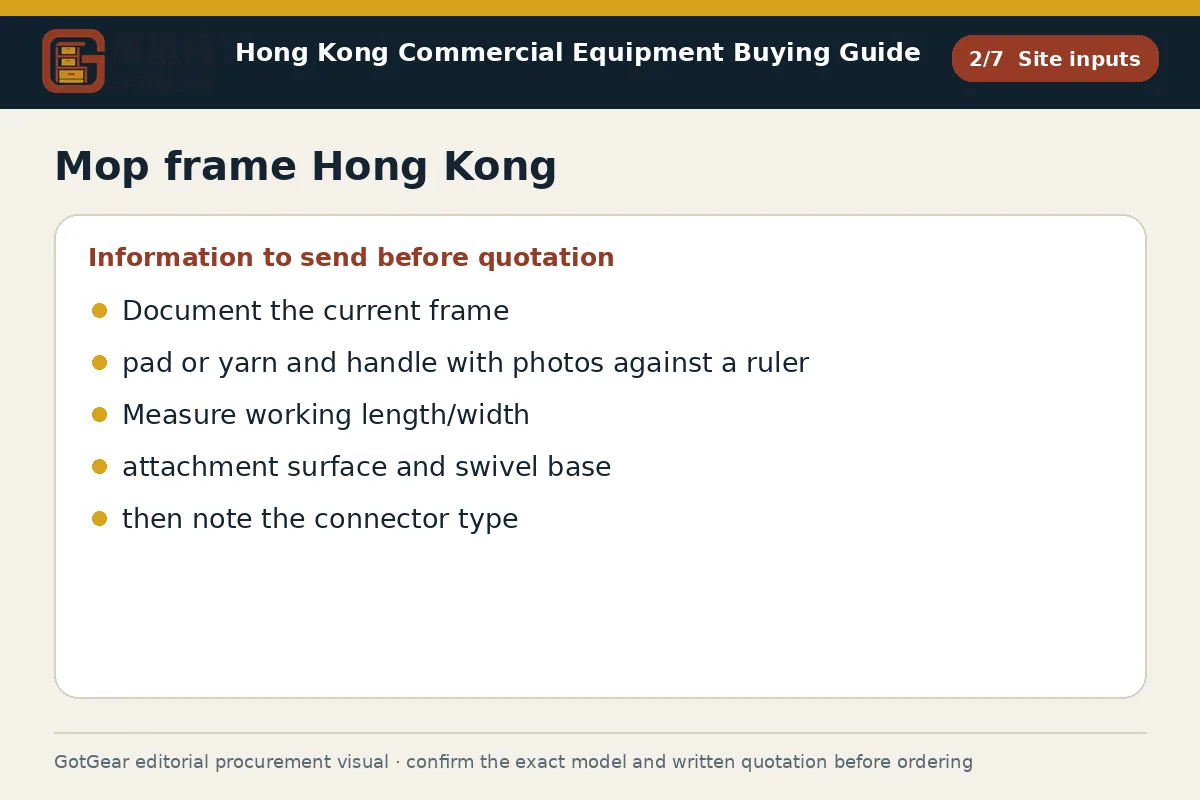
Start with field notes, photographs taken beside a ruler, and measurements in millimetres. Record the working length and width (the area that actually contacts the pad or yarn, not just end-to-end body length). For hook-and-loop frames, measure the usable Velcro strip width and its continuous length; for pocket frames, measure pocket depth, pocket opening width and any centre spine or channel. Note the baseplate thickness, corner radii and any raised bosses that affect pad seating. For flat mop system Hong Kong, teams should also capture the swivel plate size and hole pattern where applicable.
For clip or jaw frames, record clip spacing and jaw opening at rest. If it is a wire or yoke style, measure wire gauge and the distance between the arms where the head band sits. Photograph end caps and hinge hardware, because their shape affects pad fit at the tips. If your written brief simply says mop frame Hong Kong, suppliers may quote different interfaces. Include brand markings, series codes and any stampings on the frame. If you insert any example dimensions (for instance, a 400 mm working length or 110 mm Velcro width), label them as examples only and request the manufacturer or supplier to confirm against the exact model in your written enquiry and quotation.
Check handle connections before replacing mop frame Hong Kong
Handle connections determine whether the frame will actually go into service on the day it arrives. Identify whether your socket is a push‑fit cone, a clamped ferrule, a bayonet, or a threaded insert. Measure the internal or external diameter at the mating point and note thread type if present; photographs of the thread profile with a ruler help a supplier gauge pitch. Test how far your current handle seats and whether any locking collar must face a particular direction.
If upgrading to a telescopic handle, check that the swivel can rotate freely without fouling the collar at maximum extension and that the assembled length still clears goods‑lift diagonals and doorways common in Hong Kong industrial buildings. For a wet‑mop and handle order in Hong Kong, include the handle material (aluminium, fibreglass, stainless, as relevant), the approximate handle diameter and whether an adaptor was previously used. Ask vendors to state the exact connector type and any adaptor part reference on the written quotation and confirm these details in bilingual documentation when available. On receipt, trial‑fit to a representative handle before distributing frames to sites.
What should buyers compare for mop frame Hong Kong?
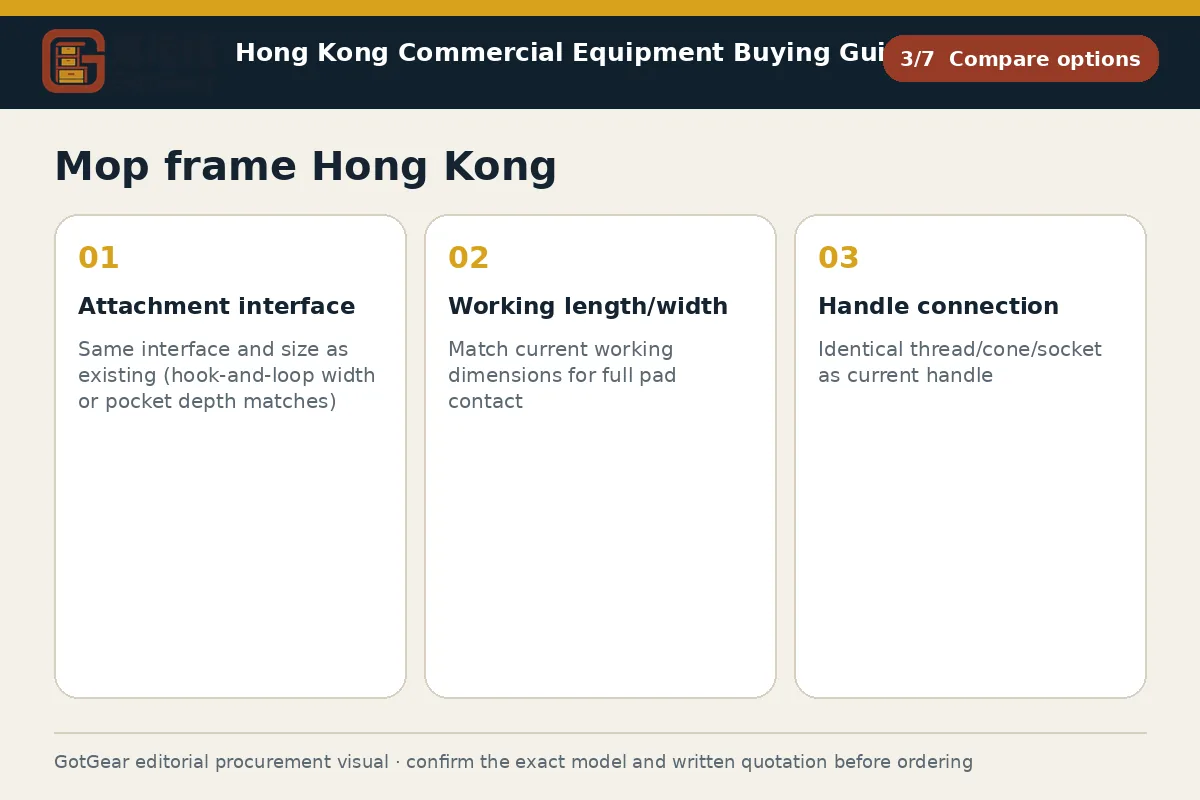
| Criterion | Straightforward requirement | More complex requirement | Evidence to provide |
|---|---|---|---|
| Attachment interface | Same interface and size as existing (hook‑and‑loop width or pocket depth matches) | Adapters or mixed pocket/clip systems validated for tolerance and corner radii | Photos with ruler; attachment type; measured interface in mm; brand/series |
| Working length/width | Match current working dimensions for full pad contact | Allow limited oversize/undersize where site needs edge reach or clearance | Dimensions in mm; drawing or sketch; example target to be confirmed |
| Handle connection | Identical thread/cone/socket as current handle | Different handle brand via adaptor; confirm anti‑rotation and swivel travel | Measured diameters; thread/profile photo; note of locking collar/adaptor |
| Replacement head spec | Head matches frame series, attachment and fibre type/size | Change fibre blend, GSM, edge bind, laundry temp to suit venue needs | Part numbers; composition; care instructions; sample fit‑test notes |
| Documentation and verification | OEM part refs on quote, invoice and packaging | Bilingual labels, lot traceability, sample approval and delivery booking | Quotation copy; label photos; delivery booking details; acceptance checklist |
This framework helps buyers create comparable written enquiries. Final model specifications, availability, delivery and commercial terms must be confirmed in a formal quotation.
Match mop replacement heads Hong Kong to the mop frame Hong Kong system
Selecting pads or yarn heads becomes easier once you confirm the attachment and the working size. For hook-and-loop frames, match the pad backing width and length to the contact area; verify the edge binding thickness will not lift at the corners. For pocket frames, confirm pocket depth and spacing so the frame slides fully without strain. When requesting mop replacement heads in Hong Kong, please include the frame brand and series, attachment type and the measured working length and width, as distributors in Hong Kong often ask for these details in an enquiry.
If you are moving to microfibre, specify pile type and blend. A request for a microfibre flat mop in Hong Kong should note GSM, backing type, edge binding and the recommended laundry temperature. For yarn systems, state whether you use narrow or wide band and whether your frame suits a Kentucky mop head in Hong Kong or another pattern. Consider local humidity: pads that dry slowly can sour in storage; ask the manufacturer for care instructions, maximum wash temperature and compatible detergents. Compare written quotations line-by-line for size, attachment style, fibre composition, colour coding and whether pads are launderable. Any example counts for wash cycles must be treated as starting points only and confirmed in writing for the proposed model.
Use part references to confirm mop frame Hong Kong compatibility
Part references reduce guesswork. Capture the frame’s moulded codes, stamped numbers, series name and any date or lot marks on the swivel plate. Photograph the original box label if you still have it. Ask suppliers to cross‑reference your photos, measured attachment dimensions and handle connector to an exact model, and to state the confirmed part number on the quotation, invoice and packing label. Where brands have look‑alike frames, request a short video or drawing showing the attachment surface and swivel assembly to verify before ordering.
For pads and yarn, request the exact head code that mates to your frame series. If multiple revisions exist, specify the revision you tested. In Hong Kong, bilingual documentation helps stores and supervisors avoid mix‑ups between centres; ask for English/Chinese descriptions where available. Use GotGear to compare specification fields and prepare a clear written enquiry. Before placing a larger order, request a sample for field fit‑check, then document acceptance criteria: correct fit, free swivel, pads lie flat with no overhang, no sharp burrs, and packaging survives transit without crushing or delamination in humid conditions.
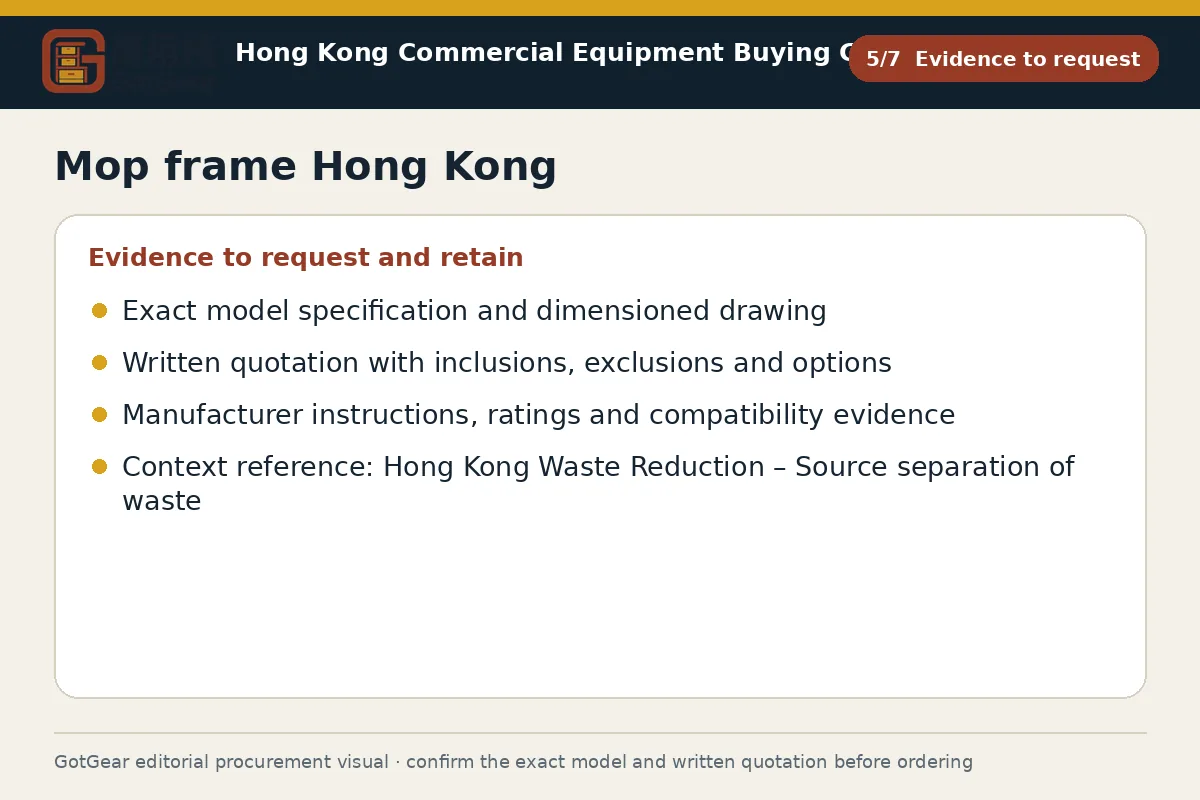
Mop frame Hong Kong decision checklist
Document the current frame, pad or yarn and handle with photos against a ruler. Measure working length/width, attachment surface and swivel base, then note the connector type, handle material and any adaptor. Record brand/series and any part marks. In your enquiry, request confirmation of attachment type, working dimensions, connector and exact part references, plus material, care guidance and recommended chemicals or laundry temperatures. For pads, include fibre, GSM and edge binding. State site constraints such as goods‑lift size, doorway clearances, loading window and bilingual labelling needs. Compare quotations line‑by‑line against your measurements and requested fields. On receipt, fit‑check to a representative handle, test swivel freedom, verify pad seating and inspect for burrs, cracked plastic or poorly bonded Velcro. Ask the manufacturer or supplier for documentation where your venue, insurer or procurement policy requires it, and file the final model numbers for future reorders.
- Operating use, quantity and expected frequency
- Dimensions, capacity, material and accessory requirements
- Delivery address, floor, goods lift and loading window
- Required documents, acceptance checks and after-sales arrangements
Key points for mop frame Hong Kong, mop replacement heads Hong Kong
Hong Kong facilities often operate within tight goods‑lift cars, narrow service corridors and short loading windows controlled by building management. Frame‑and‑handle assemblies must clear lift diagonals and standard doorways, so confirm assembled lengths before delivery. Humid stores and back‑of‑house areas can challenge adhesives and promote corrosion; material choice and care instructions matter. Coordination with the management office for booking, delivery timing and access cards is typical. Bilingual labels reduce receiving errors when multiple brands or series are in circulation across schools, hospitals, malls or event venues. Treat these as operating constraints to capture in your written brief, not legal advice.
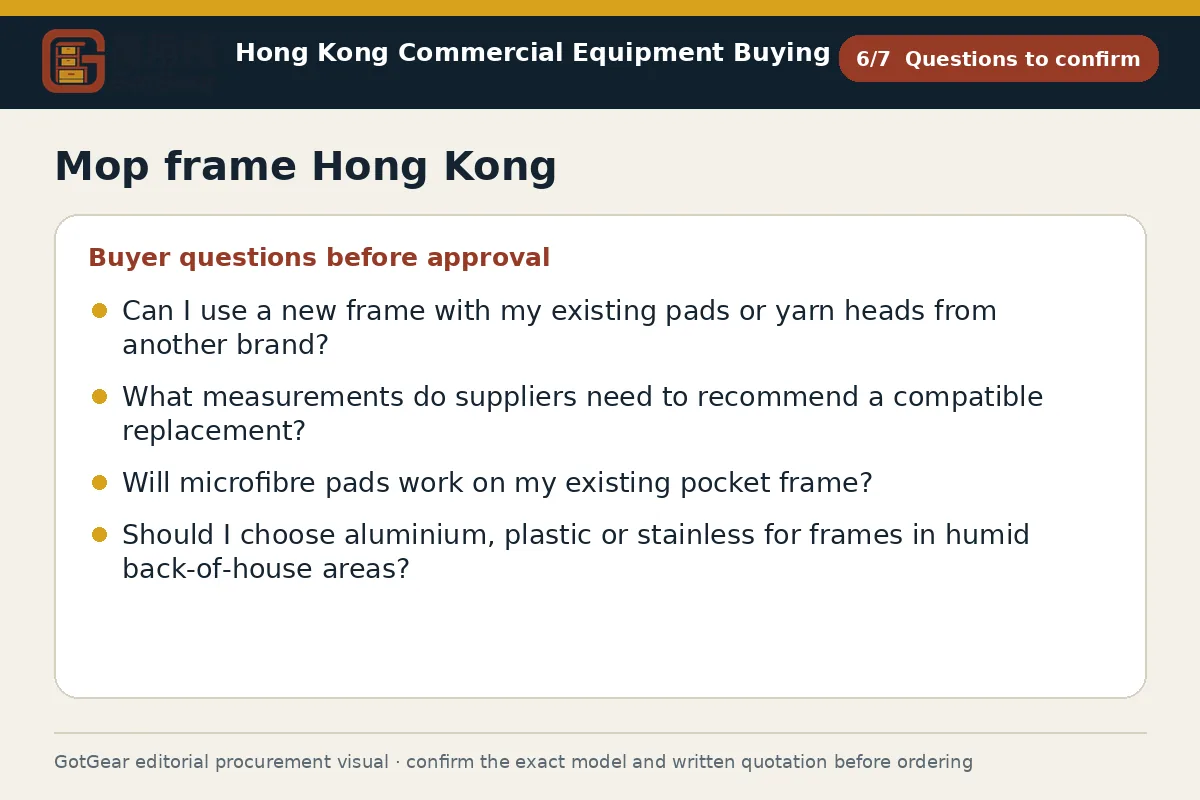
Questions about mop frame Hong Kong
Can I use a new frame with my existing pads or yarn heads from another brand?
Yes, if the attachment style and working dimensions match, and the handle connector is compatible. Tolerances differ by brand, so a small mismatch can cause lifting corners or loose pockets. Ask the supplier to confirm against your measurements and part photos, and test a sample on site before committing a larger order. Written specifications and quotation details should prevail.
What measurements do suppliers need to recommend a compatible replacement?
Provide working length and width of the attachment area, attachment type (hook‑and‑loop, pocket, clip, jaw), swivel base dimensions, and handle connector details. Add photos alongside a ruler, brand/series markings and any known part codes. If you include example sizes, label them as examples only and request written confirmation for the exact model quoted by the supplier or manufacturer.
Will microfibre pads work on my existing pocket frame?
Generally yes, provided pocket depth, opening width and frame thickness match the pad’s pocket design. Also confirm pad backing stiffness, edge binding and recommended laundry temperature to avoid premature wear. In humid Hong Kong stores, ensure drying space and care instructions are suitable. Validate with a sample and rely on the supplier’s written specification for the chosen series and revision.
Should I choose aluminium, plastic or stainless for frames in humid back‑of‑house areas?
Aluminium is lightweight and widely used; stainless offers better corrosion resistance; reinforced plastic can be quiet and non‑marking. The right choice depends on chemical exposure, impact risk and your laundering regime. Request the material specification, any protective coating details and care instructions in writing, then trial one unit in the intended area before scaling up procurement.
Continue with closely related procurement topics
These pages share equipment, operating or decision-stage signals with this guide.
Waste bin replacement lids Hong Kong
For waste bin replacement lids Hong Kong, photograph the bin, record its make and model, measure the rim and fixings, and check the hinge, opening and colour coding to confirm the fit. Guidance is from GotGear.
Read the guide
Waste stream labels Hong Kong
When specifying waste stream labels Hong Kong, confirm accepted materials, wording, colours, visibility and bin location. Pair recycling bin stickers Hong Kong with larger recycling bin signage Hong Kong for guidance from GotGear.
Read the guide
Recycling station Hong Kong
GotGear explains a recycling station Hong Kong, outlining accepted streams, signage, staff checks, volumes and transfer routes. We connect front of house recycling bins Hong Kong with back of house recycling bins Hong Kong.
Read the guide
Paper recycling bins Hong Kong
GotGear explains the differences between paper recycling bins Hong Kong, plastic recycling bins Hong Kong and glass recycling bins Hong Kong in contamination risk, filled weight, handling route and written collection rules.
Read the guideRelated topic indexOpen more English procurement pages2 topics
Browse additional equipment families, applications and procurement questions relevant to a wider buying brief.