
For a telescopic cleaning pole Hong Kong, calculate working reach from the operator’s safe position rather than choosing solely by maximum extension. Confirm attachment compatibility and manufacturer instructions, and use only the access method approved for the site under applicable Hong Kong requirements.
Calculate working reach for telescopic cleaning pole Hong Kong
Start by measuring from the operator's permitted standing point to the task. Record the vertical height to the cleaning surface, then the horizontal offset created by parapets, planters or façades that push the operator back. Working reach is the usable distance to the surface at a realistic angle, not a straight line. As an example starting point only, a lintel 5.2 m above finished floor with a 0.8 m setback will usually need a longer pole than the bare height suggests because a shallow angle reduces effectiveness and control. Confirm the standing point is authorised by the venue or building manager.
Note the floor slope, drainage grilles, crowds or traffic likely to affect footing. Ask the supplier to state, in a written quotation, maximum extended length, recommended working height (if provided), number of sections, pole weight, tip standard, and any deflection or stiffness data the manufacturer publishes. When shortlisting a telescopic cleaning pole Hong Kong, buyers should focus on measured reach rather than catalogue maximums. For multi-site portfolios, capture measurements across typical areas (atrium, shopfront, loading bay) and let the model specification and the formal quotation prevail if figures differ from site notes.
Test extended handling of telescopic cleaning pole Hong Kong
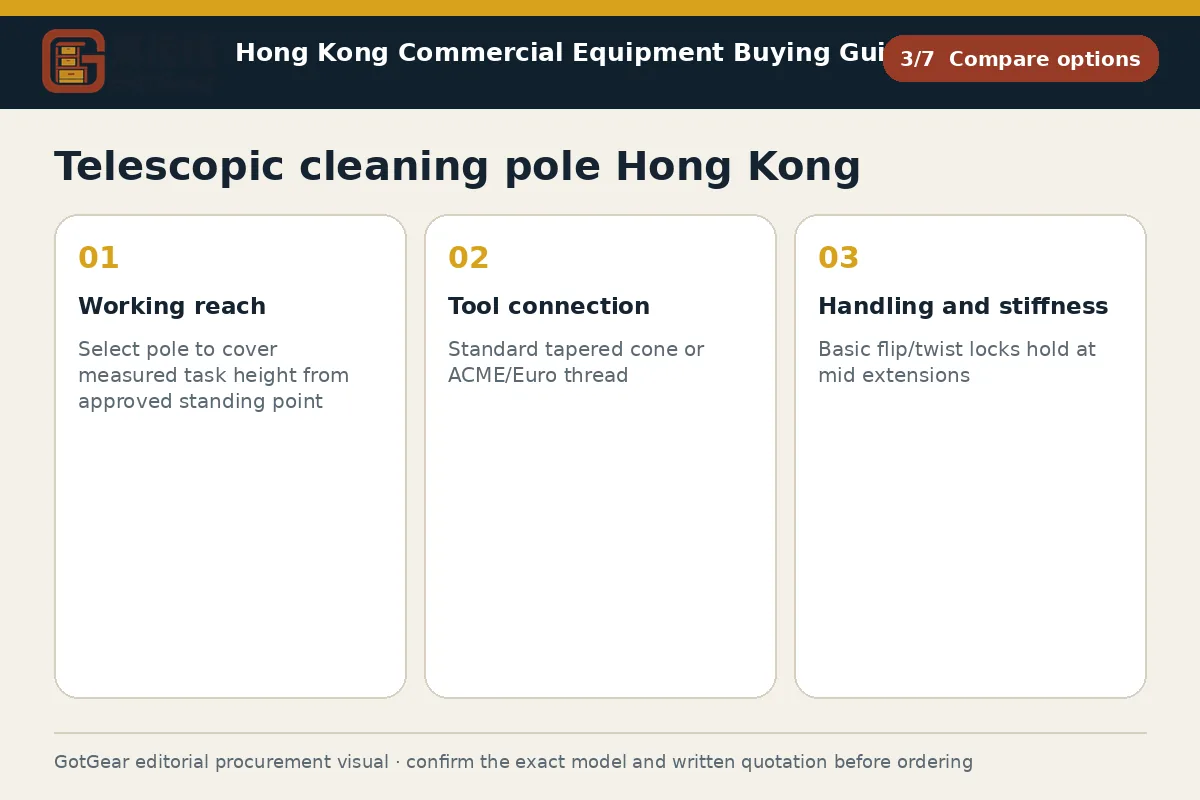
Before placing an order, verify how the pole behaves at the required length. Extend it to the measured working reach with the intended attachment, such as a window squeegee Hong Kong, already used by teams, and assess balance, bounce and twist. Try a light dusting head with a microfiber cleaning cloth Hong Kong, which supervisors might specify for vents, to see if clamps slip when the cloth is damp. In Hong Kong’s humidity, confirm that wet hands and gloves still grip the handles and locks.
Check that sections do not rotate unintentionally, that flip or twist locks hold after several extensions, and that angle adaptors stay fixed when side-loading against glass or signage. Ask the supplier or manufacturer to confirm, in writing, the maximum recommended head weight and any restrictions on chemical exposure. Request bilingual operating instructions and care guidance. On receipt, inspect for dents, binding joints, rough clamp edges, loose ferrules, missing end caps and any play between sections. If the task occurs in public hours, agree with facilities or event control the safe area and timing before conducting handling trials.
What should buyers compare for telescopic cleaning pole Hong Kong?
| Criterion | Straightforward requirement | More complex requirement | Evidence to provide |
|---|---|---|---|
| Working reach | Select pole to cover measured task height from approved standing point | Account for horizontal setbacks and work angle reduction | Site sketch with heights, offsets, standing point and example angle |
| Tool connection | Standard tapered cone or ACME/Euro thread | Proprietary click-locks or mixed-brand adaptors with angle joint | List all heads by brand/model and required adaptors/part numbers |
| Handling and stiffness | Basic flip/twist locks hold at mid extensions | Low-deflection composite sections for long reach and precise control | Request published deflection notes and test extended handling on site |
| Collapsed storage | Fits storeroom and lift when collapsed; simple wall hook | Modular split, protective sleeves, brackets and trolley restraints | Provide storage dimensions, lift car size and routing constraints |
| Documentation and spares | Basic instructions and one tip included | Bilingual manuals, spare clamps/caps and compatibility confirmation | Ask for written compatibility, spares list and maintenance guidance |
This framework helps buyers create comparable written enquiries. Final model specifications, availability, delivery and commercial terms must be confirmed in a formal quotation.
Match tool connections to telescopic cleaning pole Hong Kong
List every tool head you expect to mount so you can specify the required tip interface. Common connections include tapered push-fit cones for many squeegees and brushes, ACME or European threads for dusting tools, and proprietary click-locks. If you plan to use a floor squeegee Hong Kong cleaners keep for spill response, ask whether a rigid adaptor is available to avoid flex at the joint. For glass and façade tasks, decide whether you need an angle adaptor for soffits, signs or overhead ledges, and whether anti-rotation grooves are required for precise blade alignment.
Request written confirmation that the pole’s tip is compatible with each named head by brand and model, or that specified adaptors are included. Where different brands are mixed, ask for part numbers, materials, and any torque limits to prevent cross-threading. In coastal districts, confirm whether stainless or composite tips are recommended to reduce galvanic corrosion. If water-fed or detergent lines are envisaged, state hose routing, valve location and quick-connect type. Ensure the quotation states the tip standard, adaptor kit contents, and availability of spare tips, clamps and end caps, with the model specification prevailing if there is any discrepancy.
Plan collapsed storage for telescopic cleaning pole Hong Kong
A pole that stores neatly is used more often and sustains less damage. Measure the maximum collapsed length that will fit your storeroom, goods lift and service routes, including door swings and turning clearances. As an example starting point only, many industrial lift cars and corridors favour collapsed lengths below 1.9 m, but confirm your building’s dimensions and loading procedures. Check the collapsed diameter, clamp protrusions and whether caps snag on shelving. If the pole must travel on trolleys, consider housekeeping cart accessories Hong Kong, approved by your supervisors, to secure the shaft and prevent roll-away.
In your enquiry, ask the supplier to state collapsed length, section count, outside diameter at the grips, mass, and whether the pole splits into shorter modules for transport. Request information on protective sleeves, wall brackets or straps, and whether replacement caps and clamp levers are stocked. Confirm packaging length for delivery through loading bays and lift lobbies, and whether boxes are bilingual-labelled for easy receipt. After delivery, verify smooth extension from storage, that labels remain legible after cleaning, and that storage points keep the pole dry and away from heat or public access.
Telescopic cleaning pole Hong Kong decision checklist
Define the task surface, height and horizontal setback from the operator’s authorised standing point, then calculate a realistic working reach at an angle you can control. Record obstacles, foot traffic and floor gradients. List every head you plan to use and the tip or adaptor each requires. Request a written quotation stating extended and collapsed lengths, weight, number of sections, tip standard, any stiffness data, and adaptor part numbers. Arrange an extended-length handling check with intended heads, and confirm bilingual instructions. Verify collapsed storage and transport through lifts and doors, then inspect packaging, clamps and ferrules on receipt. Ensure the proposed access method is approved for the site.
- Operating use, quantity and expected frequency
- Dimensions, capacity, material and accessory requirements
- Delivery address, floor, goods lift and loading window
- Required documents, acceptance checks and after-sales arrangements
Key points for telescopic cleaning pole Hong Kong
Hong Kong sites often combine high atriums with tight lift cars, narrow doorways and controlled loading windows, so collapsed length and packaging size matter as much as maximum reach. Humid, coastal conditions can accelerate corrosion and affect grip performance; materials and maintenance regimes should be chosen accordingly. Many facilities teams operate bilingually, so Chinese and English instructions aid training. Public malls and event venues may restrict daytime works; coordinate access, barriers and methods with building management. These are operating realities, not legal advice—follow your organisation’s approvals.
Questions about telescopic cleaning pole Hong Kong
Can one pole cover windows, vents and light signage on the same site?
Yes, if the tip system accepts your different heads and the pole remains controllable at the required length. Specify each head by brand and model, request adaptors in writing, and check angle joints for stability. Confirm the manufacturer’s maximum head weight and any chemical restrictions. On multi-use poles, plan spare tips and clamps to minimise downtime.
Which pole material suits Hong Kong’s humid conditions?
Aluminium is robust and economical; fibreglass can provide electrical isolation; carbon or hybrid composites improve stiffness-to-weight. Selection depends on reach, handling and site risks. In humid, coastal areas, confirm corrosion resistance and care instructions. If work may approach electrical hazards, consult a competent adviser and choose an insulated model rated by the manufacturer, if appropriate.
What collapsed length is practical for typical Hong Kong facilities?
Sub‑2 m collapsed length often moves more easily through lifts, service corridors and storerooms, but treat this only as an example starting point. Measure your doors, lift cars and storage racks, and request collapsed length and packaging length in quotations. Let the model specification and your building’s written constraints determine the final requirement.
Do I need an insulated pole if work is near electrical equipment?
If tasks may bring the pole close to energised conductors, seek competent advice and consider an insulated fibreglass model rated by the manufacturer. Keep safe approach distances defined by the site, and use only the access method your organisation approves. Requirements vary by venue and insurer; confirm them in writing before purchase or deployment.
Continue with closely related procurement topics
These pages share equipment, operating or decision-stage signals with this guide.
Microfiber cleaning cloth Hong Kong
GotGear compares microfiber cleaning cloth Hong Kong and microfiber flat mop Hong Kong across cleaning surfaces, chemical compatibility, colour coding and laundering cycles, and provides guidance on selection and care.
Read the guide
Commercial broom Hong Kong
Commercial broom Hong Kong: GotGear compares bristle stiffness, head width and handle length. Dustpan and brush Hong Kong: Review lip and storage options.
Read the guide
Decorative refuse bins Hong Kong
Compare decorative refuse bins Hong Kong with lobby litter bins Hong Kong to assess capacity, opening style, finish, liner concealment and cleanability, and to confirm required floor area with GotGear, Hong Kong.
Read the guide
Slim waste bins Hong Kong
Select slim waste bins Hong Kong by considering footprint, lid movement and easy liner removal. Compare swing top waste bins Hong Kong with push top waste bins Hong Kong for clearance and staff access with GotGear.
Read the guideRelated topic indexOpen more English procurement pages1 topics
Browse additional equipment families, applications and procurement questions relevant to a wider buying brief.