
Use manufacturer-supported load and stacking conditions, assess the complete unit load and stop when pallets or goods are damaged, uncertain or unstable.
Plastic pallet stacking safety Hong Kong — Check Load Geometry and Support
Begin with the unit load, not just the pallet. Measure the load footprint, height, packaging type and any overhang relative to the pallet’s deck area and support features. Record whether cartons are arranged column- or interlocked-style, whether there are drums, trays or bagged goods, and if a slip sheet or layer pad is used. Note the pallet deck style (open or closed), the top-deck rib pattern, block locations and underside stringer geometry so you understand how weight transfers to the floor or to the pallet beneath.
Confirm the intended support method: floor stacking, pallet-on-pallet, or racking with pallets stacked on top of racked pallets. For floor stacking, inspect the floor material and flatness in the target zone, and check turning clearances, goods-lift car and doorway dimensions typical of Hong Kong industrial buildings. Where cartons cannot maintain shape, consider switching to rigid containers and refer to plastic bulk containers Hong Kong in your enquiry. State the environmental conditions (ambient, chilled, freezing), because condensation or moisture may change packaging stiffness. For decisions concerning plastic pallet stacking safety Hong Kong, list the handling equipment in use (forklift, stacker, pallet jack) and forks or clamp settings, then request from each manufacturer the permitted unit-load type, load orientation and stacking conditions for the exact pallet model and footprint you plan to use. The written quotation and manufacturer specification should prevail over assumptions.
Plastic pallet stacking safety Hong Kong — Verify Condition, Alignment and Restraint
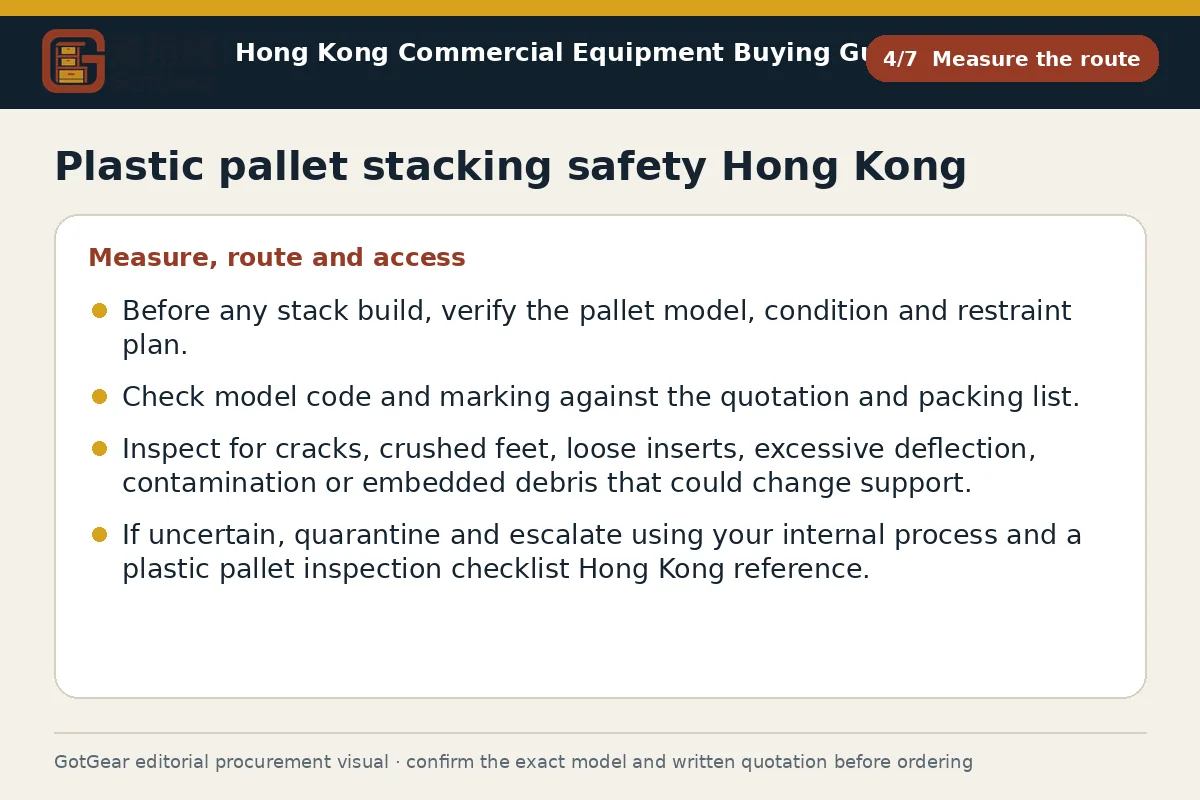
Before any stack build, verify the pallet model, condition and restraint plan. Check model code and marking against the quotation and packing list. Inspect for cracks, crushed feet, loose inserts, excessive deflection, contamination or embedded debris that could change support. If uncertain, quarantine and escalate using your internal process and a plastic pallet inspection checklist Hong Kong reference. For hygiene-sensitive sites or public venues, require bilingual pallet and load labels so teams and auditors read the same instructions.
Alignment and restraint control stability. Align pallets corner-to-corner with even bearing; avoid unsupported overhang and twisted stacks caused by uneven floors or tight aisles. Specify the restraint method in writing: film grade and wrap pattern, strap type and placement, corner protection and tie-sheets. On receipt, test that the restraint holds during a measured tug or slow turn in a safe area, and record the setting used by each shift. Confirm that MHE tines fully support the pallet, avoid jolts over thresholds, and that lift-car accelerations do not break the wrap. Stop and rework when damage, misalignment or inadequate restraint is found, and document any corrective actions taken.
What should buyers compare for plastic pallet stacking safety Hong Kong?
| Criterion | Straightforward requirement | More complex requirement | Evidence to provide |
|---|---|---|---|
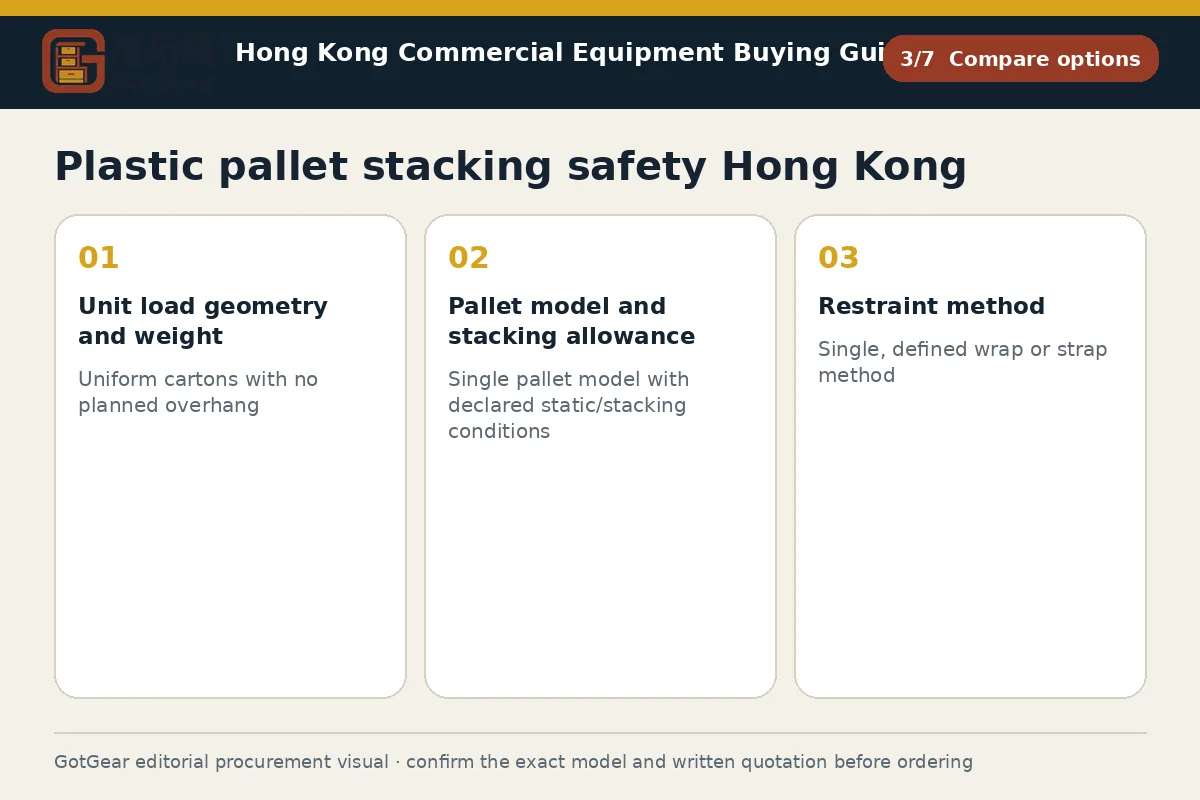
| Unit load geometry and weight | Uniform cartons with no planned overhang | Mixed packaging or irregular shapes with potential overhang | Provide load footprint, height, estimated weight and photos of packaging |
| Pallet model and stacking allowance | Single pallet model with declared static/stacking conditions | Multiple models or inter-stacking between models | Attach model code, spec sheet and any manufacturer stacking letter |
| Restraint method | Single, defined wrap or strap method | Combined methods with corner boards and tie-sheets | State film/strap type, pattern, target setting and verification method |
| Contact surface and environment | Dry, level concrete floor in ambient conditions | Wet areas, tiles, grating, chilled or frozen environments | Describe floor material, flatness info if available, and site photos |
| Handling route and access | Straight forklift move on one level | Lift-car travel, tight doorways, ramps or thresholds | Provide lift car and doorway sizes, route map and turning clearances |
This framework helps buyers create comparable written enquiries. Final model specifications, availability, delivery and commercial terms must be confirmed in a formal quotation.
Plastic pallet stacking safety Hong Kong: Set Controls for Safe Pallet Stacking
Set clear, written stack controls that your supervisors can enforce. Base limits on the manufacturer's stated static and stacking conditions for the exact pallet model, plus the proven performance of your packaging. As a starting point, you might cap mixed-SKU stacks lower than uniform stacks, but confirm limits only after a supervised trial and manufacturer review. For decision records on plastic-pallet load stability in Hong Kong projects, capture the approved pallet model, maximum stack configuration, permitted handling path and required restraint settings.
Define where stacks are allowed, marking floor zones and clearances near columns, sprinklers and doors. Coordinate with building management on loading windows, lift-car use and any restrictions on staging in common areas. In your enquiry and tender comparison, ask suppliers to state: pallet model code, deck type, stacking allowance (pallet-on-pallet), compatible load types and any overhang prohibition. For food, pharma and institutions, consider hygiene plastic pallets Hong Kong and request surface finish, wash temperature compatibility and cleaning instructions. Train crews on stop-work criteria, reporting of near-misses, and bilingual work instructions so day and night shifts follow the same rules. The final, signed quotation and manufacturer documents should control.
Plastic pallet stacking safety Hong Kong: Review Contact Conditions for Safe Stacking
Review every contact surface in the stack system: load-to-pallet, pallet-to-pallet, pallet-to-floor and pallet-to-fork. In humid Hong Kong conditions and on chilled docks, surfaces may become wet and reduce friction. Where sliding risk is identified, specify texture, grommets or friction features, and request the supplier’s test method and data. If your operation needs higher grip, state in writing that a plastic pallet anti-slip surface solution for Hong Kong is required and ask for compatible wrap or matting recommendations.
Check the receiving floor: smooth epoxy, tiles or mezzanine grating behave differently under point loads and in wet areas. For cold rooms, confirm material brittleness range, drainage through open decks and compatibility with automated stretch wrapping, then reference plastic pallets for cold storage in Hong Kong when you need temperature-tolerant options. Validate that fork tines are clean and dry, and that clamps or push–pulls do not defeat friction features. During trials, conduct a controlled slow-tilt or gentle braking test in a safe area to observe any relative movement; treat any measured slip as a trigger to revisit restraint or surface specification. Keep the trial report attached to the purchase file.
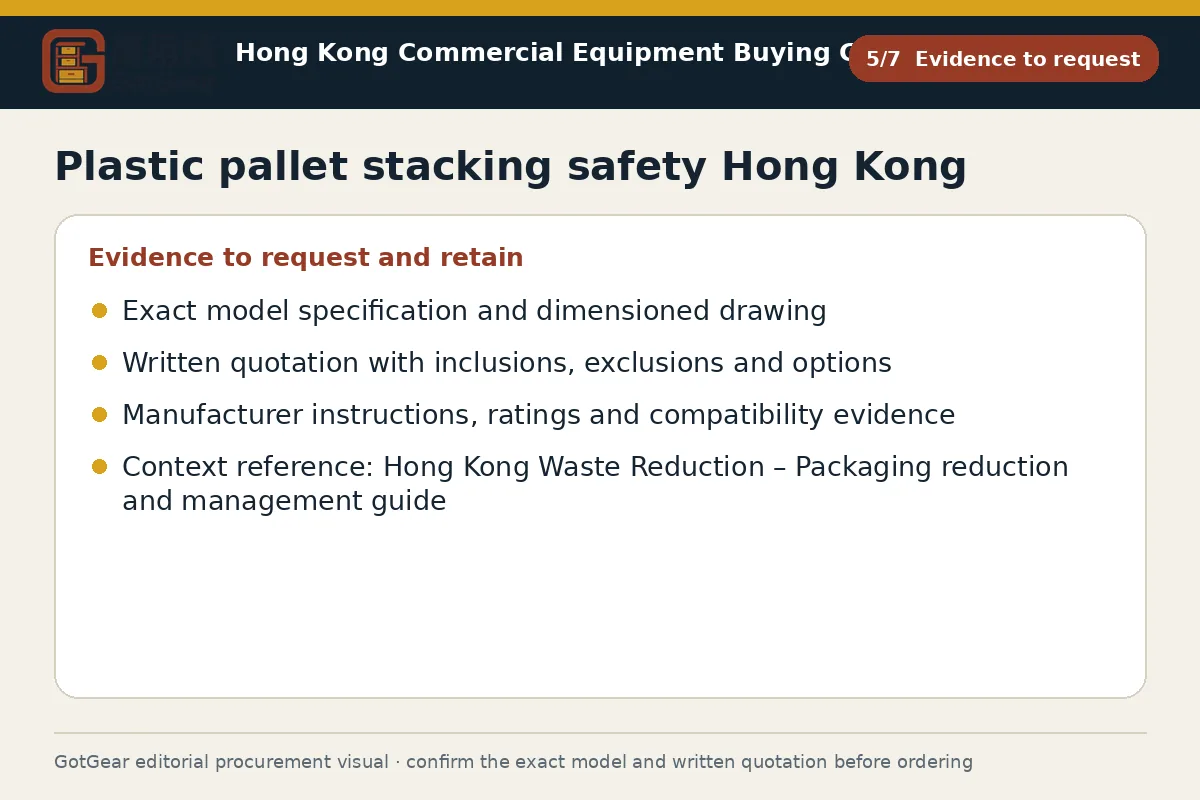
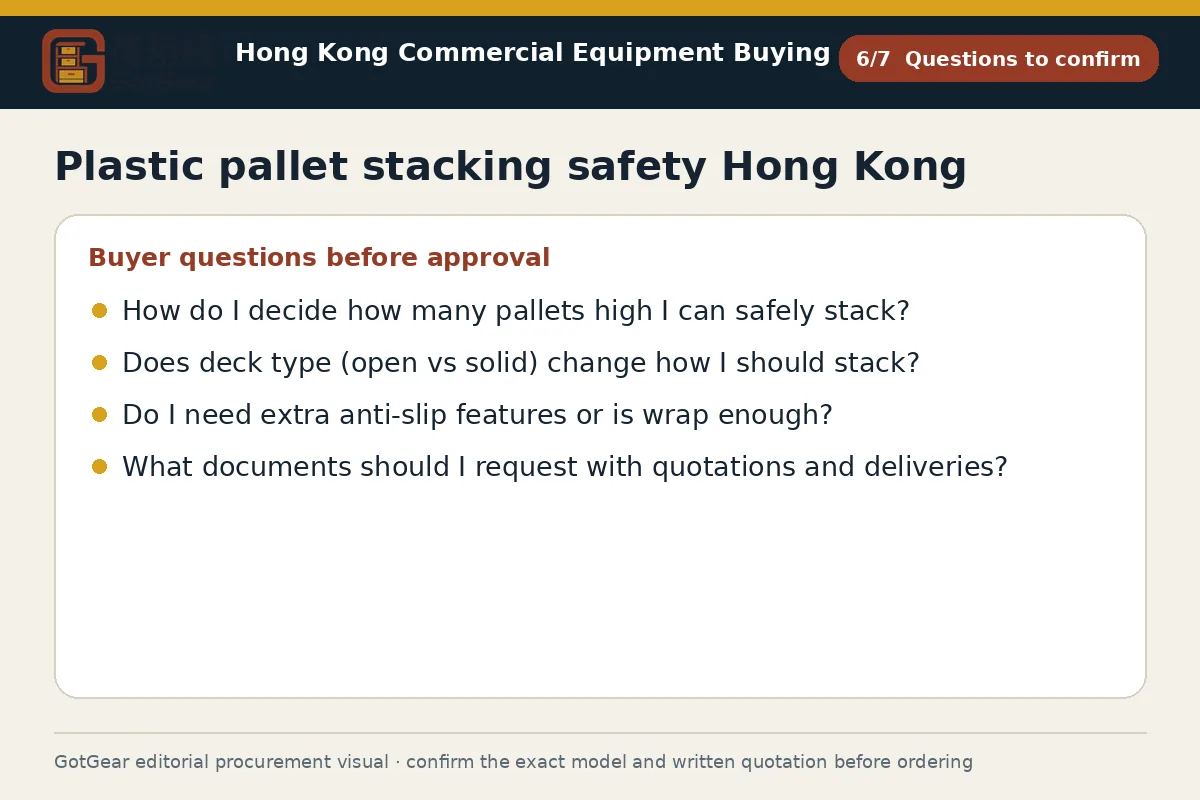
Plastic pallet stacking safety Hong Kong decision checklist
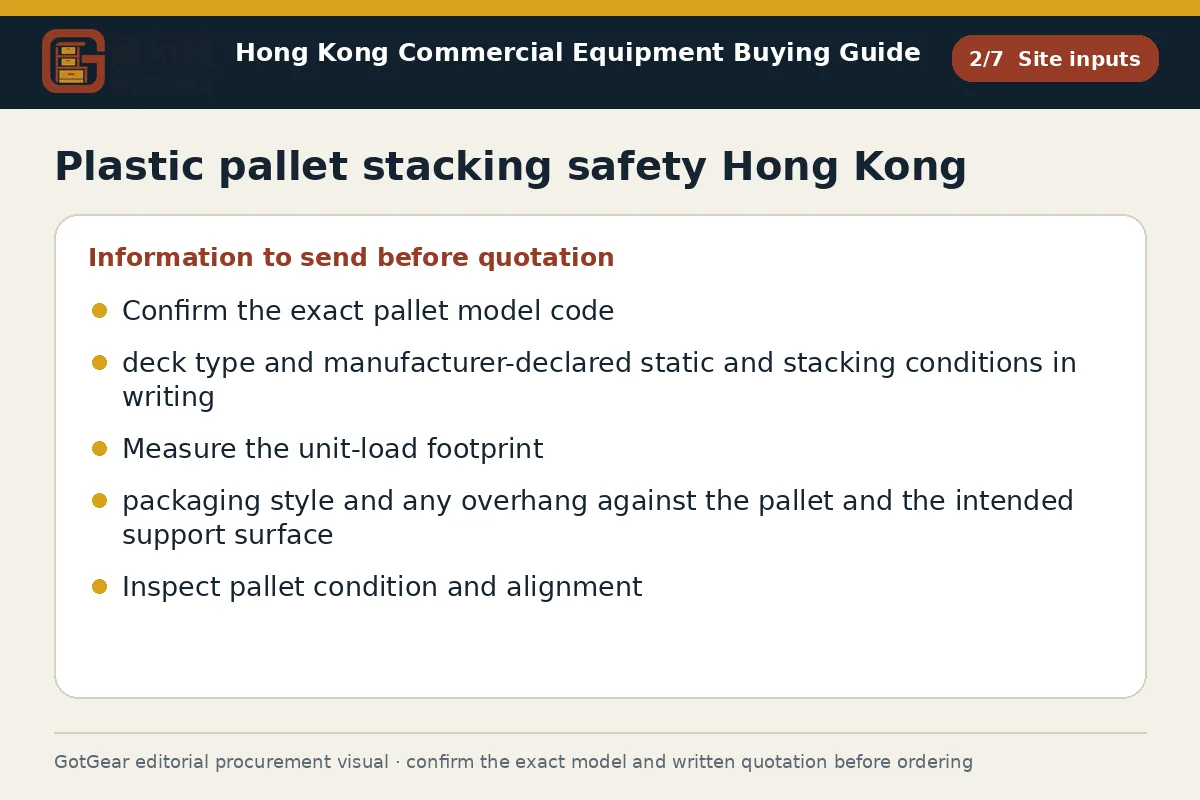
Confirm the exact pallet model code, deck type and manufacturer-declared static and stacking conditions in writing. Measure the unit-load footprint, height, packaging style and any overhang against the pallet and the intended support surface. Inspect pallet condition and alignment, and define the restraint method with verifiable settings. Map the handling route, noting lift-car dimensions, thresholds, slopes and door clearances. Record environmental factors—humidity, condensation and cold rooms—and their impact on packaging stiffness and friction. Ask bidders to state allowable stack configurations, overhang limits, compatible load types and cleaning guidance where applicable. Train crews on stop-work thresholds and bilingual instructions. The signed quotation and manufacturer documents should control.
- Operating use, quantity and expected frequency
- Dimensions, capacity, material and accessory requirements
- Delivery address, floor, goods lift and loading window
- Required documents, acceptance checks and after-sales arrangements
Key points for plastic pallet stacking safety Hong Kong, plastic pallet load stability Hong Kong, plastic pallet anti-slip surface Hong Kong
Hong Kong facilities often rely on goods lifts, narrow corridors and shared loading bays. Before approving any stacked pallet movement, coordinate with building management on lift sizes, loading windows and staging rules in common areas. High humidity, sudden rain and temperature transitions between quay, dock and cold room can reduce carton strength and surface friction, so plan for drying time and enhanced restraint where needed. For public venues or institutions, obtain bilingual instructions and any venue-specific method statements. This summary highlights typical local constraints only; confirm requirements with your site management, competent advisers and the manufacturer’s documentation.
Questions about plastic pallet stacking safety Hong Kong
How do I decide how many pallets high I can safely stack?
Start with the manufacturer’s stacking allowance for the exact pallet model, then validate with supervised trials using your own packaging, restraint and handling route. Reduce limits for mixed loads, weak packaging or wet conditions, and document stop-work criteria. Any example limits you see are only starting points; final approvals must reflect your site, equipment and the written supplier specification.
Does deck type (open vs solid) change how I should stack?
Yes. Solid decks spread load and protect small cartons from sagging into openings, while open decks drain moisture and may suit cold storage. Match deck style to packaging stiffness and hygiene needs, and verify stacking allowances with the manufacturer. If you plan pallet-on-pallet stacks, ask for the recommended contact pattern and any overhang prohibition for the specific model.
Do I need extra anti-slip features or is wrap enough?
It depends on your packaging, humidity and handling path. Where surfaces may be wet or where braking and ramps are involved, specify friction features and confirm with supplier test data. Wrap and straps control containment but do not guarantee friction. Run a short trial under your site conditions and record results before rolling out the setting fleet-wide.
What documents should I request with quotations and deliveries?
Request the pallet model code, deck type, static and stacking allowances, compatible load types, cleaning guidance, and any notes on overhang or contact conditions. Ask for test references supporting restraint or friction claims. On delivery, verify labels, batch or mould codes and condition, and keep bilingual handling instructions attached to the job file. The formal quotation and manufacturer specification should prevail.
Continue with closely related procurement topics
These pages share equipment, operating or decision-stage signals with this guide.
Reusable plastic crates Hong Kong
GotGear explains how reusable plastic crates Hong Kong are issued, sorted and inspected. It also outlines loss management, plastic crate colour coding Hong Kong and plastic crate cleaning and sanitising Hong Kong.
Read the guide
Plastic pallet for airport cargo Hong Kong
GotGear provides a checklist for plastic pallet for airport cargo Hong Kong so air-cargo handlers can record cargo profile, handling equipment, transfer points, restraint, inspection, operating limits and compatibility.
Read the guide
Perforated Euro containers Hong Kong
GotGear provides a checklist to compare perforated Euro containers Hong Kong and vented plastic crates Hong Kong for food handling and cold chain, covering airflow, drainage, containment and cleaning considerations.
Read the guide
Recycled plastic pallets Hong Kong
Use this procurement checklist to inspect recycled plastic pallets Hong Kong by verifying material evidence, load and handling practices, cleaning and reuse protocols, damage control and end-of-use routes. Contact GotGear.
Read the guideRelated topic indexOpen more English procurement pages3 topics
Browse additional equipment families, applications and procurement questions relevant to a wider buying brief.