
Quantify route volumes, cycle time, empty returns, cleaning responsibility and expected loss. Request product and test information relevant to the intended application.
Returnable transport packaging Hong Kong — Quantify Routes, Cycles and Asset Needs
Start by mapping the physical loop. List each origin, cross-dock and delivery point, plus who performs return leg collection at each stop. When scoping returnable transport packaging, Hong Kong buyers should model expected dispatches per lane, dwell time at customer sites, average turnaround for empties and the proportion of confirmed backhauls. As an example starting point only, you might assume two deliveries per outlet per week, a three-day dwell, and 80% of empties captured on backhaul; confirm all figures in the written brief with your partners.
Translate those flows into asset needs. For stackable crates or totes, estimate fleet size from peak daily demand multiplied by the end-to-end cycle time, then add a buffer to cover inspection, cleaning and transit variance. As an illustration only, 100 drops per day with a four-day cycle and a 10% buffer could indicate 440 units; your chosen model specifications and the formal quotation prevail. Note space and access constraints that can reduce stack heights: tight goods-lift doors, low lift ceilings and small van bays in industrial buildings. Record safe stack height assumptions for lifts and trucks after washing because humidity can extend drying time. Hong Kong supermarkets using reusable plastic crates often combine store-room hand carrying with lift travel; confirm external dimensions, loaded weights and grip features to suit these moves.
Returnable transport packaging Hong Kong — Allocate Commercial Responsibilities
Commercial clarity prevents asset losses and disputes. Assign which party counts, sorts and quarantines returns at each touchpoint, and who cleans, repairs and replaces units. If food or pharma is involved, identify the hygiene owner and how cleaning certificates will be shared, subject to the venue or insurer’s requirements. For collapsible pallet containers, Hong Kong operators should define who collapses and straps them for the empty leg, and where any liners are removed and disposed of under site rules.
Set rules for loss and damage. As an example starting point to be confirmed in contract, you might apply a per-item charge for declared loss with a monthly reconciliation, while damage from documented carrier incidents is excluded pending investigation. Decide who controls serial-number assignment and the master register, who buys labels or RFID, and who scans at handover. Require bilingual markings for ownership, asset ID and any safety or hygiene notices. Establish how exceptions are raised, the window for dispute, and the escalation path. Finally, specify change control: who approves specification updates, colour changes or alternative moulds, and how legacy units are phased out. Ensure the final quotation and signed terms supersede planning notes.
What should buyers compare for returnable transport packaging Hong Kong?
| Criterion | Straightforward requirement | More complex requirement | Evidence to provide |
|---|---|---|---|
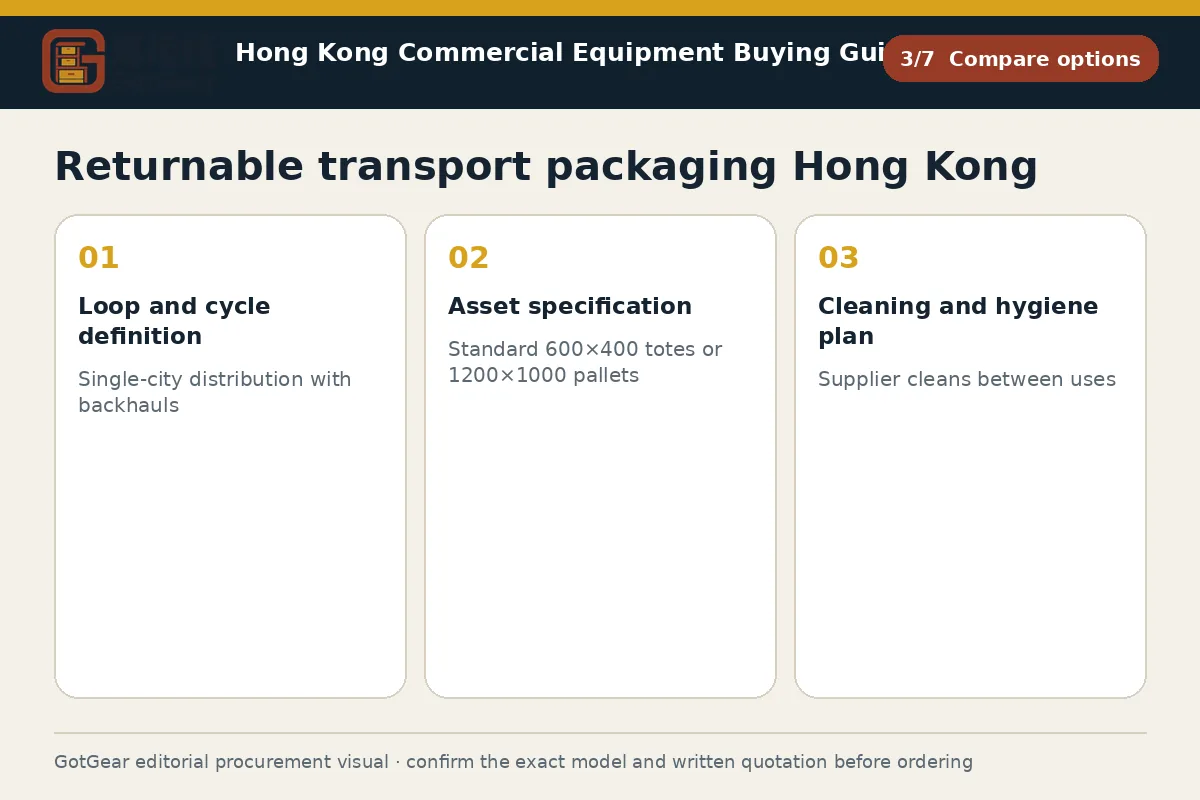
| Loop and cycle definition | Single-city distribution with backhauls | Multi-node loop including cross-boundary and island legs | Lane map, partners list, cycle-time and return-rate assumptions |
| Asset specification | Standard 600×400 totes or 1200×1000 pallets | Mixed footprints or collapsible bulk bins with inserts | Model code, drawing, material, tare, load and temp limits |
| Cleaning and hygiene plan | Supplier cleans between uses | On-site/third-party cleaning with documented SOPs | Cleaning SOP, chemicals/temperature limits, certificate format |
| Tracking and marking | Barcode labels and manual counts | RFID/IoT with portal reads and data sharing | ID ranges, data fields, marking layout and system owner |
| Loss and damage accounting | Per-item chargeback on declared loss | Pooled deposit, investigation window and write-off rules | Policy text, report cadence, evidence requirements, escalation path |
This framework helps buyers create comparable written enquiries. Final model specifications, availability, delivery and commercial terms must be confirmed in a formal quotation.
Returnable transport packaging Hong Kong — Set Comparable RFQ Response Fields
To obtain comparable quotations, issue a structured RFQ form and require every supplier to populate the same fields. Ask for external and internal dimensions with tolerances, tare weight, usable volume, nesting or folding ratio, max recommended stack height and load, and whether racking or conveyor use is supported for the proposed items. For retail distribution totes, Hong Kong teams should also ask for label-holder style, barcode window size, RFID-ready features, and compatibility with common footprints such as 600×400 modules and 1200×1000 pallets.
Request the polymer family and recycled-content percentage, colour and pigment type, operating temperature range, UV stabilisation, antistatic options and cleaning limits, including maximum wash temperature and chemical compatibility. For pallets, request deck pattern, anti-slip features and edge-rack guidance; for recycled plastic pallets, Hong Kong buyers should confirm insurance or customer acceptance of recycled content where applicable. Capture logistics details that affect your buildings: delivery pallet type and height, bundle sizes, wrapping method and the expected vehicle or lift access needed onsite. State that drawings, model specifications and the formal written quotation take precedence, and that you will review a physical sample against the declared fields before approval.
Returnable transport packaging Hong Kong — Request Relevant Supplier Documents
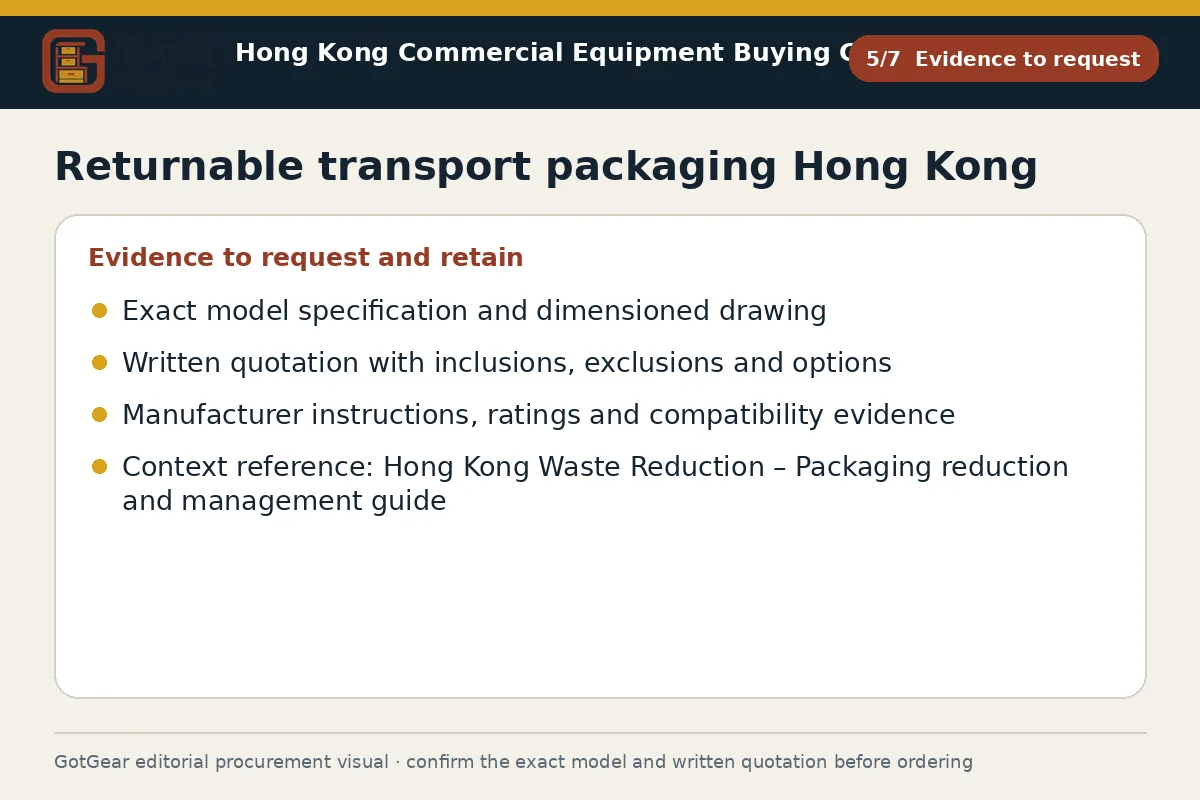
Ask each bidder for a dimensioned drawing with tolerances, a bill of materials identifying resin types and any metal components, and handling and cleaning instructions. Where the application involves food, catering or personal-care goods, request a food-contact statement for the specific model if available from the manufacturer or competent authority. For crates, totes and bulk bins, seek summary test reports where offered, such as stacking, impact or hinge-cycle tests, noting that any example figures must be confirmed in writing for the quoted model.
Request a warranty statement, batch traceability format, factory identification and point of origin, plus a sample of barcodes, label holders or embedded tags for readability checks. If using RFID or other identifiers, ask for the tag specification and proposed serial ranges. On receipt of samples or first shipment, count units and check for warpage, sharp edges, flash, lid and hinge operation, consistent wall thickness, odour, and smooth nesting or folding. As an example starting point only, you might measure key dimensions on a small sample and trial a short stack in your goods lift to verify clearance and stability; agree final sampling and acceptance with the supplier in your written brief. The formal quotation and approved model datasheet prevail.
Returnable transport packaging Hong Kong decision checklist
Confirm the lane map, partners and a shared cycle-time assumption that reflects loading windows, lift access and return compliance. Choose the asset type and footprint that fit your vehicles, store rooms and lifts, and decide on colour, markings and tracking method. Allocate cleaning, inspection, loss and damage responsibilities, with a written escalation path for exceptions. Issue a structured RFQ requesting identical fields from all bidders and plan a sample review against drawings. Request relevant manufacturer documents, test summaries where available and cleaning instructions. Prepare a delivery and staging plan that respects your building’s booking rules. Document any example figures as provisional and let the approved model specification and formal quotation prevail.
- Operating use, quantity and expected frequency
- Dimensions, capacity, material and accessory requirements
- Delivery address, floor, goods lift and loading window
- Required documents, acceptance checks and after-sales arrangements
Key points for returnable transport packaging Hong Kong
Hong Kong loops often pass through multi-tenant industrial buildings with booked loading windows, tight turning space and small goods lifts. Confirm door widths, lift car dimensions and permissible pallet heights before fixing crate and pallet stack assumptions. Humid conditions affect drying time after washing and can influence mould choice and venting. Outlying islands and cross-boundary PRD routes add ferry or customs delays to cycle time; reflect these in fleet sizing and buffer stock planning. Bilingual markings ease store and security checks. This summary highlights practical constraints and is not legal advice.
Questions about returnable transport packaging Hong Kong
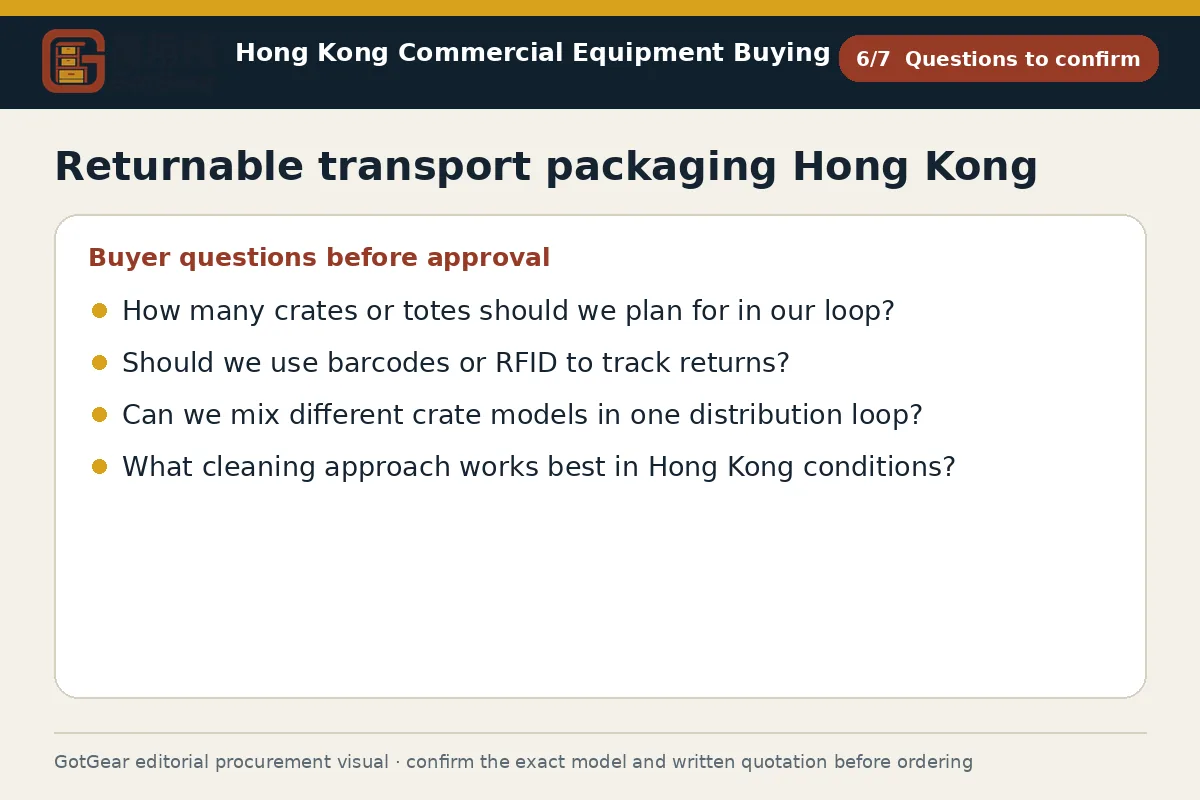
How many crates or totes should we plan for in our loop?
Estimate fleet size from peak daily demand multiplied by end-to-end cycle time, then add a buffer for inspection and variance. As an example only, 100 daily drops over a four-day cycle with a 10% buffer implies around 440 units. Your actual quantity should be confirmed with route partners, building managers and the chosen model’s handling limits in the written brief and quotation.
Should we use barcodes or RFID to track returns?
Barcodes suit low-cost, manual scans and work well for predictable handovers. RFID helps when portals or totes move quickly and you need read-through packaging. Choose based on read points, interference risk and who owns the data. Confirm tag placement, serial ranges and system responsibilities in the contract, and test in your lifts, trucks and stores before rollout.
Can we mix different crate models in one distribution loop?
Mixing is possible but reduces stack stability and complicates counting. If models must mix, define acceptable combinations, verify nesting and stacking compatibility, and mark non-compatible lines clearly. Trial in your actual lift and vehicle configurations. The agreed model specifications and the formal quotation should state compatibility limits and any phasing plan for legacy stock.
What cleaning approach works best in Hong Kong conditions?
If space and ventilation are limited, third-party washing with documented procedures is often practical. In-house washing can work if you can dry fully before stacking or lift travel; humidity lengthens drying time. Confirm chemical compatibility and maximum temperatures with the manufacturer’s instructions, and agree who holds hygiene records if your venue, client or insurer requests them.
Continue with closely related procurement topics
These pages share equipment, operating or decision-stage signals with this guide.
Reusable plastic crates Hong Kong
GotGear explains how reusable plastic crates Hong Kong are issued, sorted and inspected. It also outlines loss management, plastic crate colour coding Hong Kong and plastic crate cleaning and sanitising Hong Kong.
Read the guide
Euro containers Hong Kong
GotGear lists dimensions, volume and unit weight for Euro containers Hong Kong so you can compare sizes and specifications. Browse Euro containers with lids Hong Kong and Euro containers with partitions Hong Kong.
Read the guide
Perforated Euro containers Hong Kong
GotGear provides a checklist to compare perforated Euro containers Hong Kong and vented plastic crates Hong Kong for food handling and cold chain, covering airflow, drainage, containment and cleaning considerations.
Read the guide
Open front storage bins Hong Kong
Choose open front storage bins Hong Kong by assessing reach zones, item dimensions, refill access and shelf depth. Compare picking bins Hong Kong and shelf storage bins Hong Kong with guidance from GotGear.
Read the guideRelated topic indexOpen more English procurement pages2 topics
Browse additional equipment families, applications and procurement questions relevant to a wider buying brief.