
What should a site trial measure? Use a representative load to compare starting force, continuous rolling, turning, vibration, noise and grip, then verify the rated configuration, maintenance instructions and site-specific risk assessment.
How to choose trolley wheels for Hong Kong warehouse floors — Compare floor and load evidence
Operations managers often ask how to choose trolley wheels for Hong Kong warehouse floors. Start with evidence from your own routes. Note floor make‑up by zone: power‑floated concrete, epoxy coatings, tiles in lift lobbies, steel at thresholds, drainage grates, and outdoor aprons. Record joint spacing, crack width, step height at docks and goods‑lift sills, and any ramps. Flag wet areas from wash‑downs or condensation, plus cleaning agents that could attack rubber or polyurethane. Photograph debris traps where small wheels jam. In older industrial buildings, tight corners before lift cars and limited booking windows can determine what you can trial and when.
Define loads by route, not model. List typical and peak consignment weights, dimensions, and centre‑of‑gravity risks. Describe duty cycle: distance per trip, number of trips in a shift, and whether trolleys sit parked under heavy static load overnight, which can flat‑spot softer treads. Provide pallet type or crate foot details to judge point loads and shock over joints. In the enquiry, ask suppliers to state per‑castor dynamic and static ratings, wheel material and hardness (with Shore scale), bearing type, and chemical compatibility. Attach a sketch with key dimensions and photos; your materials handling equipment checklist Hong Kong helps structure this. Request bilingual datasheets for coordination with management offices and supervisors.
How to choose trolley wheels for Hong Kong warehouse floors — Review diameter, tread and castor layout
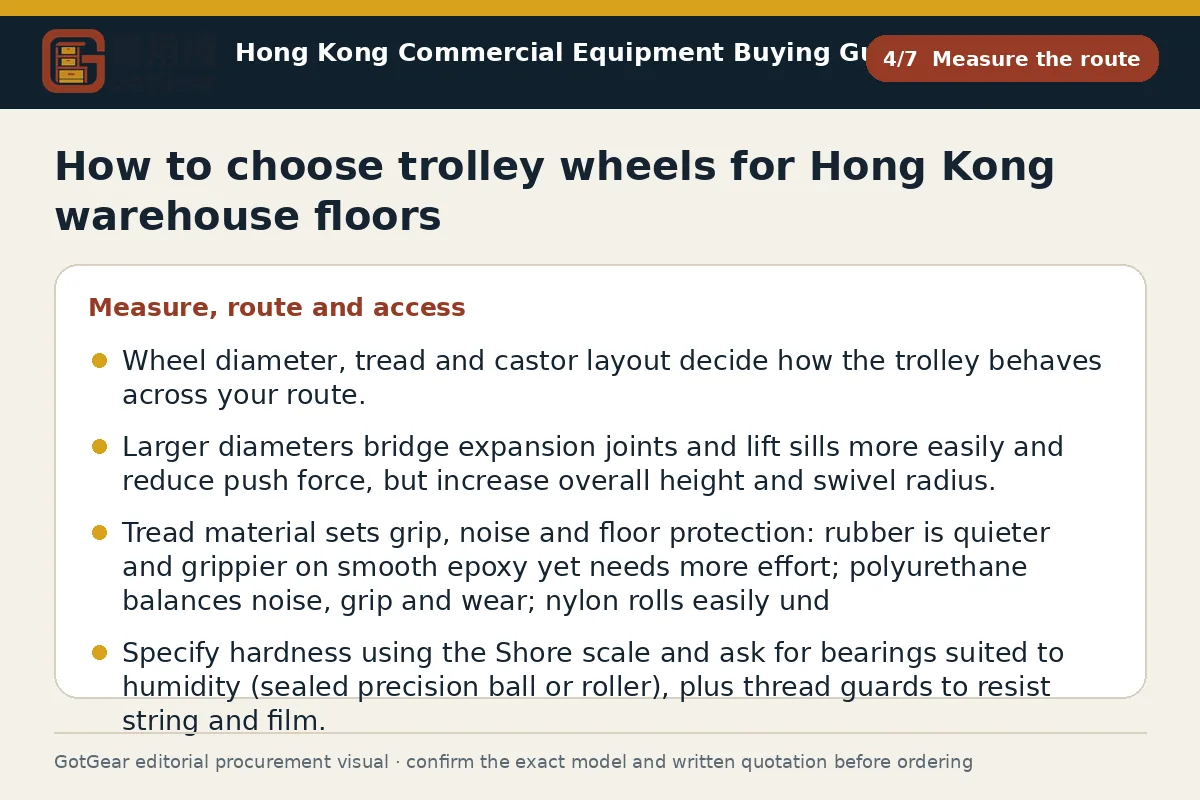
Wheel diameter, tread and castor layout decide how the trolley behaves across your route. Larger diameters bridge expansion joints and lift sills more easily and reduce push force, but increase overall height and swivel radius. Tread material sets grip, noise and floor protection: rubber is quieter and grippier on smooth epoxy yet needs more effort; polyurethane balances noise, grip and wear; nylon rolls easily under load but is harsh and louder, and can slip on wet resin floors. Specify hardness using the Shore scale and ask for bearings suited to humidity (sealed precision ball or roller), plus thread guards to resist string and film.
Layout matters as much as material. Two fixed with two swivel castors track well on long, straight runs; all‑swivel boosts manoeuvrability in tight lobbies, especially before goods‑lift doors, but can wander unless you add directional locks. Twin‑wheel castors spread load and help on uneven joints. In your specification, state wheel diameter and tread width (mm), Shore hardness, bearing type, swivel radius limit, brake type (wheel or total lock), kingpinless or kingpin frame, mounting plate size and bolt pattern. Check turning circles against your warehouse shelving access aisle planning Hong Kong so the chosen layout actually clears racking and lift cars.
What should buyers compare for how to choose trolley wheels for Hong Kong warehouse floors?
| Criterion | Straightforward requirement | More complex requirement | Evidence to provide |
|---|---|---|---|
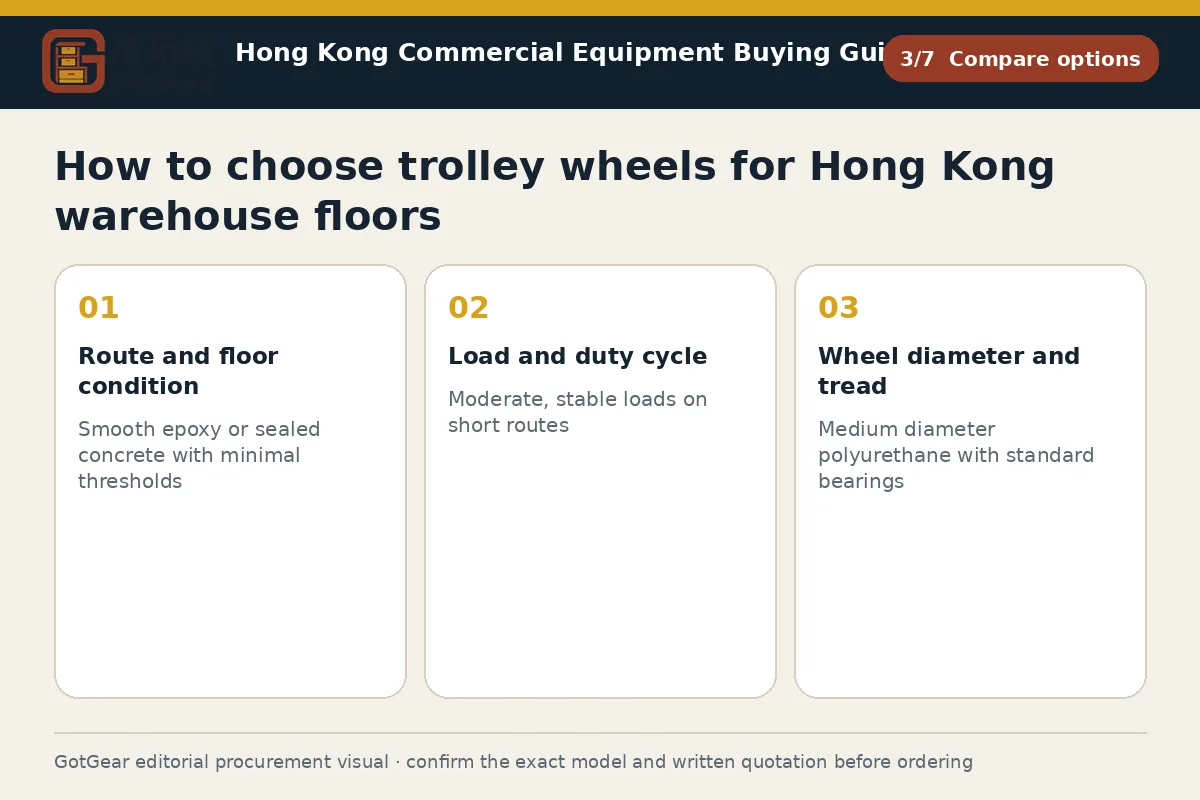
| Route and floor condition | Smooth epoxy or sealed concrete with minimal thresholds | Mixed floors, expansion joints, steel thresholds, outdoor aprons and wet patches | Annotated route map with photos; joint spacing/width; threshold heights; ramp gradients; cleaning chemicals |
| Load and duty cycle | Moderate, stable loads on short routes | Heavy peaks, high duty, long static parking, high centre of gravity or shock over joints | Gross and typical loads per route; duty cycle; parking duration; footprint and CoG notes |
| Wheel diameter and tread | Medium diameter polyurethane with standard bearings | Larger diameter; softer rubber for noise; harder nylon for low resistance; sealed bearings; antistatic or stainless options | Requested diameter/tread width (mm); material and Shore hardness; bearing type; chemical‑compatibility info |
| Castor layout and brakes | 2 fixed + 2 swivel with total‑lock brakes | All‑swivel with directional locks; twin‑wheel castors; 6‑point layouts for long platforms | Layout diagram; maximum swivel radius; mounting plate size/bolt pattern; brake type needed |
| Noise and rolling resistance evidence | Supplier provides typical push/pull and noise figures | Site trial across your route with measured forces, dB, grip and vibration logs | Test method statement; instrument used; trial data sheet; sample maintenance plan and inspection steps |
This framework helps buyers create comparable written enquiries. Final model specifications, availability, delivery and commercial terms must be confirmed in a formal quotation.
How to choose trolley wheels for Hong Kong warehouse floors — Balance rolling resistance and noise
Rolling resistance and noise often pull in opposite directions. Harder, narrower treads and larger diameters reduce starting and sustained push forces. Softer or wider treads cut vibration and impact noise, protect floors and improve wet‑surface grip, but they can increase effort and risk flat‑spotting under long static loads. Precision bearings, quality swivel heads and correctly sized castor races reduce friction without changing tread hardness. Consider site context: many Hong Kong industrial buildings share walls with offices, schools or residential blocks, where noise and vibration through slabs may be sensitive during daytime or evening deliveries.
Ask suppliers for quantified data, not adjectives. Request push/pull figures (starting and rolling) and the method used, plus indicative noise readings taken on floor types similar to yours. As an example starting point only, for a trial load of 500 kg you might target a starting force near 180 N, to be confirmed by the responsible supplier after route review. Compare written quotations on like‑for‑like fields: diameter, tread material and Shore hardness, bearing type, per‑castor dynamic and static ratings, brake style, and any anti‑static or stainless options. Clarify maintenance instructions covering tread wear, bearing lubrication or sealed units, and cleaning‑chemical compatibility; the model specification and formal quotation prevail.
How to choose trolley wheels for Hong Kong warehouse floors — Trial the rated configuration
A structured site trial validates the paper choice. Prepare a representative load and weigh it. Use a calibrated force gauge to capture peak push‑off and steady rolling forces over your exact route, including ramps, joints and lift thresholds. Mark a standard turning circle and assess manoeuvrability with the proposed castor layout, testing both loaded and unloaded. Note grip on any damp patches and the risk of wheel‑spin or floor scuffing. Log vibration and noise with consistent positioning of a basic sound app for comparison, then translate findings into actions within your manual handling risk assessment for warehouse trolleys Hong Kong.
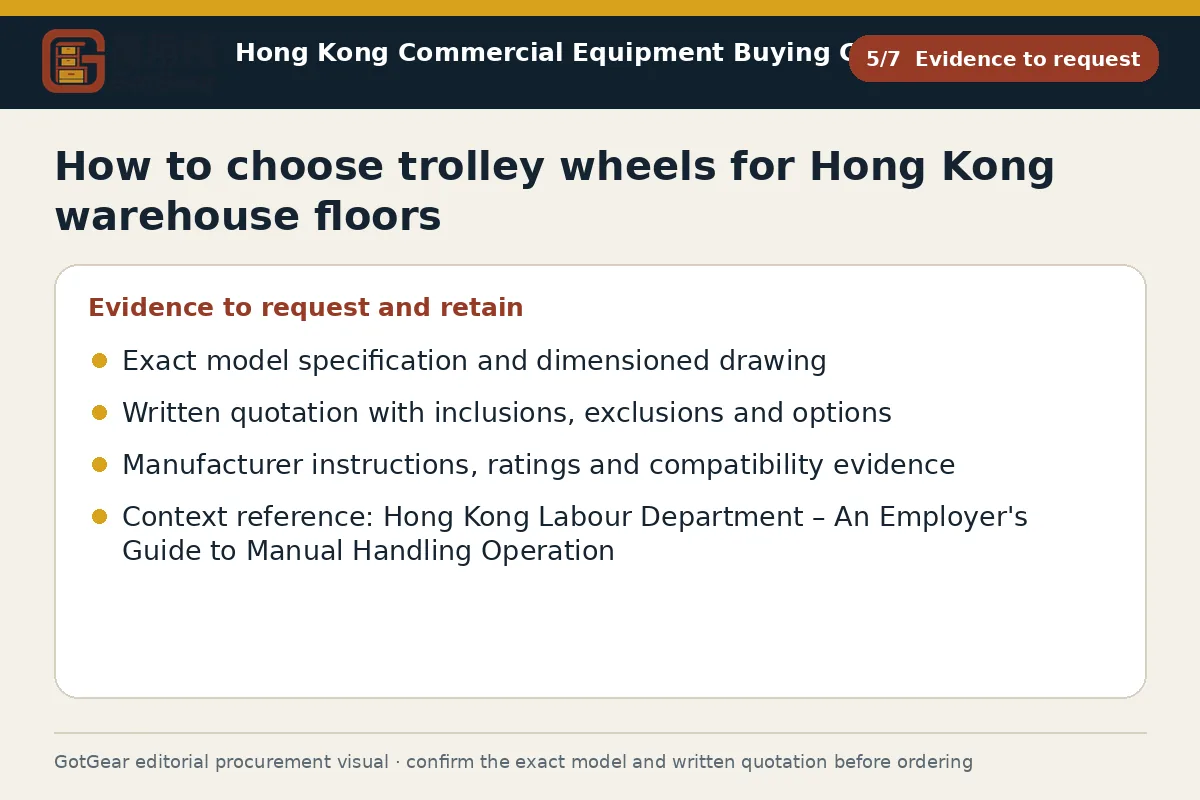
Before placing an order, confirm the “rated configuration” in writing: wheel diameter, tread material and hardness, bearing type, castor frame and brake, plus per‑castor static/dynamic ratings. On receipt, inspect: correct plate/bolt pattern against drawings; wheel size and width; hardness marking; bearing type; smooth swivel and brake hold; presence of thread guards; corrosion or shipping damage, given Hong Kong humidity. Request documentation when relevant: product datasheets, rolling‑resistance test method, chemical‑resistance statement, cleaning instructions, any ESD or stainless claims, and bilingual manuals for building‑management or institutional approval. Keep trial notes with photos to justify your selection internally.
How to choose trolley wheels for Hong Kong warehouse floors decision checklist
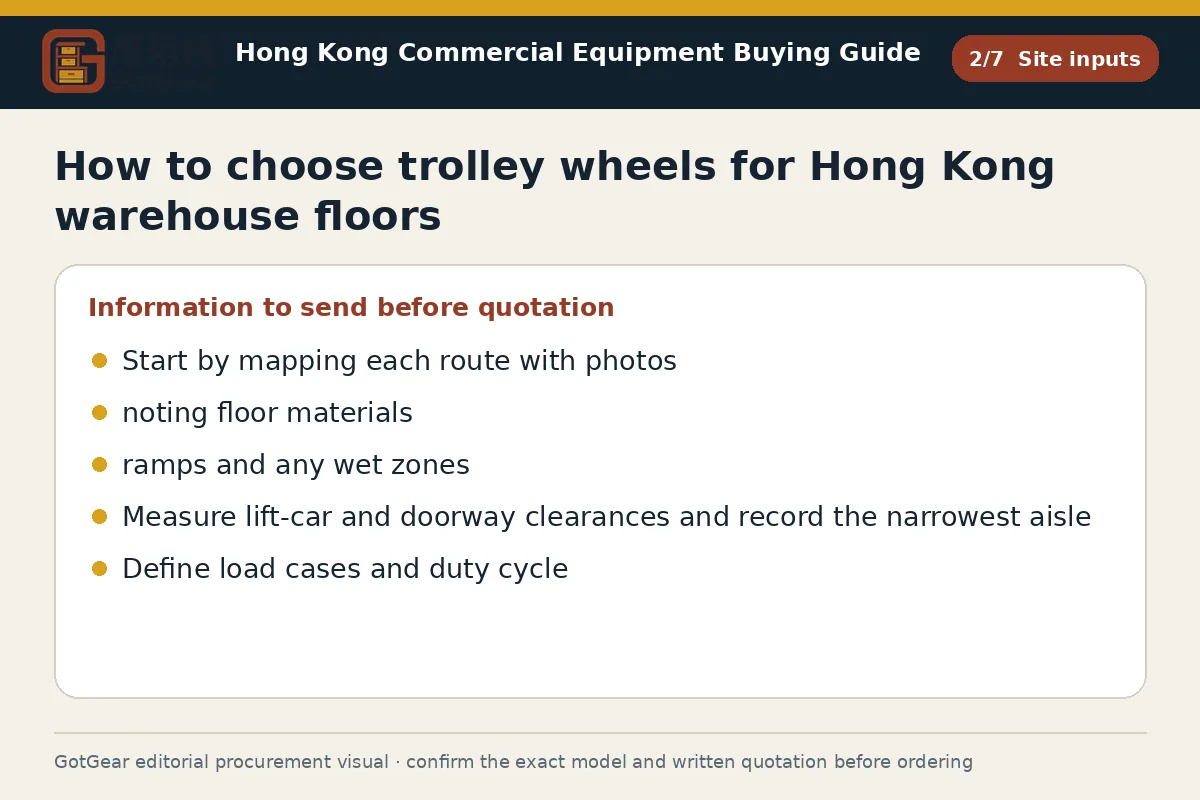
Start by mapping each route with photos, noting floor materials, joints, thresholds, ramps and any wet zones. Measure lift‑car and doorway clearances and record the narrowest aisle. Define load cases and duty cycle, including static parking periods that may cause flat‑spots. Shortlist diameter, tread and bearing types that fit those routes. Choose a castor layout that matches aisle and lift constraints, and specify swivel radius and brake style. Request per‑castor static/dynamic ratings, Shore hardness, sealed‑bearing options and chemical‑compatibility notes, all stated in a formal quotation. Run a site trial with a representative load, logging forces, turning behaviour, noise, grip and vibration. Coordinate times with building management and prepare bilingual notes. On receipt, inspect identity, dimensions, bearings, brakes and finish, and file maintenance instructions. The model specification and written quotation prevail.
- Operating use, quantity and expected frequency
- Dimensions, capacity, material and accessory requirements
- Delivery address, floor, goods lift and loading window
- Required documents, acceptance checks and after-sales arrangements
Key points for how to choose trolley wheels for Hong Kong warehouse floors
Hong Kong warehouse routes typically mix epoxy‑coated slabs, tiled lift lobbies and sharp goods‑lift sills, with tight turning spaces and booking windows managed by building offices. Humid summers and salt‑laden air can corrode unprotected bearings and fasteners, so sealed units and stainless hardware may be prudent in waterfront or open‑dock sites. Noise control in mixed‑use industrial buildings also matters, especially near offices or schools. Keep bilingual documentation ready for management approval and security checks. For cross‑facility moves into hospitality areas, align procedures with any hotel housekeeping trolley workflow Hong Kong. This summary is operational guidance, not legal advice.
Questions about how to choose trolley wheels for Hong Kong warehouse floors
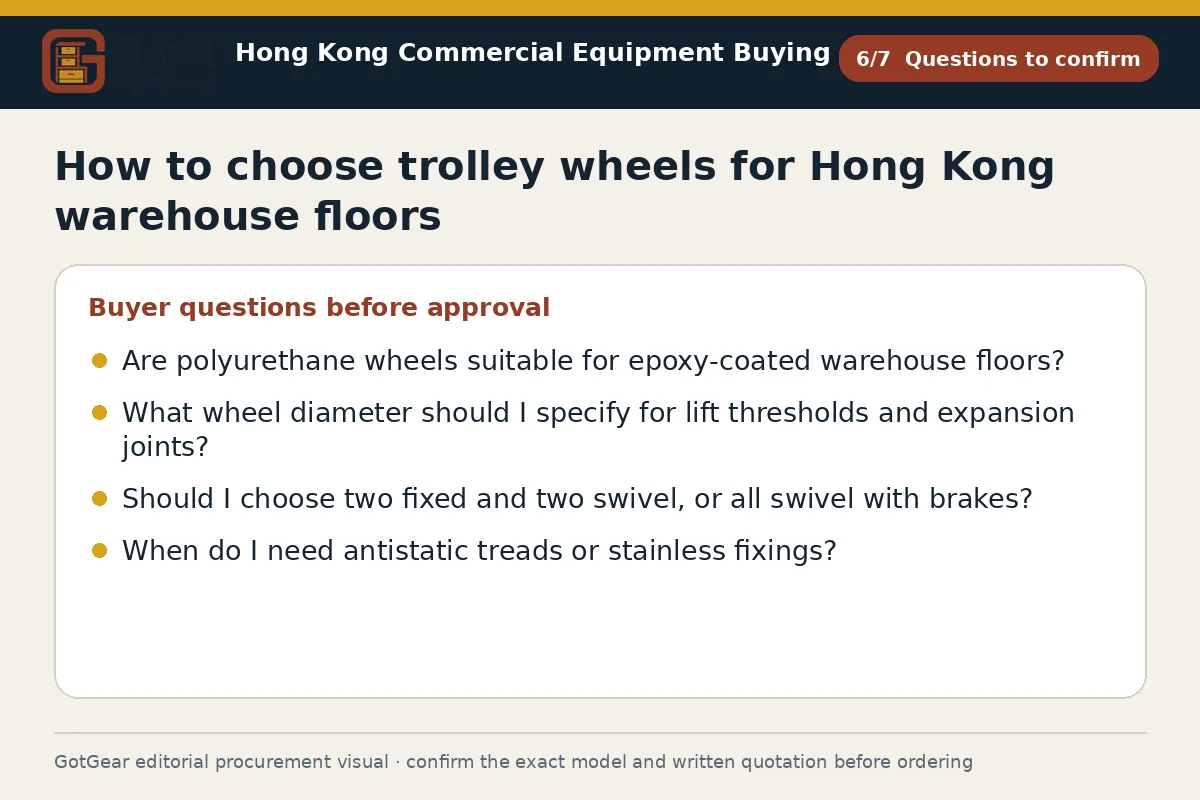
Are polyurethane wheels suitable for epoxy‑coated warehouse floors?
Often yes: polyurethane balances rolling effort, noise and wear on epoxy, with less risk of floor marking than rubber and less noise than nylon. Confirm hardness (Shore A or D), load per castor and chemical compatibility against your cleaners. If floors get wet, verify grip and braking in a site trial. Flat‑spot risk under long static loads should also be discussed with the supplier.
What wheel diameter should I specify for lift thresholds and expansion joints?
Larger diameters bridge gaps and reduce push effort over sills and joints, but increase overall height and swivel radius in tight lift cars. As an example starting point only, you might review 160–200 mm with your supplier after measuring thresholds and turning space. Confirm fit against lift dimensions, mounting height, and the castor’s stated swivel radius in the written quotation.
Should I choose two fixed and two swivel, or all swivel with brakes?
For long, straight runs, two fixed plus two swivel tracks well and needs less correction. In cramped lobbies and aisles, four swivel can help, ideally with directional locks to control wander. Total‑lock brakes stabilise loading. The right option depends on aisle width, turning space, and operator practices; test both layouts on your route with the representative load before confirming the specification.
When do I need antistatic treads or stainless fixings?
Specify antistatic or conductive wheels where electrostatic discharge could harm goods or ignite vapours, and stainless or treated hardware in humid, corrosive, catering or clean‑area conditions. Confirm any claim with the manufacturer’s datasheet and, if your venue, insurer or authority requires, supporting documents. Compatibility with cleaning chemicals and floor coatings should be stated in writing in the final quotation.
Continue with closely related procurement topics
These pages share equipment, operating or decision-stage signals with this guide.
Boltless shelving vs longspan shelving Hong Kong
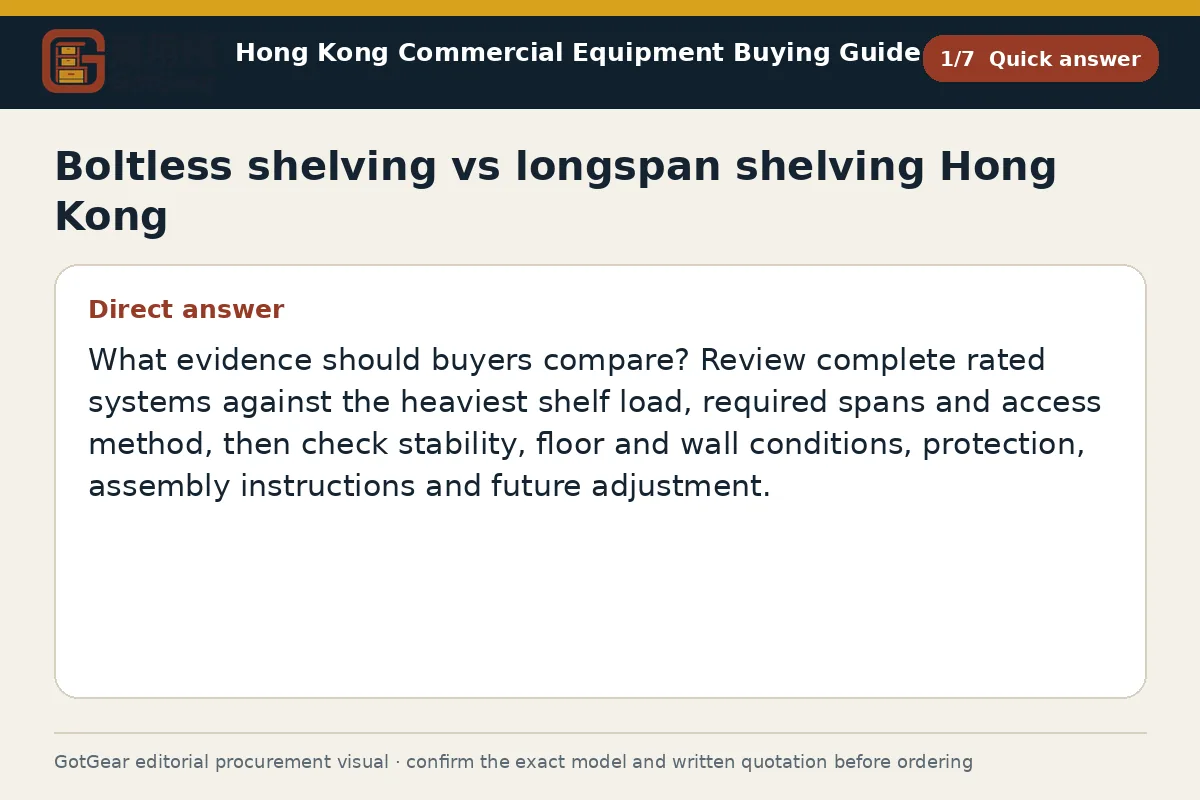
Boltless shelving vs longspan shelving Hong Kong compares load capacity, bay span, access, adjustability, stability, floor and wall fixing, and reconfiguration in a practical guide from GotGear.
Read the guide
Pegboard vs gridwall display Hong Kong
This GotGear guide to pegboard vs gridwall display Hong Kong compares merchandise size, accessory fit, display density, wall condition, fixing method and change time to support your selection.
Read the guide
Manual handling risk assessment for warehouse trolleys Hong Kong
When should a Hong Kong warehouse use a trolley instead of manual carrying? GotGear has manual handling risk assessment for warehouse trolleys Hong Kong and warehouse trolley route planning Hong Kong.
Read the guide
How to compare commercial equipment suppliers in Hong Kong
GotGear shows how to compare commercial equipment suppliers in Hong Kong by checking specifications, intended use and lead time. It explains how to compare commercial equipment quotations in Hong Kong.
Read the guideRelated topic indexOpen more English procurement pages3 topics
Browse additional equipment families, applications and procurement questions relevant to a wider buying brief.