
For waste bin replacement lids Hong Kong, use the original part reference where available and compare all stated dimensions and attachment details. Ask the manufacturer or supplier to confirm compatibility with the exact bin model before purchase.
Identify the bin before comparing waste bin replacement lids Hong Kong
When shortlisting waste bin replacement lids Hong Kong, always start with clear identification of the existing container. Photograph the bin from front, side, top, and base; include close‑ups of brand badges, moulded stamps under the rim, barcode labels and any bilingual capacity marks. Note the container family (round, square, rectangular, slim), nominal volume where stated, and whether the original lid was flat, hinged, swing, flapped, or hooded. Record the lid colour and any stream iconography in both English and Chinese to maintain site standards and avoid confusion at collection points.
Log where the bin is deployed (canteen, corridor, podium, goods yard) and who controls approval for changes. In humid Hong Kong conditions, decals can fade; capture legible details immediately and keep images with date/time. If the bin sits on a dolly or nests under a counter, note clearance above the rim and any obstruction from walls or dispensers. Identify if the bin belongs to a matched line (e.g., slim waste bins Hong Kong used in a bank of stations) so replacements maintain a consistent look. For older stock, ask housekeeping or stores if original purchase records list a part number; even a partial model name can speed up supplier confirmation.
Match openings and waste streams with waste bin replacement lids Hong Kong
Choose the opening to match the waste stream and on‑site behaviour, not just the look. Round apertures support bottles and cans; slots help with paper; flaps or swing doors control odour and conceal contents; large rectangles suit general waste. Specify the aperture dimensions, not only the style—e.g., a paper slot nominal width and thickness—as different manufacturers’ “paper” lids vary. If using colour coding, state the exact colour tone and whether icons are moulded, printed, or stickered, and whether bilingual text is required.
For venues with public footfall or events, prefer robust hinges and shrouded openings that discourage contamination, and request smooth internal surfaces for easier wipe‑down. Where pests are a concern, avoid permanently open apertures outdoors; a hooded design may be more suitable, similar to hooded waste bins Hong Kong commonly uses on podiums. Confirm liner compatibility: note liner gauge and drawstring placement so the aperture, retainer band or cinch features do not snag. Ask suppliers for cleaning guidance (compatible disinfectants, abrasion resistance) and whether the surface finish is matte or gloss, as this affects visibility of fingerprints and scuffs in front‑of‑house areas.
What should buyers compare for waste bin replacement lids Hong Kong?
| Criterion | Straightforward requirement | More complex requirement | Evidence to provide |
|---|---|---|---|
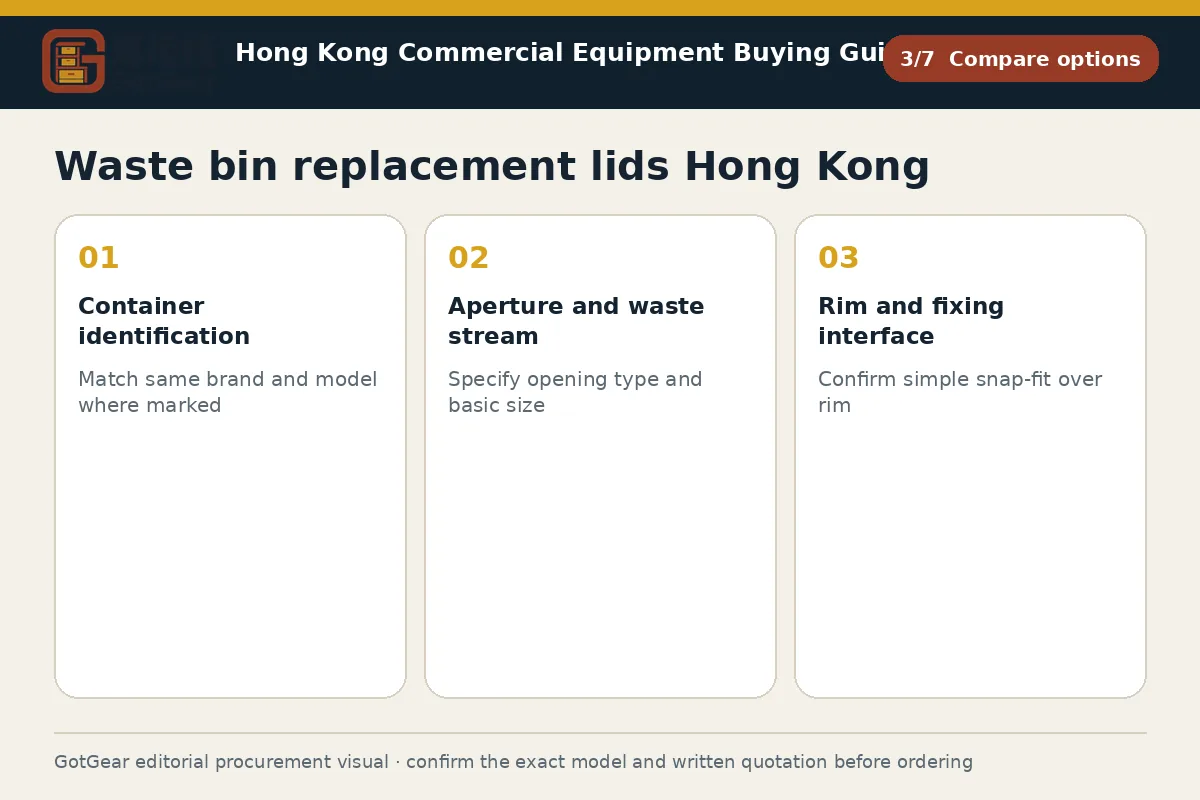
| Container identification | Match same brand and model where marked | Cross‑reference unlabelled bins via photos and rim profile | Provide photos of stamps, labels, full bin, location and capacity marks |
| Aperture and waste stream | Specify opening type and basic size | Define exact aperture dimensions, colour tone and bilingual iconography | Submit required measurements, colour reference, artwork method and examples |
| Rim and fixing interface | Confirm simple snap‑fit over rim | Detail lip thickness, seating diameter and hinge/screw specs | Send dimensioned sketch with all measurements and attachment notes |
| Material and environment | Indoor use with standard polymer | Outdoor/kitchen use needing UV stability or special finishes | Request material grade, UV/additive statements and cleaning guidance in writing |
| Commercial and documentation | Basic quote listing part name and quantity | Formal quotation stating part number, revision, dimensions, attachments, packaging and returns | Attach required confirmations; quote must reference your bin model and measurements |
This framework helps buyers create comparable written enquiries. Final model specifications, availability, delivery and commercial terms must be confirmed in a formal quotation.
Measure rim and fixing points for waste bin replacement lids Hong Kong
Measure the interface before comparing options. For rectangular or slim containers, record the outer rim length and width, the inner lip dimensions, rim thickness, and any corner radii. For round bins, capture the outer diameter, inner seating diameter, and the depth the lid must overlap the body. Note hinge‑lug spacing, slot size, screw thread type (if present), and whether the lid relies on snap‑fit ribs. Sketch the rim profile and mark measurements. Example starting points only: rectangular rim 270 mm × 495 mm; circular seating 320 mm diameter—always confirm against the supplier’s drawing.
Check site constraints that influence the lid choice. If the bin slides under a counter, measure the free height from floor to underside and ensure the new lid, especially with domes or flaps, will clear. Where bins are mounted on bin dollies for mobility in facilities in Hong Kong, verify that any added lid height or overhang does not foul handrails or doorways. For delivery into industrial buildings, ask the supplier to state packed dimensions and weight so management offices can book goods‑lift access and loading windows. Request a dimensioned lid drawing with tolerances and attachment details in writing; the model specification and the supplier’s formal quotation must prevail over informal notes.
Confirm part references before buying waste bin replacement lids Hong Kong
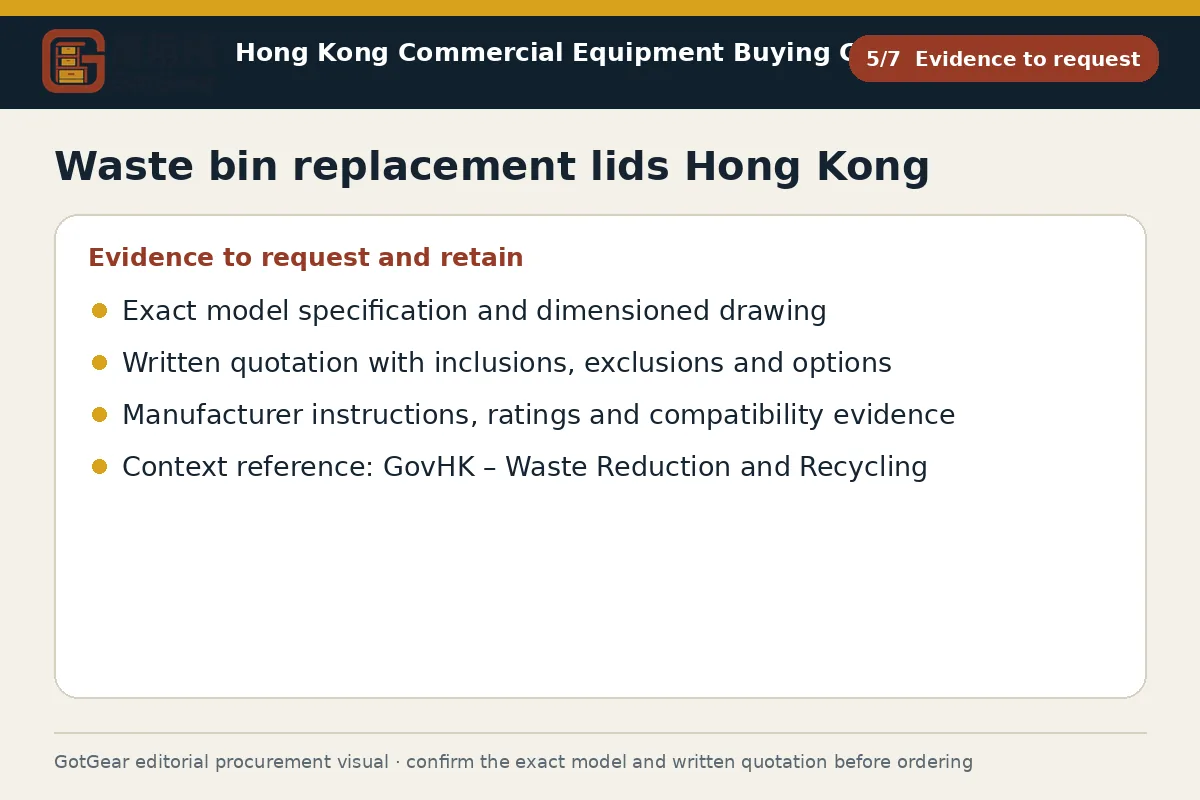
Before placing an order, tie the proposed part back to an authoritative reference. Quote the manufacturer’s part number, colour code, aperture style code and revision letter exactly as written. Where the original make is unknown or obsolete, ask for a cross‑reference and drawings showing attachment type, key dimensions and materials. Request written confirmation that the lid fits the exact bin model in your photos and measurements, and that any required bilingual stream labels are included or available.
If lids will be outdoors or near kitchens, ask whether the polymer is UV‑stabilised, impact‑modified, or includes anti‑microbial additives, and request supporting documentation if your venue or insurer requires it. For food‑adjacent use, seek hygiene guidance from the manufacturer; for malls or schools, check if management requests flame‑behaviour information for enclosed areas. Ensure the quotation lists material, aperture, colour, attachment method, MOQ, lead time and return terms. On receipt, inspect for warping, cracks, colour variance, burrs in apertures, correct hinges/fasteners, and included labels. Test‑fit on one bin before removing protective film or distributing to sites. Keep packaging until acceptance, and file all confirmations; formal specifications and the written quotation govern any dispute.
Waste bin replacement lids Hong Kong decision checklist
Confirm the bin’s identity with photos of brands, mould stamps and labels, plus location notes. Record rim measurements, fixing points and aperture needs; sketch the rim profile and mark dimensions. Specify stream iconography, bilingual text and precise colour tone. Request a dimensioned drawing, material description, attachment method and finish from the supplier. Ask for written confirmation of fit to your exact model, plus stated lead time, packaging dimensions and return terms. Coordinate delivery with the management office for goods‑lift booking. On arrival, inspect for damage, verify measurements against the drawing, check labels and hardware, and test‑fit one lid before deploying. The model specification and written quotation take precedence.
- Operating use, quantity and expected frequency
- Dimensions, capacity, material and accessory requirements
- Delivery address, floor, goods lift and loading window
- Required documents, acceptance checks and after-sales arrangements
Key points for waste bin replacement lids Hong Kong
Hong Kong sites often have tight back‑of‑house corridors, narrow goods‑lifts and managed loading bays. Ask suppliers to state packed lid size and weight so building management can schedule delivery windows and escort, especially in industrial buildings or malls. Humid conditions and rooftop exposure can age plastics; if lids are for podiums or schools’ outdoor areas, consider UV‑stabilised materials and ask for care guidance. Bilingual labels reduce sorting errors where contractors rotate staff. This is practical procurement guidance, not legal advice—confirm project‑specific requirements with the venue, insurer or competent adviser.
Questions about waste bin replacement lids Hong Kong
Can a lid from a different brand fit my bin?
Sometimes, if the rim dimensions, fixing method and aperture style match precisely. Obtain a drawing and written confirmation that the proposed part fits your exact bin model and measurements. Where uncertainty remains, request a sample or a test‑fit plan on one unit before committing to a larger quantity; formal specifications in the quotation should govern.
How do I measure for a circular bin lid accurately?
Measure the outer rim diameter, the inner seating diameter where the lid rests, and the overlap depth you need for stability. Note any hinge lug spacing or snap‑fit ribs. Use calipers where possible and sketch the profile. Example starting points only: seating 320 mm, overlap 12 mm—confirm all sizes against the supplier’s drawing and quotation.
Will colour and stream labels match our existing stations?
Not always; colour pigments and surface gloss vary across manufacturers. Provide a physical swatch or a specified tone and require supplier confirmation of the closest match, plus sample images. For public‑facing stations, ask for bilingual artwork proofs and adhesive specifications. Final acceptance should be based on approved samples and the written quotation details.
What should I choose for outdoor or kitchen‑adjacent lids?
Prefer UV‑stabilised, impact‑resistant polymers for outdoor use and consider covered or hooded apertures to limit ingress and odour. Near kitchens, request cleaning guidance and chemical compatibility. If your venue or insurer requires additional evidence (e.g., hygiene or material data), ask the manufacturer for documents. Confirm details in the quotation and verify on receipt before deployment.
Continue with closely related procurement topics
These pages share equipment, operating or decision-stage signals with this guide.
Mop frame Hong Kong
Select the correct mop frame Hong Kong by checking the attachment type, dimensions, handle connector and pad or head format to confirm it fits mop replacement heads Hong Kong. Refer to the GotGear checklist for buyers.
Read the guide
Waste stream labels Hong Kong
When specifying waste stream labels Hong Kong, confirm accepted materials, wording, colours, visibility and bin location. Pair recycling bin stickers Hong Kong with larger recycling bin signage Hong Kong for guidance from GotGear.
Read the guide
Battery recycling bins Hong Kong
GotGear checklist for battery recycling bins Hong Kong specifies a separate collection point and outlines accepted battery types, storage and labelling, assigned handlers and the designated receiver.
Read the guide
Fluorescent lamp recycling bins Hong Kong
GotGear provides a checklist for fluorescent lamp recycling bins Hong Kong to confirm accepted lamp types, collection routes, site access controls, responsible handlers and steps to reduce breakage.
Read the guideRelated topic indexOpen more English procurement pages3 topics
Browse additional equipment families, applications and procurement questions relevant to a wider buying brief.