
Specify the wet load, drainage and containment method, temperature range, handling equipment, cleaning process and return route. Verify material suitability with the manufacturer.
Seafood crates Hong Kong — Define Drainage, Containment and Temperature Needs
For seafood crates, teams in Hong Kong should begin by classifying each product stream: live with water, iced whole fish, fillets with meltwater, or dry‑chilled packs. Estimate the wet load (ice, slush, purge and rinse water) and note if brine is used. Record whether containment must be sealed (no drips permitted), partially drained (controlled outflow via plug), or free‑draining. Measure the internal usable volume required per SKU, and list any liners, absorbent pads or dividers. Confirm the handling path: bench to tote, tote to dolly, dolly to pallet, and vehicle deck to cold store rack, then state where drainage is acceptable or prohibited.
Define your target temperature band for service and cleaning. Note any exposure to short blast‑chill, deep‑chill or overnight cold storage. Specify detergent type and maximum wash temperature you plan to use so the supplier can confirm compatibility. If rapid chilling and drip‑through are required, assess vented plastic crate options in Hong Kong against solid‑wall models with plugs and lids. Request drawings that show perforation pattern and drain‑ports, and ask for the diameter and location of any plugs as a specification field. Where building managers restrict water on shared corridors, document those rules early to guide the choice between free‑draining, plug‑drained and fully sealed configurations.
Seafood crates Hong Kong — Match Construction to Product and Packed Weight
Match the crate construction to the heaviest packed unit you will carry and to how often it will be re-used. Ask the supplier to state the resin (e.g., HDPE or PP), any impact modifiers, and the operating temperature range. Request external and internal dimensions, tare mass, wall thickness at ribs and panels, base type (perimeter rib, cruciform or full lattice), and the stacking load rating with the test method. As an example starting point only, some buyers explore a 20 kg payload per crate and five layers high on a pallet; your written brief and the manufacturer’s quotation must confirm the safe limit.
Check handle design (open, closed, gloved-grip), rim stiffness, and whether lids are clip-on or hinged. Specify surface finish for hygiene (smooth, radiused corners) and ask for details on label plates, card holders and embossing. For cold-storage plastic crates, operations teams in Hong Kong should confirm anti-brittle performance at your lowest working temperature and whether impact testing was done at that condition. On receipt, inspect for warpage on a flat table, check base deflection with a trial load, ensure plugs and lids fit without gaps, and look for sharp edges or flashing. If your site requires it, request a food-contact material declaration and cleaning/chemical-compatibility guidance, and keep bilingual documents on file.
What should buyers compare for seafood crates Hong Kong?
| Criterion | Straightforward requirement | More complex requirement | Evidence to provide |
|---|---|---|---|
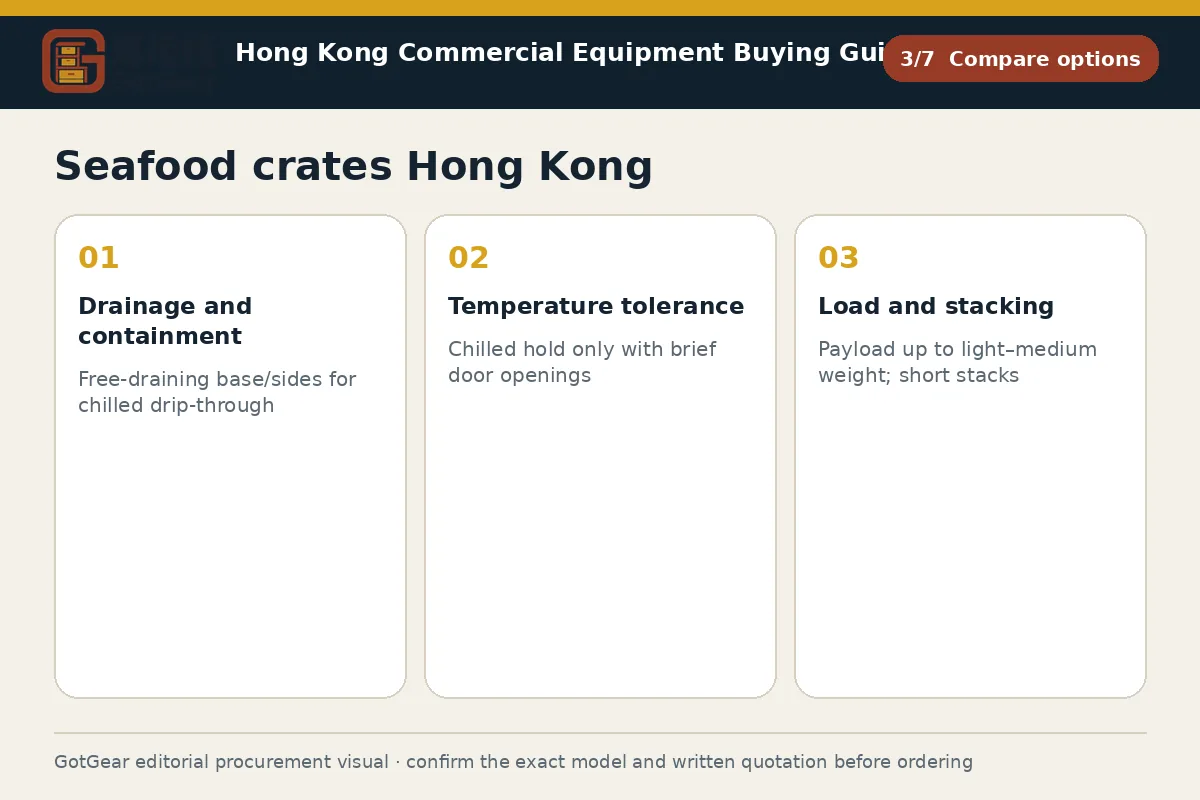
| Drainage and containment | Free-draining base/sides for chilled drip-through | Sealed base with drain plug and gasketed lid | Meltwater estimate, brine use, building spill policy |
| Temperature tolerance | Chilled hold only with brief door openings | Deep-chill or short blast-chill exposures | Target temperature range and duration; wash temperatures |
| Load and stacking | Payload up to light–medium weight; short stacks | Heavier payloads; tall stacks in 3PL transport | Packed weight range, stack height, pallet pattern |
| Material and cleaning | HDPE; request a food-contact declaration and cleaning-compatibility statement for the quoted model where required | Caustic detergent or tunnel washer compatibility | Detergent names, max wash temp; request material declaration if needed |
| Identification and return | Embossed owner mark; barcode label plate | RFID cavity; bilingual routing cards; pool ID | Data format, languages, return depots and quarantine steps |
This framework helps buyers create comparable written enquiries. Final model specifications, availability, delivery and commercial terms must be confirmed in a formal quotation.
Seafood crates Hong Kong — Set Cleaning and Cold-Chain Transfer Controls
Plan cleaning and handling controls as part of the specification, not after purchase. In your enquiry, describe the wash process in full: pre-rinse, detergent name/concentration, contact time and maximum water temperature, plus any sanitiser. Ask the manufacturer for recommended limits for thermal cycling and chemicals, and for design notes that show radiused corners, smooth interiors and drain paths that avoid dirt traps. If you will contract external washers, include their parameters too and confirm label durability. For plastic-crate cleaning and sanitising in Hong Kong, teams should be clear on the method to prevent surface damage and colour fade that can compromise identification.
Map every cold-chain transfer: receiving bay, grading line, chill hold, cross-dock, vehicle deck, and market or customer. Define acceptable time out of refrigeration at each handoff, and agree it in writing with cold-store and transport partners. Coordinate with building management on loading windows and any prohibition on dripping water in lifts or public corridors; where required, specify sealed bases, gaskets and drip trays. Document barcode or RFID formats, crate ownership marks, and cleaning status indicators (e.g., colour tags) so staff and third parties can verify readiness at a glance.
Seafood crates Hong Kong — Check Stacking, Identification and Return Routes
Verify how crates stack, nest and travel. Record the intended stack height in operations and during transport, whether stacks are strapped, and the pallet footprint used. Ask for drawings showing the interlocking rim design, anti-slip features and lid overhang. If nestable, document the orientation required and the nest ratio to estimate return volumes. Measure critical site constraints: goods-lift car width, depth and door opening, corridor pinch points, and van tail-lift platform size. Use those figures to select footprints and heights that move cleanly through your route and fit your dollies, racks and pallets.
Specify how you will mark, scan and return assets. Require permanent embossing for ownership, a smooth label plate for barcodes, and, where needed, an RFID tag cavity. State bilingual text requirements (Traditional Chinese and English) for routing cards and cleaning notices. If crates leave your site, define return depots, exchange procedures, and whether tamper-evident seals or numbered ties are used. Users of returnable transport packaging in Hong Kong who work with multiple 3PLs should include pool IDs, damage reporting steps and a simple quarantine process for suspect crates, so loss, mix-ups and hygiene risks are contained.
Seafood crates Hong Kong decision checklist
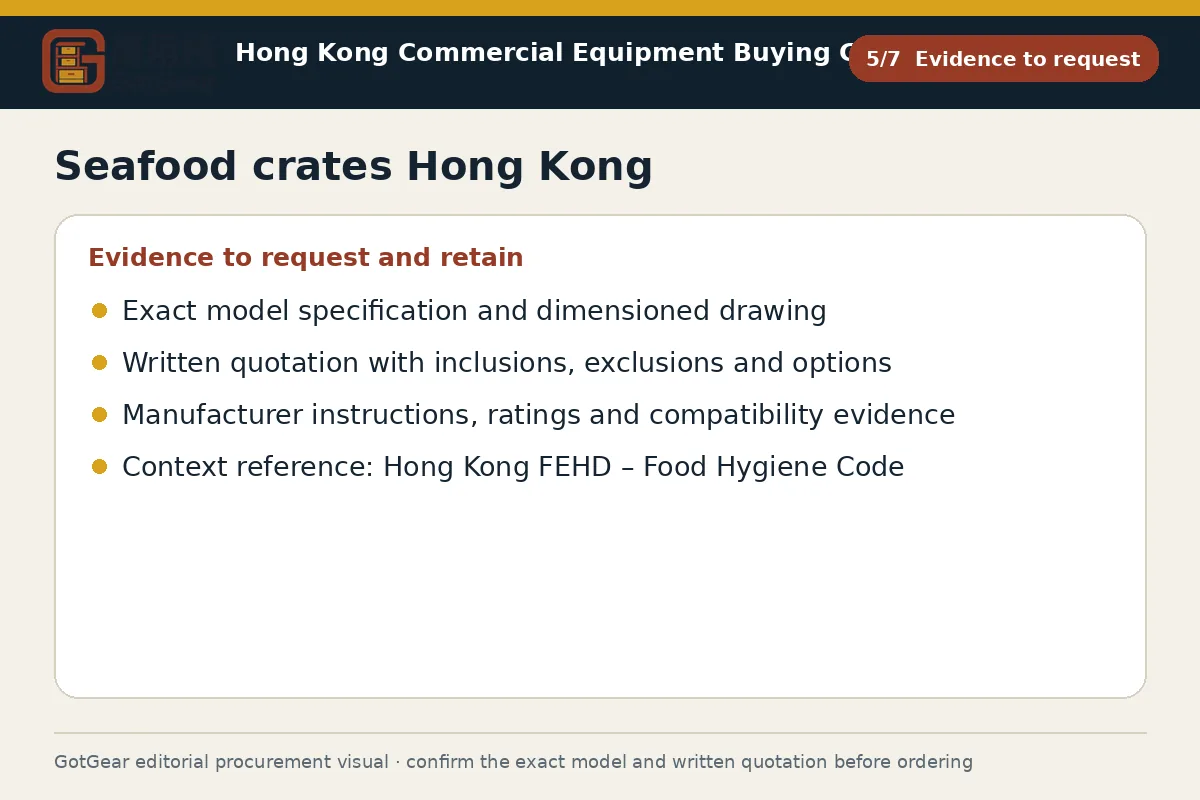
Document product formats and whether loads are dry-chilled, iced, slushed or live in water. State the expected wet load and whether drainage must be free, controlled via a plug, or fully contained. Record service and cleaning temperatures, detergent and sanitiser types. Measure internal volume needs, crate heights that pass your lifts, and pallet footprints used. Specify payload per crate, tested stacking height and preferred handle and base types. Define labelling (barcode or RFID), bilingual text, ownership marks and cleaning-status indicators. Map every transfer, agree time out of refrigeration, and note any building rules on spills. Request drawings, material declarations where required, and written confirmation of temperature and load limits. GotGear helps teams compare specifications and prepare a clear written enquiry to manufacturers.
- Operating use, quantity and expected frequency
- Dimensions, capacity, material and accessory requirements
- Delivery address, floor, goods lift and loading window
- Required documents, acceptance checks and after-sales arrangements
Key points for seafood crates Hong Kong
Hong Kong movements often pass through tight goods-lifts, shared lobbies and short loading windows. Confirm lift car and doorway sizes before choosing crate footprints and heights, and coordinate with the management office on any ban on dripping water in public areas. Humid, saline conditions around piers and markets can stress plastics; ask manufacturers to confirm material suitability at your lowest operating temperature and with brine. Bilingual labels and documents help staff and contractors. This is operational guidance only; verify requirements with your building manager, carrier and supplier.
Questions about seafood crates Hong Kong
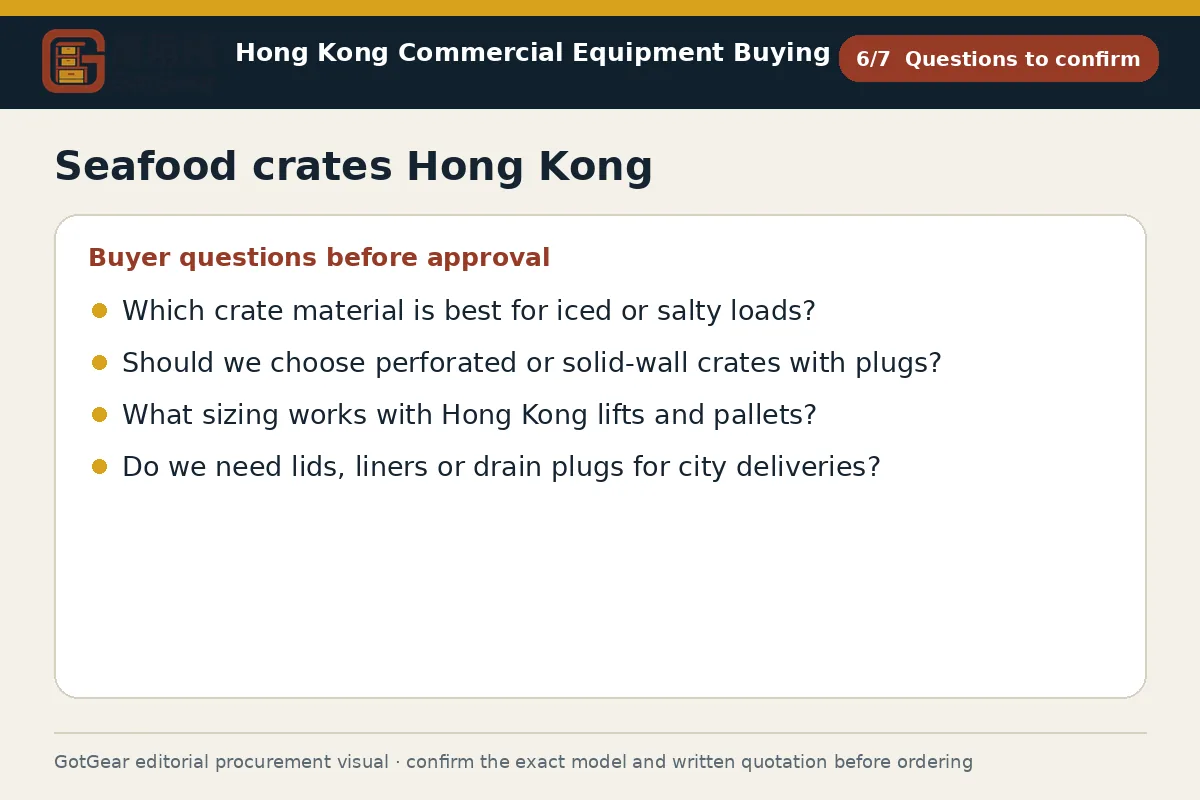
Which crate material is best for iced or salty loads?
Food-grade HDPE is commonly selected for impact resistance in chilled, wet use, while PP can be stiffer at room temperature. Ask the manufacturer which resin blend they propose for your lowest operating temperature and any brine contact. Request a written material declaration and cleaning compatibility note if your procedures or insurer require formal records.
Should we choose perforated or solid-wall crates with plugs?
Perforated crates support rapid drainage and airflow for chilled handling, provided drips are allowed along the route. Solid-wall units with drain plugs and lids contain liquids where buildings or carriers restrict spills. Decide based on meltwater volume, route permissions and cleaning method, then ask the supplier for drawings that show perforations or plug hardware.
What sizing works with Hong Kong lifts and pallets?
Measure your goods-lift door opening, car width and depth, plus any corridor pinch points, then select crate footprints and heights that clear these spaces when stacked on dollies or pallets. Confirm the pallet pattern with your 3PL. Use your site measurements in the written enquiry, and accept the manufacturer’s quoted dimensions as the prevailing specification.
Do we need lids, liners or drain plugs for city deliveries?
Use lids and sealed bases with plugs when moving through public lobbies or carrier networks that prohibit drips; liners can help with hygiene and quick turnaround. For short, controlled routes with approved drainage, vented crates may be more efficient. Always confirm the chosen method with the building manager and transport partners in writing.
Continue with closely related procurement topics
These pages share equipment, operating or decision-stage signals with this guide.
Plastic pallet for airport cargo Hong Kong
GotGear provides a checklist for plastic pallet for airport cargo Hong Kong so air-cargo handlers can record cargo profile, handling equipment, transfer points, restraint, inspection, operating limits and compatibility.
Read the guide
Milk crates Hong Kong
GotGear provides a practical checklist for milk crates Hong Kong, covering bottle and carton dimensions, typical filled weight, internal support and stacking pattern. It also outlines the cleaning and empty return process.
Read the guide
Perforated Euro containers Hong Kong
GotGear provides a checklist to compare perforated Euro containers Hong Kong and vented plastic crates Hong Kong for food handling and cold chain, covering airflow, drainage, containment and cleaning considerations.
Read the guide
Bread crates Hong Kong
GotGear offers a checklist for bread crates Hong Kong that covers loaf and tray dimensions, packed weight, ventilation and stacking, vehicle and trolley fit, route cycle, cleaning and returns.
Read the guideRelated topic indexOpen more English procurement pages1 topics
Browse additional equipment families, applications and procurement questions relevant to a wider buying brief.