
Record the cargo profile, handling equipment, transfer points, restraint method and reuse route. Confirm compatibility with the manufacturer, carrier and facility.
Plastic pallet for airport cargo Hong Kong — Document Cargo and Equipment Interfaces
Start by mapping the full journey from shipper dock to terminal acceptance. Record the built unit’s overall length, width and height with packaging applied, plus any planned overhang. Capture gross weight, layer weights and a simple centre-of-gravity sketch. Note every contact point the load will see: forklift tines, pallet trucks, dock levellers, powered rollers, ball-mats, scissor tables, and dolly bump-stops. As an example starting point for internal worksheets, some teams record dimensions to the nearest 5 mm and weights to the nearest 0.5 kg; confirm formats with your carrier, facility and internal quality lead.
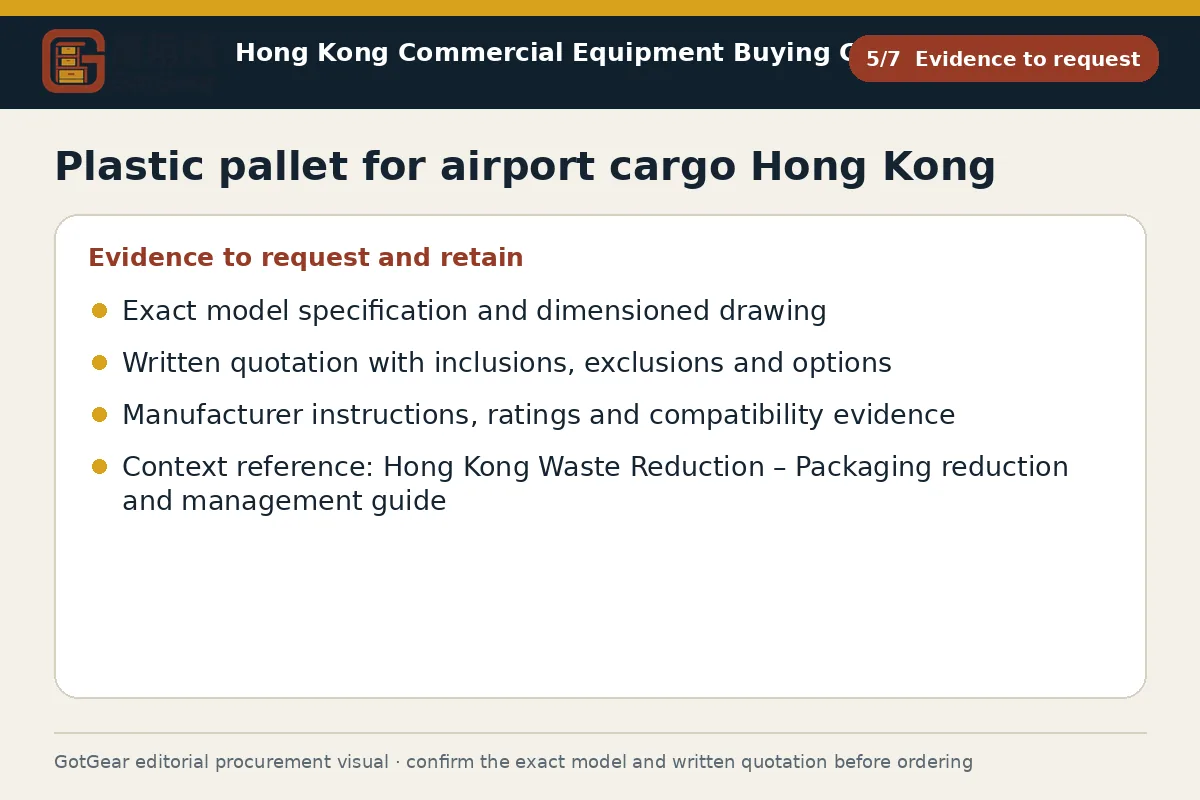
For the pallet itself, request a product drawing and specification covering: nominal footprint, deck style (solid or vented), runner orientation, fork-entry design and underside chamfers. Add anti-slip provisions, rim height or edge-lip profile, strap-through apertures, underside contact lines for roller/ball interfaces, and temperature tolerance. Specify material family and any additive claims (e.g., recycled content) only if supported by the manufacturer’s written data. In Hong Kong industrial buildings, measure goods-lift car size, door clear width, lift load rating and corridor turns so the loaded pallet can pass without rework. If the unit may roll across powered conveyors or ball-mats, ask for an underside pattern diagram showing rib spacing and flat-contact pads that will actually meet your equipment surfaces.
Plastic pallet for airport cargo Hong Kong — Review Restraint and Mass Distribution
Restraint and mass distribution drive safety and acceptance. Confirm how the load will be contained at each stage: stretch film, straps, corner boards, pallet rims and, after transfer, airline nets on ULDs. Check that strap slots or rim features match your chosen restraint and that edges will not cut film or webbing. Avoid uncontrolled overhang and record any deliberate overhang limits agreed with the carrier or terminal. As an example starting point only, some teams aim to keep mass per quadrant within ±10%; validate targets with your safety and operations stakeholders.
Measure what matters. Weigh each layer or module before wrapping, and record placement so the centre of gravity can be estimated from a defined pallet datum. Keep heavy items near stringers or solid deck zones, not above large underside cavities. Request the manufacturer’s stated dynamic, static and (if relevant) rack load ratings with the test method referenced, plus a deflection curve or span guidance for conveyors and dollies. If stacking is planned, state maximum stack height and intermediate restraining method for the quotation. For operating practice and training materials, see plastic pallet load stability Hong Kong for housekeeping and visual checks suitable for busy shift changes.
What should buyers compare for plastic pallet for airport cargo Hong Kong?
| Criterion | Straightforward requirement | More complex requirement | Evidence to provide |
|---|---|---|---|
| Footprint and access | Fits narrowest doorway and goods-lift without rework | Also compatible with roller-bed pitch and dolly stops | Measured site clearances plus pallet drawing with underside contact map |
| Load and deflection | Declared dynamic and, if used, racking load ratings cover the recorded maximum loads | Deflection acceptable on your conveyor/dolly spans under expected mass | Manufacturer test method reference and deflection guidance for your spans |
| Base design and contact | Runner layout with safe fork entry and chamfers | Perimeter/base pads or slave-board interface for roller/ball equipment | Underside photos or CAD, sample trial notes on your equipment |
| Material and environment | Material tolerates humid, saline air and cleaning chemicals in use | Any fire, hygiene or ESD provisions aligned to site or insurer expectations | Data sheet plus written statements for proposed additional properties |
| Identification and control | Visible ID and bilingual handling labels for floor teams | RFID/QR integrated with WMS and screening checkpoints where used | Label artwork, encoding format and placement diagram for approval |
This framework helps buyers create comparable written enquiries. Final model specifications, availability, delivery and commercial terms must be confirmed in a formal quotation.
Plastic pallet for airport cargo Hong Kong — Define Transfer and Inspection Responsibilities
Prevent handover gaps by defining who inspects and signs off each transfer—from shipper build-up, to landside terminal intake, to airline palletisation. At each custody change, record pallet ID, photos of all four sides and top, visible defects, restraint condition, tamper seals (if used) and moisture evidence. Pre-agree damage categories that trigger segregation rather than rework on the line. Use bilingual documentation so Hong Kong floor teams and management can read the same acceptance notes without delay. For tools and defect language, align with your plastic pallet inspection checklist Hong Kong.
On receipt of new pallets, verify against the written quotation: model code, runner configuration, deck type, declared load ratings, material, underside pattern and any requested features such as anti-slip or strap slots. Inspect moulding quality, absence of sharp flash, fork-entry lead-ins and overall flatness by placing on a known flat surface and checking for rocking. Measure footprint and fork-entry clearances against your forklift and pallet-truck tines. If you use RFID, barcodes or human-readable IDs, confirm placement and scannability. Ask the manufacturer for cleaning and disinfection guidance before introducing chemicals, and request handling/safety notes if your site, insurer or building manager requires them.
Plastic pallet for airport cargo Hong Kong — Confirm Carrier and Facility Requirements
When specifying a plastic pallet for airport cargo, Hong Kong operations teams should confirm carrier and facility requirements in writing. Some carriers accept landside plastic pallets only up to build-up, with mandatory transfer to airline pallets and nets; others may allow slave-board use on roller equipment. Check roller-bed pitch and dolly stop geometry against the pallet underside, and ask whether intermediate slip-sheets or friction mats are permitted. Confirm any security-screening constraints, such as X-ray visibility expectations, access for manual search, or tamper-evident seal placement.
Match packaging to your flow. If your process combines cartons in warehouse totes Hong Kong or broader returnable transport packaging Hong Kong, verify tote base stiffness, overhang allowances and strap pathways on the pallet. Align labelling and EDI milestones with the terminal operator, and ensure bilingual consignment markings survive humidity and handling. Coordinate with the building management office on goods-lift bookings, peak-hour restrictions and loading-bay windows so transfer moves are realistic. Where fire performance, hygiene or electrostatic provisions are proposed by your site, insurer or landlord, seek the manufacturer’s written statement and any applicable test references, and confirm that the carrier will accept those documents during audit or ramp checks.
Plastic pallet for airport cargo Hong Kong decision checklist
Compile a short brief that captures footprint, height limit, gross weight, layer map and centre-of-gravity sketch for the typical unit. Add equipment interfaces—forks, conveyors, dollies and lift constraints—and attach photos where relevant. Request a written quotation with model code, deck style, runner layout, underside pattern, restraint features, material, temperature range and declared load ratings with test methods. Ask for a dimensioned drawing and deflection guidance for your conveyor or dolly spans. On delivery, check dimensions, flatness, fork-entry lead-ins, surface finish and identification, then photograph and log findings before the first use. Agree handover inspection points and bilingual acceptance notes with partners. Where fire, hygiene or ESD claims may apply, request the manufacturer’s documents and confirm acceptance with the carrier and facility. Use this guide to compare specifications and prepare a concise enquiry.
- Operating use, quantity and expected frequency
- Dimensions, capacity, material and accessory requirements
- Delivery address, floor, goods lift and loading window
- Required documents, acceptance checks and after-sales arrangements
Key points for plastic pallet for airport cargo Hong Kong
Airport-cargo work in Hong Kong is shaped by tight industrial-building access, humid conditions and terminal booking windows. Many facilities move freight through narrow corridors and compact goods-lifts before reaching a landside build-up area, so loaded pallet dimensions and turning space must be measured, not assumed. Humidity and salt-laden air near the harbour can affect grips, labels and cleaning choices. Terminal operators may require pre-advised arrival slots and specific documentation formats. Confirm these local practices with your building manager, logistics partners and the receiving airline or terminal before ordering pallets, and keep bilingual records so shift teams and office approvers work from the same instructions. This is operational guidance, not legal advice.
Questions about plastic pallet for airport cargo Hong Kong
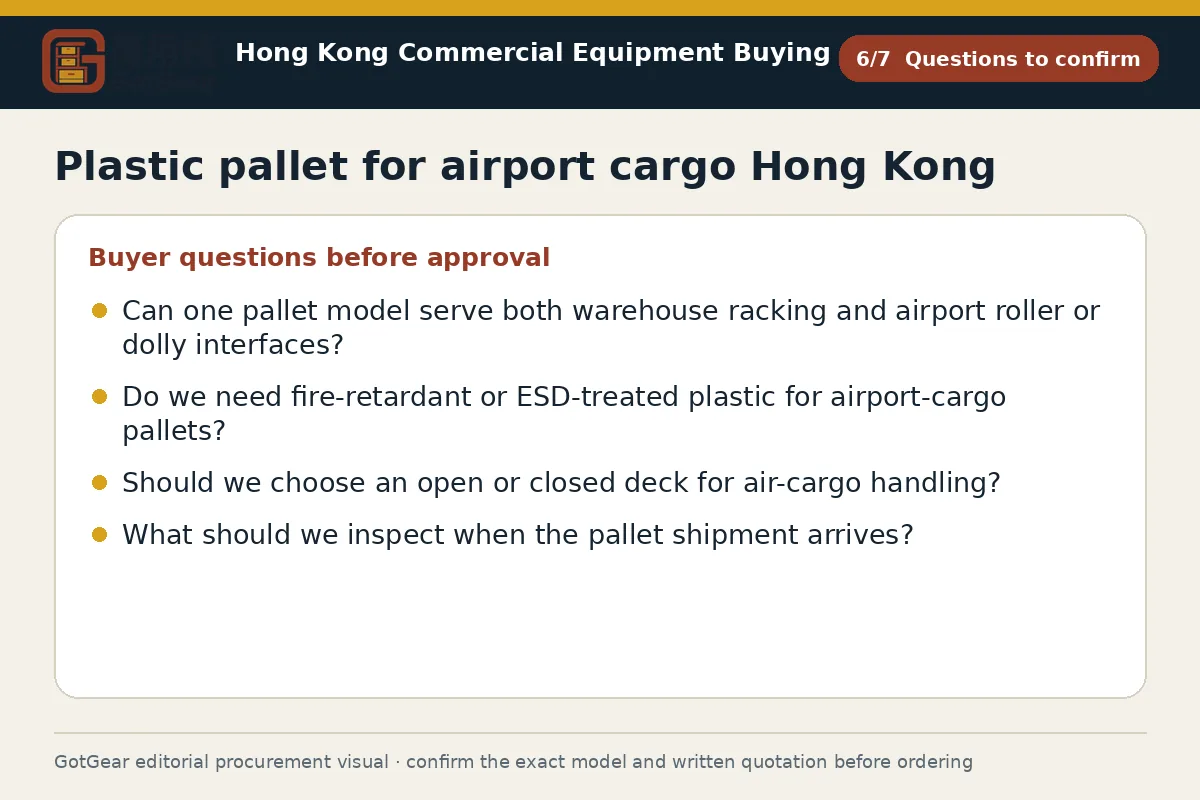
Can one pallet model serve both warehouse racking and airport roller or dolly interfaces?
Sometimes, but only if the base design, stiffness and clearances fit both environments. A runner layout that works in beam racking may not contact powered rollers correctly. Ask for a drawing of the underside, racking and dynamic load ratings with test methods, and trial a sample on your own rack span and roller pitch before approving cross-use.
Do we need fire-retardant or ESD-treated plastic for airport-cargo pallets?
Only if your site, insurer, building manager, cargo type or carrier requires it. Where such provisions are proposed, ask the manufacturer for written statements and any relevant test references, then check with the facility or carrier that these documents are acceptable. Avoid assuming overseas terms apply in Hong Kong without local confirmation.
Should we choose an open or closed deck for air-cargo handling?
Choose based on product hygiene, cleaning method and equipment contact. Closed decks help when small cartons or labels could snag, while open decks can shed water and reduce weight. Verify that underside ribs and contact pads suit your rollers or dollies, and request anti-slip or rims if you rely on film-only restraint during landside transfers.
What should we inspect when the pallet shipment arrives?
Match the delivery to your written quotation and drawing, then check footprint, flatness, fork-entry chamfers, runner integrity and surface finish. Confirm ID labels or RFID are legible and secure. Place a sample on a flat floor and across a known conveyor or roller span to spot rocking or poor contact. Log photos and segregate any suspect units for supplier review.
Continue with closely related procurement topics
These pages share equipment, operating or decision-stage signals with this guide.
Perforated Euro containers Hong Kong
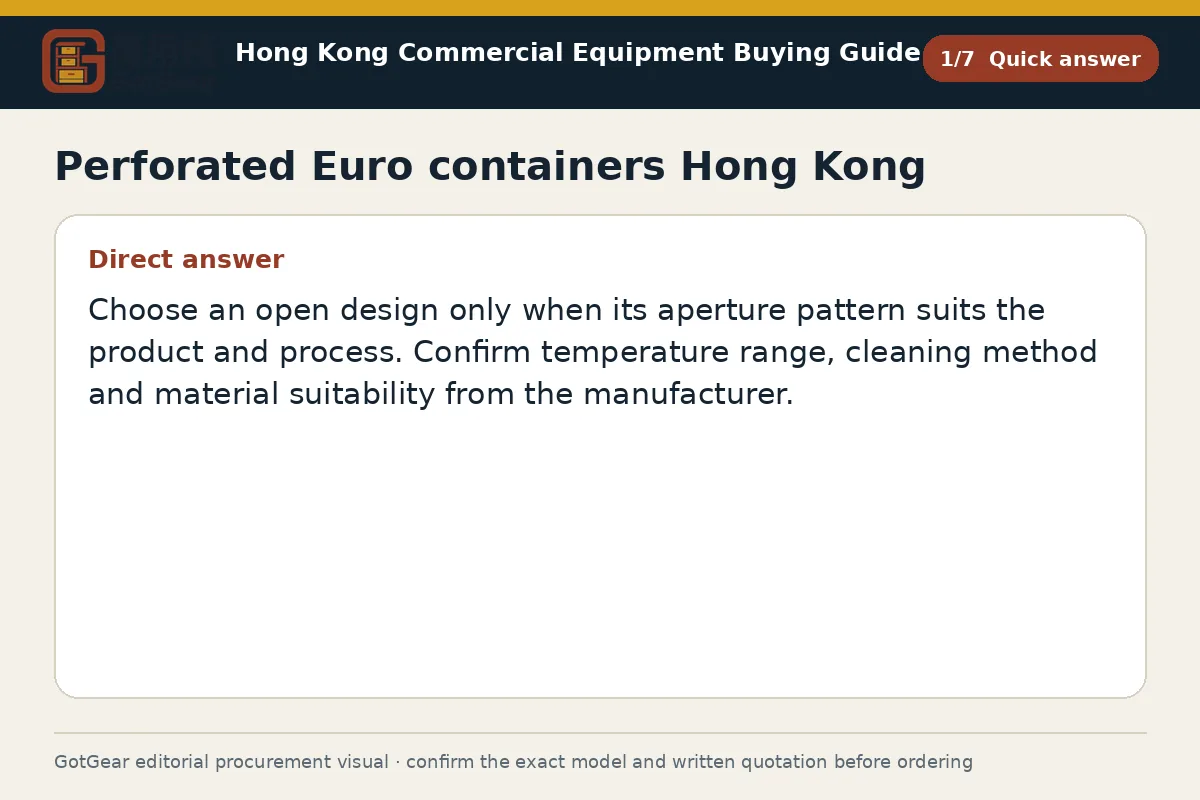
GotGear provides a checklist to compare perforated Euro containers Hong Kong and vented plastic crates Hong Kong for food handling and cold chain, covering airflow, drainage, containment and cleaning considerations.
Read the guide
Plastic pallet inspection checklist Hong Kong
GotGear provides the plastic pallet inspection checklist Hong Kong, which covers cracks, distortion and contamination. It applies the plastic pallet damage assessment Hong Kong criteria to record defects and isolate suspect items.
Read the guide
Plastic pallet stacking safety Hong Kong
GotGear explains plastic pallet stacking safety Hong Kong, plastic pallet load stability Hong Kong and plastic pallet anti-slip surface Hong Kong. It also recommends a unit-load checklist to check restraint, support and handling.
Read the guide
Seafood crates Hong Kong
GotGear provides a checklist for seafood crates Hong Kong that compares drainage, containment, pack weight, temperature control, cleaning, stacking and cold-chain transfers for wet loads.
Read the guideRelated topic indexOpen more English procurement pages1 topics
Browse additional equipment families, applications and procurement questions relevant to a wider buying brief.