
Specify the container format, unit count, filled mass, delivery equipment, stack arrangement and empty-return process. Verify cleaning and food-contact suitability from manufacturer information.
Milk crates Hong Kong — Match Geometry to Bottles, Cartons and Filled Weight
Start by mapping your primary container formats. Measure bottle diameter at the widest point, shoulder and base; record total height including closure. For cartons, confirm length, width and height after sealing. Determine units per crate and the clearance required for grasping and fast picking. Weigh a fully filled unit with cap or straw fitments and multiply by the intended count to estimate payload. Example starting point: six 1 L glass bottles could present roughly 7–9 kg per crate when filled; this is an example only and must be confirmed in the supplier’s written quotation and your route trials.
Request internal length, width and usable height, plus per-compartment pitch and corner radii to avoid scuffing. Ask for tolerances on internal dimensions and for base aperture style (open grid versus semi-closed) that suits your drainage and label-scan preferences. Specify the exact bottle/carton orientation and count. Seek material details (e.g., HDPE or PP, UV stabilisation, impact-modifier use), indicative temperature range, wall thickness strategy, ribbing pattern, and stacking-lip geometry. Confirm whether there are label panels, barcode/RFID recesses, and options for moulded owner marks and bilingual text. If approvals are needed by your institution, request a sample crate and a dimensioned drawing for sign-off before volume ordering; the model specification and formal quotation prevail.
Milk crates Hong Kong — Check Compartment Support and Load Retention
Support is what protects product and brand. For glass, ask how dividers locate the neck and shoulder to prevent clinking, and whether the base has pips or ribs that stabilise punted bottles. Confirm divider height, edge radii and clearance so labels and tamper bands will not snag. For cartons, look for continuous flat wall support to limit panel bowing in humidity and transit. State the permissible lateral movement per unit you will accept in a drop or curb-bounce scenario and request the supplier’s recommended method to achieve it.
Load retention relies on crate geometry, not just tape or stretch. Specify stacking interlock profile, anti-slip features, and whether strap channels or clip points are required for route strapping on dollies. Where lids or crossbars are proposed, ask how they affect stackability, wash-through and pick speed. Request any available stacking-load guidance (static and, if offered, dynamic on-vehicle), and confirm the test basis; treat any example figures as indicative only until documented in the quotation. On receipt, inspect moulding quality (flash, sharp edges, warping), verify dimensional fit with your bottles/cartons, check handle comfort with gloved hands, and trial a short ride on a typical trolley to confirm retention before fleet rollout.
What should buyers compare for milk crates Hong Kong?
| Criterion | Straightforward requirement | More complex requirement | Evidence to provide |
|---|---|---|---|
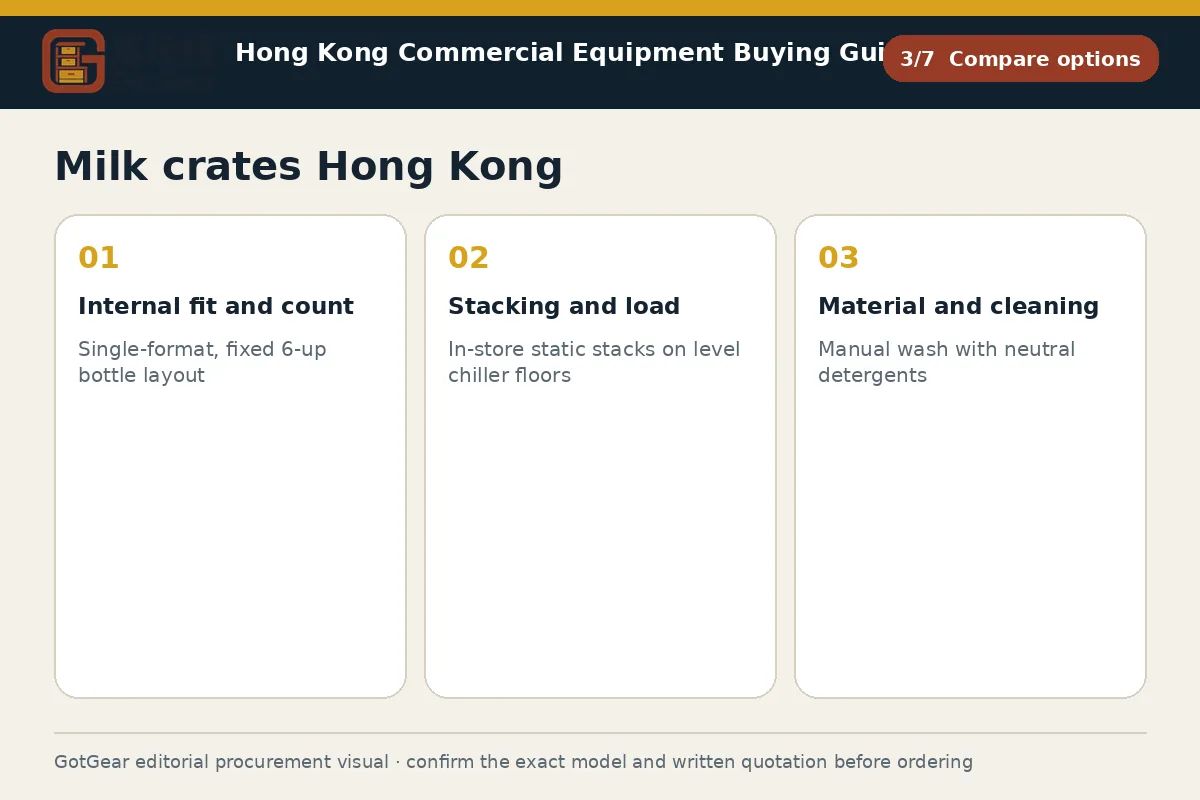
| Internal fit and count | Single-format, fixed 6-up bottle layout | Mixed formats (bottle + carton) or variable counts with divider options | Provide container dimensions, closure height, orientation and intended units per crate |
| Stacking and load | In-store static stacks on level chiller floors | On-vehicle dynamic stacks with restraints and ramps | State filled mass per crate, desired stack height; attach supplier’s stack guidance |
| Material and cleaning | Manual wash with neutral detergents | Tunnel washer, higher temperatures and caustic/oxidising agents | Request resin type, detergent compatibility statement, recommended temperature range |
| Handling interfaces | Hand-carry and basic pallet stacking | Dollies, roll-cages and vehicle shelving integration | Share external L×W×H, interlock profile drawing, handle aperture size, base-runner details |
| Identification and returns | Colour coding and moulded owner mark | Barcode/RFID, sequential numbering, bilingual panels and return SOP | Supply artwork, numbering range, label spec, return pallet pattern and strap positions |
This framework helps buyers create comparable written enquiries. Final model specifications, availability, delivery and commercial terms must be confirmed in a formal quotation.
Milk crates Hong Kong — Define Cleaning and Empty-Return Controls
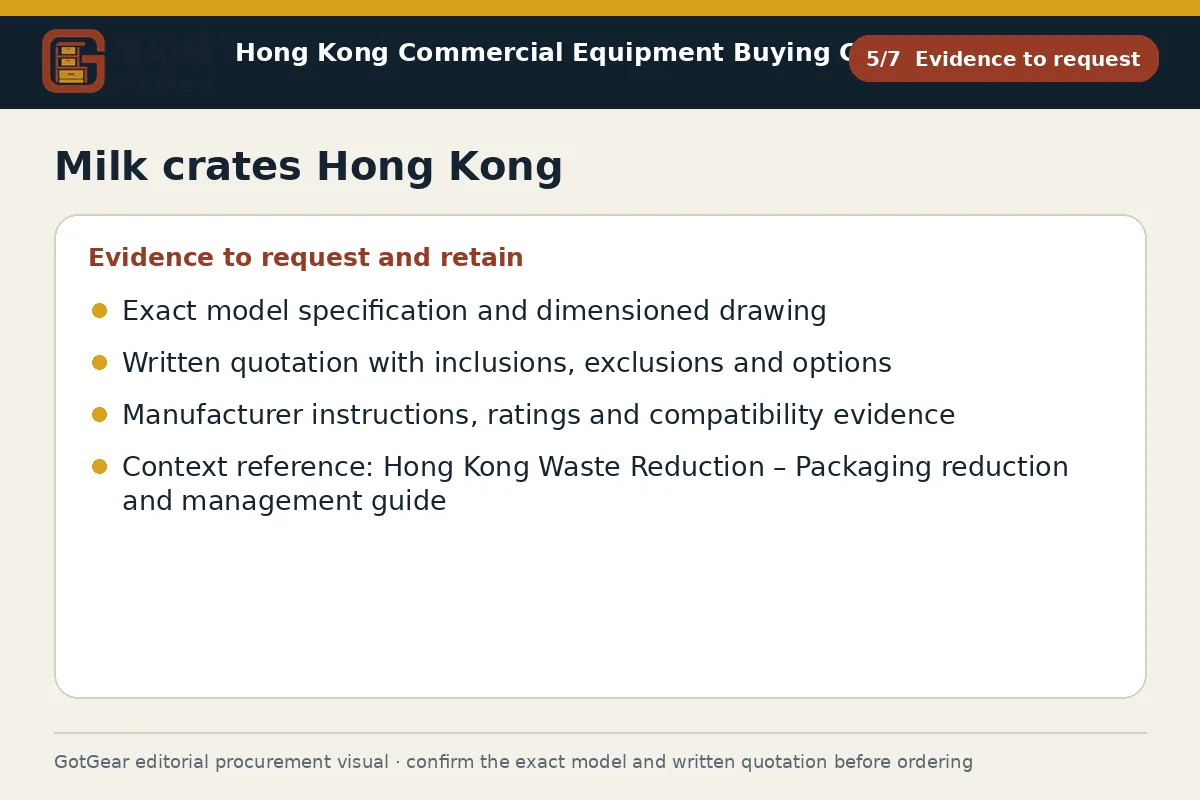
Align washing and sanitation with crate design early. State whether you use manual sink washing, a cabinet washer or a tunnel line; request the material’s compatibility statement with your detergents and sanitisers, and a recommended maximum wash temperature. Example starting point: buyers may target performance in warm (e.g., 60–70 °C) tunnel cycles, but only the manufacturer’s written data and your HACCP team’s procedures should decide this. Ask for drainage/vent apertures and rib patterns that promote fast drying to reduce odour in Hong Kong’s humidity. Confirm any food-contact suitability declaration appropriate to your operation and insurer.
Define the empty-return standard so crates come back ready for the next load. Specify whether cross-stacking is allowed, the pallet pattern, strap orientation and label position for returns. Plan where returns will be staged when goods-lift slots are tight, and note building-management delivery windows that affect backhauls. Agree colour coding, moulded owner marks and bilingual return signage to control mingling with other pools. If crates interface with automated washers or conveyors, request drawings with base-runner geometry and clearance to prevent jams. Always treat the supplier’s model specification and formal quotation as controlling.
Milk crates Hong Kong — Map Vehicle, Trolley and Stacking Interfaces
Check how crates interface with route vehicles, trolleys and storage. Measure vehicle shelf depth, bay clear height and door apertures; record trolley deck size, wheel type and turning space in corridors and goods lifts. Specify the maximum stack height you will place on dollies and in vans, and ask the supplier to confirm the stack interlock profile and base stiffness that supports this. Request drawings for external length, width and height, interlock geometry, handle aperture size, and base-runner or foot pattern. If using roll-cages, confirm how crates bridge the cage mesh and where straps will sit.
At sites, confirm cold-room shelf spacing, condensation drainage and floor gradients in loading docks. If you must stage stacks outdoors during tight loading windows, ask about UV stabilisation and wet-grip features on the base. Agree the stacking safety guidance (static in-store and, if available, dynamic on-vehicle) as part of the written quotation, noting that any example figures are not binding unless stated. Before committing, conduct a witnessed fit-check on an actual trolley and route vehicle, photograph interfaces, and record acceptance criteria for future re-orders. The quoted model specification remains the reference.
Milk crates Hong Kong decision checklist
Confirm container formats, dimensions and closure heights, then define units per crate and the maximum filled mass you will route. Capture site constraints: lift car size, doorway widths, turning spaces and loading windows. Request a dimensioned drawing, material details, stack interlock profile, handle design and any divider options. Ask for statements on detergent compatibility, recommended wash temperature and food-contact suitability. Standardise the pallet and dolly pattern for both full and empty returns, including strap channels and label positions. Compare quotations line-by-line on internal geometry, external footprint, stacking guidance and identification options. Accept a pre-production sample, test-fit on vehicles and trolleys, and record acceptance photos. On receipt, inspect moulding quality and dimensional fit; the model specification and formal quotation prevail.
- Operating use, quantity and expected frequency
- Dimensions, capacity, material and accessory requirements
- Delivery address, floor, goods lift and loading window
- Required documents, acceptance checks and after-sales arrangements
Key points for milk crates Hong Kong
Route planning in Hong Kong is often constrained by tight goods-lifts, narrow corridors and managed loading windows at industrial buildings and estates. Many procurement teams that are evaluating milk crates in Hong Kong will need to coordinate goods-lift bookings and confirm that full stacks, together with dollies, can pass through fire doors and fit inside lift cars without unstacking. Humid conditions increase drying time, so drainage and airflow in crate bases are important. Also allow for vehicle height limits in car parks, include bilingual owner marks to prevent mingling with other pools, and obtain management-office approvals for staging areas. Treat local building policies and the supplier's written quotation as prevailing guidance, not legal advice.
Questions about milk crates Hong Kong
How do I choose a crate for 1 L glass milk bottles?
Measure the bottle’s maximum diameter and total height including cap, and decide the units per crate. Ask for internal cell size, divider height, corner radii and stack interlock details. Request a sample to confirm label clearance and shoulder fit. Final selection should follow the manufacturer’s dimensioned drawing and your own route and wash trials documented in procurement notes.
Can one crate handle both cartons and glass bottles?
It can, but only if geometry and dividers support both formats without crushing cartons or letting bottles clink. Specify each pack’s movement tolerance and require a trial with real loads on your trolley and vehicle. Some models offer inserts or different dividers; rely on the supplier’s written specification and your acceptance test results before standardising.
What helps reduce crate loss or pool mixing on routes?
Use distinctive colours, moulded owner marks, and durable barcode or RFID identification with sequential numbers. Agree bilingual text for institutional or public venues. Define return procedures, pallet patterns and strap positions in writing, and train crews to check marks at cross-docks. Your marking method and data format should be accepted by both your QA team and the crate manufacturer.
What should I verify when the crates arrive?
Count and inspect for warping, flash and sharp edges; check internal dimensions and divider fit with your bottles/cartons. Test the stacking interlock with your existing fleet, and confirm handle comfort and base stability on trolleys. Run one wash cycle and inspect drying. Keep delivery photos and batch IDs. Your approved drawing and the supplier’s quotation remain the reference.
Continue with closely related procurement topics
These pages share equipment, operating or decision-stage signals with this guide.
Plastic pallet for airport cargo Hong Kong
GotGear provides a checklist for plastic pallet for airport cargo Hong Kong so air-cargo handlers can record cargo profile, handling equipment, transfer points, restraint, inspection, operating limits and compatibility.
Read the guide
Seafood crates Hong Kong
GotGear provides a checklist for seafood crates Hong Kong that compares drainage, containment, pack weight, temperature control, cleaning, stacking and cold-chain transfers for wet loads.
Read the guide
Perforated Euro containers Hong Kong
GotGear provides a checklist to compare perforated Euro containers Hong Kong and vented plastic crates Hong Kong for food handling and cold chain, covering airflow, drainage, containment and cleaning considerations.
Read the guide
Bread crates Hong Kong
GotGear offers a checklist for bread crates Hong Kong that covers loaf and tray dimensions, packed weight, ventilation and stacking, vehicle and trolley fit, route cycle, cleaning and returns.
Read the guideRelated topic indexOpen more English procurement pages1 topics
Browse additional equipment families, applications and procurement questions relevant to a wider buying brief.