
For canopy sidewall rain seam inspection Hong Kong, examine both faces of each seam and join, record the panel ID and isolate any wall whose condition is uncertain pending competent review. Before reuse, verify the manufacturer’s care instructions, forecast and site conditions, venue rules and applicable Hong Kong requirements rather than treating a visual check as proof of weather performance.
Visual seam and join checks for canopy sidewall rain seam inspection Hong Kong
Work in a clean, well-lit area where each sidewall can be fully unfolded without creasing across the rain seams. Coordinate with the building management office if you need to use a loading bay or corridor to gain length, and protect floors to avoid contamination. Inspect both faces of every stitched seam, welded join and attachment edge, feeling for steps, ridges or soft spots that suggest bond loss. Check zips, keder, hook-and-loop fastenings and eyelets at seam crossings, where tension concentrates, and look for misalignment that could create water paths.
Record the panel ID as printed, or apply your own durable bilingual label, then measure total seam length, seam type (stitched, welded, taped), number of plies and any reinforcement patches. Note previous repairs, including method and extent. For an effective canopy sidewall rain seam inspection Hong Kong, buyers should also note orientation (ground edge, roof edge, doorway side) so the same section is traceable on site. When preparing a written enquiry, ask the manufacturer to confirm seam construction, compatible threads or welding media, recommended cleaning agents for use around seams, and the nominal seam allowance. Example starting points, such as noting a seam allowance observed at approximately one finger width, must be confirmed against the model specification and the supplier’s formal quotation, which always prevails.
Wear, separation and staining in canopy sidewall rain seam inspection Hong Kong
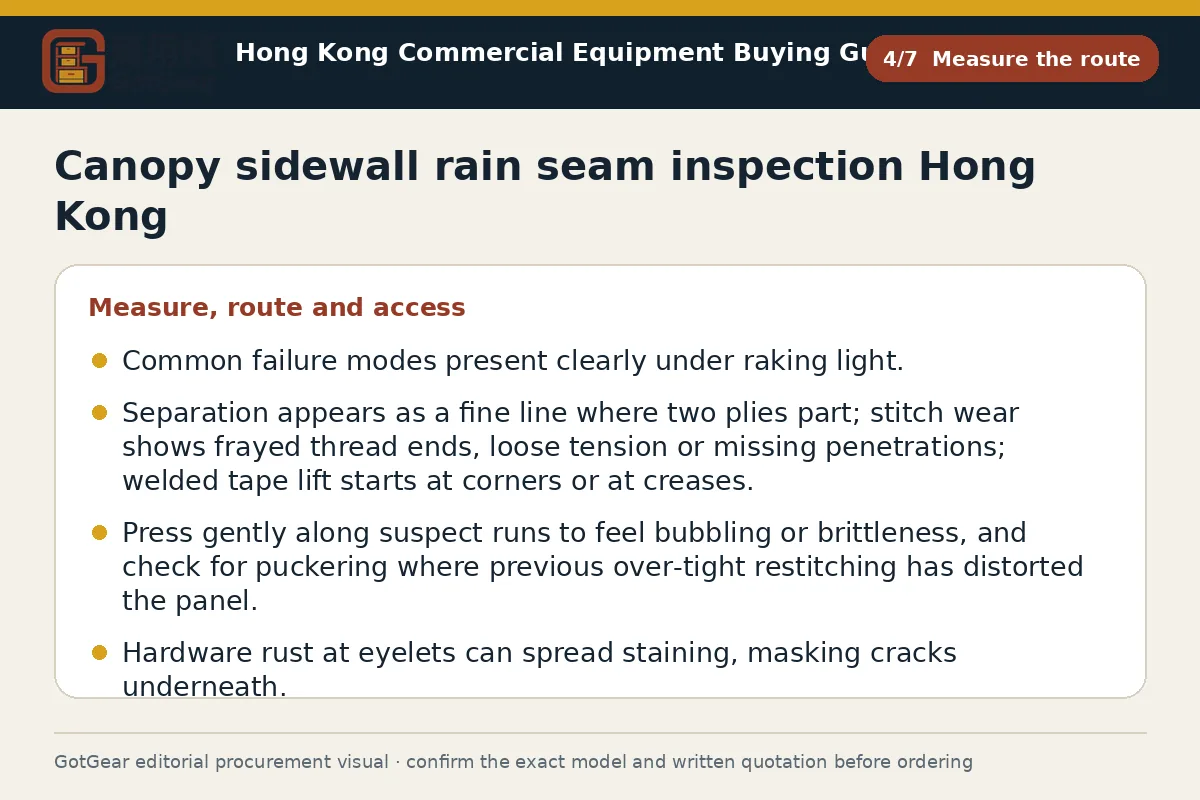
Common failure modes present clearly under raking light. Separation appears as a fine line where two plies part; stitch wear shows frayed thread ends, loose tension or missing penetrations; welded tape lift starts at corners or at creases. Press gently along suspect runs to feel bubbling or brittleness, and check for puckering where previous over‑tight restitching has distorted the panel. Hardware rust at eyelets can spread staining, masking cracks underneath.
Document holes, slits and abrasion with a steel rule in frame and capture both faces. Measure gap width or tape lift where practical and note length and location in relation to panel edges. As an example starting point only, flag any daylight visible through a seam over a continuous 20 mm run for competent review; do not adopt this as a universal threshold. Staining matters: oil can weaken adhesives, black mildew indicates trapped moisture in Hong Kong humidity, and yellowing or a tacky feel may suggest fabric coating breakdown. Before attempting cleaning, verify the manufacturer’s care notes to avoid solvents that could further degrade seam bonds. If you see heat‑shrink or crisp, whitening creases, treat the area as brittle and isolate it for assessment.
What should buyers compare for canopy sidewall rain seam inspection Hong Kong?
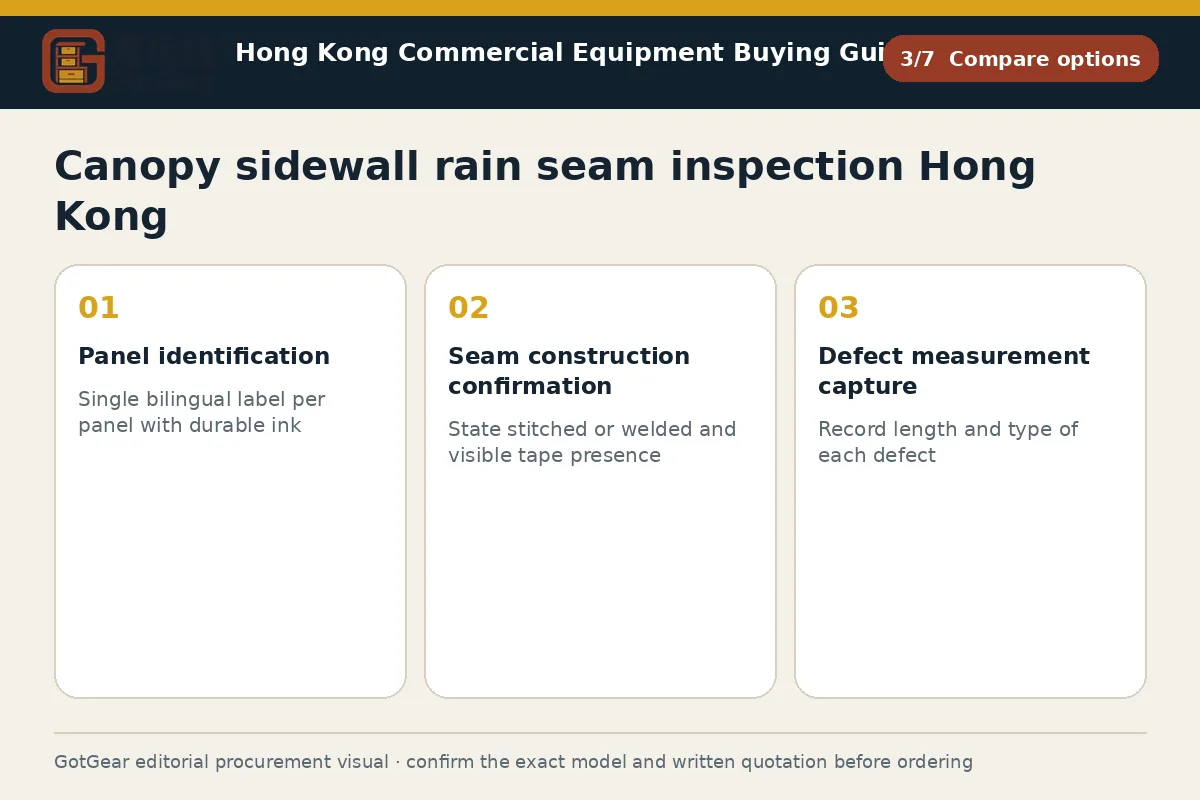
| Criterion | Straightforward requirement | More complex requirement | Evidence to provide |
|---|---|---|---|
| Panel identification | Single bilingual label per panel with durable ink | Permanent ID plus QR/serial linked to maintenance log | Photo of ID in every defect image; ID list in enquiry |
| Seam construction confirmation | State stitched or welded and visible tape presence | Request model‑specific seam method and seam allowance | Manufacturer spec sheet or email confirming method for your fabric code |
| Defect measurement capture | Record length and type of each defect | Add gap/tape‑lift width and position from nearest edge/zip | Photos with ruler; measurement table referencing panel map |
| Site and access constraints | Note venue, date and general access window | Add goods‑lift car and doorway clear sizes; loading bay rules | Dimensions with photos; management‑office booking notes |
| Quotation comparability | Ask for itemised repair per seam metre | Ask for method, materials, warranty scope and logistics | Written quotations citing your panel ID and fabric code |
This framework helps buyers create comparable written enquiries. Final model specifications, availability, delivery and commercial terms must be confirmed in a formal quotation.
Documenting defects during canopy sidewall rain seam inspection Hong Kong
Create clear, comparable evidence so procurement can act quickly. Photograph each defect with the panel ID card and a ruler in the same frame; take overview shots for context and close‑ups at 90 degrees. Capture both seam faces and any adjacent reinforcement. Use consistent file naming, for example: venue‑date_panelID_location_defect‑type_01, and keep bilingual notes if your institution requires dual‑language records. Record ambient conditions (damp, direct sun, air‑conditioned) because Hong Kong humidity can temporarily mask or exaggerate seam behaviour.
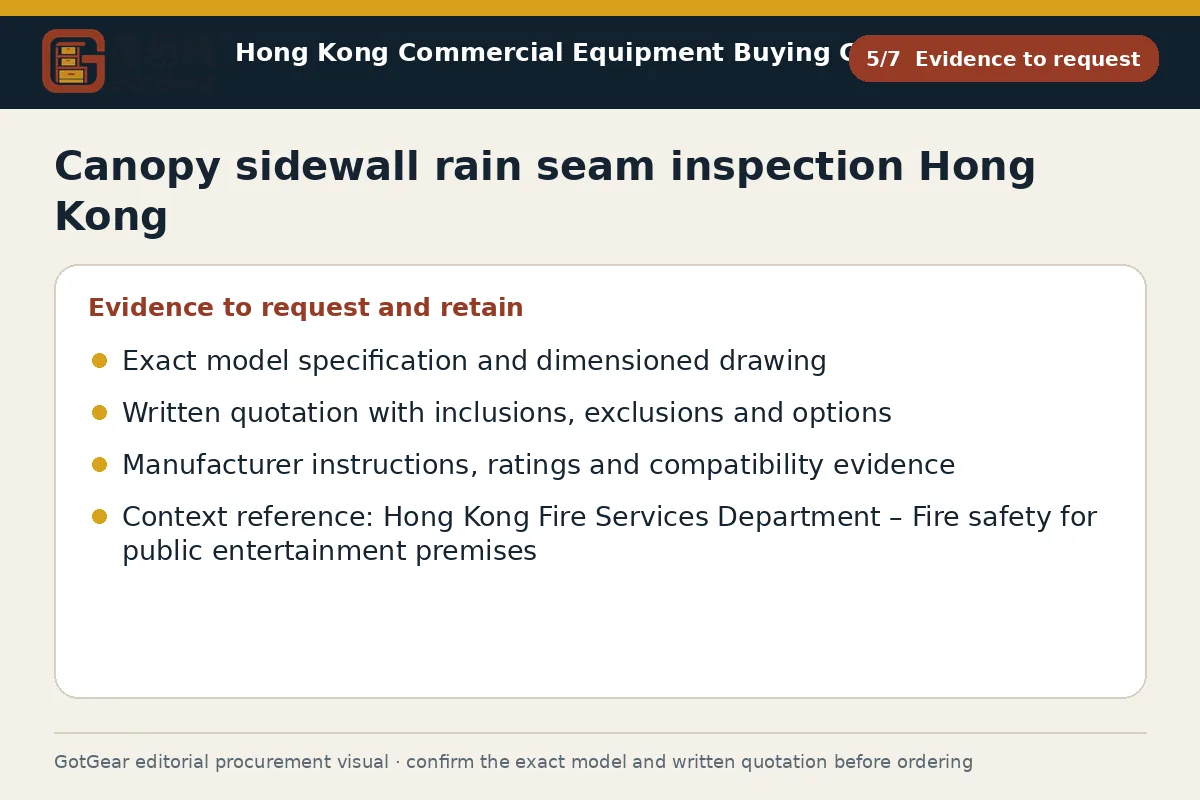
Your defect log should include: panel ID, seam/join type, precise location (distance from edge or zip), defect category (separation, lift, hole, abrasion, staining), dimensions, photos and any past repair tags. Build your written enquiry by attaching this log, stating requested actions (restitch, reweld, patch, replace), preferred timelines, and site constraints such as goods‑lift size, doorway clear widths and loading windows. Ask the supplier or manufacturer for the fabric data sheet, cleaning compatibility around seams, recommended repair methods for this model, and, if your venue or insurer asks, evidence of fire performance for the specific fabric code. For quotation comparison, request an itemised quotation per metre of seam work, materials to be used, workmanship warranty terms stated for this model, and logistics (collection/return arrangements) in writing.
Escalation after canopy sidewall rain seam inspection Hong Kong
After you complete documentation, quarantine any panel whose integrity is uncertain. Bag and tag it dry, label clearly in two languages, and store off the floor in a ventilated area. Escalate to a competent repairer or the manufacturer with your evidence pack; ask them to confirm whether restitching, welding, taping or panel replacement is appropriate for this model and expected site exposure. If a controlled water test is proposed, do it in a safe area with drainage and avoid creating slip hazards; do not equate a brief hose test with storm performance.
Plan contingencies early. Keep a serviceable spare sidewall where budgets and storage allow, and coordinate building access, goods‑lift bookings and loading bay windows for any repair collection or replacement delivery. For exposed or funnelled sites, also consider wind control measures and refer your team to canopy sidewall wind flap prevention Hong Kong. Where pooling or ballast may be a concern, align your inspection outcomes with canopy water weight leak check Hong Kong. If your event kit is modular, reconcile labels during folding tent accessory inventory Hong Kong, and document any changes through your institutional approval route. For new shipments, follow a folding tent delivery inspection checklist Hong Kong on receipt.
Canopy sidewall rain seam inspection Hong Kong decision checklist
Before confirming reuse, retrieve the manufacturer’s care and repair notes for your exact model and read venue instructions for weather exposure. Unfold each panel fully, clean if permitted by the care notes, and inspect both faces of all seams and joins. Record panel IDs, seam types and precise defect dimensions with photos. Quarantine uncertain panels. Compile a written enquiry attaching the log, your site constraints, preferred timelines and any venue or insurer documentation requests. Seek itemised quotations that state the fabric code, repair method, workmanship scope and logistics. Coordinate goods‑lift sizes and loading windows for collections and returns, and schedule a final check after repair with bilingual labelling aligned to your institution’s approval process.
- Operating use, quantity and expected frequency
- Dimensions, capacity, material and accessory requirements
- Delivery address, floor, goods lift and loading window
- Required documents, acceptance checks and after-sales arrangements
Key points for canopy sidewall rain seam inspection Hong Kong
Hong Kong’s event calendar, humid summers and sudden downpours mean small seam issues can escalate quickly on site. Facilities often work within tight goods‑lift cars, narrow stair cores and supervised loading bays, so plan space to unfold and inspect full‑height sidewalls without tripping the building’s housekeeping rules. Management offices may require prior booking and escorts for access to rooftops or back‑of‑house areas. Many venues and institutions prefer bilingual documentation for approvals and incident reporting. None of this is legal advice; always confirm venue and building requirements in writing and follow the manufacturer’s instructions for the specific model you hold in stock.
Questions about canopy sidewall rain seam inspection Hong Kong
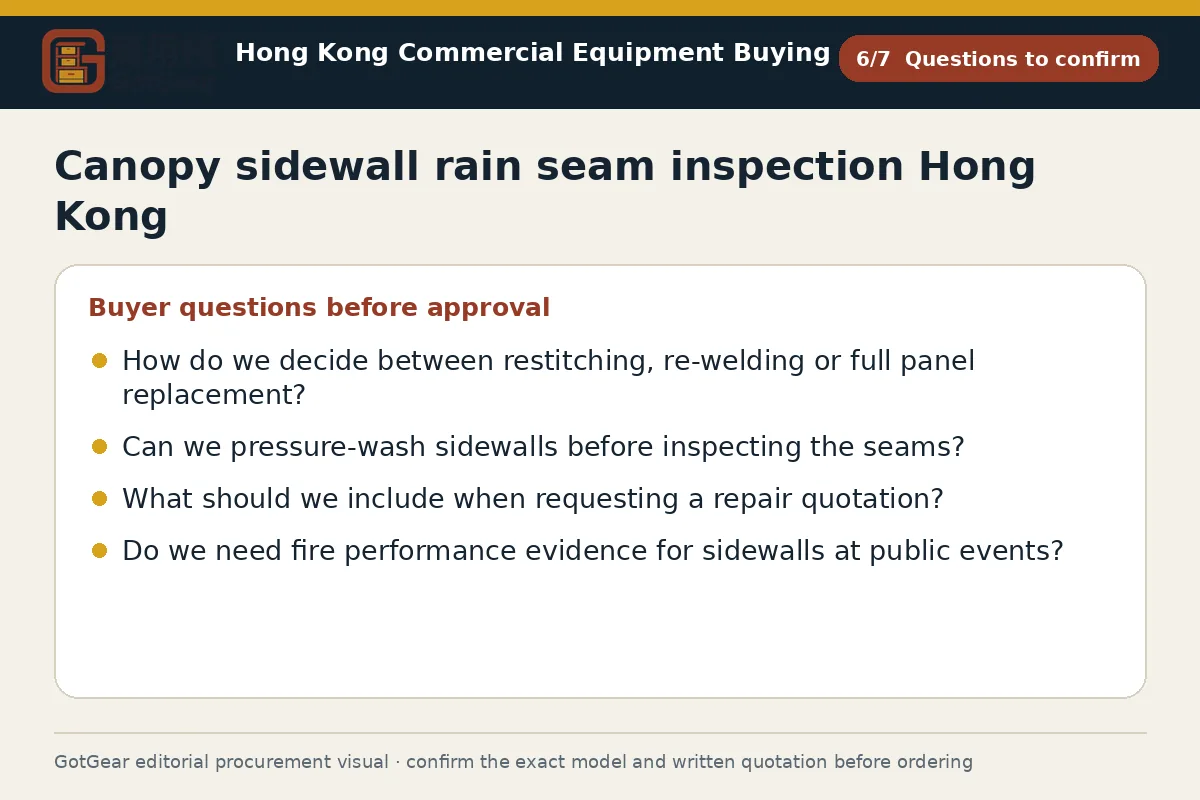
How do we decide between restitching, re‑welding or full panel replacement?
Decide by construction type, extent of separation and fabric condition. Short, clean failures on otherwise supple fabric may suit restitching or re‑welding; widespread coating brittleness or multiple repairs near edges can justify replacement. Always send photos with measurements and panel IDs, and let the manufacturer or a competent repairer confirm suitability for your specific model and expected weather exposure.
Can we pressure‑wash sidewalls before inspecting the seams?
Avoid high‑pressure washing near seams unless the manufacturer explicitly permits it for your fabric and seam construction. Water jets can drive moisture under tapes or open stitch holes, obscuring defects. If cleaning is needed, use the products and methods listed in the care instructions for your model, then allow the wall to dry fully before inspection so separation and staining are visible.
What should we include when requesting a repair quotation?
Provide panel IDs, seam/join types, defect dimensions, high‑resolution photos of both faces, fabric code if known, prior repair notes, and site constraints (goods‑lift size, doorway clearance, loading windows). State the requested action (restitch, re‑weld, patch, replace) and preferred timeframe. Ask the supplier to confirm repair method, materials, workmanship scope, and any evidence needed by your venue or insurer for that fabric.
Do we need fire performance evidence for sidewalls at public events?
Check the venue operator, event insurer and the sidewall manufacturer for what's required for your model and fabric code. Some venues may ask for documented fire performance or equivalent product information, while others may not. Obtain only the documents they specify, confirm they match your fabric, and keep bilingual copies with your event file for verification if requested.
Continue with closely related procurement topics
These pages share equipment, operating or decision-stage signals with this guide.
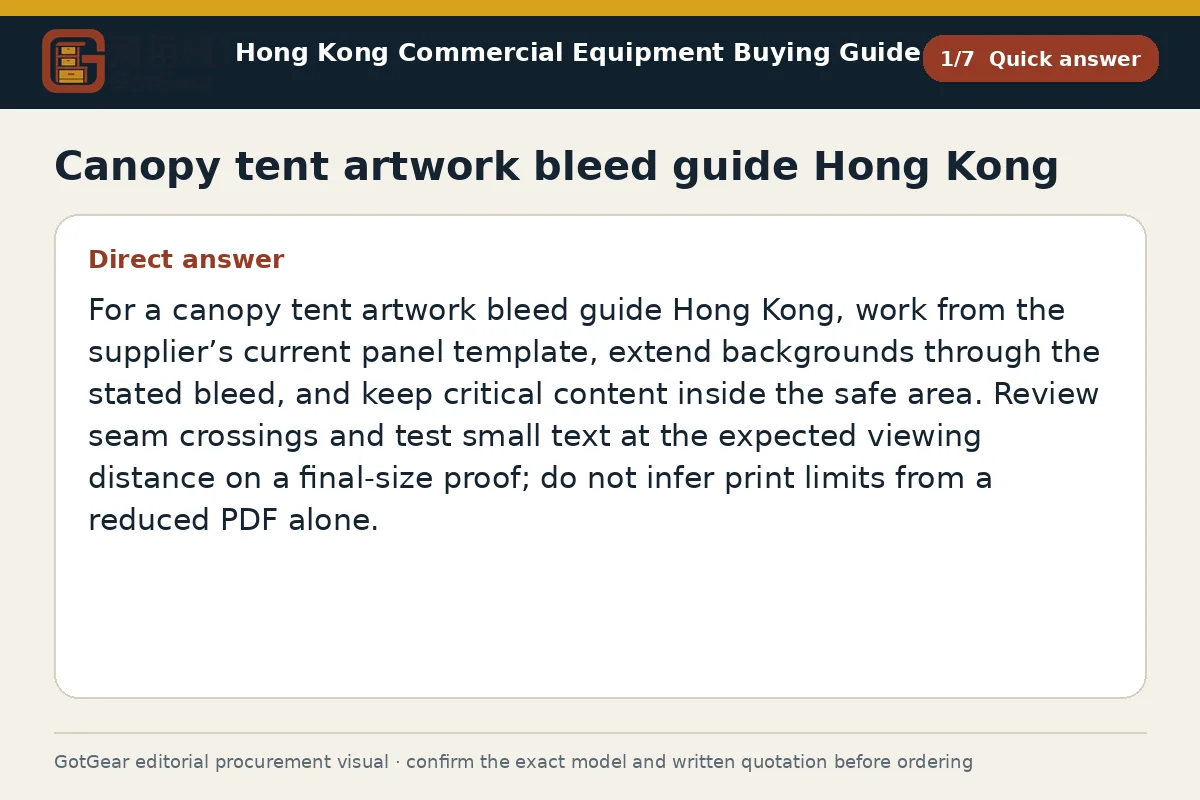
Canopy tent artwork bleed guide Hong Kong
Refer to the GotGear canopy tent artwork bleed guide Hong Kong to set bleed and safe areas. Also review canopy tent seam artwork Hong Kong and test custom canopy small text printing Hong Kong on a final-size proof.
Read the guide
Printed gazebo sidewall door layout Hong Kong
Use this checklist to finalise door positions and visitor flow for printed gazebo sidewall door layout Hong Kong and to plan canopy sidewall cable access Hong Kong. Keep artwork clear of openings during setup with GotGear.
Read the guide
Canopy sidewall wind flap prevention Hong Kong
GotGear guide to canopy sidewall wind flap prevention Hong Kong explains how to inspect fixings, check panel tension and exposed edges, and monitor the weather. Escalate any movement or damage promptly.
Read the guide
Custom canopy Pantone colour matching Hong Kong
GotGear explains how to prepare files and request proofs for custom canopy Pantone colour matching Hong Kong. It also covers custom canopy gradient printing Hong Kong and custom canopy photo resolution printing Hong Kong.
Read the guideRelated topic indexOpen more English procurement pages1 topics
Browse additional equipment families, applications and procurement questions relevant to a wider buying brief.