
For a folding tent delivery inspection checklist Hong Kong, identify who checks, who may sign off and what evidence is needed for any discrepancy. Document the order comparison, component count and visible condition without assuming that a checklist creates contractual acceptance rights; follow the agreed purchase terms and internal approval process.
Order comparison in folding tent delivery inspection checklist Hong Kong
Begin by matching the received cartons against the purchase order, the supplier’s written quotation and the final approved artwork proof. Use a folding tent delivery inspection checklist Hong Kong to align item codes, frame series, nominal footprint, colour references and all ordered accessories. Photograph carton labels before opening; ensure they show the supplier name, your PO reference, model code and carton count. If your enquiry pack noted access limits or loading windows, confirm the delivered model still suits the site plan and any management-office booking.
Measure what matters. Check the collapsed bundle length and the deployed leg centre-to-centre footprint; confirm the leg profile, footplate type and locking mechanism stated in the quotation or data sheet. For printed roofs and walls, verify Pantone or colour references against the signed proof and confirm the correct revision number appears on attached documents. Count accessories such as weights, pegs, ropes, gutters, clamps, repair patches and carry bags against the packing list. For consistent sourcing, ensure your enquiry pack fields in custom pop up canopy RFQ Hong Kong include frame material, canopy fabric description, print coverage, anchoring method, and any required documentation, noting that the model specification and the supplier’s formal quotation prevail if wording differs.
Component records: Folding tent delivery inspection checklist Hong Kong and canopy tent event acceptance checklist Hong Kong
Create a precise record of every component, noting any part numbers on tags or labels. The frame sub-assembly typically includes corner legs, scissor trusses, sliders or glides, lock pins or pull rings, a peak hub and footplates; check for caps, end-plugs and protective sleeves. Note the finish (e.g., powder-coated or anodised as quoted) and photograph joints, welds and rivets that appear stressed or misaligned. Where serial numbers or batch codes exist on frames, log them against your asset register.
For fabrics, list the roof, sidewalls, doors, windows, gutters and any joining strips by quantity and size, and record any care or fire-retardancy labels provided by the manufacturer, if applicable to your venue or insurer. Capture print positions, seams, hook-and-loop strips, zips and attachment straps in close-up photos. If weight kits, ballast plates, stakes, guy lines, clamps, repair patches, spare bolts or wheeled carry bags were ordered, count and photograph each. For an event-team handover, your canopy tent event acceptance checklist for events in Hong Kong should include serials, batch labels and proof references in bilingual notes where available. Keep a running parts list to support future orders through your folding tent accessory inventory in Hong Kong.
What should buyers compare for folding tent delivery inspection checklist Hong Kong?
| Criterion | Straightforward requirement | More complex requirement | Evidence to provide |
|---|---|---|---|
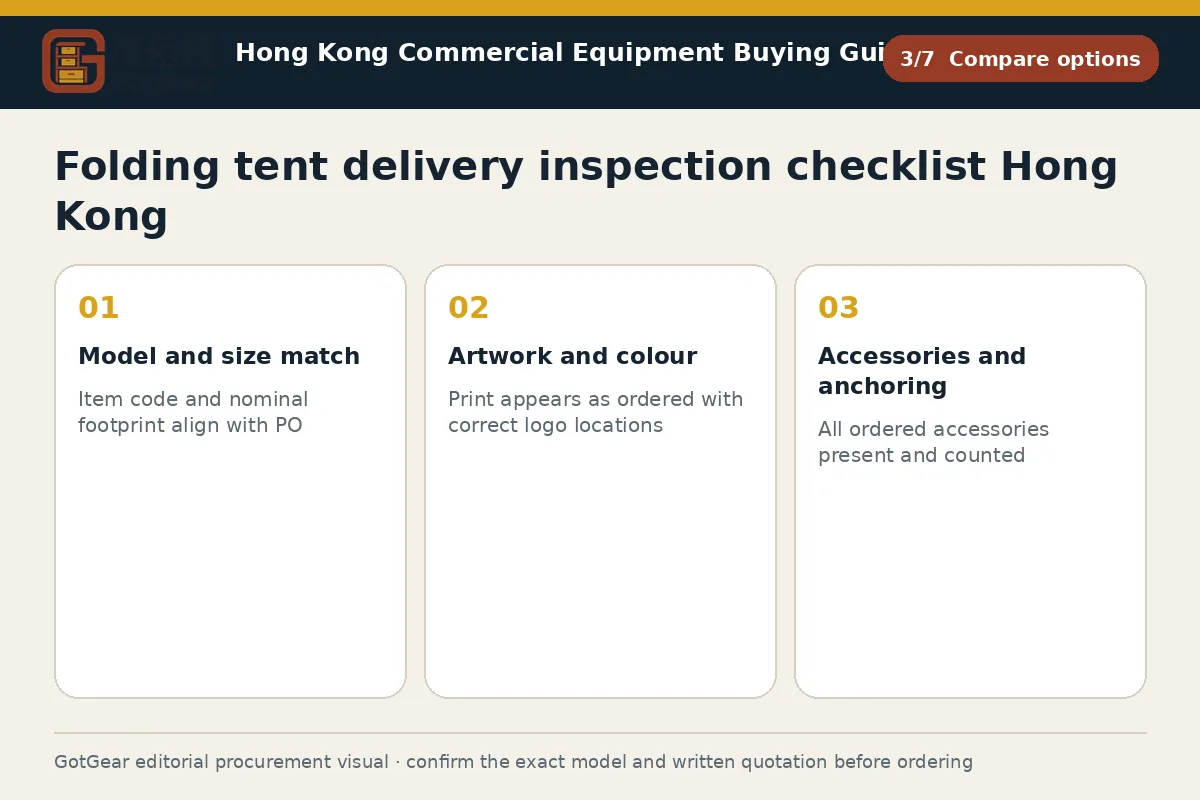
| Model and size match | Item code and nominal footprint align with PO | Frame profile, footplate type and deployed footprint verified against quotation | PO, supplier quotation, data sheet, measurements and labelled photos |
| Artwork and colour | Print appears as ordered with correct logo locations | Pantone/colour refs and artwork proof revision match close-up inspection | Signed artwork proof, swatch reference and canopy detail photos |
| Accessories and anchoring | All ordered accessories present and counted | Anchoring kit suits venue policy and site substrate as planned | Packing list, accessory count, site anchoring plan and venue guidance notes |
| Packaging and condition | Cartons intact with correct labels and counts | Internal components free from dents, tears, corrosion or moisture | Time-stamped photos before/after opening and exception report |
| Documentation | Packing list and basic instructions included | Fire-retardancy/care statement and warranty note if requested by venue/insurer | Copies of manuals/statements and any serial or batch labels recorded |
This framework helps buyers create comparable written enquiries. Final model specifications, availability, delivery and commercial terms must be confirmed in a formal quotation.
Discrepancy handling for folding tent delivery inspection checklist Hong Kong
If any items differ from the order or the approved proof, quarantine the shipment and do not deploy it until the discrepancy is clarified. Photograph the packaging before opening, then photograph each component with the discrepancy visible; include a ruler or measuring tape for scale where relevant. Note any moisture, dents or abrasions on cartons and retain the packing for possible carrier review. Submit a single exception report to the named procurement contact with item codes, quantities, measurements, proof revision and time-stamped images. As a starting point, aim to notify the supplier within one working day, subject to your contract and the supplier’s written instructions.
For urgent events, state the deadline and request the supplier’s proposed corrective path (replacement, parts dispatch, artwork reprint or credit note). If a public venue or an insurer has specific documentation needs, ask the supplier for the appropriate fabric statement, assembly guidance and maintenance notes for the quoted model. When counts are disputed, reconcile against your receiving log and any outdoor tent unloading access planning records for Hong Kong, including the driver’s details and the carton manifest. Consider partial acceptance with clearly documented exceptions only if operations can proceed safely and the purchase terms allow; otherwise, hold the goods pending written direction.
Sign-off roles in folding tent delivery inspection checklist Hong Kong
Define who performs each check. The receiving team counts cartons and inspects visible condition; operations confirms the model and dimensions through measurements and, where time and safety permit, by conducting a controlled trial set-up; marketing or the event owner reviews printed elements against the signed proof; procurement decides on acceptance, with or without exceptions. In schools or other institutions, a department head or facilities manager may be required to co-sign according to the internal approval path.
Use a two-step record: first "received for inspection" on the day, then "accepted for use" after functional verification. Where a sample build is done, capture photos of joints, canopy fit and tensioning, and confirm the planned anchoring method using the folding tent anchoring checklist for Hong Kong before any outdoor exposure. File the goods-received note, packing list, comparison sheet, serial log, artwork proof and exception report together. Record bilingual names, roles and timestamps of all signatories. Acceptance should reflect the quoted model, the approved proof and your institution’s process; if any doubt remains, document the hold point and seek the supplier’s written guidance.
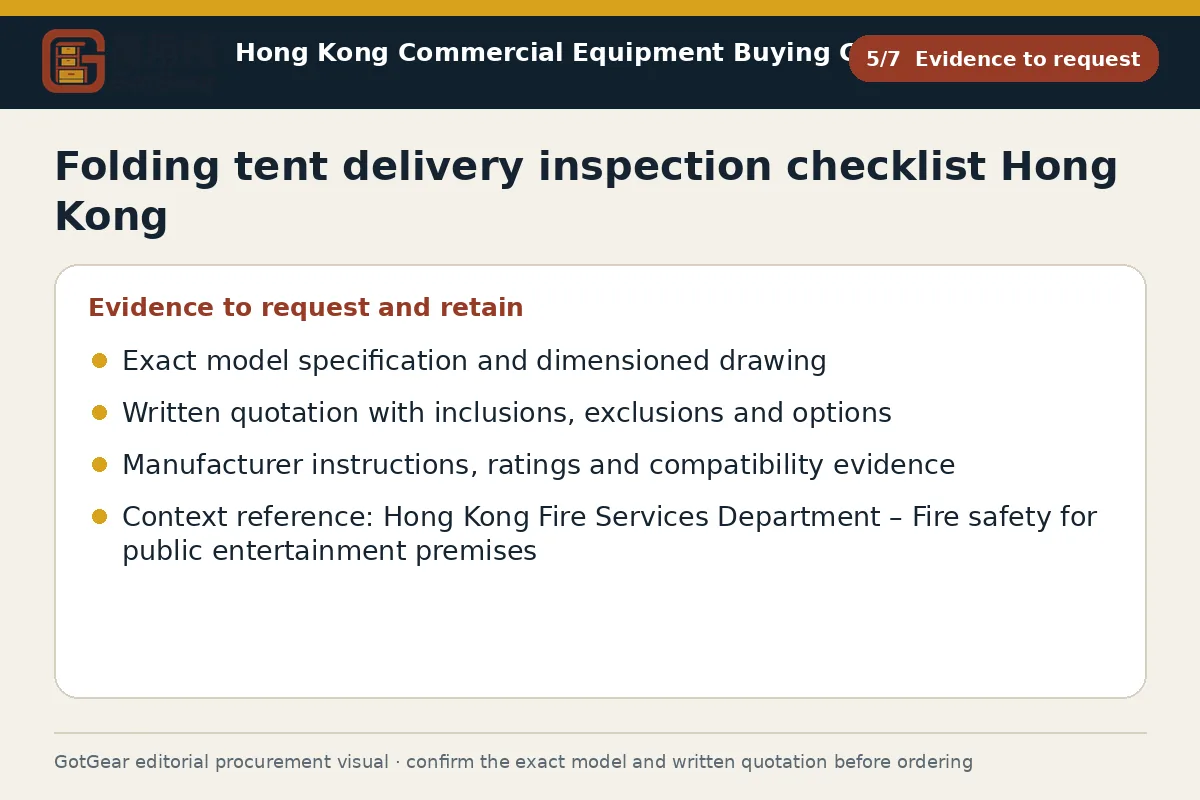
Folding tent delivery inspection checklist Hong Kong decision checklist
On arrival, match cartons to the PO, quotation and approved artwork proof, then photograph labels before opening. Measure collapsed length and deployed footprint, confirm frame profile and locking type, and count all accessories against the packing list. Compare colours and print positions to the signed proof revision. Record any serials and fabric batch labels in bilingual notes. If differences appear, quarantine, document and escalate to procurement with time-stamped images. For venues or insurers that require it, request the relevant fire-retardancy or care statement for the quoted model. Decide on full acceptance, acceptance with exceptions, or hold pending supplier direction, and file all evidence with the goods-received note and your internal approval record.
- Operating use, quantity and expected frequency
- Dimensions, capacity, material and accessory requirements
- Delivery address, floor, goods lift and loading window
- Required documents, acceptance checks and after-sales arrangements
Key points for folding tent delivery inspection checklist Hong Kong, canopy tent event acceptance checklist Hong Kong
Hong Kong receiving often means tight loading windows, industrial-building rules and narrow goods lifts. Coordinate with the building manager in advance for lift dimensions, floor protection and any required booking or insurance note. Confirm the collapsed bundle and trolley can negotiate doorways, lobbies and turns without dismantling. In humid or rainy conditions, dry wet fabrics promptly to avoid mould; store only when fully dry. Public-event venues may request a fabric fire-retardancy statement or method notes, depending on the organiser’s policy. Treat this as practical guidance, not legal advice, and follow the venue and supplier’s written requirements.
Questions about folding tent delivery inspection checklist Hong Kong
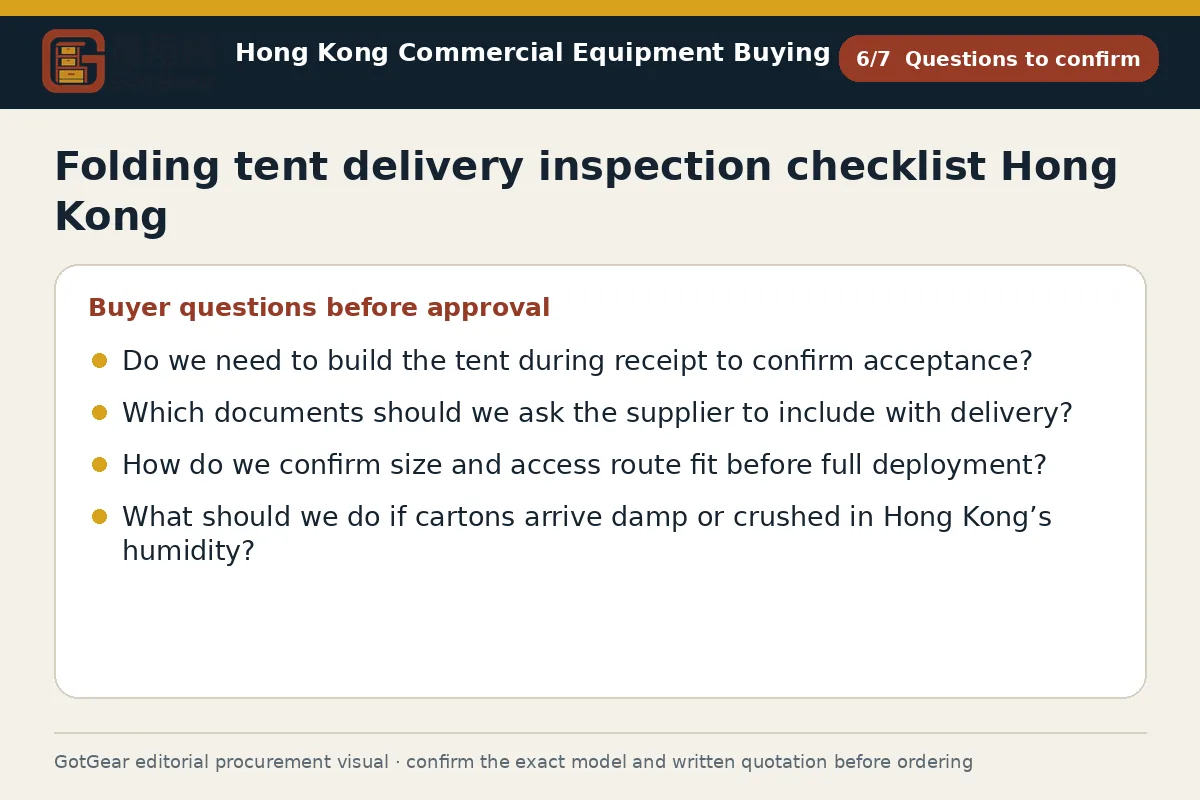
Do we need to build the tent during receipt to confirm acceptance?
A controlled trial set-up is recommended for first-time purchases or new models to verify fit, locking action and canopy tension. Where access, weather or venue rules prevent this, complete dimensional checks and visual inspection, then schedule a supervised set-up later. Protect floors, plan safe anchoring, and confirm with the building manager or organiser before any on-site trial.
Which documents should we ask the supplier to include with delivery?
Request a packing list, assembly and care instructions, and the approved artwork proof revision for printed units. If your venue, insurer or internal policy requires it, ask for a fabric fire-retardancy statement relevant to the quoted model. Where serials or batch labels exist, record them. The supplier’s formal quotation and specification remain the reference for what is provided.
How do we confirm size and access route fit before full deployment?
Measure the collapsed bundle length and the deployed leg centre-to-centre footprint, and compare with your access survey of doors, corridors and lifts. As an example starting point, note a target collapsed length and trolley width that your lift can accept, then confirm with the supplier and building manager in writing. The quoted model specification and site measurements prevail.
What should we do if cartons arrive damp or crushed in Hong Kong’s humidity?
Photograph condition before opening, note moisture on the delivery record, and dry fabric immediately in a clean, ventilated area. Quarantine the shipment and escalate with time-stamped images. Do not store wet canopies sealed in bags. Ask the supplier for cleaning and drying guidance for the quoted fabric, and proceed per your purchase terms and venue requirements.
Continue with closely related procurement topics
These pages share equipment, operating or decision-stage signals with this guide.
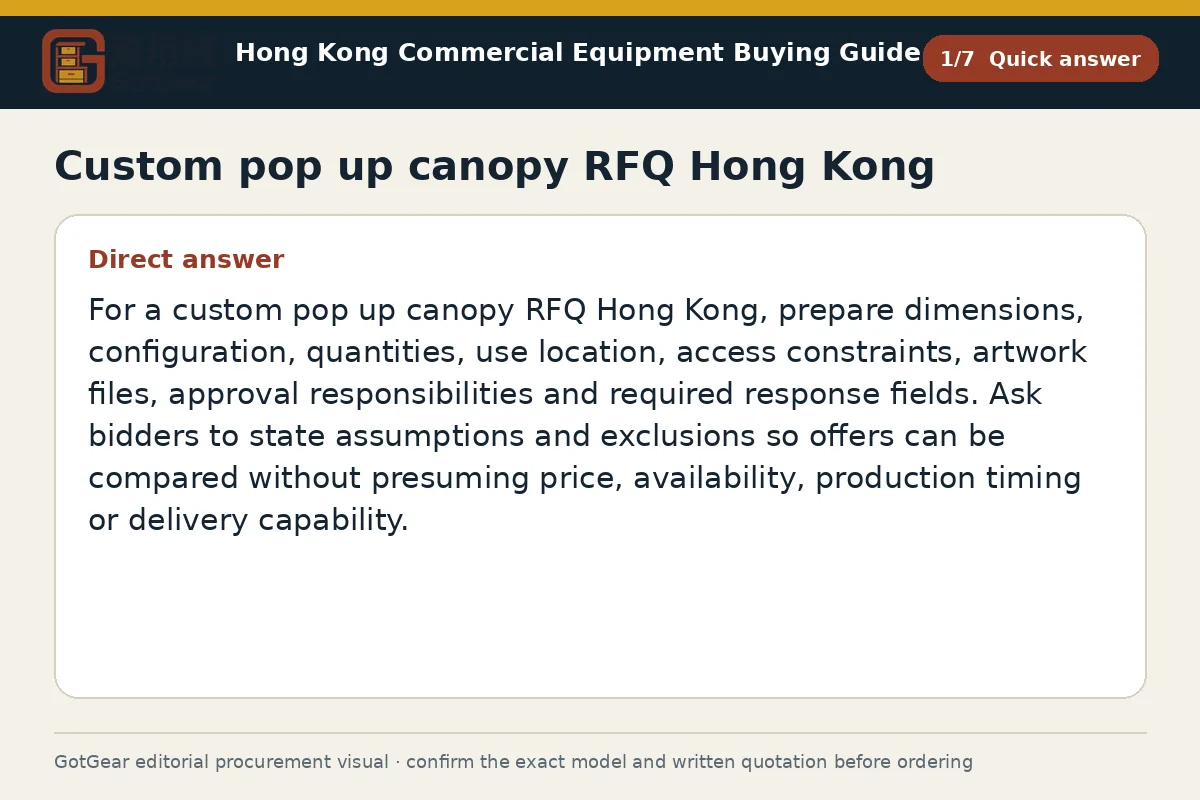
Custom pop up canopy RFQ Hong Kong
GotGear's custom pop up canopy RFQ Hong Kong is a checklist to document dimensions, configuration, access and artwork. It creates a branded gazebo procurement specification Hong Kong so suppliers respond to a single brief.
Read the guide
Folding tent accessory inventory Hong Kong
GotGear covers folding tent accessory inventory Hong Kong and what to record for kit storage. It links canopy sidewall packing and labelling Hong Kong with folding tent condition report Hong Kong to keep kits traceable.
Read the guide
Canopy tent artwork bleed guide Hong Kong
Refer to the GotGear canopy tent artwork bleed guide Hong Kong to set bleed and safe areas. Also review canopy tent seam artwork Hong Kong and test custom canopy small text printing Hong Kong on a final-size proof.
Read the guide
Canopy tent rooftop anchoring Hong Kong
GotGear offers guidance on approval, structural input, exposure, ground conditions and permitted fixing methods for canopy tent rooftop anchoring Hong Kong. It also covers measures for canopy tent anchoring on sand Hong Kong.
Read the guideRelated topic indexOpen more English procurement pages3 topics
Browse additional equipment families, applications and procurement questions relevant to a wider buying brief.