
There is no universal safe adjustment for canopy sidewall wind flap prevention Hong Kong. Follow the manufacturer’s instructions, verify current site and weather conditions, venue directions and applicable Hong Kong requirements, and stop use or escalate to the event safety lead whenever movement, damage or exposure falls outside the approved plan.
Fixings and panel tension for canopy sidewall wind flap prevention Hong Kong
Start with physical attachment points. Identify how each sidewall connects to the frame: zipped corner posts, keder tracks, hook-and-loop wraps, buckle straps or eyelets with bungees. Measure and record the spacing of fixings along eaves and uprights as an example starting point only, then confirm with the manufacturer’s drawing for your exact model; mismatched spacing leads to slack pockets that flap. Check hems, webbing and reinforcement patches for abrasion, loose threads and UV brittleness. Verify zip sliders run freely and that pullers have lanyards suitable for gloved use on wet days.
For procurement, ask for the wall cut length against the leg height, the intended tension method at eaves and base, fabric weight (gsm), coating type, seam construction and thread specification in writing. Confirm compatibility with the frame model and any canopy tent weights and tie down straps Hong Kong listed on the supplier quotation. Request bilingual manuals where needed and photos of the installed wall-to-frame interface. In humid conditions, specify adjustable tensioners rather than fixed-length ties to allow re-tensioning during the day. Check the packed wall bundle length against goods-lift and doorway limits typical of industrial buildings. For canopy sidewall wind flap prevention Hong Kong, ensure the quotation states which reinforcement and fixing hardware is included; model specifications and the formal written quotation prevail over any verbal guidance.
Venue and manufacturer limits in canopy sidewall wind flap prevention Hong Kong
Treat the manufacturer’s limits and the venue’s directions as co‑equal constraints. Ask for a written statement listing the permitted configurations: all walls closed, windward open, leeward open, half‑height skirts, and any prohibition on mixing clear PVC with opaque fabric. Request the specified anchoring scheme for each configuration, including the number and placement of tie points per leg. If the brand provides example wind thresholds, treat them as a starting point only and reconfirm with the current site brief and the competent person in charge at the event.
Venue managers in Hong Kong frequently restrict ground penetration, rooftop attachments and façade tie‑ins. Where stakes are disallowed, quotations should identify ballast types and placements compatible with your frame and canopy tent sidewalls wind anchoring Hong Kong for your plan. Note loading windows and goods‑lift sizes that can delay ballast delivery. Insist that suppliers state the frame model cross‑compatibility of wall fixings and any adapters needed. Request bilingual method statements if institutional approval is needed, and ask the venue to confirm acceptable anchor locations in writing. Ensure your comparison of written quotations aligns accessories, anchor counts per leg and any venue‑mandated safety supervision; model specifications and formal written quotation prevail.
What should buyers compare for canopy sidewall wind flap prevention Hong Kong?
| Criterion | Straightforward requirement | More complex requirement | Evidence to provide |
|---|---|---|---|
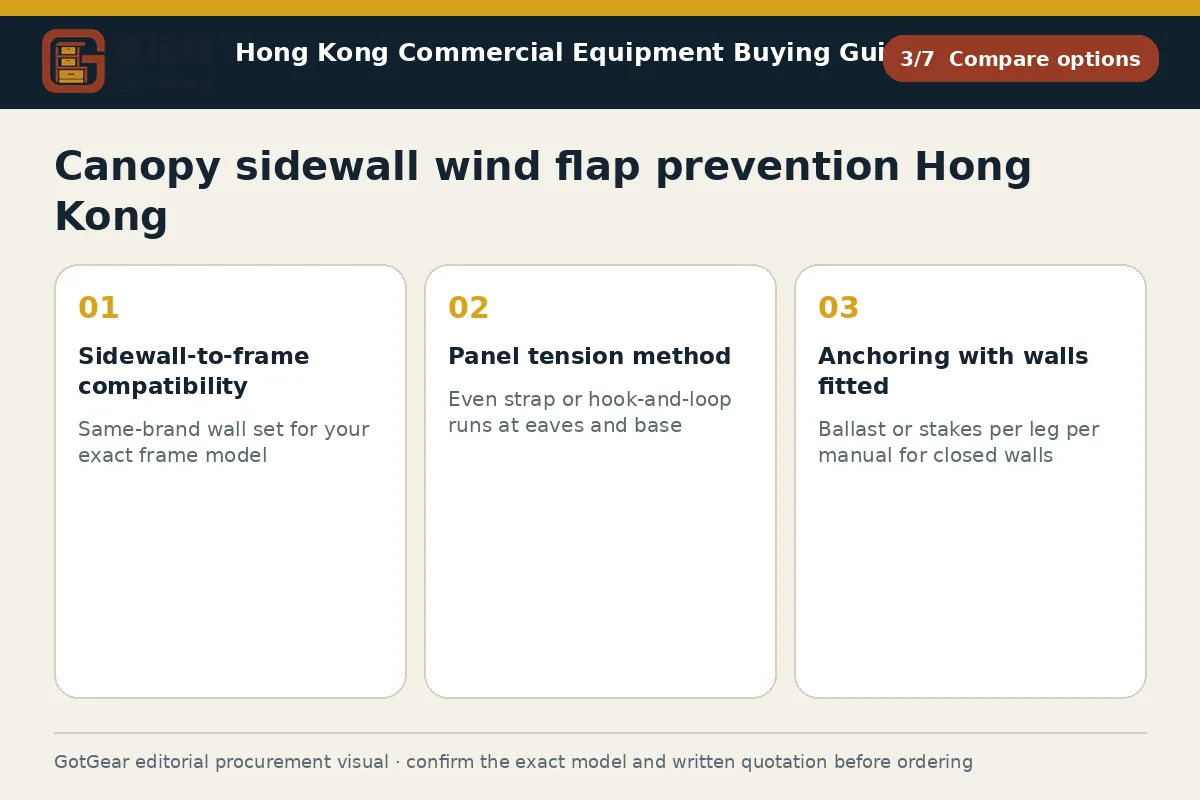
| Sidewall-to-frame compatibility | Same-brand wall set for your exact frame model | Cross-brand walls with approved adapters and verified spacing | Frame model code, wall set SKU, photos of nodes and spacing |
| Panel tension method | Even strap or hook-and-loop runs at eaves and base | Ratchet lines or keder with adjustable base skirts for re-tensioning | Drawing showing fixing pattern and adjustment range |
| Anchoring with walls fitted | Ballast or stakes per leg per manual for closed walls | Engineered ballast layout accepted by venue for each configuration | Manual page reference and venue acceptance note |
| Site access and constraints | Ground-level plaza with open anchor options | Rooftop/podium, goods-lift limits, restricted tie points and loading windows | Access measurements, photos, management-office constraints |
| Documentation and approvals | Product manual and fabric flame-retardant statement, if applicable | Bilingual method statement, exposure plan and venue confirmation | PDFs, contact names, revision dates and quotation references |
This framework helps buyers create comparable written enquiries. Final model specifications, availability, delivery and commercial terms must be confirmed in a formal quotation.
Exposure changes during canopy sidewall wind flap prevention Hong Kong
Adding, removing or closing walls changes exposure, pressure pathways and internal turbulence. Walk the site perimeter after any layout change: new fencing, temporary hoarding, parked vans or container trucks can funnel wind to a formerly sheltered edge. Monitor shifts in local gusts caused by sea breezes, street canyons and podium levels. In wet, humid periods, fabrics can relax; plan timed checks to re-tension panels before audible flutter starts. If the manual allows, partial openings on leeward sides can reduce pressure, but do not improvise beyond the manufacturer’s options.
Build operations routines and records. Use a simple tell-tale (a light ribbon at eaves) to indicate rising turbulence near seams. Feel for zipper strain at mid-height and at the base hem; any hard pulsing suggests re-tensioning or configuration change. Your folding tent anchoring checklist for Hong Kong should note orientation (bearing), noted windward edges, and obstructions within a few metres as an example recording scope only. When ordering, request vents, overlap flaps, continuous hook-and-loop runs at posts, spare straps and approved repair patches. Public events may require certain walls to remain open for circulation and may require an approved temporary event canopy emergency-exit layout; coordinate both constraints before committing to a wall plan or extra hardware.
Escalation and stop-use decisions for canopy sidewall wind flap prevention Hong Kong
Define clear triggers for escalation to the event safety lead and be ready to stop use. Warning signs include repeated panel flutter that returns within minutes of re-tensioning, snaps or cracks at seams, visible racking of legs, bungees reaching full extension, anchors walking on the surface, and doors that no longer close without force. Do not add improvised tie points, ratchet to structural elements, or tape panels to neighbouring fixtures; such actions can transfer loads dangerously and breach venue directions.
Pre-plan an orderly reduction in exposure consistent with the manual: for example, reverting to fewer walls, then full opening, then full stand-down as an example sequence only. Establish who calls each step, how staff are briefed bilingually, and how access is maintained for first aid and exit routes during changes. Agree a pack-down route that respects loading-area time slots and industrial-building lift capacities. Keep supplier and manufacturer contacts on the day, and document any damage with photos before moving items. If observed conditions depart from the approved configuration or written plan, stop use and inform the venue manager; model specifications and the formal written quotation prevail.
Canopy sidewall wind flap prevention Hong Kong decision checklist
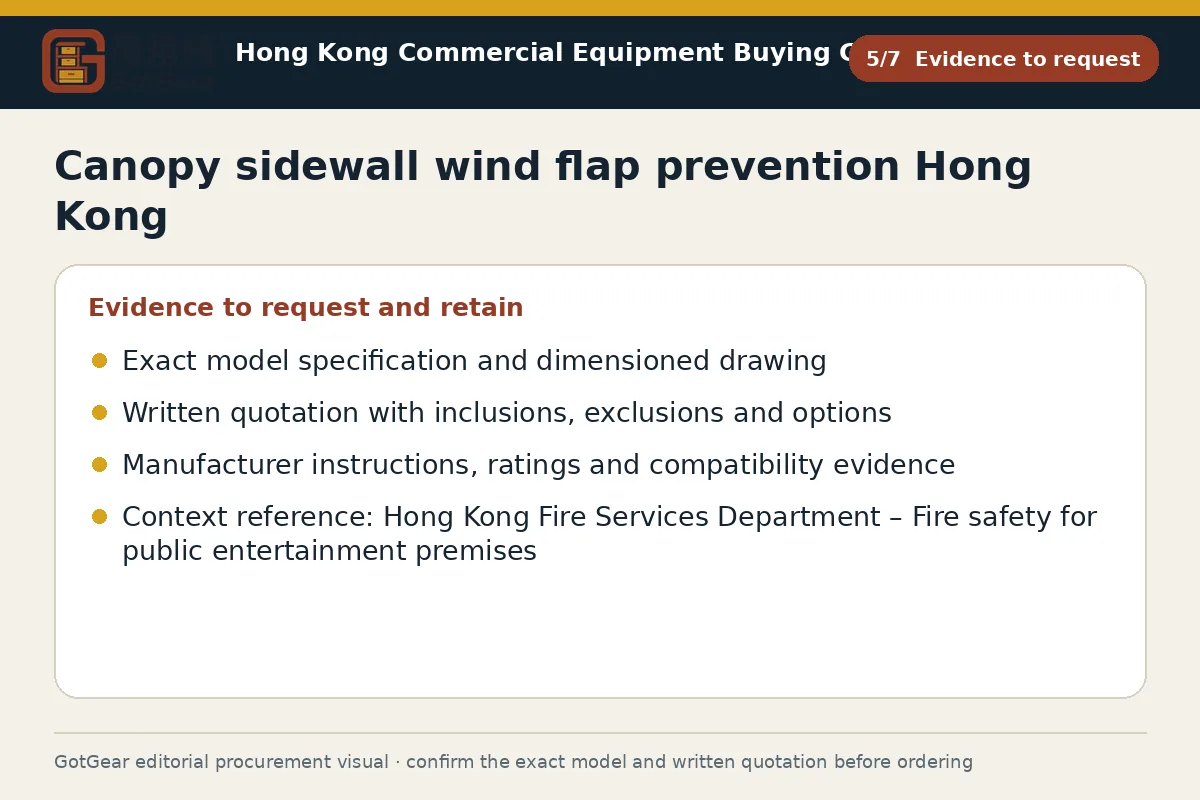
Confirm the exact frame model, intended wall configuration and the manufacturer’s written limits. Walk the site and record access constraints, permitted anchor points, likely windward edges and adjacent obstructions. Compare quotations line by line for wall-to-frame fixing type, included anchors or ballast, reinforcement details and bilingual documentation. On receipt, inspect stitching, zips, webbing and fixing hardware, and verify counts against the packing list. Before opening, tension panels evenly, set tell-tales, and brief staff on escalation triggers and a stop-use route. During use, re-check slack, anchor movement and exposure changes after wall adjustments or nearby setup changes. If any condition falls outside the plan, escalate promptly and stand down as necessary.
- Operating use, quantity and expected frequency
- Dimensions, capacity, material and accessory requirements
- Delivery address, floor, goods lift and loading window
- Required documents, acceptance checks and after-sales arrangements
Key points for canopy sidewall wind flap prevention Hong Kong
Hong Kong sites combine tight access, podium-level wind acceleration and sudden showers. Street-canyon effects around mixed-use towers can change a sheltered morning into a gusty afternoon, and rooftop or promenade venues often prohibit penetrative anchoring. Management offices may require bilingual method statements and advance sign-off for ballast locations and any wall-closure plan. Goods-lift dimensions and loading windows can constrain when ballast and sidewalls reach the floor. Treat weather bulletins and venue directions as inputs to your on-site checks, and seek competent advice where required; this summary does not constitute legal guidance.
Questions about canopy sidewall wind flap prevention Hong Kong
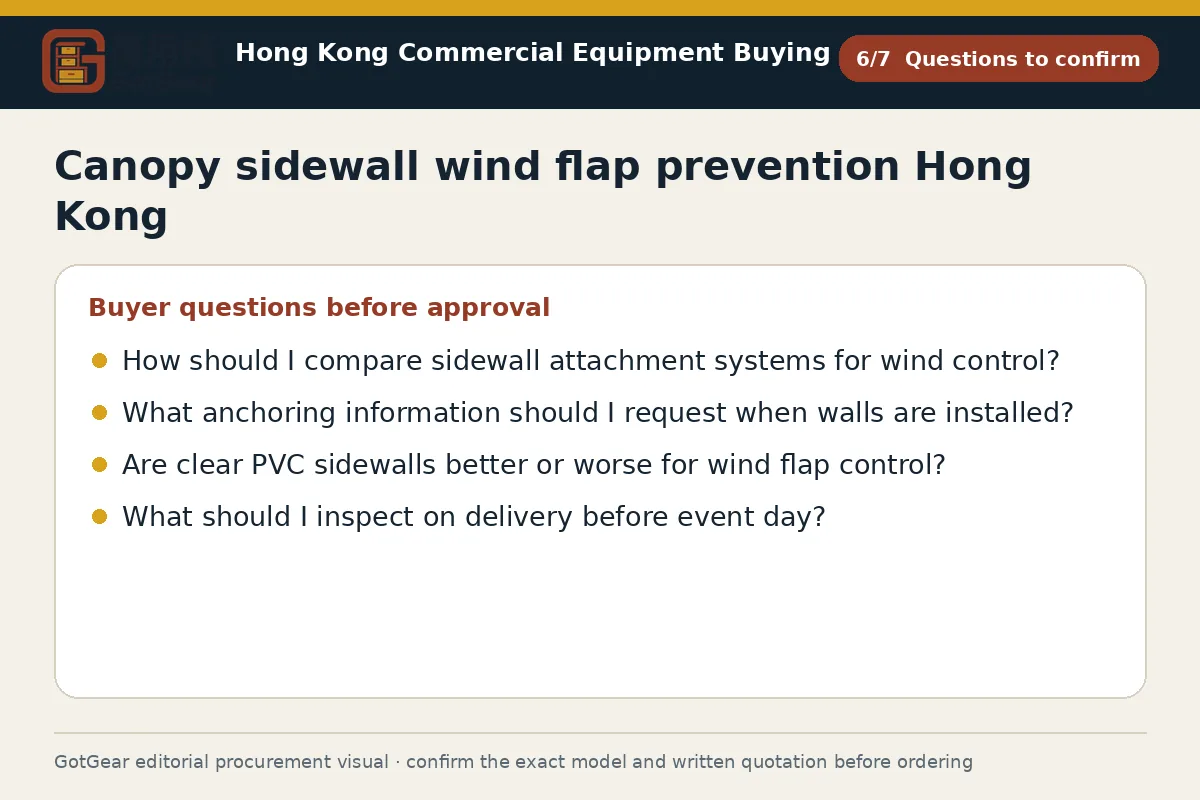
How should I compare sidewall attachment systems for wind control?
Prefer systems that match your frame’s original fixing pattern and allow even tension at eaves, corners and base. Zips with continuous hook-and-loop backups tend to resist flutter more than point ties. Always verify compatibility in writing for your frame model and request drawings. Field trials are valuable, but the model specification and formal written quotation govern the final selection.
What anchoring information should I request when walls are installed?
Ask for the anchoring scheme specific to each wall configuration, including the number and placement of tie points per leg and compatible ballast or ground fixings. Request manufacturer pages that link sidewall use to anchoring. Where venues restrict penetrations, seek a written note accepting the proposed ballast plan. Treat any example thresholds as starting points only, confirmed by the responsible parties.
Are clear PVC sidewalls better or worse for wind flap control?
Clear panels can be heavier and stiffer, which may reduce small ripples yet transfer more load to zips and fixings. Opaque fabric may absorb gusts differently. The best choice depends on your frame, fixing pattern and venue constraints. Ask the manufacturer for configuration-specific guidance and ensure the quotation states reinforcement details for corners and doorways.
What should I inspect on delivery before event day?
Count panels and hardware against the packing list, then check zips, sliders, hems, webbing, buckles and eyelets for defects. Confirm that fixing spacing matches your frame and that any adapters are included. Look for clear bilingual labels and manuals if needed. Photograph any concerns and seek written confirmation of corrective actions before the equipment is scheduled for loading or installation.
Continue with closely related procurement topics
These pages share equipment, operating or decision-stage signals with this guide.
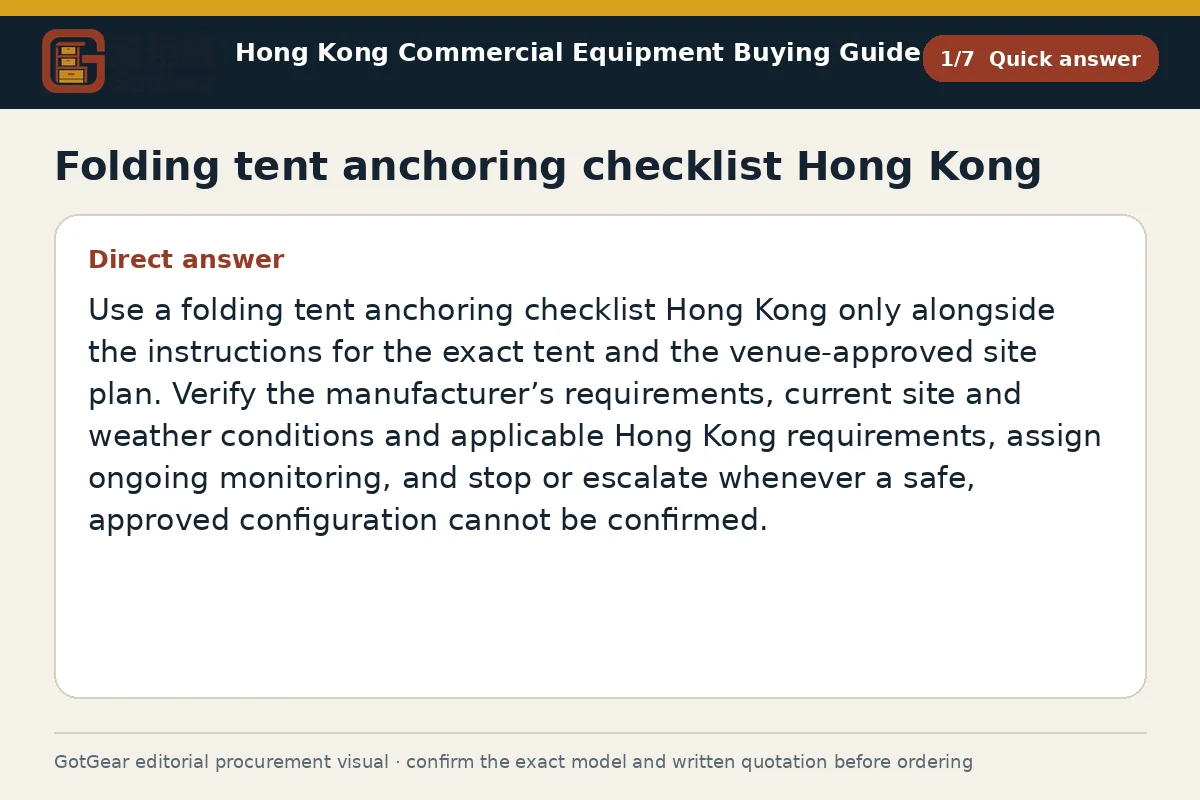
Folding tent anchoring checklist Hong Kong
Use the folding tent anchoring checklist Hong Kong to assess surface exposure, confirm layout and anchoring, and inspect fixings and ballast. Record checks, assign monitoring and include GotGear in your documentation.
Read the guide
Printed gazebo sidewall door layout Hong Kong
Use this checklist to finalise door positions and visitor flow for printed gazebo sidewall door layout Hong Kong and to plan canopy sidewall cable access Hong Kong. Keep artwork clear of openings during setup with GotGear.
Read the guide
Canopy sidewall rain seam inspection Hong Kong
Canopy sidewall rain seam inspection Hong Kong covers inspection of seams and welded joins, photographing splits, holes and abrasion and logging panel identification. Check the weather and site rules before work with GotGear.
Read the guide
Canopy tent rooftop anchoring Hong Kong
GotGear offers guidance on approval, structural input, exposure, ground conditions and permitted fixing methods for canopy tent rooftop anchoring Hong Kong. It also covers measures for canopy tent anchoring on sand Hong Kong.
Read the guideRelated topic indexOpen more English procurement pages2 topics
Browse additional equipment families, applications and procurement questions relevant to a wider buying brief.