
For a folding tent accessory inventory Hong Kong, record item ID, description, compatible kit, quantity, storage location, last check and current status. Reconcile the list at return and again before issue, using labelled bags and a condition report to separate ready, missing, cleaning-required and review-required items.
Asset fields for a folding tent accessory inventory Hong Kong
Build your register around clear, durable identifiers that tie each component to a kit and a storage point. For a folding tent accessory inventory Hong Kong, set unique IDs for frames, roofs, sidewalls, gutters, leg weights, pegs, guy lines, repair patches and tools. Capture compatible tent model, nominal size (example starting point: 3 m x 3 m to be confirmed), fabric/material type, colour, fastening type (zip, hook-and-loop, buckle), piece count per kit, and spare threshold. Add storage location (rack/bay/shelf), typical bag ID, estimated bag weight (as an example only), and handling note (two-person lift if required). Where barcodes/QR are used, record the symbology and the exact code printed on the label.
Procurement actions: measure goods-lift cabin and doorway clearances and record the tightest width/height so packed bags will pass without forcing. Log floor level, loading window and any management-office escort or permit needs. When requesting quotations, ask suppliers to confirm fabric composition, example GSM, coating, stitching and webbing spec, plus any fire-retardant statement if the venue or insurer requires it. Request sample label artwork showing bilingual English/Chinese fields, barcode size, and adhesive or sew-in method. Confirm whether item serials are printed on frames or tags, and where. Always let the model specification and formal written quotation prevail over internal assumptions.
Bag IDs: Folding tent accessory inventory Hong Kong and canopy sidewall packing and labelling Hong Kong
Assign every soft-accessory bag a readable, weather-resistant identity so kits can be reassembled quickly. A practical structure is Bag ID = Kit Code + Component Type + Sequential Number, presented both as human-readable text and as QR/Code-128. Specify labels that resist abrasion and humidity: stitched PVC windows for paper inserts, plus a permanent underside label. Include the kit name, item description, location code, and a contact number for found items. Ensure the font supports bilingual characters and that IDs can be scanned in dim loading bays. Request sample swing tags and heat-shrink barcode sleeves from suppliers to compare durability.
For sidewalls, define a repeatable fold-and-roll method, the required strap count, and desiccant use so weight and volume remain predictable. State the maximum safe bag weight as an example starting point only, then confirm it against your manual-handling policy. For canopy sidewall packing and labelling in Hong Kong, specify whether walls are packed by size, by window type, or by set. Add an inspection note referencing canopy side-seam rain inspection in Hong Kong so water-shedding seams are checked before sealing bags. On receipt, verify zip gauge, stitching, odour (for PVC off-gassing), and that Bag IDs match the register.
What should buyers compare for folding tent accessory inventory Hong Kong?
| Criterion | Straightforward requirement | More complex requirement | Evidence to provide |
|---|---|---|---|
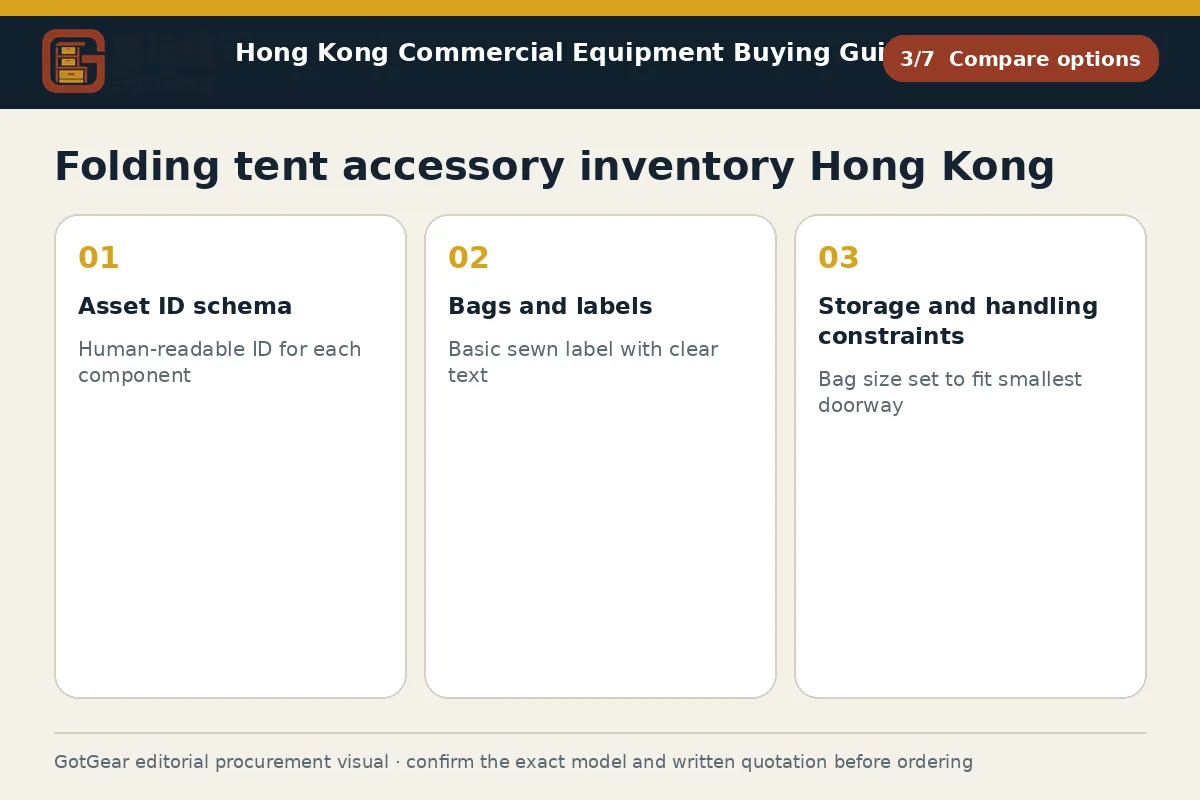
| Asset ID schema | Human-readable ID for each component | Human-readable plus barcode/QR aligned to software | Proposed ID format, sample label artwork, barcode symbology |
| Bags and labels | Basic sewn label with clear text | Stitched PVC window + permanent label; abrasion/moisture resistant | Bag material spec, label material, sample photos |
| Storage and handling constraints | Bag size set to fit smallest doorway | Bag size/weight tuned to lift limits and trolley type | Measured door/lift sizes, example max bag size/weight |
| Reconciliation workflow | Return and pre-issue counts with scans | Counts, scans, quarantine shelf, photo evidence and pick-lists | Draft SOP, device choice, status codes, sample screenshots |
| Condition reporting | Simple pass/fail tick boxes | Detailed fields with photos and fault categories, linked to kits | Condition form template, example images, escalation path |
This framework helps buyers create comparable written enquiries. Final model specifications, availability, delivery and commercial terms must be confirmed in a formal quotation.
Reconciliation workflow for folding tent accessory inventory Hong Kong
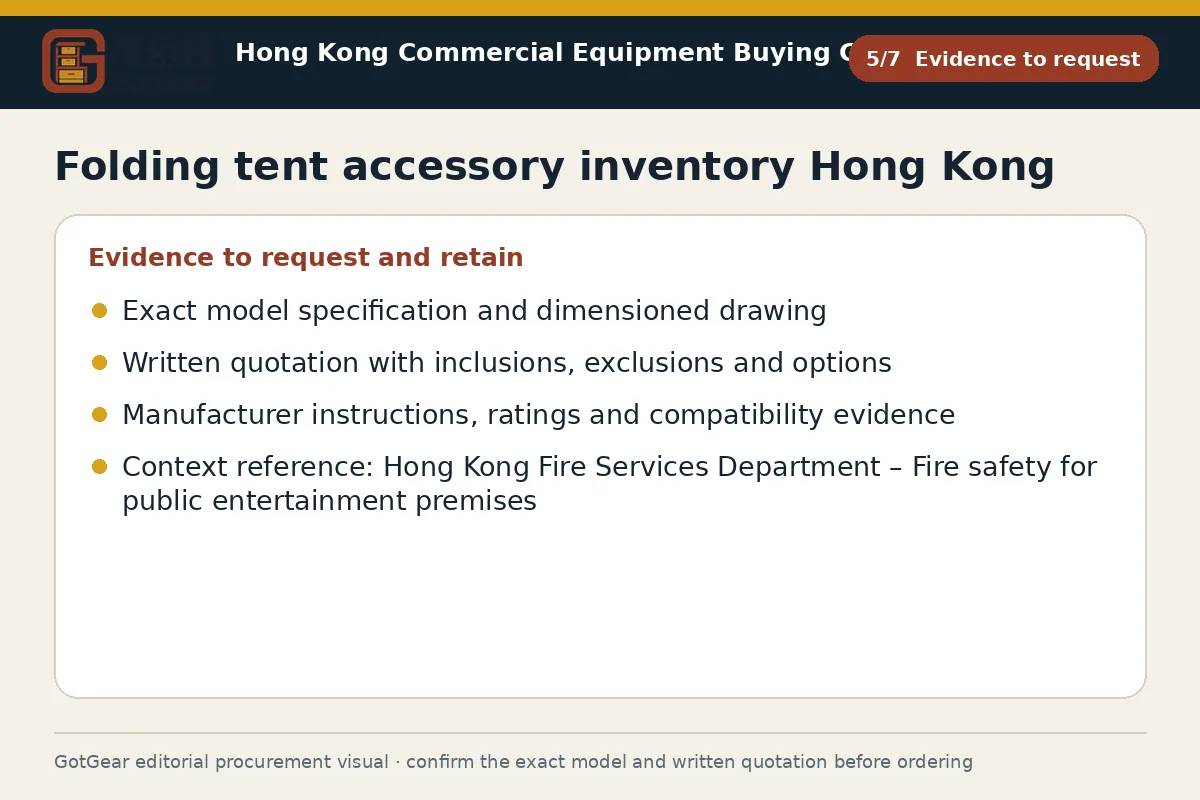
Design a simple, unmissable flow that happens twice: at return and pre-issue. On return, scan every bag ID into the job record, count items against the pick-list, and separate anything wet. Use drying racks and airflow; a humidity card in one bag per kit (example starting point only) helps decide when to close. Record discrepancies immediately and park non-conforming items in a quarantine shelf. Photograph damage in situ and log missing parts against the relevant kit. If frames carry stamped serials, confirm they match the register before racking.
Before issue, pull a system pick-list by kit, scan each bag, and confirm piece counts and readiness status. If a component shows “quarantine”, swap from spares or update the booking scope. Include a quick visual of seams, buckles and guy-line knots, guided by your folding tent delivery inspection checklist Hong Kong. Procurement actions: specify the scan tools (handhelds or mobile phones), the barcode type to be printed, and where codes sit on bags/frames. Ask manufacturers to confirm serial-mark locations and spare-part codes in writing. Treat any suggested timing or sampling level here as examples to be confirmed in your SOP.
Condition history: Folding tent accessory inventory Hong Kong and folding tent condition report Hong Kong
Condition notes must be fast to capture and useful later. Configure fields for date/time, inspector, kit, component, status (ready, cleaning-required, repair-required, review-required), moisture observed, odour, abrasion, seam integrity, fastener function, frame straightness, and ballast integrity. Attach 2–3 photos (example starting point) and note immediate actions taken. Reference related checks, such as the canopy water-weight leak check used in Hong Kong, when assessing ballast. For cleaning, record the chemical used, the dilution per the manufacturer's guidance, and the drying location.
When a pattern of faults appears, raise a folding tent condition report in Hong Kong that groups items by issue type and links to purchase batches. Procurement actions: ask suppliers for care-and-repair instructions, fabric cleaning limitations, spare-part lists with identifiers, and any warranty claim process. Where venues or insurers may require flame-retardant or wind-use statements for canopies or accessories, request the manufacturer’s documentation and keep copies with the register. If seaside or humid deployments are common, specify post-event rinse/dry steps and confirm they align with the model’s materials and the written quotation.
Folding tent accessory inventory Hong Kong decision checklist
Confirm the asset fields you will maintain, including kit compatibility, storage location, bag ID, barcode type and spare thresholds. Measure lift cabins, doorways and turning spaces, then set maximum bag size and example weight limits to be confirmed internally. Specify label materials, bilingual artwork and where IDs sit on frames and bags. Define return and pre-issue reconciliation, quarantine locations and condition-photo requirements. Ask suppliers to confirm fabric composition, stitching/webbing details, serial-mark locations and spare-part codes in the written quotation. Compare offers on accessory-bag construction, replacement labels and lead times. On receipt, inspect labels, zips, seams and that Bag IDs match the register. If a venue or insurer requires flame-retardant statements, obtain the manufacturer’s documentation.
- Operating use, quantity and expected frequency
- Dimensions, capacity, material and accessory requirements
- Delivery address, floor, goods lift and loading window
- Required documents, acceptance checks and after-sales arrangements
Key points for folding tent accessory inventory Hong Kong, canopy sidewall packing and labelling Hong Kong, folding tent condition report Hong Kong
In Hong Kong, plan your register and packing around tight goods-lift cabins, narrow fire doors and short loading windows. Record the smallest doorway and lift dimensions at your storage site and main venues so bag sizes and trolleys fit without forcing. High humidity and sudden rain demand routine drying space and airflow before sealing bags. Building management may require advance booking, escorts or permits for industrial-building access; log these with each storage location. Bilingual IDs and check sheets help mixed teams reconcile kits under time pressure. This page provides operational guidance, not legal advice.
Questions about folding tent accessory inventory Hong Kong
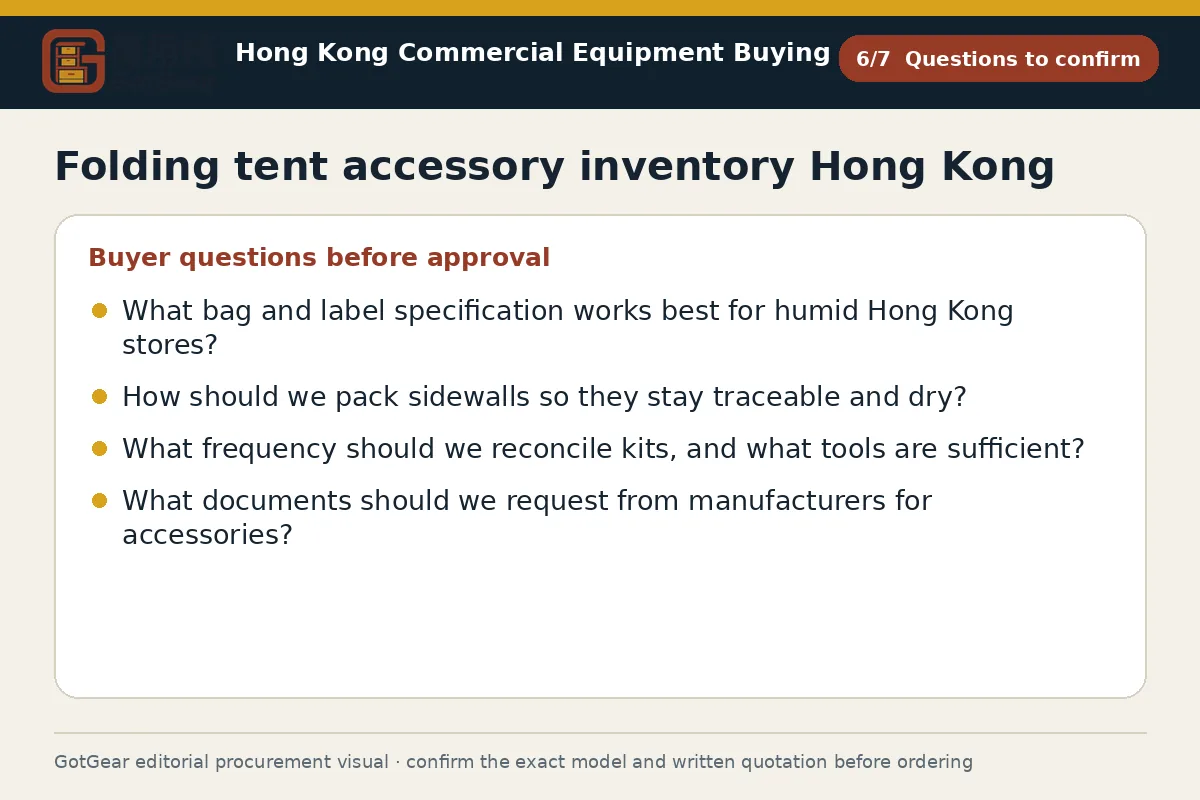
What bag and label specification works best for humid Hong Kong stores?
Use stitched PVC windows for paper inserts plus a permanent underside label, and request abrasion- and moisture-resistant materials. QR or Code-128 should be scannable in low light. Confirm adhesive, stitching and laminate samples with the supplier. Finalise after checking your goods-lift fit, handling policy and bilingual artwork needs.
How should we pack sidewalls so they stay traceable and dry?
Roll to a fixed width, strap consistently, add desiccant, and place a scannable Bag ID facing the zip opening. Group by size or window type as your jobs require, then mirror this in the register. Dry fully before sealing. Method, strap count and desiccant use are example starting points that must be confirmed in your SOP.
What frequency should we reconcile kits, and what tools are sufficient?
Scan and reconcile at every return and pre-issue. Handheld scanners or phones with a simple app are usually adequate. Any weekly or monthly spot-check interval beyond this is an example starting point and must be confirmed by your risk assessment, event volume and insurer or venue expectations.
What documents should we request from manufacturers for accessories?
Ask for fabric composition, example GSM, coating details, stitching/webbing specification, care-and-cleaning guidance, spare-part identifiers and any warranty procedure. Where venues or insurers request it, obtain fire-retardant or use statements. Always let the model specification and formal written quotation prevail over summaries or assumptions.
Continue with closely related procurement topics
These pages share equipment, operating or decision-stage signals with this guide.
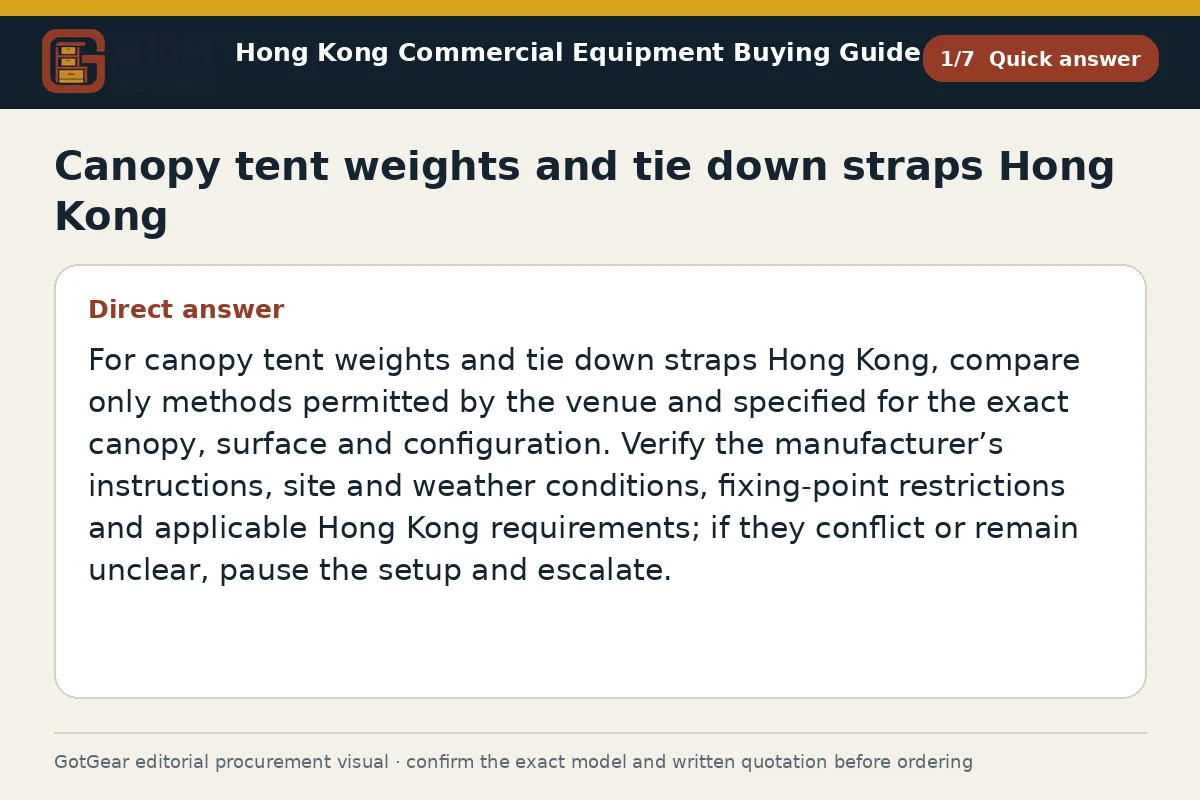
Canopy tent weights and tie down straps Hong Kong
Compare canopy tent weights and tie down straps Hong Kong by considering the venue, surface and permitted fixing points. Check the manufacturer's instructions and local weather before use and follow guidance from GotGear.
Read the guide
Custom canopy full wall vs half wall Hong Kong
Compare enclosure, visibility, access and branding area when choosing between custom canopy full wall vs half wall Hong Kong. Also consider privacy, how customers will approach and venue rules when planning with GotGear.
Read the guide
Clear canopy sidewall vs mesh sidewall Hong Kong
Compare clear canopy sidewall vs mesh sidewall Hong Kong to assess visibility, airflow, enclosure, panel compatibility and visitor comfort when planning your site. Get practical guidance from GotGear.
Read the guide
Canopy water weight leak check Hong Kong
For a canopy water weight leak check Hong Kong, GotGear recommends inspecting the shell, seams and cap, photographing and labelling any leaks, isolating suspected ballast and following the manufacturer's guidance.
Read the guideRelated topic indexOpen more English procurement pages2 topics
Browse additional equipment families, applications and procurement questions relevant to a wider buying brief.