
Use a folding tent anchoring checklist Hong Kong only alongside the instructions for the exact tent and the venue-approved site plan. Verify the manufacturer’s requirements, current site and weather conditions and applicable Hong Kong requirements, assign ongoing monitoring, and stop or escalate whenever a safe, approved configuration cannot be confirmed.
Ground, surface and exposure in folding tent anchoring checklist Hong Kong
Begin at ground level. When compiling a folding tent anchoring checklist Hong Kong, walk the full footprint and the access routes. Identify the surface at each leg: grass, compacted soil, paving block, tile, asphalt, concrete or rooftop membrane. Note compressibility, drainage and any voids. Use a straightedge or level to estimate slope and mark levelling or packing needs at each foot. Photograph every intended anchor point, including cracks, expansion joints, manhole covers, drains and soft spots. If penetration is proposed, request the venue’s written conditions; if not, list no‑drill zones and approved tie‑off points. Record nearby services, trees, street furniture, façade overhangs and cables.
Map the exposure. Waterfronts, podium edges and corridors between towers accelerate gusts; courtyards may funnel wind in particular directions. On rooftops, parapets and plant screens can cause eddies. Write down the nearest reliable wind reference and who will check it during use. Include practical constraints: lift car and doorway clear widths and heights for moving ballast, the strongest trolley route that avoids tiles or thresholds, loading windows agreed with the management office, and any noise or vibration limits affecting hammering or drilling. Add bilingual site notes if stewards or contractors need Chinese and English instructions.
Records and monitoring for folding tent anchoring checklist Hong Kong
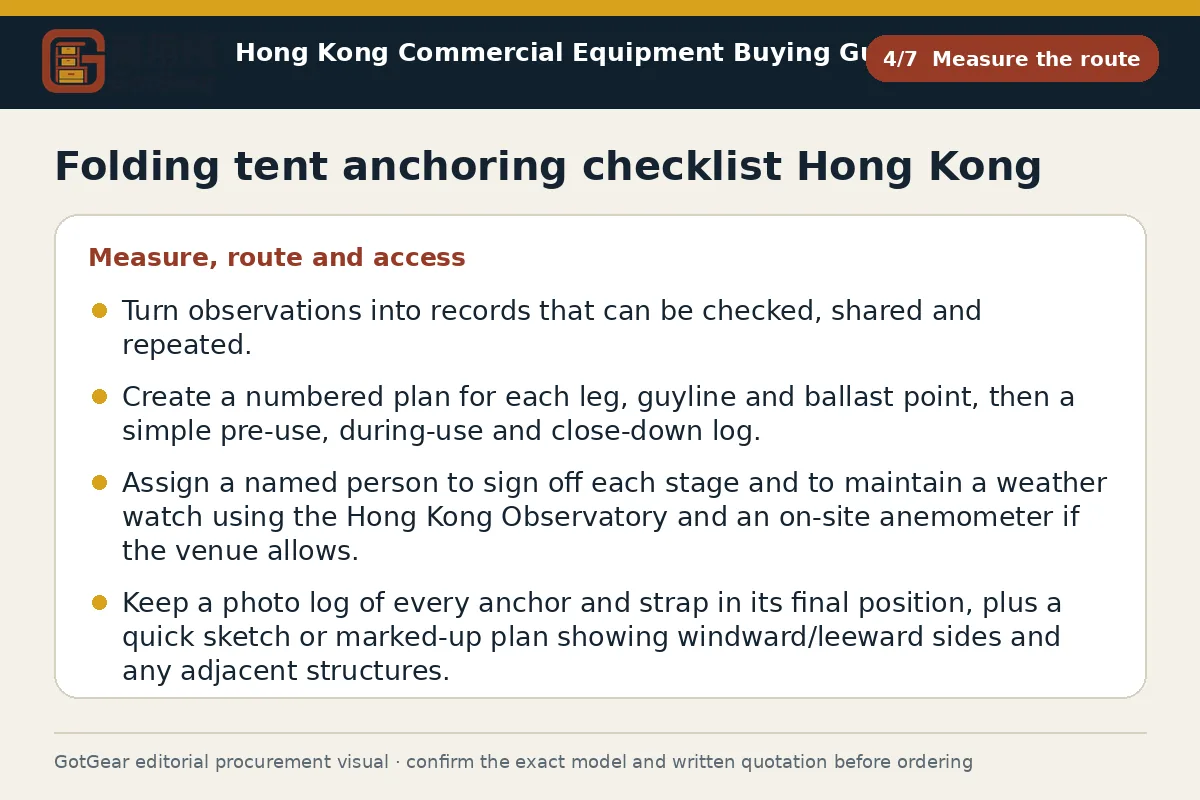
Turn observations into records that can be checked, shared and repeated. Create a numbered plan for each leg, guyline and ballast point, then a simple pre‑use, during‑use and close‑down log. Assign a named person to sign off each stage and to maintain a weather watch using the Hong Kong Observatory and an on‑site anemometer if the venue allows. Keep a photo log of every anchor and strap in its final position, plus a quick sketch or marked‑up plan showing windward/leeward sides and any adjacent structures.
File the tent model’s manual, venue approval emails, and any method statement or risk note in one bilingual pack. If sidewalls are used, record their configuration and the devices employed for canopy sidewall wind flap prevention Hong Kong, because flapping can loosen fixings and distract stewards. Note changes that trigger a re‑check: wall additions or removals, neighbouring builds, stage backdrops, crowd barriers, vehicle parking line‑ups and equipment loads moved under the canopy. Keep a tally of spare straps, edge protectors and weights on site, and document who can authorise substitutions or relocation if a leg must be moved to maintain exits or avoid underground services.
What should buyers compare for folding tent anchoring checklist Hong Kong?
| Criterion | Straightforward requirement | More complex requirement | Evidence to provide |
|---|---|---|---|
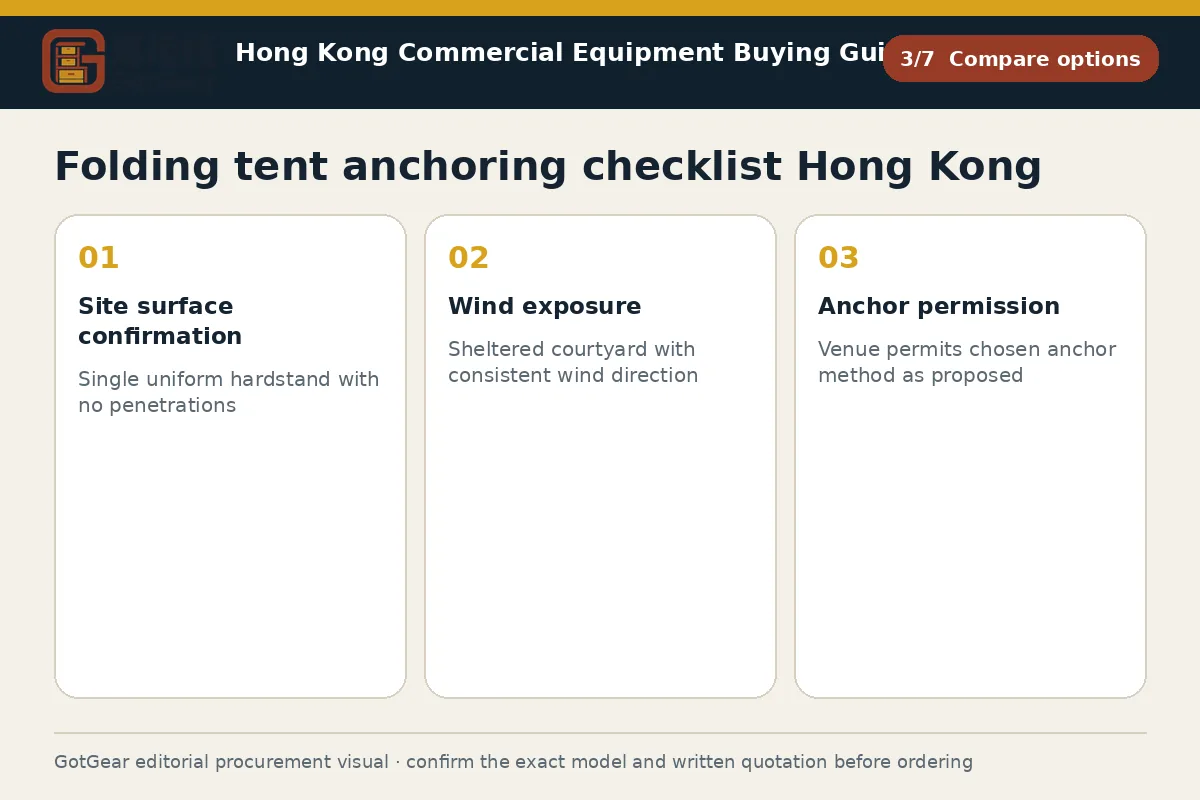
| Site surface confirmation | Single uniform hardstand with no penetrations | Mixed surfaces and partial penetration allowed in specific zones | Photos, surface types per leg, no‑drill areas, utility clearances |
| Wind exposure | Sheltered courtyard with consistent wind direction | Waterfront/rooftop or tower canyon with variable gusts | Wind notes, nearest reference, monitoring method and person in charge |
| Anchor permission | Venue permits chosen anchor method as proposed | Conditional approval with protection layers and load limits | Written venue acceptance, membrane/tile protection method, constraints |
| Ballast specification | Standard blocks/plates sized for lifts and doorways | Engineered ballast plan with distribution and tie‑down geometry | Model compatibility, per‑leg rating, calc sheet or manufacturer guidance |
| Layout and egress | Single tent with clear margins all around | Multiple canopies joined with defined exit routes and barriers | Scaled plan, offsets, exit widths, steward positions and signage |
This framework helps buyers create comparable written enquiries. Final model specifications, availability, delivery and commercial terms must be confirmed in a formal quotation.
Anchors, ballast and layout in folding tent anchoring checklist Hong Kong
Select anchors and ballast only after the site and exposure are known and the layout is approved. For hardstands, consider plate weights, purpose‑made blocks, water barrels with approved attachments, or chemical or mechanical fixings if permitted. For turf, stakes or screw anchors may be appropriate if the soil profile and venue allow penetration and utilities have been cleared. Where drilling is restricted, review canopy tent weights for concrete Hong Kong and check each proposed weight’s form factor, handle design for tight lifts, and protection for tiles or membranes. Ask for proof of compatibility with the tent model’s tie‑down points and the specified strap hardware.
In the written enquiry, request: tent model and size; number and location of legs; anchor or ballast type at each leg; rated capacity per fixing method; strap width and abrasion protection; hardware grade and corrosion resistance; expected guyline angles and clearances; and a scaled plan showing offsets from drains and exits. If rooftop use is proposed, reference canopy tent rooftop anchoring Hong Kong and seek the building manager’s written acceptance. On receipt, inspect blocks for cracks, flattened edges and secure lifting points; check stitching, buckles, D‑rings and labels; and match packing lists to the quotation. Any example sizing or loads given by a supplier must be confirmed against the manufacturer’s instructions and the venue’s conditions in writing before use.
Escalation points in folding tent anchoring checklist Hong Kong
Define in advance when the team must pause, re‑configure or stand down. Escalate if any leg, strap, anchor or ballast cannot be installed exactly as approved, or if the tent is moved, walls are changed, or nearby structures alter wind flow. If measured gusts exceed the agreed trigger, the structure creaks, sidewalls flap excessively, or ballast shifts, stop activities, clear the area and consult the responsible person, the venue and, where required, the manufacturer or a competent adviser.
Escalate when access restrictions prevent moving the planned ballast safely through lifts and corridors, or when a no‑penetration rule removes the only approved fixing option. Document all changes and take new photos before recommencing. Keep exits clear: any revised plan must still reflect temporary event canopy emergency exit layout Hong Kong, including sightlines and barrier positions. When a safe, approved configuration cannot be achieved or monitored, suspend use and record the decision, including who was notified and what conditions must be met before reopening.
Folding tent anchoring checklist Hong Kong decision checklist
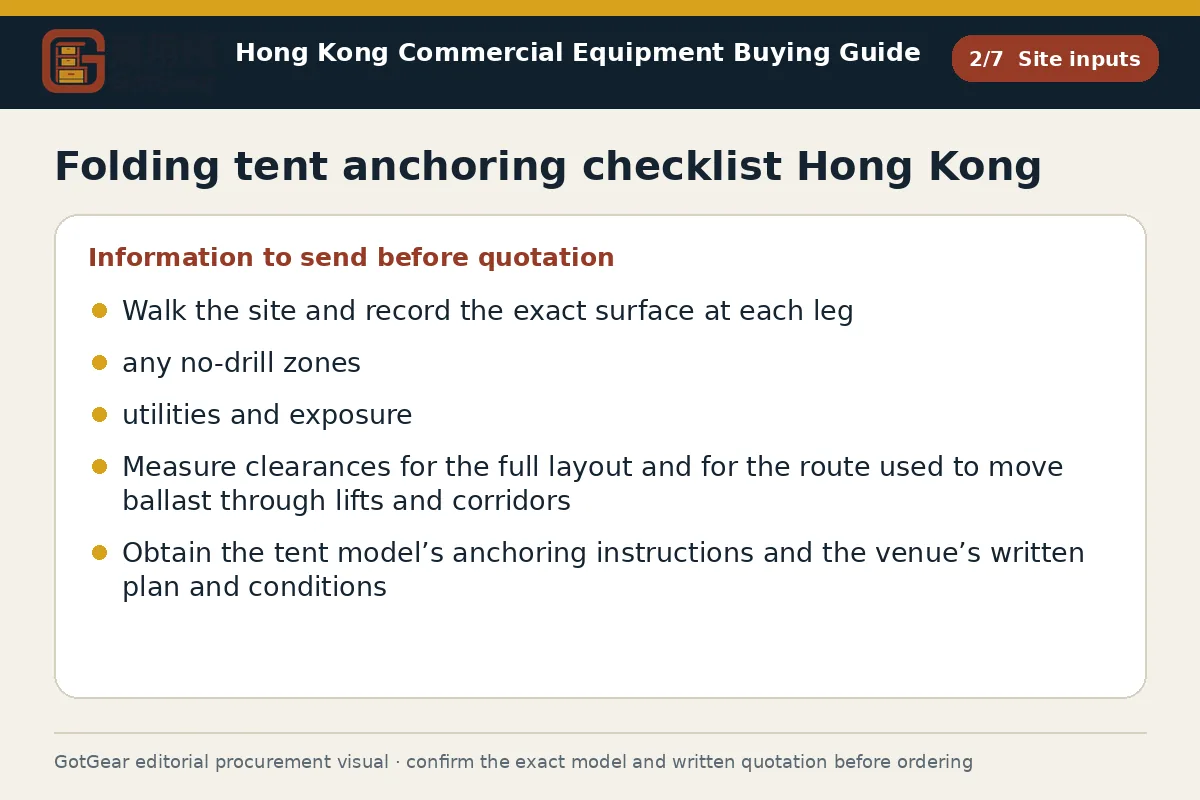
Walk the site and record the exact surface at each leg, any no‑drill zones, utilities and exposure. Measure clearances for the full layout and for the route used to move ballast through lifts and corridors. Obtain the tent model’s anchoring instructions and the venue’s written plan and conditions. Request written quotations that specify ballast or anchor types and capacities, straps and hardware, corrosion protection and layout geometry. Compare offerings against the site notes and confirm they fit through doors and lifts. Before opening, photograph each fixing in its final position, label spares, and assign a named monitor to check weather and record changes. If walls, neighbouring structures, wind or access conditions change, pause, re‑check and, if needed, escalate to the venue, manufacturer or a competent adviser. Keep exits clear at all times and document any substitution or relocation.
- Operating use, quantity and expected frequency
- Dimensions, capacity, material and accessory requirements
- Delivery address, floor, goods lift and loading window
- Required documents, acceptance checks and after-sales arrangements
Key points for folding tent anchoring checklist Hong Kong
Hong Kong venues present tight access, wind acceleration between towers, humid conditions and frequent no‑penetration policies on podiums and roofs. Many event sites are managed by building offices that require prior method statements, loading‑bay bookings and bilingual communications. Waterfronts and elevated podiums can see rapid gust changes, especially during monsoon periods; teams should follow venue and authority guidance on observatory alerts and reconfiguration or closure, as applicable. Ballast and anchors must be compatible with membranes and tiles, and practical for goods‑lift movement. Written approvals and the manufacturer’s instructions should underpin the final anchoring plan; local practice varies by landlord, insurer and event type, so site‑specific confirmation is essential and this page is not legal advice.
Questions about folding tent anchoring checklist Hong Kong
How do we anchor on concrete without drilling?
Use ballast blocks, plate weights or water-filled systems only with attachments that the tent manufacturer specifies for the exact model. Reference canopy tent weights for concrete Hong Kong in your enquiry and confirm the form factor fits lifts and access routes. Final ballast mass and configuration must follow the manufacturer’s instructions and the venue’s conditions; written acceptance from the building manager is recommended.
What should a supplier’s quotation include for anchoring kits?
Ask for tent model and size, anchor or ballast type at each leg, rated capacity per fixing method, strap/webbing specification, hardware grade, corrosion protection and edge guards. Request a scaled layout showing offsets, guyline angles and clearances, plus handling notes for lifts and tiles. The model specifications and the final written quotation prevail over marketing materials.
Is rooftop use acceptable for folding tents?
It can be acceptable only where the building manager permits and the anchoring method matches the roof build‑up. Cite canopy tent rooftop anchoring Hong Kong and ask for written acceptance, including membrane protection and parapet considerations. Ballast handling through lifts and onto roofs must be practicable and supervised; follow the manufacturer’s instructions and any venue or insurer requirements.
When should we remove sidewalls or change the setup in wind?
Remove, secure or re‑configure sidewalls when monitoring shows gust increases or flapping that could stress fixings; reference techniques for canopy sidewall wind flap prevention Hong Kong. Any change to walls, nearby structures or crowd barriers should trigger a fresh check of anchors, ballast and exits. Follow the manufacturer’s guidance and venue instructions, documenting decisions and photos.
Continue with closely related procurement topics
These pages share equipment, operating or decision-stage signals with this guide.
Canopy sidewall wind flap prevention Hong Kong
GotGear guide to canopy sidewall wind flap prevention Hong Kong explains how to inspect fixings, check panel tension and exposed edges, and monitor the weather. Escalate any movement or damage promptly.
Read the guide
Canopy tent weights for concrete Hong Kong
See the GotGear guide to canopy tent weights for concrete Hong Kong, pop up gazebo weights for tiled floor Hong Kong and canopy tent ground anchors for grass Hong Kong. Check venue approval and installation requirements.
Read the guide
Canopy tent rooftop anchoring Hong Kong
GotGear offers guidance on approval, structural input, exposure, ground conditions and permitted fixing methods for canopy tent rooftop anchoring Hong Kong. It also covers measures for canopy tent anchoring on sand Hong Kong.
Read the guide
Outdoor tent unloading access planning Hong Kong
GotGear provides a clear brief for outdoor tent unloading access planning Hong Kong, detailing route dimensions, obstacle photographs, vehicle limits, permit requirements, access times and the receiving contact.
Read the guideRelated topic indexOpen more English procurement pages3 topics
Browse additional equipment families, applications and procurement questions relevant to a wider buying brief.