
For canopy tent weights and tie down straps Hong Kong, compare only methods permitted by the venue and specified for the exact canopy, surface and configuration. Verify the manufacturer’s instructions, site and weather conditions, fixing-point restrictions and applicable Hong Kong requirements; if they conflict or remain unclear, pause the setup and escalate.
Surface constraints for canopy tent weights and tie down straps Hong Kong
Surface dictates method and specification. Concrete slabs and pavers will usually accept plate or stackable ballast, provided the area is level, clean and free of oil. Timber sports floors, tiled plazas and membrane rooftops are more delicate; contact pads, non‑marking feet and geotextile or rubber interlayers should be planned in advance to prevent abrasion or point loading. When evaluating canopy tent weights and tie down straps Hong Kong, teams should start with the ground itself: note any slopes, drainage grates, tactile paving, expansion joints and set‑down zones that might affect safe placement.
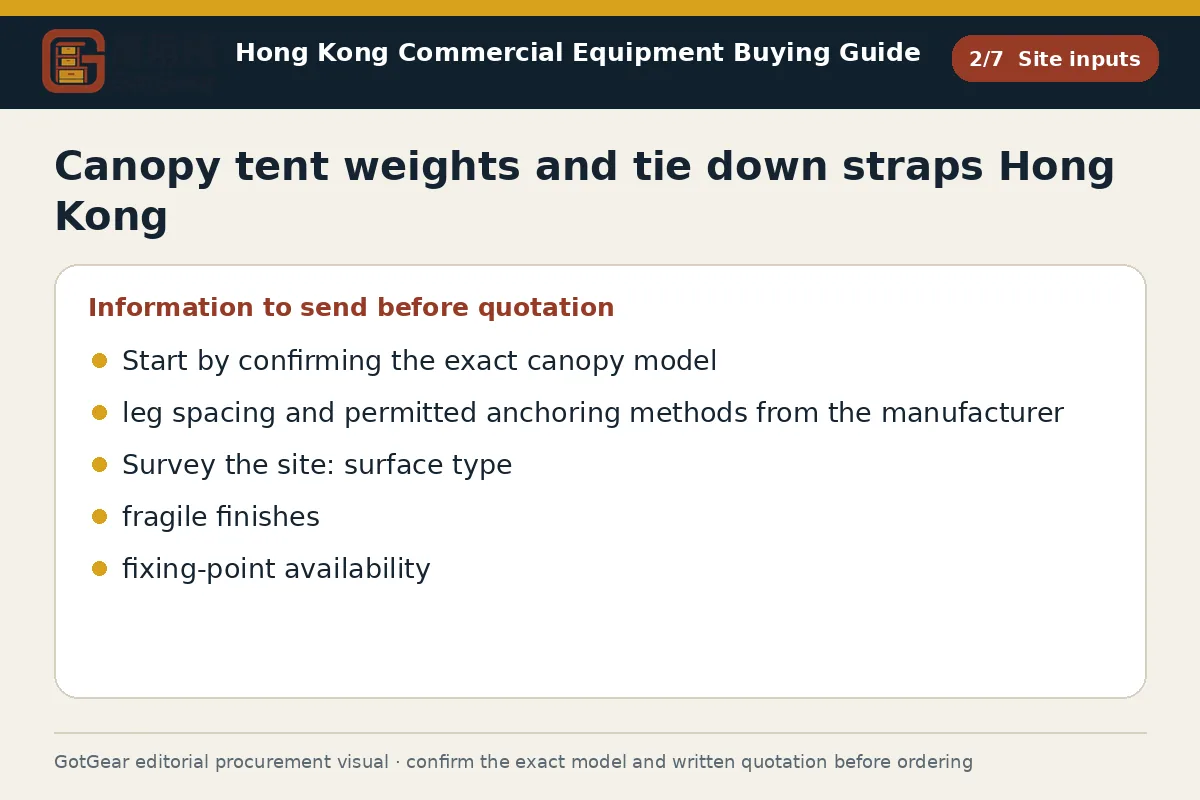
Record the canopy model, leg count and spacing, base‑plate size, leg shape, and the anchoring methods permitted by the manufacturer. Ask suppliers to confirm in writing the per‑leg ballast mass, the footprint of each weight, maximum stack height, handling features, and the exact contact material that will bear on the floor. Request drawings that show clearance around each leg for egress and for wheelchair access. For fragile finishes, ask for a floor‑protection method statement (your internal notes may reference canopy tent weight floor protection in Hong Kong). Where floor load capacity is uncertain, obtain written confirmation from the venue or building manager. For access planning, measure doorways and goods‑lift cabins and doors; tight lift cars in older industrial buildings often limit the safe size or the number of pre‑cast weights that can be moved in a single trip.
Layout and exposure in canopy tent weights and tie down straps Hong Kong
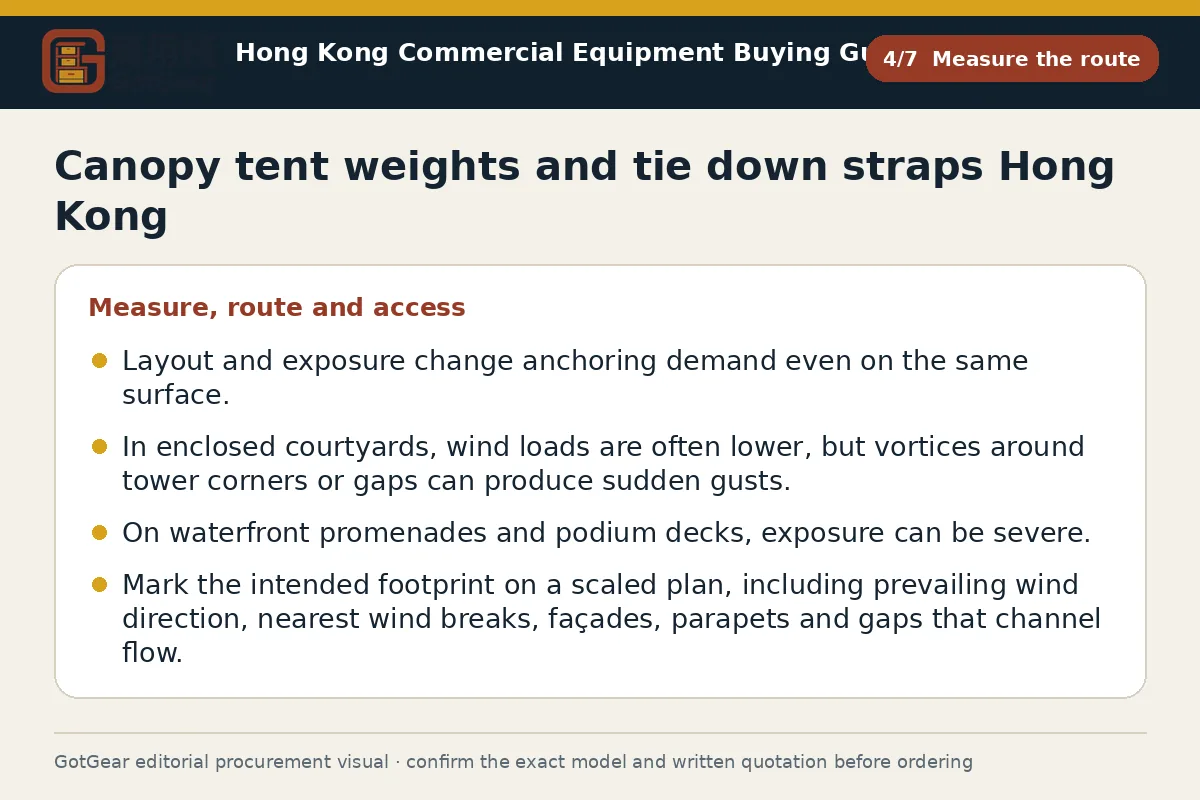
Layout and exposure change anchoring demand even on the same surface. In enclosed courtyards, wind loads are often lower, but vortices around tower corners or gaps can produce sudden gusts. On waterfront promenades and podium decks, exposure can be severe. Mark the intended footprint on a scaled plan, including prevailing wind direction, nearest wind breaks, façades, parapets and gaps that channel flow. Note queue lines, escape routes and cable runs to ensure straps do not cross traffic paths or obstruct barrier-free access.
In your enquiry, specify strap routing (inside or outside legs), preferred strap angle relative to the canopy frame, and whether corner bracing or cross-tying is proposed. Request hardware details: strap width, weave type, UV resistance, buckle or ratchet model, protective sleeves for edges, and abrasion guards where contact occurs. For weights, ask for stacking stability, interlock features and provision for anti-slip layers. In humid Hong Kong conditions, confirm mildew-resistant webbing and corrosion-resistant metalwork, especially near marine districts. State any site rules for high-visibility coverings on low-level ties to reduce trip risk. If your operating plan includes weather triggers, include them as example starting points only and have the venue and manufacturer confirm or replace them in writing before event day.
What should buyers compare for canopy tent weights and tie down straps Hong Kong?
| Criterion | Straightforward requirement | More complex requirement | Evidence to provide |
|---|---|---|---|
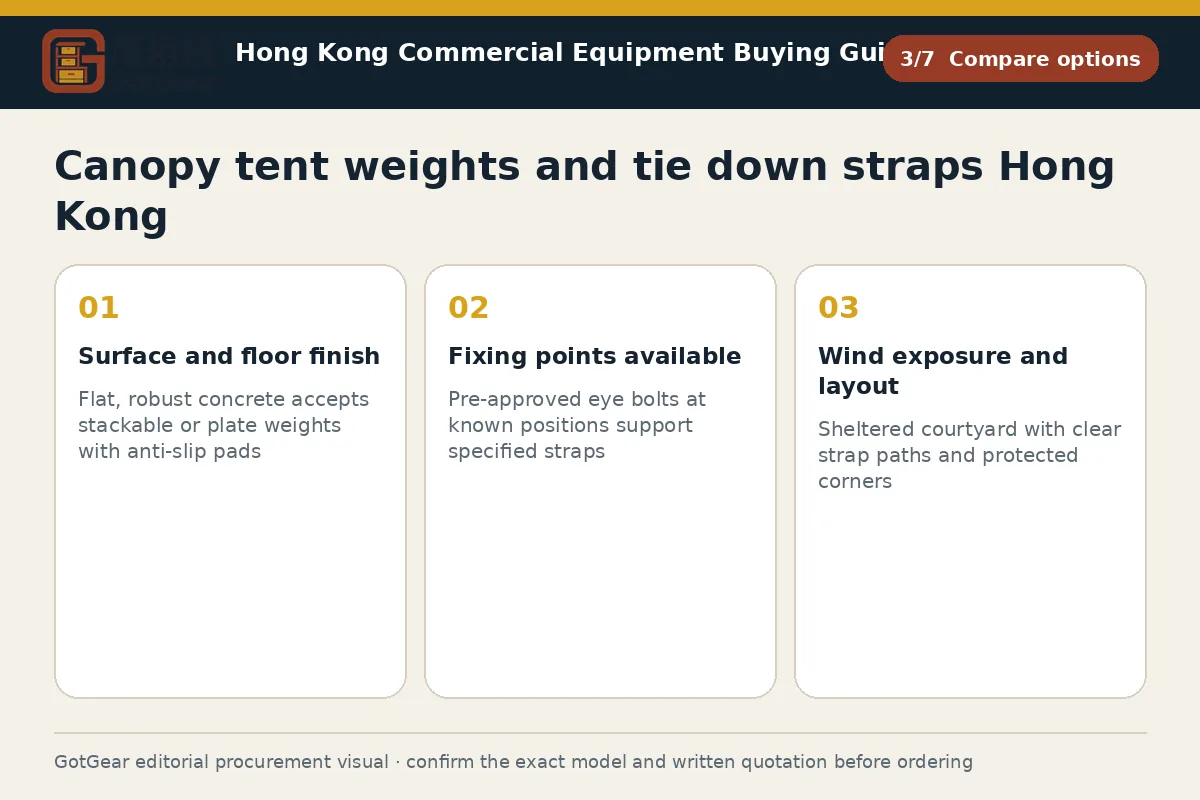
| Surface and floor finish | Flat, robust concrete accepts stackable or plate weights with anti-slip pads | Fragile tiles or membranes need defined interlayers and limited contact pressure | Photos, notes on finish type, slope, drains; floor-protection plan details |
| Fixing points available | Pre-approved eye bolts at known positions support specified straps | No anchors permitted; ballast-only layout required with clear egress | Venue letter/email with permitted points, heights and load notes |
| Wind exposure and layout | Sheltered courtyard with clear strap paths and protected corners | Open waterfront/podium; corner bracing, cross-tying and higher ballast masses | Site plan with wind notes, façade gaps, and strap routing sketch |
| Access and handling | Ground-floor access with trolley routes and wide doors | Tight goods-lift and timed loading; smaller, more trips or modular weights | Lift and doorway dimensions; loading-window confirmation email |
| Documentation and approvals | Manufacturer anchoring instructions attached to quote | Venue-specific method statement and bilingual safety notices required | PDFs of manuals, approvals, and marked-up drawings with clearances |
This framework helps buyers create comparable written enquiries. Final model specifications, availability, delivery and commercial terms must be confirmed in a formal quotation.
Permitted fixing points for canopy tent weights and tie down straps Hong Kong
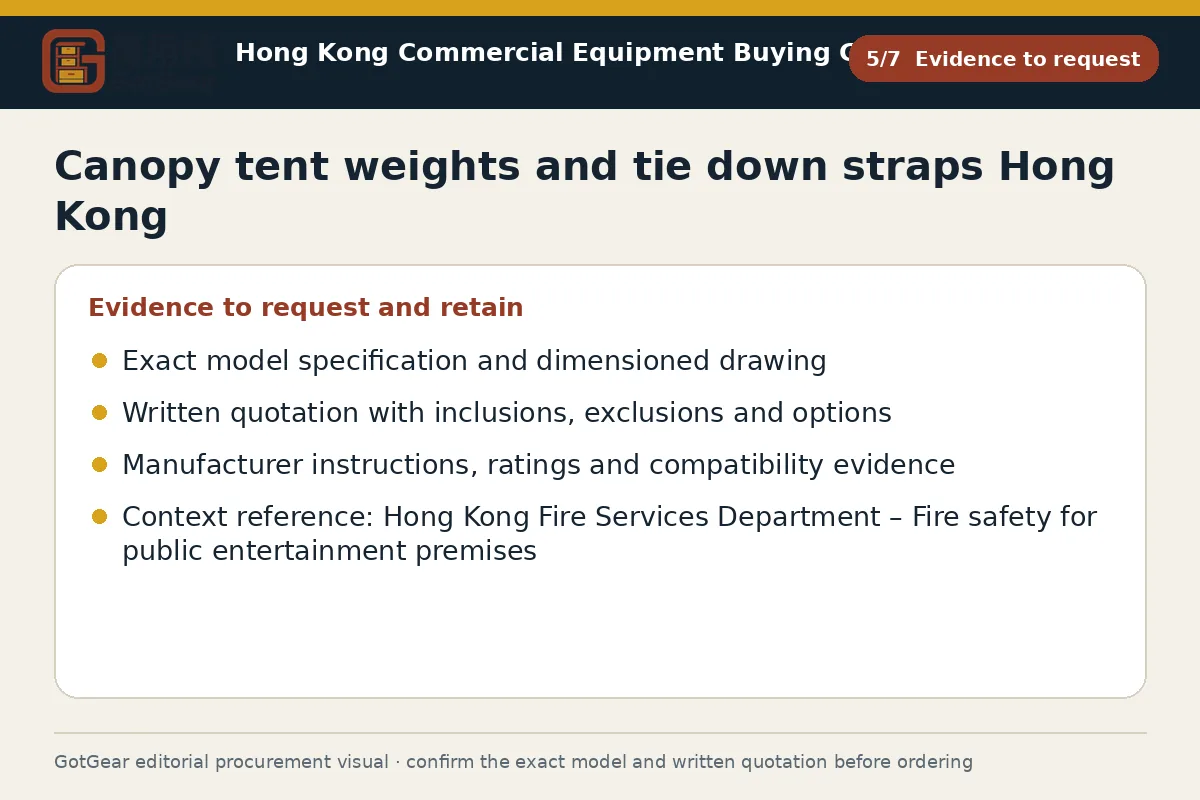
Permitted fixing points must be identified and approved before you compare tie-down options. Do not assume railings, balustrades, planter frames or light poles can be used; obtain written permission and the allowable load from the responsible venue, building manager or organiser. Ask the canopy manufacturer to confirm acceptable fixing hardware and connection locations on the frame, plus the required working load limit (WLL) for each strap and connector.
In your specification request, detail the type and size of connectors (e.g., screwgate carabiners or D-shackles), corrosion protection, and any anti-chafe interfaces where straps turn over edges. Provide photos with measurements of proposed anchors, their heights above ground, clearance from edges, and any protective sleeves required to avoid damage to finishes. Where no permanent anchors exist, ask the venue whether temporary anchors can be installed; if not, confirm that only ballast is allowed. Treat sample figures from suppliers as example starting points to be confirmed by the venue and manufacturer. For rooftops, confirm parapet use, fall-protection clearances and any prohibition on over-the-edge tie-offs; cross-reference your internal planning notes for canopy tent rooftop anchoring Hong Kong to keep stakeholders aligned.
When venue rules govern canopy tent weights and tie down straps Hong Kong
Venue rules often determine the safe and acceptable method long before equipment arrives. Management offices for schools, LCSD facilities, private estates and mall podiums may restrict drilling, require barrier-free routes to stay clear, and limit strap routing across public walkways. Many sites prohibit water discharge; if using fillable ballast, request a spill-prevention and emptying plan. Submit a concise method statement, with bilingual diagrams if requested, identifying anchor types or ballast layout, strap paths, floor protection and emergency take-down steps.
Procurement should capture the venue’s written position on fixing points, maximum allowed footprint, acceptable contact materials, and whether signage or high-visibility sleeves are required. Ask suppliers to confirm manufacturer compliance for the exact canopy model and provide product data sheets in English and Chinese where available. For concrete podiums, align choices with your notes under canopy tent weights for concrete Hong Kong; for rooftop placements, ensure any tie-off plan aligns with property-management instructions. If site rules conflict with manufacturer requirements, escalate to both parties and pause deployment. A structured pre-check against your folding tent anchoring checklist Hong Kong helps reconcile constraints before the loading window opens.
Canopy tent weights and tie down straps Hong Kong decision checklist
Start by confirming the exact canopy model, leg spacing and permitted anchoring methods from the manufacturer. Survey the site: surface type, slope, drainage, fragile finishes, fixing-point availability, wind exposure, egress paths and any management-office restrictions. Measure doorways, corridors and goods-lifts to plan how weights and accessories will be transported. In your written enquiry, request per-leg ballast mass, footprint and stack height, strap width and WLL, connector types, corrosion protection, and floor-protection materials. Ask for drawings showing strap routing and clearances. Compare quotations line by line against the stated model and site conditions; supplier assumptions should be marked as example starting points pending venue confirmation. Before delivery, schedule the loading window and confirm packaging sizes. On receipt, inspect stitching, ratchets, labels, protective sleeves, and weight surfaces for damage, and verify bilingual documentation where required. If any specification or venue rule conflicts, pause setup and escalate.
- Operating use, quantity and expected frequency
- Dimensions, capacity, material and accessory requirements
- Delivery address, floor, goods lift and loading window
- Required documents, acceptance checks and after-sales arrangements
Key points for canopy tent weights and tie down straps Hong Kong
In Hong Kong, anchoring choices are shaped by property-management rules, tight access and weather. Many venues ban drilling and limit tie-offs to pre-approved anchors, so ballast and floor protection plans are common. Goods-lift dimensions and timed loading windows constrain the size and number of weights you can move per trip. Gusty conditions around high-rises and on waterfronts increase exposure, and bilingual documentation may be required for institutional approval. Treat any wind or loading figures as example starting points only, and confirm the final method with the venue, manufacturer and organiser; this is operational guidance, not legal advice.
Questions about canopy tent weights and tie down straps Hong Kong
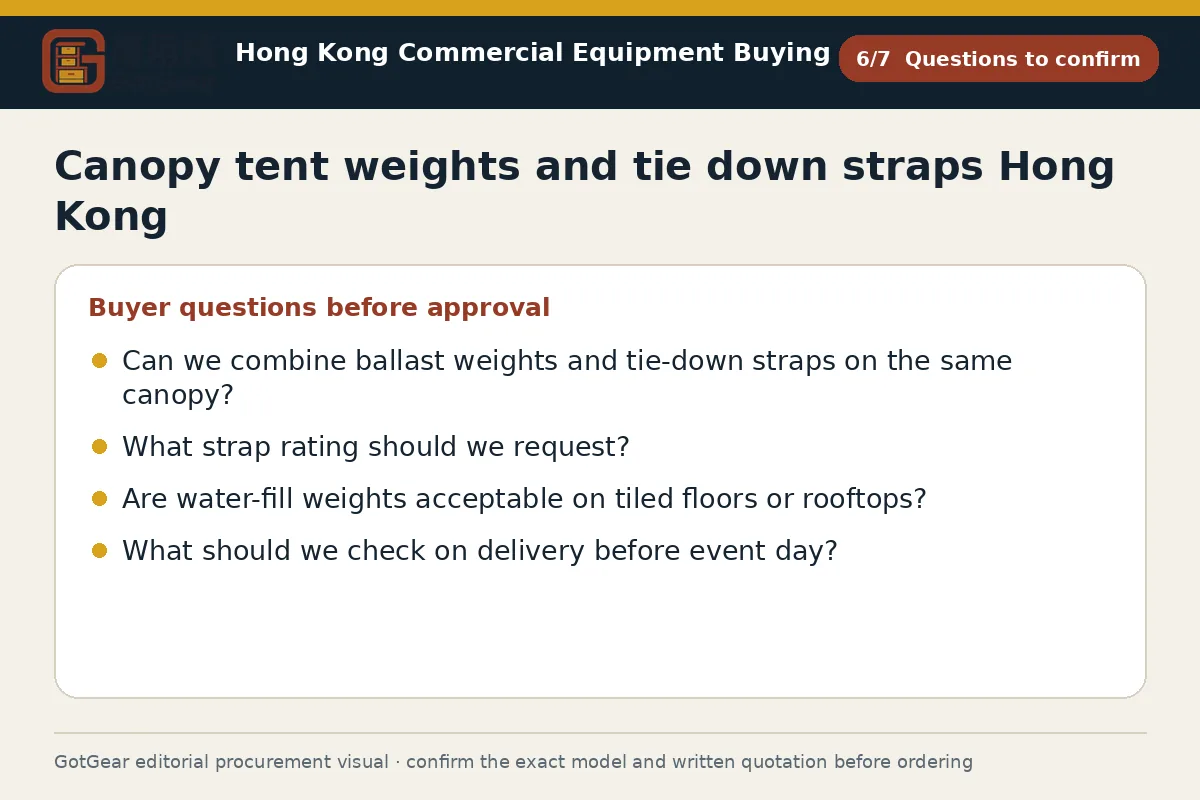
Can we combine ballast weights and tie-down straps on the same canopy?
Yes, if the canopy manufacturer specifies a combined method and the venue permits both fixing to anchors and placing ballast. Obtain written confirmation for the exact model, location and configuration. Where anchors are not approved, rely on ballast-only methods specified by the manufacturer and confirmed by the venue; do not improvise combinations on site without sign-off.
What strap rating should we request?
Match the manufacturer’s anchoring instructions for your canopy and ask suppliers to state the working load limit per strap and connector. As an example starting point only, some planners request WLLs in the hundreds of kilograms, but final values must be confirmed in writing by the manufacturer, supplier and venue. Ensure labels are legible and include corrosion and UV-resistance details.
Are water-fill weights acceptable on tiled floors or rooftops?
Only if the venue allows them and the manufacturer lists them for your canopy. Plan drip trays and non-marking interlayers, and propose a controlled fill/empty method to avoid spills. Any example volume or per-leg mass you see is a starting point only; confirm the final ballast specification with the supplier and venue, and follow any rooftop water restrictions.
What should we check on delivery before event day?
Confirm quantities against the quotation, then inspect straps for stitching quality, fraying, mould and clear rating labels. Check ratchets and connectors for smooth operation and corrosion protection. For weights, verify surfaces are intact, stacking features align, and contact pads or interlayers are included. Ensure bilingual documentation if requested by the venue. If anything is unclear or conflicts with site rules, stop and escalate.
Continue with closely related procurement topics
These pages share equipment, operating or decision-stage signals with this guide.
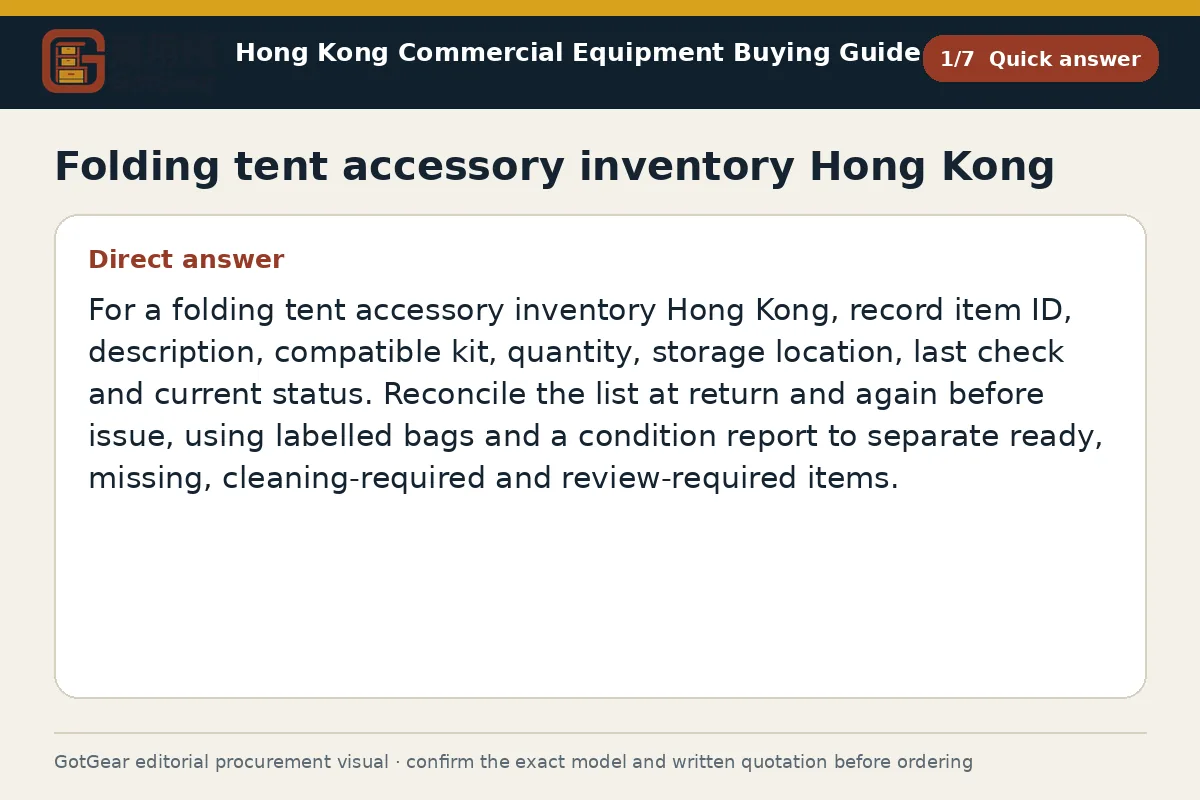
Folding tent accessory inventory Hong Kong
GotGear covers folding tent accessory inventory Hong Kong and what to record for kit storage. It links canopy sidewall packing and labelling Hong Kong with folding tent condition report Hong Kong to keep kits traceable.
Read the guide
Custom canopy full wall vs half wall Hong Kong
Compare enclosure, visibility, access and branding area when choosing between custom canopy full wall vs half wall Hong Kong. Also consider privacy, how customers will approach and venue rules when planning with GotGear.
Read the guide
Clear canopy sidewall vs mesh sidewall Hong Kong
Compare clear canopy sidewall vs mesh sidewall Hong Kong to assess visibility, airflow, enclosure, panel compatibility and visitor comfort when planning your site. Get practical guidance from GotGear.
Read the guide
Canopy tent rooftop anchoring Hong Kong
GotGear offers guidance on approval, structural input, exposure, ground conditions and permitted fixing methods for canopy tent rooftop anchoring Hong Kong. It also covers measures for canopy tent anchoring on sand Hong Kong.
Read the guideRelated topic indexOpen more English procurement pages1 topics
Browse additional equipment families, applications and procurement questions relevant to a wider buying brief.