
Manual stacker Hong Kong — Match the stacker to the load dimensions, lift height, support arrangement and manoeuvring space at the site. Review model-specific capacity information, controls, braking and manufacturer instructions, and complete the relevant workplace risk assessment before use.
Manual stacker Hong Kong — Define load centres, pallet interfaces and lift heights
Start the enquiry by defining the load, where its centre of gravity sits, and how it is supported. Measure the load length, width and height, note any overhang, and identify whether the centre of gravity is central or offset. Ask the owner or shipper for a documented mass; if weighing is needed, request a controlled measurement. For procurement, and specifically for manual stacker Hong Kong, record the actual load centre from the fork heel (or platform face) to the centre of gravity, as capacity ratings depend on that distance. If the load is fluid, flexible or top‑heavy, flag it for stabilisation requirements.
Map the pallet or skid interface. Confirm if pallets are open‑bottom (suitable for fork‑over) or closed‑bottom (usually requiring straddle legs). Note pallet entry direction, underside clearance, board thickness and any runners or feet that could foul legs or wheels. Provide photos and a sketch with dimensions. State the preferred fork length, fork spread range and minimum fork height. Define the lift envelope: the highest placement height (to top of fork or platform), the lowest pick‑up height, and the clearance needed to pass under doorways, sprinklers and signage. For Hong Kong sites, also capture goods‑lift car size, door width and depth, plus turning room on the receiving floor. In your enquiry, request the model’s rated capacity at your stated load centre, the mast’s collapsed and extended heights, fork specifications and a dimensional drawing. The supplier’s written specification and capacity chart prevail over assumptions.
Manual stacker Hong Kong — Compare propulsion, lifting controls and braking arrangements
Compare how the unit moves, lifts and stops. Propulsion on a manual stacker is typically push/pull via a tiller; the effort depends on wheel material, bearing quality and floor condition. Ask for starting and rolling resistance data on level concrete as an example starting point, then plan a site trial to verify forces on your floors and gradients. Specify preferred steering handle height, handle return behaviour and wheel material suited to your environment (quiet, non‑marking, corrosion‑resistant or cut‑resistant).
Lifting controls vary by model: hand‑pump, foot‑pump, double‑acting pump, winch or geared crank. Request the pump strokes (or crank turns) required to reach your maximum lift, the descent control type (proportional valve vs on/off), and confirmation of an overload relief valve. For braking, state whether you need a simple parking brake, dual wheel brakes, or an automatic deadman/position brake. If occasional slopes or thresholds are unavoidable, specify your maximum measured gradient and ask the manufacturer for written guidance on safe operation for that gradient and load. For busy Hong Kong facilities, include noise and ergonomic limits agreed with EHS, bilingual safety decals and instructions, and the preferred location of the operating labels. Always compare like with like across quotations: note the exact control layout, brake type, wheel spec and any included accessories.
What should buyers compare for manual stacker Hong Kong?
| Criterion | Straightforward requirement | More complex requirement | Evidence to provide |
|---|---|---|---|
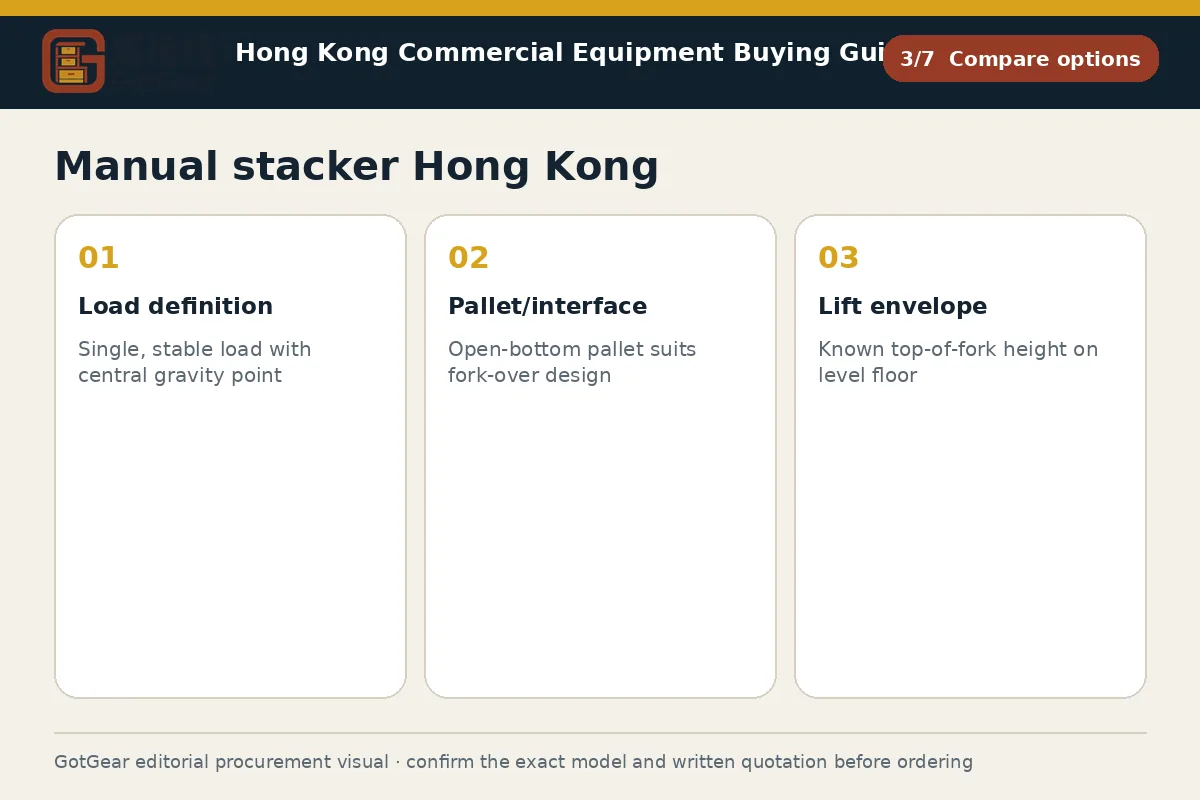
| Load definition | Single, stable load with central gravity point | Offset or fluid load needing stabilisation or attachment | Mass evidence, CG sketch, photos, handling method |
| Pallet/interface | Open‑bottom pallet suits fork‑over design | Closed‑bottom pallet requires straddle legs or platform | Pallet drawing with underside dimensions and entry direction |
| Lift envelope | Known top‑of‑fork height on level floor | Height plus collapsed mast must clear doors/lifts/fixtures | Measured bay height, door/lift sizes, required clearances |
| Manoeuvring space | Adequate straight aisles and clear turning bay | Tight aisles requiring multi‑point turns and staging | Scaled layout with narrowest widths and turn radii |
| Controls and brakes | Hand/foot pump with parking brake | Proportional lowering, dual brakes, slope guidance | EHS preferences, gradient data, wheel and handle specs |
This framework helps buyers create comparable written enquiries. Final model specifications, availability, delivery and commercial terms must be confirmed in a formal quotation.
Manual stacker Hong Kong — Check aisle width, turning room and floor condition
Aisle width and turning room determine whether the stacker is practical at your site. Measure clear aisle width at the narrowest point with pallets resident on racks, and measure the turning bay at the target bay. Record door widths, corridor pinch‑points and lift‑lobby space. Capture the planned travel path from the delivery point to storage, including any 90‑degree turns. For multi‑tenant buildings, coordinate with the management office to measure the goods‑lift car depth, door width and load allowance, then verify the stacker’s collapsed mast height and overall length against those constraints.
Assess floors methodically. Note surface type (smooth concrete, epoxy, tiles), joints and thresholds, gradient changes, wet or greasy areas, and any mats or metal plates at entrances. Rolling resistance and stopping distance change with these factors. Where floors are imperfect, specify wheel type and diameter, request push/pull force demonstrations on your worst area, and document the maximum workable gradient. If aisle geometry is restrictive, consider whether pick‑and‑place at the aisle end, using a scissor lift table Hong Kong, can reduce in‑aisle lifting. For dense layouts, review our narrow aisle material handling Hong Kong resources to plan turning radii, staging zones and one‑way flows. Keep a record of measured dimensions and photographs in the enquiry pack so suppliers can validate manoeuvrability before quoting.
Manual stacker Hong Kong — Verify capacity charts and operating limits by model
Ask each supplier for the model‑specific capacity chart and operating limits, not just a headline load rating. Confirm the rated capacity at your stated load centre and at the maximum lift height you require; some masts derate significantly near full extension. If you need attachments (drum cradle, boom, platform), request the combined capacity with that attachment installed. Verify minimum fork height, maximum top‑of‑fork height, and whether side stabilisers or outriggers are required above a given height.
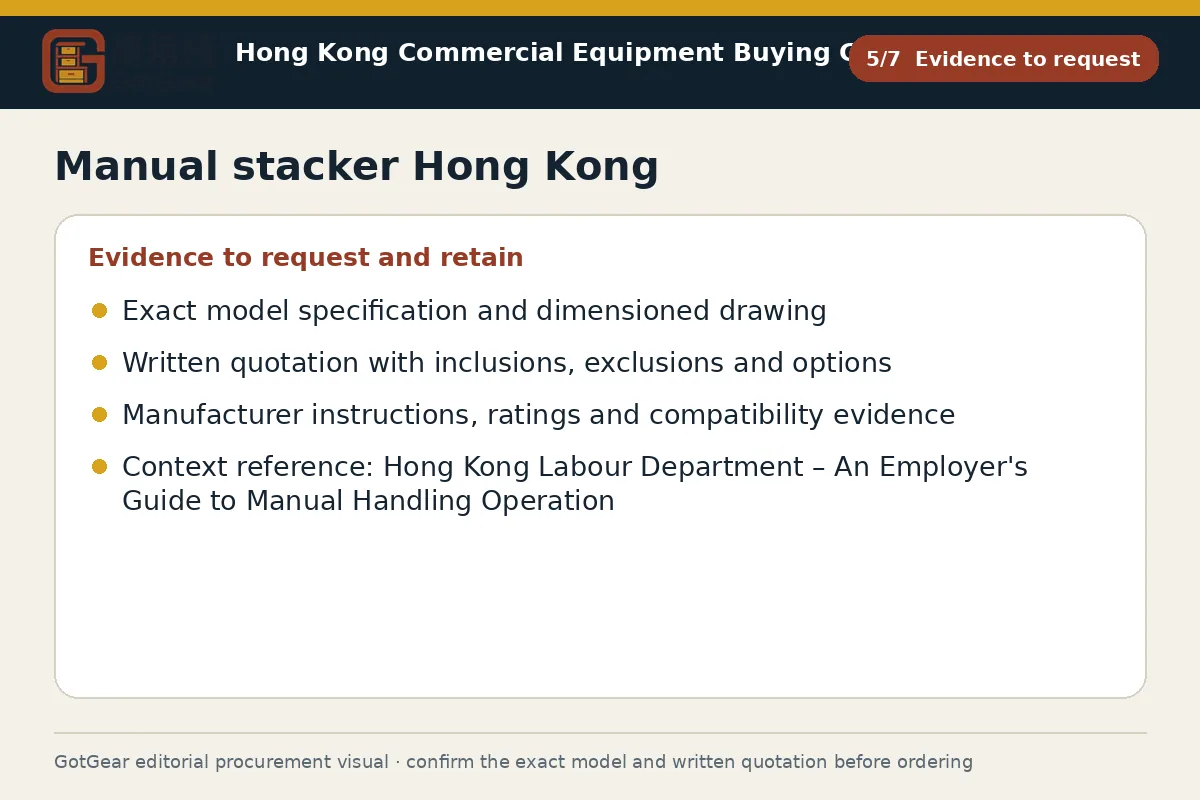
Request a legible rating plate sample, the operating manual (preferably bilingual) and written maintenance instructions for your site file. Where floors include ramps or thresholds, ask the manufacturer for explicit slope guidance, braking instructions and any two‑person handling advisories for your load type. For institutional approvals, include the instruction manual, declaration of conformity or equivalent manufacturer statement appropriate to Hong Kong practice, and your completed manual handling risk assessment Hong Kong. On receipt, inspect welds, mast straightness, chains, rollers and fasteners; confirm the supplied wheels, forks and controls match the quotation and drawing. Conduct a supervised test lift with your representative load, within the published limits, and record the results. The model specification and the supplier’s formal written quotation take precedence over any illustrative figures.
Manual stacker Hong Kong decision checklist
Build a concise enquiry pack: a sketch of the load with mass and measured load centre, pallet or skid details with photos, and the lift envelope with collapsed and extended height needs. Add a marked‑up plan showing aisle widths, turning spaces, thresholds and the full travel path from receiving to storage. State preferred controls, brake arrangements, wheel material and any slope measurements. Ask for capacity at your load centre and height, dimensional drawings, wheel specs, manuals and a sample rating plate. Compare quotations line by line against that pack and note exclusions. Secure internal approvals, confirm delivery routing and loading window with the building manager, and agree a supervised test on receipt. Finally, record user training arrangements, inspection checks and any model‑specific limits issued by the manufacturer or competent adviser.
- Operating use, quantity and expected frequency
- Dimensions, capacity, material and accessory requirements
- Delivery address, floor, goods lift and loading window
- Required documents, acceptance checks and after-sales arrangements
Key points for manual stacker Hong Kong
Hong Kong facilities often work within tight goods‑lifts, narrow back‑of‑house corridors and short loading windows. Measure lift car depth, door width and ceiling height, then compare them with the stacker’s collapsed mast and overall length to avoid access surprises. Shared corridors, public‑area crossings and event venues may require spotters, cordons or time‑bound moves agreed with the management office. Humid conditions and occasional outdoor transfers can influence wheel and finish choices; ask for corrosion‑resistant options if relevant. Documentation is frequently reviewed by bilingual teams, so request manuals and safety decals in Chinese and English where possible. Always align any operating limits with your building rules, insurer conditions and the manufacturer’s instructions.
Questions about manual stacker Hong Kong
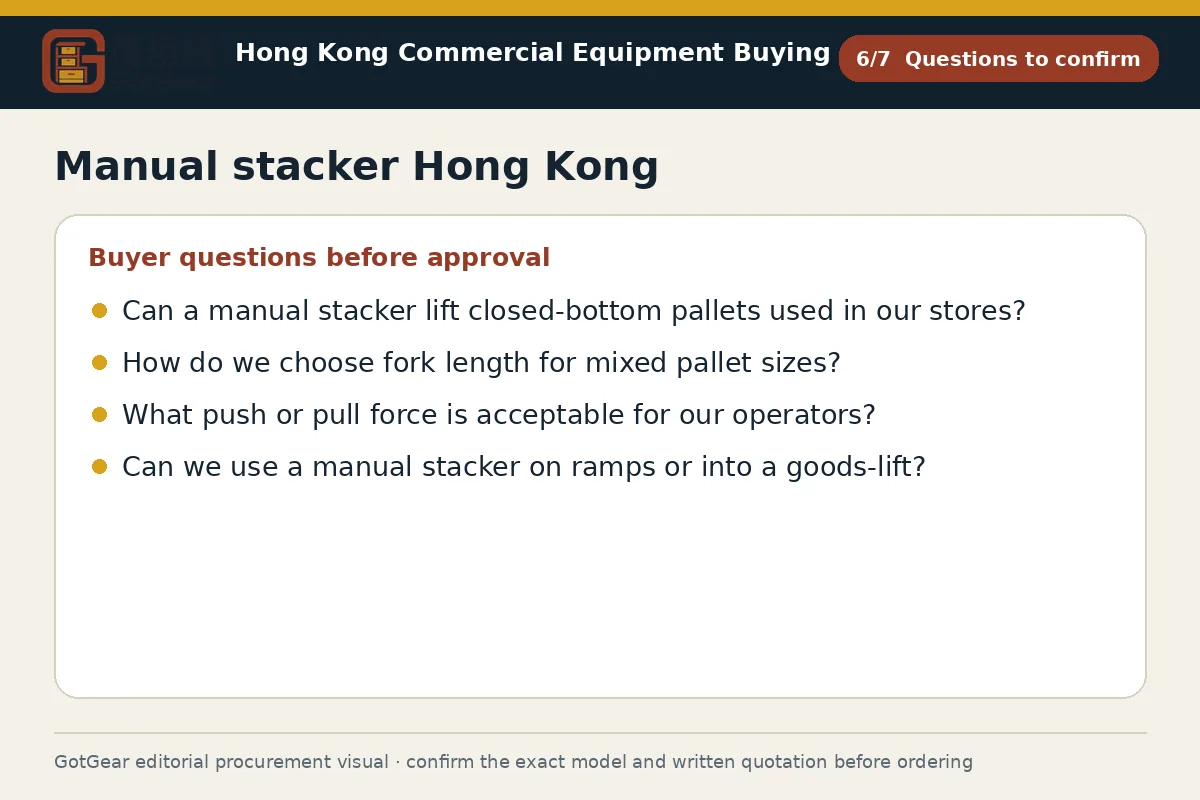
Can a manual stacker lift closed‑bottom pallets used in our stores?
Yes, but you’ll usually need a straddle‑leg stacker or a platform attachment because fork‑over types can’t enter closed‑bottom pallets. Confirm underside dimensions, runner layout and any feet that could foul the legs. Ask the supplier to validate compatibility in writing against your pallet drawing and to show the relevant capacity at your load centre and lift height.
How do we choose fork length for mixed pallet sizes?
Match fork length to the longest pallet you regularly handle so the forks support the load without dangerous overhang. For smaller pallets, ensure the forks don’t protrude into aisles or fixtures when fully inserted. Provide pallet drawings and target bay dimensions, then ask the manufacturer to confirm acceptable overhang limits and the capacity impact at your stated load centre.
What push or pull force is acceptable for our operators?
There isn’t a universal value. Agree ergonomic limits with your EHS team, then verify forces with a site trial on your actual floors, slopes and thresholds. Ask the supplier for starting and rolling resistance figures as a starting point, and request a demonstration with your load. Your insurer or competent adviser may set additional conditions for your venue.
Can we use a manual stacker on ramps or into a goods‑lift?
Prefer level floors. Small ramps or thresholds may be manageable with appropriate brakes, procedures and supervision, but only within the manufacturer’s written operating limits. Measure gradients and lift car dimensions, and seek confirmation for your load and route. Building managers may impose time windows, escorts or cordons; align your method statement with those site requirements before use.
Continue with closely related procurement topics
These pages share equipment, operating or decision-stage signals with this guide.
Scissor lift table Hong Kong
Compare scissor lift table Hong Kong models by rated load, platform size, lowered and raised heights, mobility, controls and operator access for warehouse use in Hong Kong. See full specifications and model details at GotGear.
Read the guide
Caster wheel selection Hong Kong
GotGear explains caster wheel selection Hong Kong and compares swivel caster vs rigid caster Hong Kong. This guide helps you evaluate steering, tracking, wheel diameter, floor compatibility, load and duty cycle.
Read the guide
Manual handling risk assessment Hong Kong
GotGear explains what to record during a manual handling risk assessment Hong Kong and how to use a manual handling safety checklist Hong Kong. The guide also describes how to prioritise material handling risk controls Hong Kong.
Read the guide
Trolley load securing Hong Kong
GotGear provides guidance on trolley load securing Hong Kong, explaining how to check the centre of gravity, identify restraint points and compare straps, rails and clamps. It also covers trolley load stability Hong Kong.
Read the guideRelated topic indexOpen more English procurement pages4 topics
Browse additional equipment families, applications and procurement questions relevant to a wider buying brief.