
Trolley turning radius Hong Kong — Check the complete swept path along the actual route, including operator space and any load projecting beyond the deck. A controlled trial can expose multi-point turns, pinch points and blocked sightlines before equipment or layout decisions are finalised.
Trolley turning radius Hong Kong — Measure the complete swept path, not trolley width alone
Start by mapping the actual route, not just the aisle where the trolley will mostly run. For planning, refer to trolley turning radius Hong Kong data and measure door widths, hinge-side clearances, lift lobbies, column recesses and the approach to every corner. Record both the narrowest static gap and any dynamic obstruction such as door closers, handrails, fire-stopping strips and kerbs. Chalk the intended track and note where an operator’s hands, elbows and feet would sit at full lock with the load in place.
Capture geometry that governs the swept path: wheelbase (axle-to-axle), track width, caster swivel offset, handle length and height, and any deck extensions or side rails. Ask suppliers to state minimum inside and outside turning radii, the swivel offset per caster, wheel diameter and tread, deck footprint and the assumed handle position for their published figure. As an example starting point only, add 150–250 mm each side to your measured deck for hand and knuckle room; confirm the final allowance with your responsible manager and the selected manufacturer.
When comparing alternatives, include a small scaled sketch of each critical corner with your enquiry and request the vendor to confirm pass/fail in writing against that geometry. Align this work with your trolley route assessment Hong Kong and with the route plan so the written quotation, model code and turning data all reference the same route and load envelope.
Trolley turning radius Hong Kong — Small warehouse material handling Hong Kong: Allow for handles, load overhang and operator position
The usable turning space grows once you account for the operator’s stance, the handle arc and any load that projects beyond the deck. In small warehouse material handling Hong Kong, operators often push from the corner of the handle to gain leverage, which shifts their shoulder and foot position into the corridor. Measure the furthest handle position at full lock, then add space for the operator’s leading foot and elbow. Where possible, test both push and pull because visibility and tripping risks differ with each.
Specify handle features clearly: fixed, folding, dual-height or end handles for two-person control. Note the handle width and the distance from deck edge to handle face. Ask how the supplier measured the turning radius—handle vertical or angled, and with which load height. If overhanging loads are routine, request the maximum recommended overhang and the safe centre-of-gravity zone. On humid or sloped sites, brakes and total-lock casters may be prudent; align this with your caster wheel selection Hong Kong. Check that wheel diameter, tread material and swivel resistance suit the floor. If your choice of equipment trolley Hong Kong includes removable sides or cages, confirm whether fittings protrude during turns and whether latches are guarded against catching on racking.
What should buyers compare for trolley turning radius Hong Kong?
| Criterion | Straightforward requirement | More complex requirement | Evidence to provide |
|---|---|---|---|
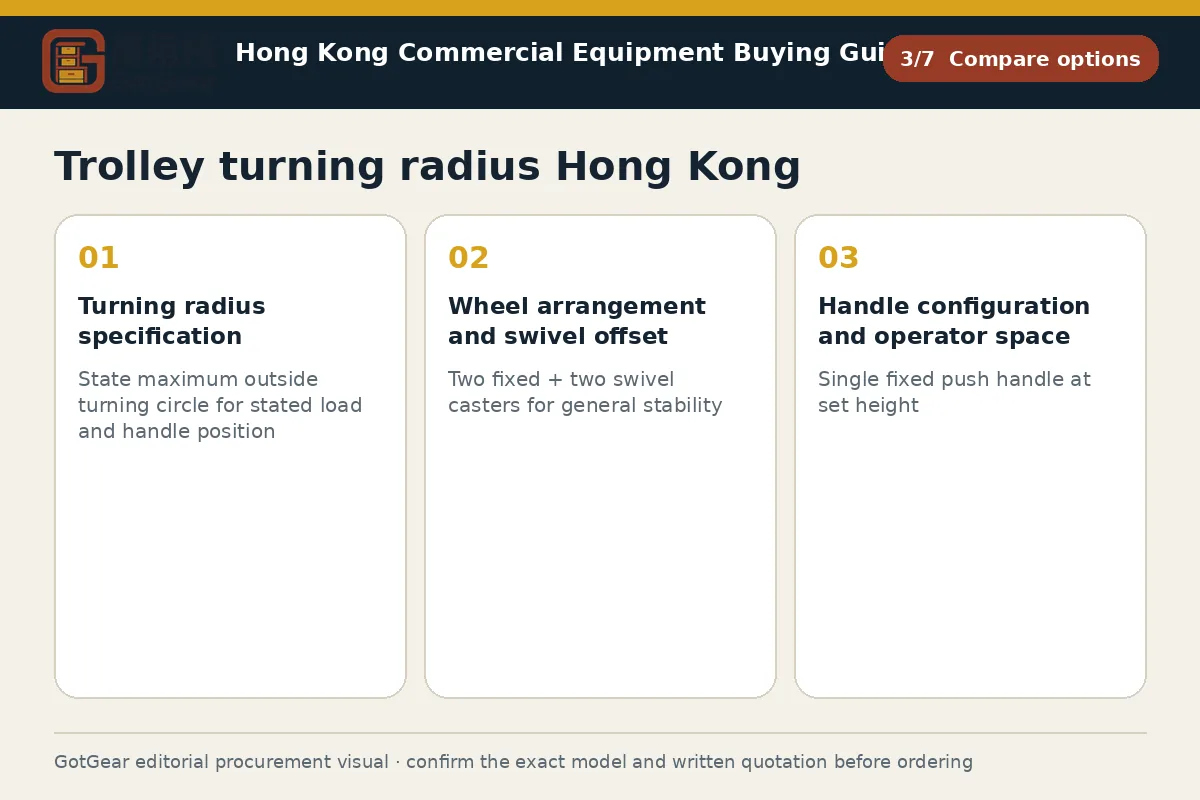
| Turning radius specification | State maximum outside turning circle for stated load and handle position | Provide full swept-path check at each critical corner along the actual route | Annotated sketches with door widths, approach distances and corner radii |
| Wheel arrangement and swivel offset | Two fixed + two swivel casters for general stability | Four swivel, total-lock or directional locks for complex manoeuvres | Wheel diameter/tread, bearing type, swivel offset per caster, lock type |
| Handle configuration and operator space | Single fixed push handle at set height | Dual-height/folding handles; two-person end handles | Handle width/height, arc at full lock, operator stance allowance |
| Load envelope and overhang | Load within deck footprint only | Irregular or overhanging loads with shifting centres of gravity | Max L×W×H, overhang dimension, tie-down points, example COG location |
| Site constraints and approvals | Simple dock-to-aisle route with standard doors | Goods lift, thresholds, time windows, public-area crossings | Lift car size, door reveals, ramp gradient, management-office conditions |
This framework helps buyers create comparable written enquiries. Final model specifications, availability, delivery and commercial terms must be confirmed in a formal quotation.
Trolley turning radius Hong Kong — Narrow aisle material handling Hong Kong: Apply turning checks to narrow aisles and small warehouses
Apply the same swept-path logic directly to aisles. For narrow aisle material handling Hong Kong, the tight spots are rarely the straight runs; they’re the tee-junctions, end-of-aisle turnouts, pallet overhangs and column nibs at intersections. Mark out minimum widths with tape, then simulate pallet encroachment and temporary bins. In multi-level industrial buildings, add the lift car, lobby and threshold ramps to your map. Where aisles meet fire doors or shutters, test the turning bay with the door fully open and again at a controlled partial opening if that occurs in practice.
In your enquiry, request drawings or a dimensioned diagram from the trolley vendor showing inside and outside turning arcs of the exact model under your stated load. Ask for wheel arrangement (two fixed/two swivel or four swivel), swivel offset, deck size, handle geometry and the method used to derive radii. Compare written quotations on identical route notes: the same aisle widths, corner radii, floor types and gradients. Coordinate with the building management office regarding loading windows, designated lift routes and public-area crossings, and fold these rules into your procedures for trolley traffic management Hong Kong. On receipt, physically verify caster size and lock functions before deploying trolleys into tight aisles.
Trolley turning radius Hong Kong — Trial the intended route before committing to a layout
Before fixing a layout or placing a bulk order, run a controlled, documented route trial. Create a full-size outer-envelope template using cardboard or taped rods that match the deck plus your best estimate of operator and handle protrusion. Load a representative weight and volume—boxed, bagged or irregular—and attempt each turn with spotters controlling pedestrians. Video the sequence and mark any multi-point turns, blind corners or snag points.
Trial thresholds, ramps and floor transitions. If a bridging plate or leveller is needed, test with the specific trolley model and load. As an example starting point only, set a provisional gradient limit you believe is safe with your team, then confirm acceptability with the manufacturer and your competent workplace adviser. In humid conditions or after cleaning shifts, evaluate traction and braking on damp floors. Where the route crosses public spaces or school corridors, agree a temporary control—barriers, signs or time windows—with the venue manager in bilingual form. After the trial, revise aisle widths, turning bays or trolley selection and capture the final route drawing in your enquiry. If any uncertainty remains, request the maker’s written guidance on swept path for your stated load, rather than relying on catalogue thumbnails.
Trolley turning radius Hong Kong decision checklist
Walk the entire route and record the narrowest gaps, corner approach angles, lift and lobby sizes, thresholds and ramp gradients. Sketch each critical turn and note handle arc, operator stance and any expected overhang. State load dimensions, mass and height in your enquiry. Ask vendors for inside/outside turning radii, wheel arrangement, swivel offset, wheel diameter and tread, deck size, handle style and the assumed handle position for their figures. Compare quotations against the same route sketch and load envelope, verifying model codes and configuration. Where approvals apply, request a user manual and a data sheet showing turning arcs and wheel materials; bilingual information can assist institutional reviewers. On receipt, inspect caster diameter, bearings, locks, deck alignment, handle latching and bumper integrity before first use. If brakes, anti-static wheels or food-contact claims influence selection, ask the manufacturer for written confirmation aligned to your site and insurer requirements.
- Operating use, quantity and expected frequency
- Dimensions, capacity, material and accessory requirements
- Delivery address, floor, goods lift and loading window
- Required documents, acceptance checks and after-sales arrangements
Key points for trolley turning radius Hong Kong, narrow aisle material handling Hong Kong, small warehouse material handling Hong Kong
Hong Kong sites often combine compact warehouses with narrow lift lobbies, tight fire doors and shared public corridors. The most common constraint is the goods lift: door reveal depth, sill profile and car size can defeat an otherwise workable route. Confirm management office rules on movement times, lift booking and public-area crossings, then factor bilingual notices and spotters into your method statement where appropriate. Wet-weather ingress and humid conditions can alter wheel grip and brake performance; include these observations in your turning checks. This guidance supports planning only and is not legal advice.
Questions about trolley turning radius Hong Kong
How can we estimate turning radius if it isn’t listed on the data sheet?
Start with wheelbase, track width and caster swivel offset to approximate inside/outside arcs, then confirm with a taped floor mock-up and a loaded trial. Many makers will share a turning diagram on request. Treat any calculation as indicative only and seek written confirmation from the manufacturer that the stated route and load are feasible before finalising layout or orders.
Which turns better in tight aisles: two fixed plus two swivel casters, or four swivel casters?
Two fixed with two swivel typically track straighter and keep control on ramps, while four swivel allow crab-like moves in confined spaces. Choice depends on load height, floor quality and operator skill. Ask vendors for swivel offset and wheel diameter, and validate on your route. If in doubt, trial both configurations before committing to a fleet.
Do folding handles or removable sides affect the turning envelope?
Yes. Handle length and arc, plus latch protrusions or side posts, can widen the swept path and catch on racking. Check both the in-use and folded dimensions and whether the handle changes steering leverage. Request the maker’s drawing that shows turning radii with the handle at your normal operating angle and with any cage or side fitted.
What documents help institutional or venue approval for a new trolley route?
Provide a data sheet stating inside/outside turning radii, wheel materials and lock types, plus the user manual and your annotated route plan. Some venues may also ask for a simple risk assessment and confirmation of brake or anti-static features if relevant. Where reviews involve multiple departments, bilingual documentation often speeds coordination.
Continue with closely related procurement topics
These pages share equipment, operating or decision-stage signals with this guide.
Material handling floor condition checklist Hong Kong
GotGear links material handling floor condition checklist Hong Kong with workplace transport risk assessment Hong Kong and warehouse loading bay trolley safety Hong Kong. It logs defects, gradients, edges and vehicle paths.
Read the guide
Trolley inspection checklist Hong Kong
GotGear’s trolley inspection checklist Hong Kong and trolley preventive maintenance Hong Kong explain how to inspect wheels and brakes, log defects and schedule servicing under maker guidance.
Read the guide
Trolley load securing Hong Kong
GotGear provides guidance on trolley load securing Hong Kong, explaining how to check the centre of gravity, identify restraint points and compare straps, rails and clamps. It also covers trolley load stability Hong Kong.
Read the guide
Trolley anti-slip deck Hong Kong
GotGear explains how to assess a trolley anti-slip deck Hong Kong by reviewing load retention, material, contamination and contact risks. It also outlines considerations for trolley bumper protection Hong Kong.
Read the guideRelated topic indexOpen more English procurement pages3 topics
Browse additional equipment families, applications and procurement questions relevant to a wider buying brief.